
The College Application Essay, Explained: What It Is and Why It Matters (2026)
On this page
- What Is the College Application Essay? (The Direct Answer)
- Why the College Essay Matters More Than Most Students Expect
- What Should Your College Essay Actually Be About?
- You Know You Need a Strong Essay. Here Is Where Most Students Get Stuck.
- Not Sure Where to Start With Your College Essay?
- The Seven 2026-27 Common App Prompts (And How to Choose One)
- College Essay Format and Structure: What You Actually Need to Know
- How Long Is the College Application Essay, and When Should You Write It?
- What Admissions Readers Actually Look For in a College Essay
- Personal Statement vs. Supplemental Essays: Understanding the Difference
- FAQ
- What are the 7 Common App essay prompts for 2026-27?
- Is 300 words too short for a college essay?
- Is it okay to write about yourself in a college application essay?
- How formal should a college essay be?
- Do college applications always require an essay?
- How much does the college essay actually affect admissions decisions?
- Ready to Get Your Essay Right
- Ready to Write a College Essay That Sounds Like You?
A college application essay is a short personal narrative, typically 250 to 650 words on the Common Application, that lets an admissions reader hear a student's voice, values, and character beyond grades and test scores. Most students write one personal statement submitted to all Common App schools, plus shorter supplemental essays required by individual colleges. The 2026-27 Common App prompts are unchanged from the prior year, and admissions readers use the essay to understand who the student is as a person, making it one of the most consequential and most personal parts of the entire application.
Those specifics come straight from the official prompt announcement. The harder question, the one this article answers, is what the essay actually needs to accomplish and where students get stuck trying to write it.
What Is the College Application Essay? (The Direct Answer)
The college application essay, also called the personal statement, is a single piece of first-person writing between 250 and 650 words that a student submits through the Common Application to every Common App member school at once. The Common Application is used by more than 1,000 colleges and universities, which means the personal statement you write in July can appear in the file at Yale, at the University of Michigan, and at a small liberal arts school in Ohio without a single word changed.
Beyond the personal statement, many selective colleges also require supplemental essays, which are school-specific prompts written separately for each institution. Supplemental word limits vary, typically 100 to 650 words per prompt. A student applying to eight selective schools might write one personal statement plus anywhere from three to fifteen supplementals, depending on the schools.
The admissions reader on the other end reads hundreds of applications per cycle. The essay is the one place in the file where they hear the student's actual voice, not a teacher's recommendation, not a transcript, not an activity list. That's what makes it different from every other part of the application, and it's why we treat it as its own discipline in our coaching. For a full view of when the essay needs to be finished, see our guide to college application deadlines.
Why the College Essay Matters More Than Most Students Expect
Selective admissions is holistic. Readers weigh GPA, course rigor, test scores, recommendations, activities, and essays together, and at highly selective schools with acceptance rates under roughly 15%, the essay is frequently the deciding factor when two applicants have similar academic profiles. It won't rescue a significantly weak transcript. It can, and often does, tip a borderline decision.
At test-optional schools, where a student chooses not to submit SAT or ACT scores, the essay and other qualitative materials carry proportionally more weight in the review. Test-optional policies vary by school and by year, so verify each school's current stance on the FairTest tracker or the admissions page directly before making a submit-or-withhold decision.
Strong AP scores signal academic rigor in the transcript section of your application, but the essay is where you explain the curiosity and drive behind that rigor in your own words. A 5 on AP Literature tells a reader you can handle college-level reading. The essay tells them why you kept reading past the assignment.
Here's the part most students miss. Admissions readers at large universities may process roughly 50 to 100 applications a day during peak season. They're skimming for a person. A well-written essay isn't a lyrical masterpiece; it's a piece of writing specific enough that the reader can picture the student across the desk in an office hour. That's a much lower bar than "great writer" and a much higher bar than "no typos."
If you're a parent trying to understand how to support your student through this process without overstepping, our college essay help for parents covers exactly that. For students who want structured 1-on-1 support, our common app essay tutor service pairs you with a coach who has read hundreds of drafts across dozens of schools.
What Should Your College Essay Actually Be About?
Short answer: a small, specific moment or tension that reveals a larger truth about who you are.
Long answer: in our coaching, the most common early mistake is choosing a topic that describes an impressive achievement rather than revealing a specific, human dimension of the student's character. A student writes about winning the state robotics championship. What ends up on the page is a play-by-play. What's missing is the student.
Topics that tend to work in the personal statement:
- A small, specific moment that opens onto a larger reflection (a conversation with a grandparent, a failure in a lab, a decision made at 2 a.m.)
- An unusual interest or obsession the reader has never encountered in exactly this form
- A formative tension or contradiction the student has actually worked through, not one they resolved in a paragraph for the essay
Topics that tend to underperform:
- Generic "I learned teamwork from sports" narratives without a specific, surprising angle
- The mission trip essay written from the outside, where the narrator is the observer and the subjects are scenery
- Essays that read as a resume in paragraph form, listing accomplishments without revealing the person behind them
- The sports injury essay that ends in "I came back stronger," a real story, but so common that it needs unusual specificity to land
Apply the "so what" test. If you finish a draft and can't articulate in one sentence what the essay reveals about you that isn't already in your activities list or transcript, you have a topic problem, not a writing problem. Choosing the right topic is often the hardest part of the process, and our guide to the best college essay topics walks through which angles resonate with readers and which to avoid.
You Know You Need a Strong Essay. Here Is Where Most Students Get Stuck.

In our coaching, the three most common sticking points are: not knowing whether the topic is interesting enough, writing in a formal academic register that strips out the actual voice, and not knowing when the essay is "done."
Topic paralysis is the biggest one. A junior stares at a blank document for two weeks, convinced everyone else has a better story. They don't. Almost every student has three to five viable topics, and the coaching work is surfacing them, not manufacturing them. A brainstorming session that generates five candidate stories is a genuinely different experience from staring at Prompt 1 alone in a bedroom.
The voice problem shows up in draft two. The student, worried about sounding "impressive enough for Harvard," rewrites their natural sentences into passive constructions and thesis-statement openings. The essay reads like a five-paragraph AP Lang response about themselves. In our coaching, essays that open with a specific sensory detail or piece of dialogue tend to pull readers in faster than essays that open with a generalization.
The "when is it done" problem is real. Without an outside reader with admissions context, students either over-polish (they revise the same paragraph fourteen times and the essay loses its life) or under-polish (they submit a first draft that hasn't earned its length yet).
A quick word on AI. Colleges are increasingly aware of AI-generated text and use a combination of detection tools and comparison with a student's other writing samples, like the graded paper some schools now request. We can't tell you exactly how accurate any single detection tool is, but the risk is real, and more importantly, an AI-written essay doesn't sound like you, which is the entire point of the exercise.
Here's what a structured essay process looks like when it works:
-
Brainstorming session that surfaces three to five viable topics
-
Diagnostic read of a first draft to identify the actual story on the page (which is often different from the story the student thought they were writing)
-
Targeted revision on voice and specificity, one section at a time
-
Final polish pass for pacing, opening, and closing
Students who start brainstorming in the summer before senior year have materially more time for revision than those who begin in October, and in our coaching that time is the single largest predictor of essay quality. For a diagnostic read of a completed draft, our essay review service works well for students who have a draft in hand and want expert eyes on it before submission.
Not Sure Where to Start With Your College Essay?
Book a free 15-minute call with an IvyStrides essay coach. We'll help you identify your strongest story angle and give you a concrete plan for drafting your personal statement, no obligation. Parents welcome on the call.
The Seven 2026-27 Common App Prompts (And How to Choose One)
The Common App confirmed in its official 2026-27 announcement that all seven prompts remain unchanged from the 2025-26 cycle. Here they are with the strategic angle each is best suited to:
-
Background, identity, interest, or talent. For students whose story is inseparable from a specific facet of who they are or where they come from.
-
Challenge, setback, or failure. For students with a genuine failure to reflect on, not a humblebrag disguised as a challenge.
-
A time you questioned or challenged a belief or idea. Strong for intellectually curious students who can show real thinking on the page.
-
A problem you've solved or would like to solve. Not necessarily a global problem. A well-observed local one often works better.
-
An accomplishment, event, or realization that sparked personal growth. The "personal growth" essay. Requires specificity to avoid becoming generic.
-
A topic, idea, or concept you find so engaging it makes you lose track of time. Ideal for the passionate specialist who genuinely lights up when talking about one thing.
-
Share an essay on any topic of your choice. The open prompt. Often the best fit for students with a specific story that doesn't map cleanly to the other six.
Choose the prompt that fits the story you already want to tell, not the other way around. The prompt is a frame, not a constraint. In practice, once a student has a topic, the prompt often reveals itself. Once you know which of the seven prompts fits your story best, the next step is learning how to answer it strategically, which we cover in our guide to how to answer common app prompts.
College Essay Format and Structure: What You Actually Need to Know
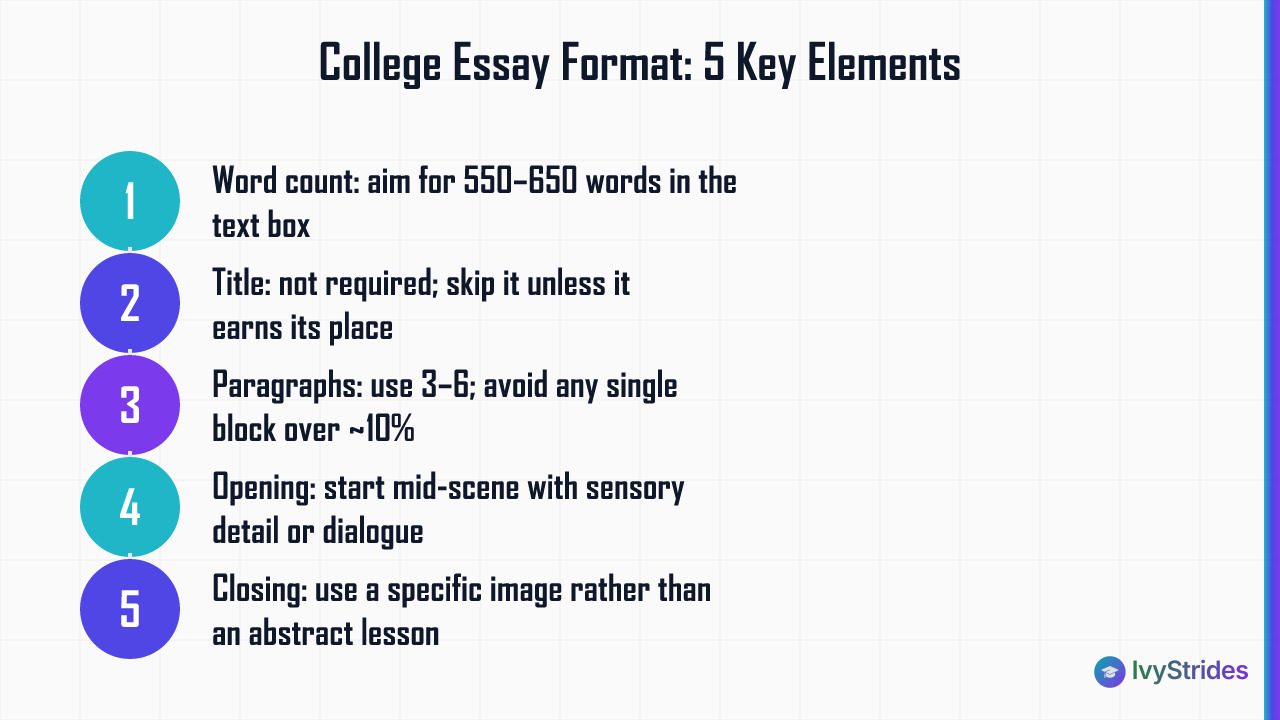
The Common App personal statement is 250 words minimum, 650 words maximum, per the Common App. There's no MLA or APA formatting requirement, no double spacing, no title required, no header. The Common App text box accepts plain text, and it counts your words for you.
Format basics that actually matter:
- Word count: aim for roughly 550 to 650. Under about 400 words rarely has enough space to develop a scene, reflect on it, and leave the reader with a clear impression.
- Title: not required. Most strong essays don't have one. If you write one, it should earn its space.
- Paragraphs: three to six is typical. The "10% rule" (no paragraph over roughly 10% of total length) is a useful heuristic for balance, not an official guideline. For a 650-word essay that's about 65 words per paragraph, though a longer central paragraph and a shorter closing paragraph often works better than mechanical uniformity.
- Opening: strong essays typically open in the middle of a scene (in medias res) with a specific sensory detail, a piece of dialogue, or an action. They don't open with a broad thesis statement about the meaning of life.
- Closing: doesn't need to be a neat bow. A specific closing image often lands harder than an abstract lesson.
The essay is submitted as plain prose in a text box. Save your energy for the writing, not the formatting. For students who want structured support through the drafting process, our one-on-one help for common app essay service pairs you with a coach specifically for the personal statement and supplementals.
How Long Is the College Application Essay, and When Should You Write It?
The personal statement caps at 650 words. That's a hard limit; the Common App won't accept a longer submission. The minimum is 250 words, though as noted, we'd steer you toward the 550-650 range for the space to do the topic justice.
In our coaching, a strong personal statement typically goes through three to five substantive drafts before it's ready to submit. That isn't three passes of comma cleanup. Those are three to five rounds where a coach reads the draft, the student sees what's working and what isn't, and the student rewrites with a specific revision goal for that pass.
Realistic timeline:
- June to July before senior year: brainstorming and a rough first draft
- August: draft two, focused on voice and specificity
- September: draft three and beyond, focused on opening, pacing, and closing
- October to November: final polish, then submit for Early Decision or Early Action
Students who begin brainstorming in June or July before senior year have roughly eight to twelve weeks to draft and revise before Early Decision and Early Action deadlines in October and November. Students who start in October are writing a first draft the same week they're writing supplementals for six schools. Something suffers, usually everything.
Supplemental essays are their own workload. Some schools ask for one or two short essays of about 100 to 250 words each. Highly selective schools may require three to five supplementals totaling over roughly 1,000 additional words, essentially a second personal statement's worth of writing per school. Because the personal statement feeds into every Common App school you apply to, it belongs on your application timeline early, ideally drafted before senior year begins. Our guide to college application deadlines lays out the full sequence.
What Admissions Readers Actually Look For in a College Essay
Not impressive things. Evidence of a person.
The College Board's counselor resource on the essay describes the personal statement as "an opportunity for students to personalize their college application beyond grades and scores." Read that phrasing carefully. Personalize. Beyond grades and scores. The activities list handles what you've done. The essay handles who you are.
Admissions readers are looking for evidence that the student can think, reflect, and communicate. Specifically:
- Authentic voice. The essay sounds like a thoughtful, articulate 17-year-old, not a 45-year-old professor and not a marketing brochure.
- Specificity. Concrete details, named things, actual dialogue, real moments. In our coaching, across hundreds of essay drafts, the single most common revision note is "add a specific detail here" because vague claims don't create a memorable impression.
- Character revelation. The reader closes the essay knowing something true about the student that they couldn't have inferred from any other part of the application.
- One clear insight. A memorable essay typically has one clear central insight or moment, not three or four competing ideas.
The "5 Ds" heuristic (Dialogue, Details, Describe, Demonstrate, Depth) circulates widely in essay-coaching circles as a practical checklist. It isn't a College Board framework and it isn't gospel, but as a self-check for a draft, it works. Does your essay use actual dialogue? Concrete details? Does it describe rather than summarize? Demonstrate character rather than assert it? Have depth beyond the surface event? If not, you have a revision list.
The "show don't tell" principle applies here more than in almost any other kind of writing. "I am resilient" is telling. A specific paragraph in which the reader watches you fail, sit with the failure, and then decide what to do next is showing. Only one of those two is memorable, and it isn't the first one. For the broader picture of how the essay fits alongside test scores in a competitive application, our overview of the official SAT study guide 2026 is a useful companion read.
Personal Statement vs. Supplemental Essays: Understanding the Difference
The distinction confuses international students and first-generation applicants, sometimes junior year, sometimes as late as October senior year. Here it is cleanly:
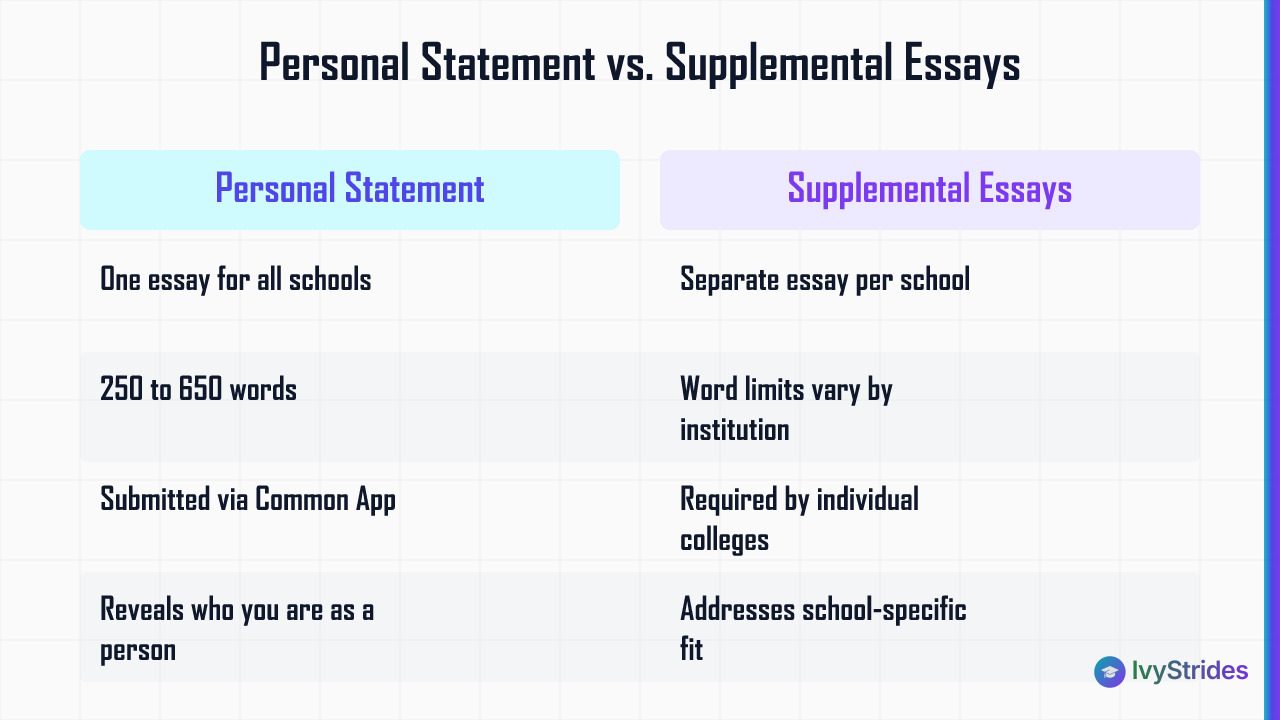
Personal statement: one essay, 250 to 650 words, submitted through the Common App to every school you apply to on the platform. Same essay for every school. You write it once.
Supplemental essays: school-specific essays required by individual colleges beyond the personal statement. Word limits and prompts vary by institution. You write these separately for each school that requires them.
Common supplemental types:
- "Why This College" (most common). Why do you want to attend this specific school? Requires actual research on the school, not generic praise.
- Extracurricular deep-dive. Describe one activity in more depth than the activities list allows.
- Community or identity. How have you contributed to a community, or what community shapes you.
- Short-answer questions. Typically 25 to 150 words. Faster to write, harder to write well.
For 2026-27, a development worth flagging: several selective universities announced changes to their supplemental essay requirements, with some reducing or removing supplementals. This isn't a universal trend and it isn't permanent. Verify each school's current requirements on its Common App portal or admissions page before writing. Requirements can change between when a guidebook publishes and when you actually apply.
Strategic note: the personal statement and the supplementals shouldn't repeat each other. The personal statement is where you reveal who you are as a person. Supplementals are where you address school-specific fit and additional dimensions of yourself that didn't make it into the personal statement. If your Yale supplemental restates your personal statement in different words, you've wasted an essay. For students planning across essays and test scores together, understanding your SAT percentiles alongside your essay strategy helps you allocate application energy where it moves the needle.
FAQ
What are the 7 Common App essay prompts for 2026-27?
The seven prompts are unchanged for 2026-27 per the Common App's official announcement. They cover background and identity (Prompt 1), a challenge or failure (Prompt 2), a challenged belief or idea (Prompt 3), a problem you've solved or want to solve (Prompt 4), an accomplishment or realization that sparked growth (Prompt 5), a captivating topic (Prompt 6), and an open topic of your choice (Prompt 7). Prompt 7 is the most flexible and is often the right choice when your story doesn't map cleanly to the other six.
Is 300 words too short for a college essay?
Three hundred words meets the Common App's 250-word minimum, so it will submit successfully. That said, it's on the short end. In our coaching, essays under roughly 400 words rarely have enough space to develop a specific scene, reflect on its meaning, and leave the reader with a clear sense of the student's character. Aim for 550 to 650 words. The extra room is where the essay earns its impact.
Is it okay to write about yourself in a college application essay?
Yes, and in fact the personal statement is specifically designed for that purpose. The essay isn't the place for a research argument or an analysis of an external topic. It's the place where the admissions reader learns who you are as a person. The key is to write about yourself through a specific story or moment rather than making broad claims about your character. "I am curious" is a claim. A specific scene of you being curious is an essay.
How formal should a college essay be?
Less formal than an AP Lang essay, more polished than a text to a friend. The essay should sound like a thoughtful, articulate version of your own voice. Avoid overly formal constructions, passive voice, and thesis-statement openings. At the same time, it should be clean, well-paced, and free of errors. The target register is clear, specific, personal, and confident.
Do college applications always require an essay?
Most four-year colleges that use the Common Application require the personal statement. Many selective schools also require supplemental essays. A small number of colleges, primarily larger public universities and some direct-admission programs, don't require any essay. Requirements vary by school and by application cycle, so check each school's specific requirements on the Common App portal or the admissions website before assuming.
How much does the college essay actually affect admissions decisions?
At highly selective schools, the essay is frequently the differentiating factor when two applicants have similar academic profiles. At less selective schools, it plays a smaller role, though a poorly written essay can still hurt. In test-optional applications where scores are withheld, the essay and other qualitative materials carry proportionally more weight. The essay won't overcome a significantly weak academic record, and it won't guarantee admission at any school regardless of how well it's written. What it can do, and often does, is tip a borderline decision.
Ready to Get Your Essay Right
The college application essay is a small piece of writing that carries real weight in a competitive admissions process. It's also learnable. The students we work with rarely lack a story; they lack a clear way to find, shape, and revise it. That's the work of essay coaching. If you'd like to see how we approach it, our About page covers the methodology. You can also meet the coaching team directly.
Ready to Write a College Essay That Sounds Like You?
Our essay coaches work 1-on-1 with students to find the right story, sharpen the voice, and produce a personal statement that admissions readers remember. Parents are welcome to join the call. Start with a free 15-minute strategy call, no obligation.

Award-winning author (South Asian Book Award) and graduate of BITS Pilani and UCLA Luskin School of Public Affairs. Brings a published writer's eye to Common App essays and grammatical precision to SAT and ACT R&W instruction.