
Is Your ACT Prep Built on the Enhanced Format or the Old One?

On this page
- What the Enhanced ACT Looks Like Section by Section
- What the Enhanced ACT Composite Score Actually Measures
- How to Audit Any ACT Prep Book or Course for Format Accuracy
- How to Build an ACT Prep Plan Around the Enhanced Format
- FAQ: Enhanced ACT Prep and Scores
- Is 32 out of 36 a good ACT score?
- Is 27 a high ACT score?
- Which ACT prep site is the best?
- What is the best ACT prep class?
- Your Next Step on Enhanced ACT Prep
The enhanced ACT is a shorter, restructured exam: 131 core questions in 125 minutes across English, Math, and Reading, with Science now optional and excluded from the Composite. Most books and courses still teach the legacy 215-question test. Studying from them builds wrong pacing habits and misleading practice scores.
Those section counts come from ACT, Inc.'s official format page, cited throughout below. The harder problem is that format accuracy is a prerequisite for score gains, so the fix is to audit your own materials against the exact numbers, which is what this page hands you.
What the Enhanced ACT Looks Like Section by Section
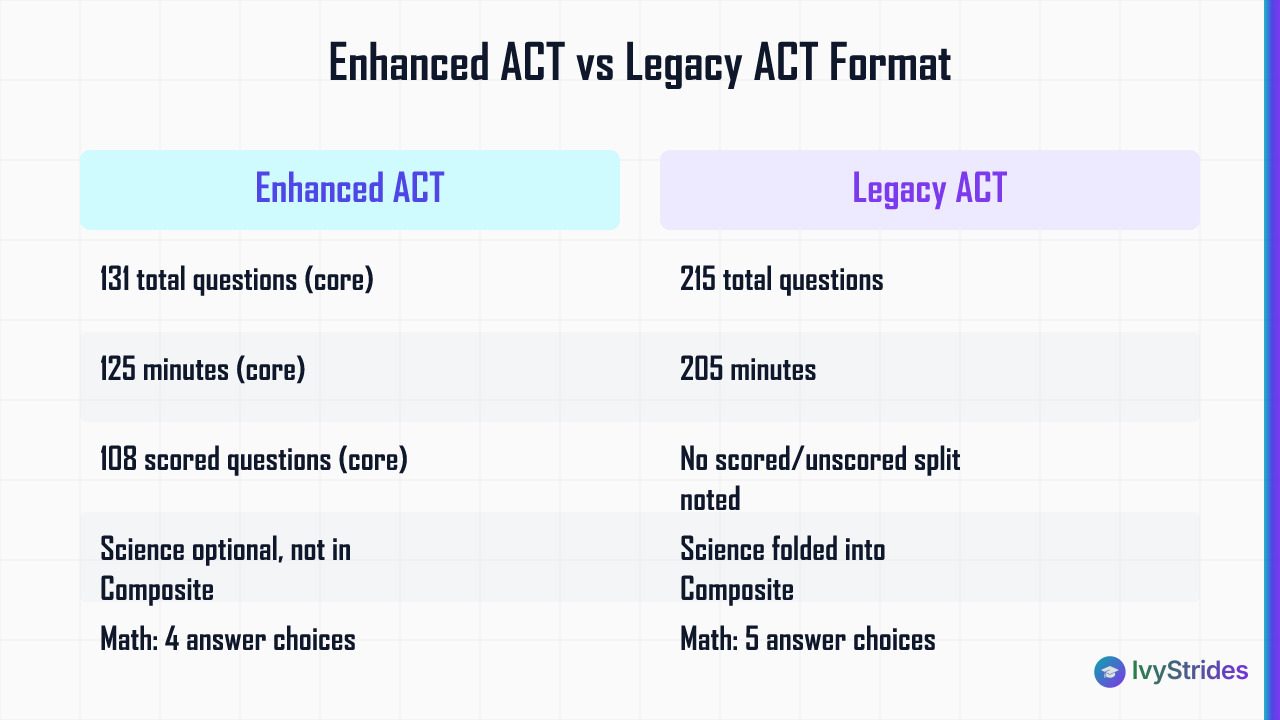
The enhanced ACT runs three scored sections plus one optional section. English is 50 questions in 35 minutes, Math is 45 questions in 50 minutes, and Reading is 36 questions in 40 minutes, for a core total of 131 questions in 125 minutes. The optional Science section adds 40 questions in 40 minutes and is scored separately.
Totals are not scored counts. Each section carries unlabeled embedded field-test items that do not count toward your score, and you cannot tell which ones they are while you sit the test. That gap is where legacy prep quietly misleads you.
Scored items, not totals, set your real pace. English scores 40 of its 50 questions, Math scores 41 of 45, Reading scores 27 of 36, and Science scores 34 of 40, all per ACT, Inc. Enhanced ACT Math also offers four answer choices instead of five, which changes answer-choice elimination on every question.
| Section | Total Questions | Scored Questions | Time (min) | Sec/Scored Q | In Composite? |
| English | 50 | 40 | 35 | 52.5 | Yes |
| Math | 45 | 41 | 50 | ~73 | Yes |
| Reading | 36 | 27 | 40 | ~89 | Yes |
| Science (optional) | 40 | 34 | 40 | ~71 | No |
| Core total | 131 | 108 | 125 | , | Yes |
Per-scored-question pace is IvyStrides' arithmetic: ACT, Inc. publishes section times and scored-item counts separately, not the pace.
Compare that to the legacy ACT, which ran 215 questions in 205 minutes with Science folded into the Composite. That old format is what most commercial prep books still reflect, and it is the most significant structural change to the exam in decades. For the complete section-by-section breakdown with timing tables, see our act format 2026 guide.
Official full-length practice tests built for the enhanced format are the only reliable way to calibrate your pacing before test day. Start with format-accurate act practice problems rather than any test that still shows 215 questions.
What the Enhanced ACT Composite Score Actually Measures
The enhanced ACT Composite is the average of the English, Math, and Reading section scores only, rounded to the nearest whole number, reported on a 1 to 36 scale. Science stays out of it. That single rule reorders your prep priorities: three sections drive your headline number, and the optional fourth does not.
Building on those scored-item counts, the components split into what counts and what doesn't. The optional Science section yields a separate STEM score alongside the Composite. Writing, if you add it, is scored on a 2 to 12 scale and does not affect the Composite either.
| Component | Scale | Counts Toward Composite? | Notes |
| English | 1–36 | Yes | Core section score |
| Math | 1–36 | Yes | Core section score |
| Reading | 1–36 | Yes | Core section score |
| Science (optional) | 1–36 | No | Feeds a separate STEM score |
| Writing (optional) | 2–12 | No | Essay, separate report |
Test-optional does not mean test-irrelevant. Policies vary by school and year, per the FairTest tracker, and College Board's own list names 21 private and 42 public colleges that currently or soon will require SAT or ACT scores, some starting Fall 2027 entry. A strong Composite stays strategically valuable, and admissions still depend on the full application, not the score alone.
Whether to add the optional Science section is a separate strategic question. Students targeting STEM programs often add it for the STEM score; students who need every hour on their three core sections often skip it. Weigh it against the score band you're chasing rather than adding it by default.
How to Audit Any ACT Prep Book or Course for Format Accuracy

Photo by https://kaboompics.com/ on Pexels
Auditing an ACT prep book means checking its section counts against the enhanced format's exact numbers. A format-accurate resource shows 131 core questions in 125 minutes; a legacy one shows 215 questions in 205 minutes with Science in the Composite. If the book's practice test totals 215, it is teaching a test your student will not sit.
Run these six checks against any book, online course, or practice test before you trust its mock scores.
| Check | What a Format-Accurate Resource Shows |
| English section | 50 questions in 35 minutes |
| Math section | 45 questions in 50 minutes |
| Reading section | 36 questions in 40 minutes |
| Science framing | Optional, excluded from Composite |
| Practice test total | 131 core questions, not 215 |
| Answer choices in Math | Four, not five |
Four choices, not five, in Math. A legacy book drills five-choice elimination; the enhanced Math section offers four. That sounds minor. It changes your guessing odds and your elimination sequence on every timed question, and a course that still teaches five choices trains the wrong reflex.
For a free, format-accurate benchmark, the Official ACT Prep Guide 2026-2027 contains full-length practice tests built for the enhanced structure. Once your materials pass the audit, you still need a timeline to use them, and our guide to ACT prep in 2 months lays out the weeks.
How to Build an ACT Prep Plan Around the Enhanced Format
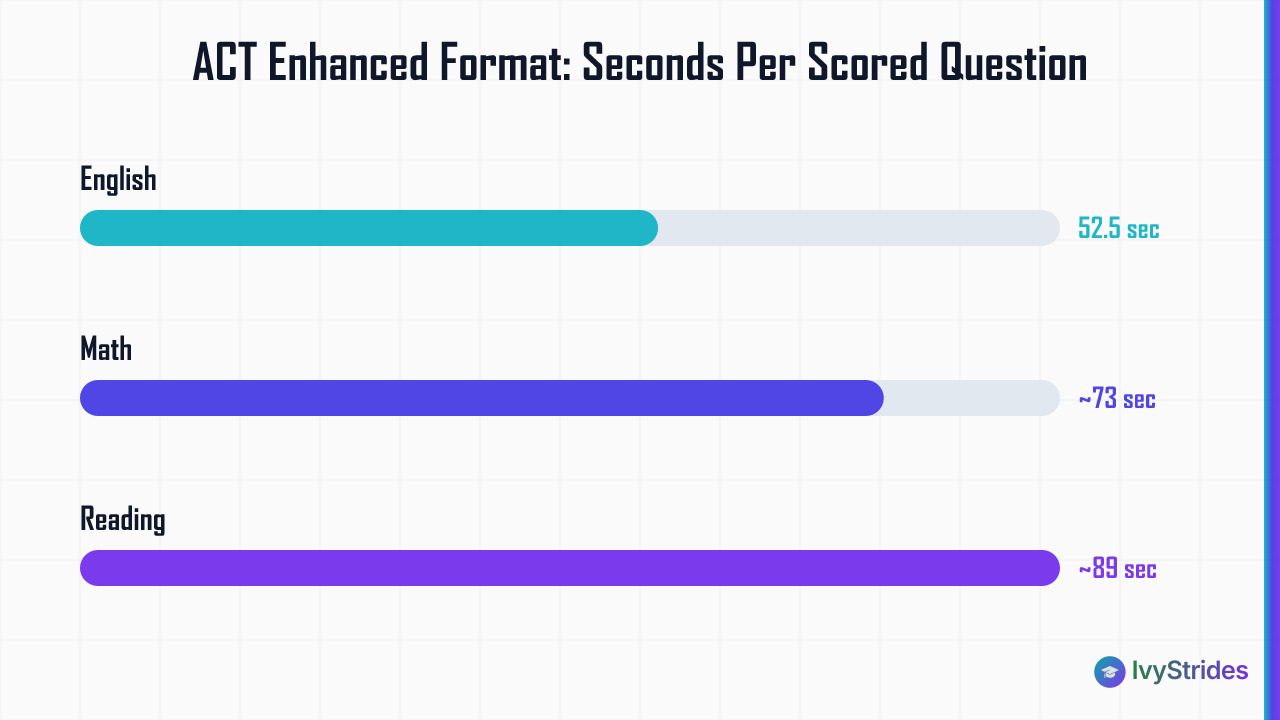
A format-accurate ACT prep plan sets pacing targets from scored items, not total question counts. English gives you 52.5 seconds per scored question, Math about 73 seconds, and Reading about 89 seconds. Legacy prep calibrates pacing to the old 215-question counts, so students over-rush Reading and drain time they had.
In our coaching with students who arrive using legacy-format books, the most common symptom is exactly that Reading pacing collapse: they've practiced 40 questions in 40 minutes when only 27 are scored, so they burn seconds racing questions that never counted and rush the ones that do.
| Section | Scored Q | Time (min) | Sec/Scored Q | Legacy Pacing Error |
| English | 40 | 35 | 52.5 | Pacing to 75 questions |
| Math | 41 | 50 | ~73 | Five-choice elimination |
| Reading | 27 | 40 | ~89 | Rushing to a phantom 40 |
Pace figures are IvyStrides' arithmetic from ACT, Inc.'s published section times and scored-item counts.
Diagnostic first, then one section. Take one full-length enhanced-format practice test before you plan anything. Students at the 24-to-28 Composite band typically have one section pulling the average down by 3 to 5 points, and identifying that section is the first move in any real plan. Chasing all three equally wastes hours.
Targeted work on the weakest section beats spreading the same hours evenly across every section. That single gap is what a section-specialist coach diagnoses in the first session, and you can book that targeted work through 1-on-1 ACT prep. Once your materials match the format, the next question is which section to target first, and our guide to how to raise your ACT score 4 points walks through that decision.
Then set a retake window. ACT offers seven national test dates in 2026-27; the September date is September 19, 2026 (regular deadline August 14), and the October date is October 17, 2026 (regular deadline September 11). Plan backward from one of those, and check the full ACT test dates 2026-2027 schedule.
FAQ: Enhanced ACT Prep and Scores
Is 32 out of 36 a good ACT score?
A 32 Composite is strong, placing a student roughly in the top few percent nationally. It meets or exceeds the 75th-percentile mark at most selective universities. Whether it's enough depends on each school's middle-50% range, which varies, so check the Common Data Set for every target school for the most accurate benchmark.
Is 27 a high ACT score?
A 27 Composite sits around the 85th percentile and is competitive at many four-year colleges. It falls below the 25th-percentile line at highly selective schools, where the middle 50% often runs 33 to 35. For students aiming there, a 4-point gain to 31 or higher is a realistic goal with targeted section work.
Which ACT prep site is the best?
The best ACT prep site is the one built for the enhanced format. ACT.org's official prep page offers full-length practice tests matched to the current structure, which makes it the most format-accurate free starting point. Paid options vary; the key audit is whether the practice tests show 131 core questions in 125 minutes, not the legacy 215-question format.
What is the best ACT prep class?
The best ACT prep class uses enhanced-format practice tests, targets your specific weak sections rather than covering all content equally, and sets pacing targets from scored-item counts, not total question counts. A class still running legacy 215-question tests produces inaccurate mock scores and trains wrong pacing habits.
Your Next Step on Enhanced ACT Prep
Format accuracy comes first; everything else in ACT prep sits on top of it. Before you spend another hour with your current materials, confirm they teach the test your student will actually sit.
- Pull out your prep book and check the practice test total: 131 core questions, not 215.
- Confirm the Math section shows four answer choices and 45 questions in 50 minutes.
- Take one full-length enhanced-format practice test to find your weakest of the three Composite sections.
- Set pacing targets from scored items: 52.5 seconds in English, about 73 in Math, about 89 in Reading.
- Plan backward from a 2026-27 test date, and replace anything that still teaches the legacy format.

Award-winning author (South Asian Book Award) and graduate of BITS Pilani and UCLA Luskin School of Public Affairs. Brings a published writer's eye to Common App essays and grammatical precision to SAT and ACT R&W instruction.