
How to Study for AP US History and Score a 5: Your 2026 Game Plan
On this page
- What the AP US History Exam Actually Looks Like in 2026
- Is AP US History Hard? What the Score Data Actually Says
- The Nine APUSH Units: Which Ones Are Most Heavily Tested
- How to Prep for AP US History: The Four Question Types, Explained
- Multiple Choice: read the stimulus for the argument, not the facts
- Short Answer: three sentences, no thesis, direct claim
- DBQ: the 7-point rubric, and the two points everyone misses
- LEQ: same rubric skills, tighter package
- Building Your 12-Week AP US History Study Plan
- What Percent of Students Score a 5 on AP US History?
- Self-Study vs. Coached Prep: Which Approach Works for APUSH?
- Frequently Asked Questions About AP US History Prep
- What is the best way to study for AP US History?
- What is the hardest unit in AP US History?
- Is a 70% raw score a 5 on the AP US History exam?
- Can I self-study AP US History and still score a 5?
- Which AP US History prep book is worth buying?
- How does a strong AP US History score affect college admissions?
- Your Next Move
AP US History prep starts with knowing what you're up against: a 3-hour-15-minute exam, nine curriculum units from 1491 to the present, and four question types (MCQ, SAQ, DBQ, LEQ). Roughly 10-14% of test takers score a 5 in a typical year, per College Board score distributions. A realistic path to a 5 combines a diagnostic practice exam in week one, unit-by-unit content review focused on Units 3 through 8, and consistent timed writing practice on DBQ and LEQ prompts. Most students need roughly 10 to 14 weeks of structured preparation to move from a 3 to a 5.
Those numbers come from College Board's AP Program documentation. The harder question is where your points are actually leaking, and how to plug those leaks before test day. The rest of this guide walks through it.

What the AP US History Exam Actually Looks Like in 2026
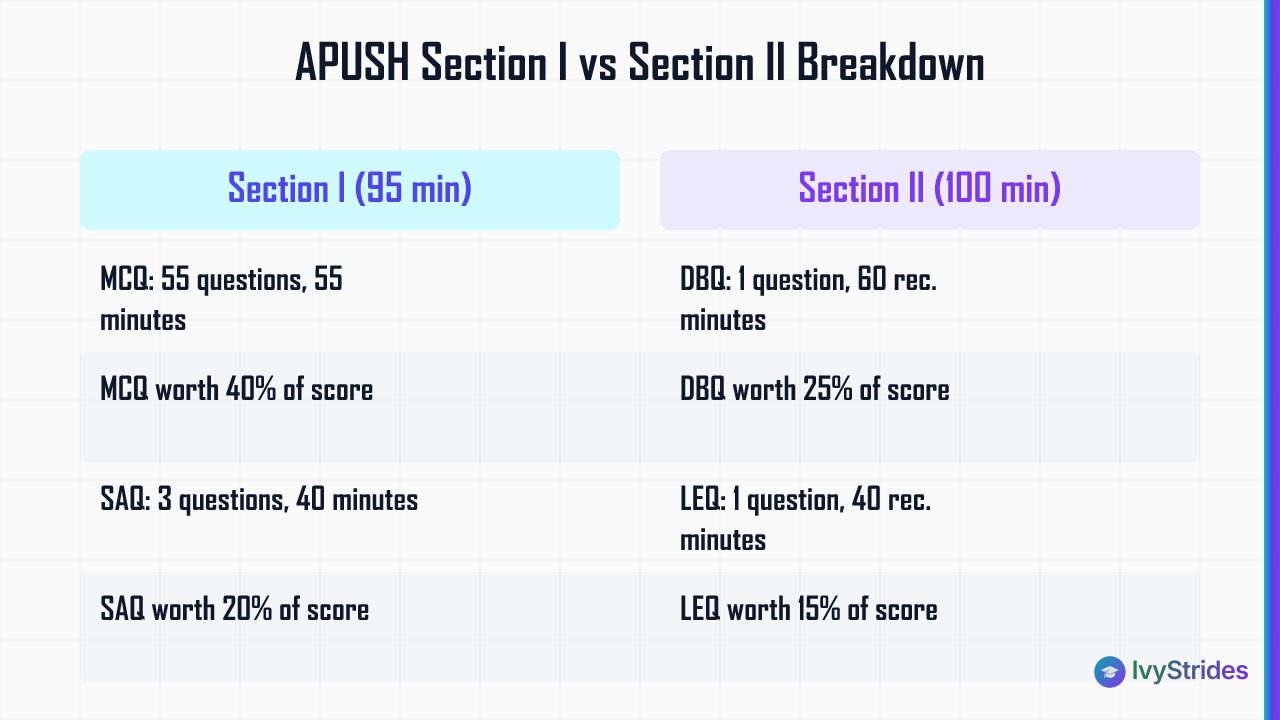
APUSH is two sections, four question types, one tight clock.
Section I runs 95 minutes:
- Multiple Choice (MCQ): 55 questions in 55 minutes, worth 40% of your score, per College Board. Every question is stimulus-based, meaning it hangs off a primary source excerpt, a secondary source, an image, a map, or a chart. You're not being asked "what year did X happen." You're being asked what an argument implies, what a cartoon is criticizing, what a chart's trend reveals.
- Short Answer (SAQ): 3 questions in 40 minutes, worth 20% of your score. The first two are required. The third gives you a choice between two options. No thesis required. Each part answered in three to four focused sentences.
Section II runs 100 minutes:
- Document-Based Question (DBQ): 1 question, 60 recommended minutes, worth 25% of your score (College Board). Seven documents to analyze, plus outside evidence you bring yourself. Scored on a 7-point rubric.
- Long Essay Question (LEQ): 1 question, 40 recommended minutes, worth 15% of your score. You pick one of three prompts. Scored on a 6-point rubric.
Total time: 3 hours 15 minutes. Score reported on the College Board 5-point scale.
The nine curriculum units span 1491 to the present, and the AP curriculum framework breaks them into weighted periods.
One freshness note. AP Central has flagged updated official practice exams rolling out in the 2026-27 school year. When those release, prioritize them over older versions, because they best reflect the current rubric interpretations graders are trained on. If you're studying now with a mix of resources, use the newest official material you can find, and supplement with our ap classes online for structured unit review.
Is AP US History Hard? What the Score Data Actually Says
Yes. Let's be specific about what "hard" means.
In a typical year, roughly 10-14% of APUSH test takers earn a 5, and about 50-55% earn a 3 or higher, per College Board's annual AP score distributions. That's a lower 5 rate than APs like AP Psychology and a higher one than exams like AP Physics 1. APUSH sits squarely in the "demanding but achievable" tier.
Here's why students find it hard. Most AP exams test one thing well: content recall, or lab reasoning, or math procedure. APUSH tests two things at once. You need dense content knowledge across 500+ years of American history, and you need to write analytically under time pressure with a rubric that rewards specific structural moves (thesis, contextualization, complexity). Content-strong students who can't write lose the 40% that lives in Section II (College Board). Writing-strong students who haven't memorized enough evidence lose SAQ points and outside-evidence points on the DBQ.
In our coaching, students who arrive without timed DBQ practice are the most likely to lose points on the 25% writing block even when their content knowledge is solid. It's the single most common gap we see in April.
The right question isn't "is APUSH hard?" It's "am I preparing for both halves of the exam?" If you're weighing whether coached support is worth the investment for APUSH specifically, our honest breakdown of when AP tutoring pays off addresses that question directly.
The Nine APUSH Units: Which Ones Are Most Heavily Tested
Here are the nine units and their date ranges:
- Unit 1: Period 1, 1491-1607
- Unit 2: Period 2, 1607-1754
- Unit 3: Period 3, 1754-1800
- Unit 4: Period 4, 1800-1848
- Unit 5: Period 5, 1844-1877
- Unit 6: Period 6, 1865-1898
- Unit 7: Period 7, 1890-1945
- Unit 8: Period 8, 1945-1980
- Unit 9: Period 9, 1980-present
Not all units are equal. The College Board AP curriculum framework assigns approximate percentage ranges to each period, and Units 3 through 8 collectively account for the majority of exam content. Units 1, 2, and 9 sit at the lighter end of the weighting.
That doesn't mean you skip Units 1 and 2. Contextualization points on DBQs and LEQs frequently require reaching back into colonial-era developments to frame a later argument. Units 1 and 2 are the historical furniture you use to earn contextualization, even when the prompt is about the Progressive Era. Skipping them costs you writing points, not MCQ points.
Which unit is hardest? Two contenders.
Unit 7 (1890-1945) is the content-volume champion. The Progressive Era, WWI, the 1920s, the Great Depression, the New Deal, and WWII all live inside one unit. In our coaching, Unit 7 MCQ sets trip up students most often because the overlapping causation chains (why did the US enter WWI vs. WWII, what caused the Depression vs. what prolonged it) get compressed and confused.
Unit 3 (1754-1800) is the analytical challenger. It asks you to hold the Revolution, the Articles of Confederation, and the Constitution as a coherent argument about federal power, and DBQ prompts love this period precisely because it forces that synthesis.
Prioritize both. If you're balancing a science AP this year, the same diagnostic-first approach applies; see our AP Biology prep guide for a parallel framework.
How to Prep for AP US History: The Four Question Types, Explained
This is where the score is won or lost. Each question type rewards a different skill, and the tactics don't transfer between them.
Multiple Choice: read the stimulus for the argument, not the facts
Every MCQ is anchored to a stimulus. A treaty excerpt, a political cartoon, a historian's paragraph, a labor statistics chart. The rookie move is to skim the stimulus for names and dates, then try to match them to answer choices.
Read it differently. Every stimulus is making an argument or reflecting a perspective. Ask: who is the author, what are they claiming, and what historical development would make this claim make sense? That's the historical reasoning skill being tested: causation, continuity and change over time (CCOT), or comparison. Once you've identified the author's argument, the answer choices sort themselves out fast.
Pacing: 55 questions in 55 minutes is one minute each. Bank time on stimulus sets you recognize quickly. Spend the surplus on the two or three sets that require actually working through the source.
Short Answer: three sentences, no thesis, direct claim
SAQs are the cleanest points on the exam if you know the structure. Each SAQ has three parts (A, B, C). No thesis. No introduction. Just answer.
For each part, write three to four sentences: (1) a direct historical claim answering the prompt, (2) specific historical evidence supporting that claim (name a person, act, event, or document), (3) a sentence connecting the evidence back to the claim. That's it. Students lose SAQ points by writing paragraphs when they should be writing sentences, or by giving vague evidence like "the Revolution changed things" instead of "the Declaratory Act of 1766 asserted Parliament's right to legislate for the colonies."
DBQ: the 7-point rubric, and the two points everyone misses
The DBQ is a 7-point rubric worth 25% of your score, per the official College Board rubric. Here's what those points are:
- Thesis (1 pt): a historically defensible claim that responds to the prompt with a line of reasoning.
- Contextualization (1 pt): a description of broader historical context relevant to the prompt, situated before, during, or continuing beyond the time period.
- Evidence from documents (2 pts): use content from at least three documents (1 pt) or at least four documents (2 pts) to support the argument.
- Outside evidence (1 pt): describe one piece of specific historical evidence not in the documents.
- Analysis and reasoning, sourcing (1 pt): for at least two documents, explain how or why the point of view, purpose, audience, or historical situation is relevant to the argument.
- Complexity (1 pt): demonstrate a complex understanding of the historical development in the prompt.
In our coaching, contextualization and complexity are the two points students most frequently miss. Not thesis. Not document evidence. The two "framing" points.
Contextualization fails when students reference a broad era ("during a time of change in America") instead of a specific development that logically precedes the prompt. If the prompt is about the 1930s New Deal, contextualization is "the laissez-faire economic policies of the 1920s and the stock market crash of 1929 created the conditions that made federal intervention politically possible." Specific. Situated. Connected.
Complexity fails when students argue one side and stop. To earn complexity, you need to acknowledge nuance: counter-evidence, competing causation, change over time, or connections across regions. One extra body paragraph that says "however, some historians emphasize X" and develops that thread with evidence is often the difference between a 5 and a 6 on this rubric.
LEQ: same rubric skills, tighter package
The LEQ is a 6-point rubric worth 15% (College Board). You choose one of three prompts, each covering a different broad time period. The rubric points map almost identically to the DBQ, minus the documents:
- Thesis (1 pt)
- Contextualization (1 pt)
- Evidence (2 pts, requires specific evidence supporting the argument)
- Analysis and reasoning (1 pt, use of a historical reasoning skill like causation, comparison, or CCOT)
- Complexity (1 pt)
Because there are no documents, all the evidence comes from your memory. That means the LEQ rewards whichever unit you know deepest. Pick your prompt strategically. Don't pick the one that "sounds interesting." Pick the one where you can name six to eight specific pieces of evidence in under thirty seconds of brainstorming.
In our coaching, students who practice timed DBQ writing at least once per week in the final six weeks before the exam show the most consistent rubric-point gains. Once per week. Timed. With rubric-based feedback. That's the pattern.
Students who want structured instruction rather than solo review can enroll in our ap classes online with a subject-specialist teacher who covers the full APUSH curriculum unit by unit. If you're juggling APUSH alongside a science, the workflow in our AP Chemistry prep guide mirrors the same diagnostic-first, rubric-driven approach.
Building Your 12-Week AP US History Study Plan
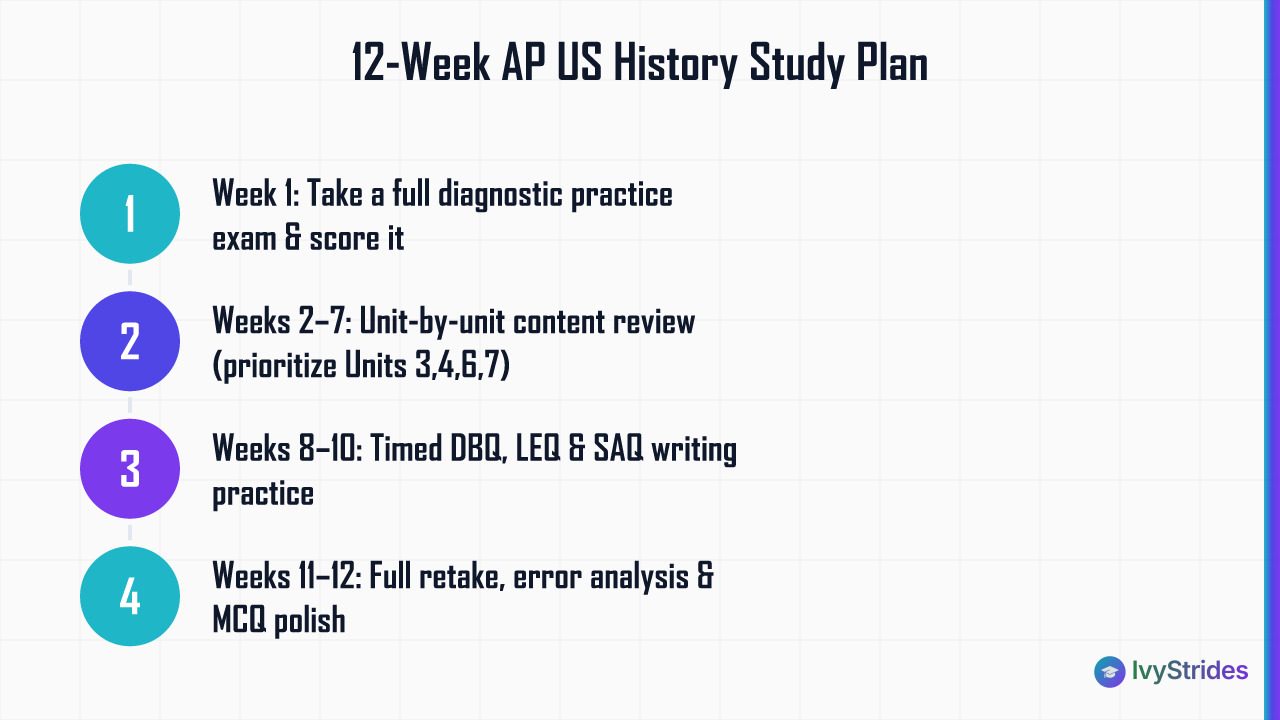
A 12-week plan splits cleanly into three phases: diagnose, review, write.
Week 1: Diagnostic full-length practice exam. Sit down for the full 3 hours 15 minutes. Use an official College Board released practice exam. Score it against the official rubrics. This is not optional and it isn't "too early." In our coaching, students who skip the diagnostic and go straight to content review often over-invest in units they already know and under-prepare on their actual weak periods. Roughly 20% of the plan's value lives in this one test.
Weeks 2 through 7: Unit-by-unit content review. Six weeks, six units. Prioritize Units 3, 4, 6, and 7 because they're the highest-weighted and the ones your diagnostic almost certainly flagged. Spend one week per unit. During each week: read the unit content, take practice MCQ sets tied to that period, write one SAQ. Keep a running list of specific evidence (people, acts, court cases, treaties) you can cite from memory. Aim for roughly 40 to 50 concrete evidence points per unit.
Weeks 8 through 10: Timed writing. Three weeks focused entirely on the DBQ and LEQ. One timed DBQ per week, one timed LEQ per week, plus continuous SAQ practice. Score each essay against the actual rubric. This is where a coach helps most, because self-scoring your own thesis for "historically defensible with a line of reasoning" is genuinely hard. If you're self-studying, use the AP Central classroom resources sample essays and score commentary to calibrate your eye. Primary-source practice for outside evidence is available from the Gilder Lehrman Institute, organized by period.
Weeks 11 and 12: Full-length retake, error analysis, MCQ polish. Take a second full-length practice exam under strict conditions. Compare your unit-level performance to the diagnostic. Spend the final week on error analysis (what type of MCQ errors keep repeating?) and light content review of your remaining weak spots. Sleep, don't cram, in the last 48 hours.
A student starting from a diagnostic score of 2 or 3 typically needs about 10 to 14 weeks of structured preparation to reach a 4 or 5, in our coaching experience. Students carrying both APUSH and a math AP often ask how to split study hours; our AP Calculus AB/BC prep guide walks through a comparable weekly schedule. If a science AP is on your plate too, the parallel framework lives in our AP Biology prep guide.
What Percent of Students Score a 5 on AP US History?
Roughly 10-14% of APUSH test takers score a 5 in a typical year, per College Board's score distribution reports. About 50-55% score a 3 or higher. The exact percentages shift slightly each administration based on exam difficulty and cohort performance.
Here's what that means practically. A 5 is not a one-in-a-hundred outcome. It's roughly the top eighth of test takers, per College Board score distributions. Selective, but not a lottery. It's a threshold reached by students who prepare across all four question types rather than optimizing for MCQ alone.
What raw score corresponds to a 5? College Board doesn't publish the exact raw-to-scaled conversion, and the cut score shifts annually. The 70% heuristic that circulates online is a rough approximation, not an official statement. Rather than chasing a percentage, aim for consistent performance across MCQ (roughly 35+ correct out of 55), SAQ (full-point answers on all three), and both essays (5+ on the DBQ, 4+ on the LEQ).
One caveat that matters for the college-credit conversation. AP credit policies vary by institution. Some colleges award credit for a 4, some require a 5, and some don't award credit for APUSH at all, particularly if you're heading into a history-related major and the department wants you to take their intro course. Verify with your target colleges directly. And remember that AP scores are one signal among many in an application. If you're also weighing test-optional strategy, our take on does the SAT matter for college admission covers how these signals interact.
Self-Study vs. Coached Prep: Which Approach Works for APUSH?

Honest answer: it depends on three factors.
Self-study works when you have 12 or more weeks before the exam, you can consistently write timed essays, you have access to the official College Board scoring guidelines, and you're able to score your own writing against a rubric with reasonable objectivity. If those four conditions hold, plenty of students self-study to a 4 or 5.
Coached prep adds the most value on the writing. In our coaching, the students who improve most on APUSH writing sections are those who receive specific rubric-point feedback on their DBQ drafts, not just content corrections. A tutor who has scored thousands of DBQs against the rubric will spot in twenty seconds why your contextualization paragraph doesn't earn the point. A student reading their own essay rarely can.
Our ap prep courses run 1-on-1 with a per-AP-subject specialist, not a generalist tutor rotating across ten APs. The diagnostic drives the plan, not a preset curriculum. That matters more for APUSH than for content-heavy STEM APs, because the writing coaching is impossible to standardize across students.
One important caveat. AP score alone does not determine college admission. Admissions readers weigh the full application: grades, rigor, essays, activities, recommendations, and (where required) test scores. Test-optional policies vary by school and year, and FairTest tracks the current landscape. A strong APUSH score signals course rigor. It doesn't guarantee an outcome.
Students preparing college admissions essays alongside APUSH often benefit from coordinating both timelines. A strong AP score signals rigor to admissions readers, but the essay is where your voice comes through; if you're also working on your Common App personal statement this cycle, our common app essay tutor team can help both pieces move forward together.
Frequently Asked Questions About AP US History Prep
What is the best way to study for AP US History?
Start with a full-length diagnostic practice exam to identify your weakest units, then prioritize content review on Units 3 through 8 before shifting to timed DBQ and LEQ writing practice in the final six weeks. In our coaching, students who combine content review with weekly timed writing consistently outperform those who only review content.
What is the hardest unit in AP US History?
There's no single hardest unit, but in our coaching Unit 7 (1890-1945) is most commonly cited for content volume, and Unit 3 (1754-1800) is cited for analytical complexity. Unit 7 packs Progressive Era, WWI, the Depression, the New Deal, and WWII into one period. Unit 3 forces you to synthesize the Revolution, the Articles of Confederation, and the Constitution as a coherent argument about federal power. Both appear frequently in DBQ and LEQ prompts.
Is a 70% raw score a 5 on the AP US History exam?
The 70% figure circulates as a rough heuristic, but College Board doesn't publish an official raw-to-5 conversion for APUSH, and the cut score shifts slightly each year based on exam difficulty. A safer target is strong performance across all four question types (roughly 35+ MCQ correct, full-point SAQs, a 5+ DBQ, a 4+ LEQ) rather than optimizing for a specific raw percentage.
Can I self-study AP US History and still score a 5?
Yes, self-study is achievable for motivated students with 12 or more weeks of lead time, strong writing skills, and access to official College Board practice exams and scoring guidelines. The hardest part to self-study is DBQ and LEQ writing, because objectively evaluating your own thesis and contextualization without rubric-trained feedback is genuinely difficult. If you're strong on content but shaky on writing, our essay review service or targeted coaching on the writing sections is often the highest-use add.
Which AP US History prep book is worth buying?
The right prep book depends on your learning style and timeline. Students who want comprehensive content review often reach for a full-length review book like AMSCO; students prepping closer to the exam often prefer a shorter crash-course format. The most important resource, regardless of which book you use, is the official College Board released practice exam with scoring guidelines. That's the only source that reflects the actual rubric graders use in June.
How does a strong AP US History score affect college admissions?
A 4 or 5 on APUSH signals course rigor to admissions readers and may qualify for college credit, though credit policies vary by institution and score threshold. Admissions outcomes depend on the full application, not AP scores alone, and test-optional policies at many schools mean AP scores are evaluated in context rather than as a hard requirement. For more on the coaching-support question, see our take on AP tutoring, is it worth it.
Your Next Move
A 5 on APUSH isn't a personality trait. It's the output of a diagnostic-driven plan, six weeks of prioritized content review, three weeks of timed writing with rubric-based feedback, and enough calm on exam day to execute what you've practiced. The students who reach it aren't the ones who studied hardest. They're the ones who studied the right things in the right order.
Whether you're 16 weeks out or 6, the first move is the same: know your baseline.

Two decades teaching quantitative and verbal aptitude on standardized tests. Rare dual expertise across Math and Verbal — particularly effective for students with gaps on both sides. Senior AP Mentor for our Calculus and English tracks.