
ACT vs Digital SAT Transitions Questions: What Changes and What Stays the Same

On this page
- What Transitions Questions Actually Test on the SAT and ACT
- How Digital SAT Transitions Questions Actually Work
- How ACT English Transitions Questions Actually Work
- Why Students Still Miss Transitions Questions Even After Studying the Word Lists
- Still Missing Transitions Questions on Practice Tests?
- What Stays the Same: The Core Logic Both Tests Share
- The Four-Step Process That Works on Both Tests
- Side-by-Side Comparison: ACT English vs. Digital SAT Transitions Questions
- Should You Take the ACT or the Digital SAT? What Transitions Questions Reveal About Your Fit
- FAQ
- What is a transitions question on the Digital SAT?
- Are transitions questions harder on the ACT or the Digital SAT?
- How do I improve at transitions questions on both tests?
- Can I use the same transition word list to prepare for both the ACT and the Digital SAT?
- Should I switch from the SAT to the ACT if I keep missing transitions questions?
- What is the difference between a hard and a soft transition word?
- Ready to Stop Losing Points on Transitions Questions?
If you've prepped hard for one test and now face the other, you've probably asked: do I start over on transitions, or does my work carry?
Most of it carries. ACT and Digital SAT transitions questions test the same core skill: identifying the logical relationship between two ideas and choosing the word or phrase that signals it accurately. Both tests lean on the same three relationship categories, contrast, addition, and causation. What changes is the format. The Digital SAT presents a short 2-4 sentence stimulus text and asks which choice "completes the text with the most logical transition." The ACT embeds the transition inside a full 300-word passage, adds NO CHANGE as a live option, and includes between-paragraph transitions that require paragraph-level reading. The underlying logic transfers. The reading load and trap design do not.
What Transitions Questions Actually Test on the SAT and ACT
Both tests ask one question in two different costumes: which word correctly labels the relationship between idea A and idea B?
On the Digital SAT Reading and Writing section, transitions questions live in the Expression of Ideas subdomain. You'll see a short stimulus text, typically two to four sentences, with a blank between two of them. The stem reads, "Which choice completes the text with the most logical transition?" Four answer choices follow, each a single transition word or short phrase (per College Board, Digital SAT R&W).
ACT English wraps the same question type in a longer passage. The section runs 75 questions in 45 minutes across five passages of roughly 300 words each (per ACT, Inc.). The transition word is underlined inside the passage. You get four answer choices, one of which is always NO CHANGE, meaning the original word stays put.
Three relationship categories carry the bulk of the work on both tests:
- Contrast (however, nevertheless, although, conversely, yet)
- Addition (on top of that, additionally, also, beyond that, in addition)
- Causation (therefore, thus, hence, as a result)
Concession, illustration, and sequence relationships round out the taxonomy. You'll see all six on both tests, just at different rates. For test-specific worked questions on the SAT side, see our digital sat transitions practice breakdown.
How Digital SAT Transitions Questions Actually Work
The Digital SAT R&W section runs two modules of 27 questions each, 32 minutes per module (College Board). Module 1 routes your difficulty for Module 2. Strong Module 1 performance routes you into a harder Module 2, where transitions questions get noticeably more subtle.
What does "more subtle" mean in practice? Three things shift.
First, stimulus texts move into academic or scientific register. You're reading short passages about marine biology, urban economics, or art history rather than everyday topics. Second, the relationship signals get less obvious. Sentence A no longer hands you an explicit cue, so you have to infer the logic. Third, the answer choices cluster tightly around near-synonyms in the same relationship family.
The classic Module 2 trap pairs:
- however vs. nevertheless (both hard contrast, but "nevertheless" carries a concessive undertone)
- therefore vs. thus (both causation signals, but "thus" often introduces a conclusion drawn rather than a direct cause-effect)
- on top of that vs. beyond that (both hard addition, with slight emphasis differences)
Here's a worked example at moderate difficulty. A three-sentence stimulus on coral reef restoration. Sentence 1 establishes that traditional restoration techniques have shown limited success. Sentence 2 says researchers tried a new approach using heat-resistant coral strains. Sentence 3, starting with the blank, reports that survival rates tripled.
The relationship between sentence 2 (new approach) and sentence 3 (better outcome) is causation. Eliminate contrast options ("however," "nevertheless") and addition options ("additionally"). That leaves "so" or a similar causation signal as the answer.
In our coaching with students in the 550-650 R&W score band, transitions and Command of Evidence are the two highest-use question types. Fix the relationship-identification habit, and the section score moves. If you keep missing these even after practice, our sat transitions mistakes post drills into the exact error patterns. Once transitions are solid, command of evidence score band strategy is the next move. Transitions questions in harder modules often appear alongside SAT Information and Ideas strategy items that require interpreting data, and building both skills together speeds up R&W gains.
How ACT English Transitions Questions Actually Work
The ACT English structure changes the game in two specific ways: passage length and pacing.
Across five passages and 75 questions, you have 45 minutes. That's roughly 36 seconds per question. Transitions show up at a rate of about 3-5 per passage, so 15-25 across the full test (an in-our-coaching observation across cohorts). For act practice test online work that surfaces this rate, full-length practice is the only way to feel the pacing.
ACT transitions split into two subtypes. Between-sentence transitions behave like Digital SAT items: read the sentence before and after the underlined word, identify the relationship, pick the choice. Between-paragraph transitions are the harder subtype. The transition word sits at the start of a new paragraph, and to answer correctly you have to read the last sentence of the preceding paragraph and the first sentence of the new one. Paragraph-level logic, not sentence-level.
NO CHANGE is the second shift. Roughly 20-25% of the time on ACT English overall, NO CHANGE is correct (in-our-coaching observation across full-length cohort tests). Students who train themselves to reflexively eliminate it lose points they had no reason to lose.
A worked example. Imagine a five-sentence ACT paragraph about a small-town farmer's market expansion. Sentence 1: the market opened in 2015 with 12 vendors. Sentence 2: by 2023, it hosted over 50 vendors. Sentence 3, with an underlined "However," at the start: the market began offering live music on weekends. Sentence 4: attendance doubled. Sentence 5: organizers added a second weekly date.
Reading sentence 2 and sentence 3 together, the relationship is addition. The market grew in vendor count, and it also added live music. "However" signals contrast, which is wrong. NO CHANGE is wrong. "Additionally" fits. This is exactly the kind of question students in the 24-28 ACT English score band tend to miss when they read only the sentence with the blank (in-our-coaching framing).
For broader section strategy, our ACT prep overview walks through how transitions fit alongside the other ACT English question types.
Why Students Still Miss Transitions Questions Even After Studying the Word Lists

Photo by RDNE Stock project on Pexels
Knowing the words is not the skill. Identifying the relationship is.
Look at how the trap answers are built. Take "however" versus "although." Both signal contrast. But "however" is a hard transition word: idea B directly opposes idea A. "Although" is a soft transition word: idea B acknowledges idea A while introducing a complication. If the relationship is full opposition, "although" sounds reasonable but is wrong. If the relationship is partial concession, "however" sounds reasonable but is wrong.
Another high-frequency trap: "therefore" versus "additionally." Students who read only the second sentence (the one with the blank) often pick "therefore" because that sentence sounds like a conclusion. But if you read the first sentence too, you see it never set up a cause. It just introduced a parallel idea. The correct answer is an addition signal, not a causation signal.
Honestly, the most common failure mode in our coaching is mechanical, not conceptual. Students in the ACT 24-28 band and the SAT 580-650 R&W band keep reading only the sentence containing the blank, not both surrounding sentences. The fix is just as mechanical. Force yourself to read sentence A in full, then sentence B in full, then state the relationship out loud before glancing at choices.
Concession transitions are where the hardest Module 2 SAT questions live. "Admittedly," "granted," "to be sure," and "while it is true that" all signal that the writer is acknowledging a counterpoint before pivoting. The Digital SAT loves these in academic-register Module 2 stimulus texts. The ACT uses them in between-paragraph transitions where the new paragraph concedes a point from the previous one.
A few less common hard SAT transition words worth knowing for harder modules: "nevertheless," "conversely," "notwithstanding." Each shows up rarely, but when it does, it's usually the answer.
Different tests, different specialist coaches. A junior we worked with last fall had mastered Digital SAT transitions, then switched to ACT prep and still needed two full weeks of ACT-specific practice to adjust to the longer passage context and the NO CHANGE option. Same skill, different reading load. If you're prepping ACT English, work with someone who lives in ACT passages. Our 1-on-1 ACT prep (signature service) is built around ACT English specialists. For the SAT side, the same section-specialist model applies in our 1-on-1 SAT prep (signature service).
Still Missing Transitions Questions on Practice Tests?
A 15-minute strategy call with an IvyStrides section specialist will identify exactly which relationship type you are misreading, and build a targeted plan to fix it before your next test date. Students and parents are both welcome on the call.
What Stays the Same: The Core Logic Both Tests Share
Here's the part most students miss. The relationship taxonomy is identical across both tests. Contrast, addition, causation, concession, illustration, sequence. That's the entire universe. In our coaching, students who learn 30-40 transition words organized by relationship type cover 95%+ of the items they'll see on either test.
The elimination strategy is also identical. Identify the relationship first. Eliminate all choices in wrong relationship families. Then, and only then, decide between near-synonyms by checking relationship strength.
What about overall difficulty? ACT, Inc. notes that ACT and SAT questions have "very similar levels of average difficulty" (act.org/content/act/en/products-and-services/the-act/scores/act-vs-sat.html). For transitions specifically, the logical difficulty is comparable. The reading load is higher on the ACT because of the 300-word passage context. The relationship subtlety is higher on the harder Digital SAT Module 2.
Transitions questions sit inside Expression of Ideas, but punctuation errors in the same sentence can cost you the same point. Our guide to SAT Standard English Conventions covers the punctuation rules that interact with transition placement. If you want extra structured practice, the Free downloads library has worksheets for both tests.
The Four-Step Process That Works on Both Tests
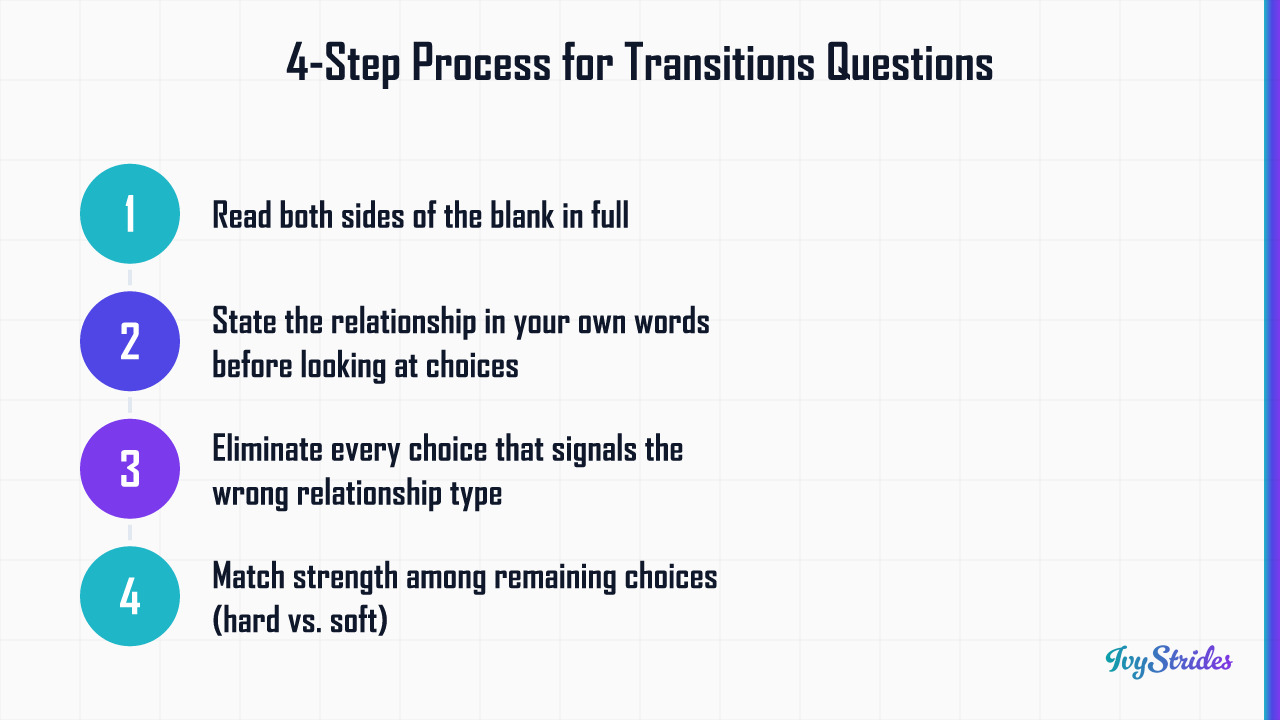
This is the single repeatable method our section specialists teach for both ACT English and Digital SAT R&W transitions. The steps are the same. The test-specific adjustments are small.
Step 1: Read both sides of the blank in full. For Digital SAT, that's both sentences flanking the blank. For ACT between-sentence transitions, same. For ACT between-paragraph transitions, that's the last sentence of the prior paragraph and the first full sentence after the transition word.
Step 2: State the relationship in your own words before looking at choices. Out loud, or in your head, but explicitly. "Idea A is X, idea B is the opposite, so this is contrast." Or, "Idea A is the cause, idea B is the effect, so this is causation." In our coaching, students who verbalize the relationship before scanning answer choices show measurable accuracy improvement within the first two weeks of targeted practice.
Step 3: Eliminate every choice that signals the wrong relationship type. If the relationship is causation, every contrast and addition word is gone. You'll typically be down to one or two options.
Step 4: Among remaining choices, match strength. Hard versus soft. "However" (hard contrast) versus "although" (soft contrast). Pick based on whether the relationship is full opposition or partial concession.
ACT adjustment: always check NO CHANGE on the same logic. If the original word signals the correct relationship at the correct strength, NO CHANGE is right.
Digital SAT adjustment: when the stimulus text is in academic or scientific register, slow down on Step 2. Harder modules use abstract claims where the relationship isn't surface-level.
Worked Digital SAT example. Stimulus: "Researchers studying urban heat islands measured surface temperatures across 12 cities. They found that neighborhoods with tree canopy coverage above 30% were on average 4°F cooler than neighborhoods with less than 10% coverage. _____, city planners have begun prioritizing tree-planting initiatives in low-coverage districts."
Relationship: causation. The finding led to the policy response. Eliminate "however" (contrast) and "additionally" (addition). The correct answer is "so."
Worked ACT example. Five-sentence excerpt: "The museum's collection had grown steadily through donations. By 2020, storage space was nearly full. _Therefore_, curators began rotating exhibits seasonally. Visitor engagement increased noticeably. Membership followed."
The underlined word is "Therefore." Reading sentences 2 and 3 together, the relationship is causation: storage was full, so curators rotated exhibits. NO CHANGE is correct. A student who reflexively eliminates NO CHANGE here picks "However" or "Additionally" and loses the point.
If you're still missing these after the four-step process, the specific error patterns are walked through in our command of evidence practice questions post, which uses the same elimination logic. Command of Evidence is the next high-use question type once transitions are stable. To see who teaches this method, Meet the tutors.
Side-by-Side Comparison: ACT English vs. Digital SAT Transitions Questions
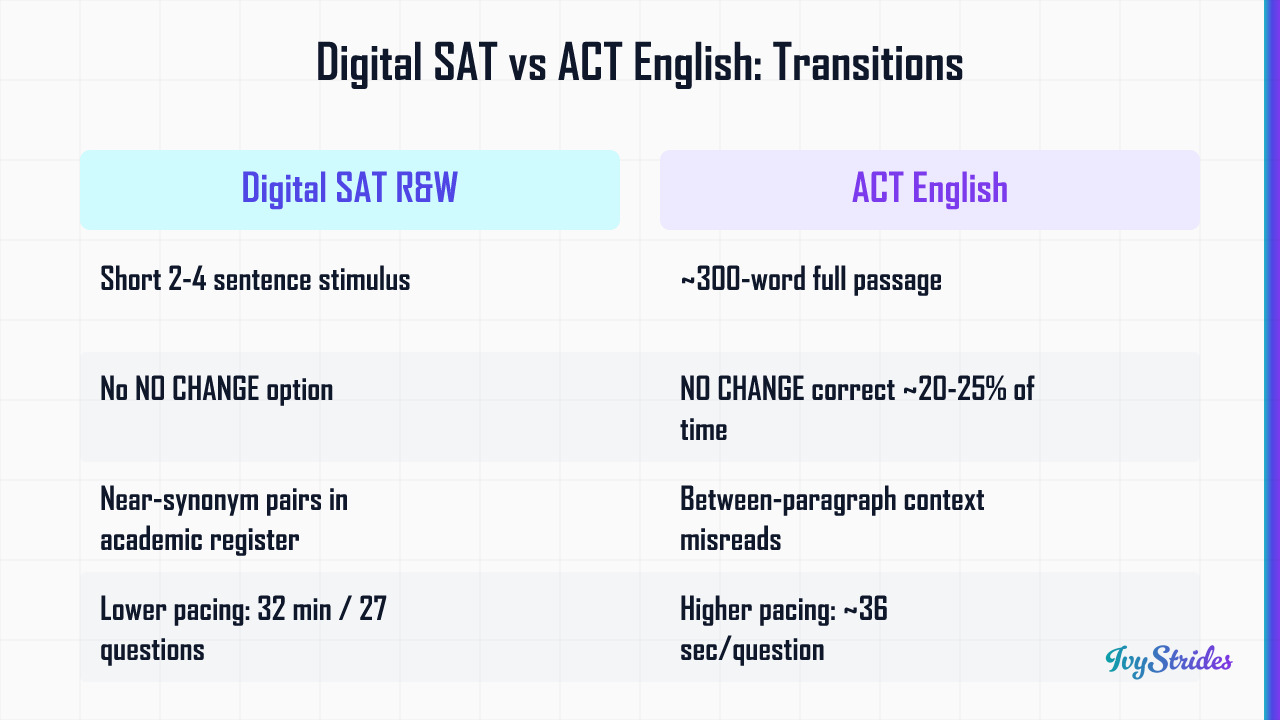
| Attribute | Digital SAT R&W | ACT English |
| Format | Short stimulus text, blank between sentences | Underlined word inside full passage |
| Passage length | 2-4 sentences | ~300 words, 5 passages |
| Answer choices | 4 transition words/phrases | 4 options including NO CHANGE |
| NO CHANGE option | No | Yes (correct ~20-25% of the time) |
| Difficulty escalation | Module 1 routes to harder Module 2 | Fixed difficulty across the test |
| Pacing pressure | Lower (32 min / 27 questions) | Higher (~36 sec/question) |
| Primary trap type | Near-synonym pairs in academic register | Between-paragraph context misreads |
| Strategy adjustment | Identify relationship before reading choices | Read prior paragraph for between-paragraph items |
| Scoring | Within 200-800 R&W score band | Within 1-36 ACT English subscore |
Both tests score transitions inside a broader section score. Neither breaks transitions out as a standalone subscore, so improvement shows up as composite section movement, not a discrete transitions number.
Ready to put this into structured practice? Look at SAT summer batch enrollment for Digital SAT cohort options. The equivalent on the ACT side is ACT summer batch enrollment.
Should You Take the ACT or the Digital SAT? What Transitions Questions Reveal About Your Fit
Transitions questions are a useful diagnostic lens, even if they're not the deciding factor.
If you find longer reading passages under time pressure draining, ACT English transitions will feel harder than Digital SAT transitions. Not because the logic differs. Because you're processing ten times the surrounding context per question while the clock runs faster.
If short, dense, academic-register stimulus texts give you trouble (think marine biology abstracts or economic theory excerpts), harder Digital SAT Module 2 transitions will feel harder than the ACT version.
Neither pattern alone is a reason to switch tests. The correct way to decide is a full-length diagnostic for each, scored side by side. That's the methodology we run with every IvyStrides student: diagnostic first, plan second. A single question-type comparison is a hint, not a verdict.
One caveat worth surfacing for parents and students reading this together. Test-optional policies vary by school and by application year. Some schools that went test-optional during 2020-2022 have reinstated test requirements; others remain optional or are now test-blind. Verify the current policy at each target school via FairTest or the school's published Common Data Set before deciding not to submit scores. Strong scores still help at the majority of selective schools, even where optional.
Beyond test selection, the broader admissions picture includes AP coursework and essays. Our ap classes online offerings run subject-specialist teachers per AP, the same per-section model we use for SAT and ACT prep. To see the people behind the methodology, visit our IvyStrides founders page.
FAQ
What is a transitions question on the Digital SAT?
A transitions question on the Digital SAT presents a short 2-4 sentence stimulus text with a blank, typically between two sentences, and asks which word or phrase "completes the text with the most logical transition." The four answer choices are each a single transition word or short phrase representing different relationship types. The question appears in the Expression of Ideas subdomain of the Reading and Writing section, and can show up in both Module 1 and the harder Module 2.
Are transitions questions harder on the ACT or the Digital SAT?
The underlying logic is equally demanding on both. The ACT adds reading-load difficulty: transitions are embedded in 300-word passages, between-paragraph items require reading across paragraph boundaries, and pacing is tighter at roughly 36 seconds per question. The Digital SAT's harder Module 2 transitions use more academic register and subtler relationship signals. ACT, Inc. states overall question difficulty is similar across both tests. For transitions specifically, the ACT's longer context and NO CHANGE option make it feel harder if you're stronger at short-text analysis.
How do I improve at transitions questions on both tests?
Stop reading answer choices first. Identify the logical relationship between the two ideas in your own words before looking at the options. Then eliminate every choice that signals the wrong relationship type, and among the remaining choices, select the one that matches the strength of the relationship (hard versus soft contrast, for instance). Targeted practice with real ACT and Digital SAT questions, not generic word lists, gives the fastest gains. Pair it with an error log that tracks which relationship type you're consistently misreading.
Can I use the same transition word list to prepare for both the ACT and the Digital SAT?
Yes, with one addition. The core list of 30-40 transition words covering contrast, addition, causation, concession, illustration, and sequence applies to both tests. For the Digital SAT's harder Module 2 questions, add the less common concession and qualification words: "notwithstanding," "admittedly," "granted," and "to be sure." For the ACT, practice applying the list in longer passage contexts rather than short stimulus texts, and always include NO CHANGE as a live option in your practice.
Should I switch from the SAT to the ACT if I keep missing transitions questions?
No. Missing transitions questions is not by itself a reason to switch tests. The skill transfers between both tests, and targeted practice on the four-step relationship-identification process typically resolves the error pattern within two to four weeks of focused work. The right reason to switch is a full diagnostic comparison showing a meaningfully higher composite score on one test than the other. If you're unsure, a diagnostic-driven strategy call can help you decide based on your actual score data.
What is the difference between a hard and a soft transition word?
A hard transition word signals a strong, clear version of a relationship. "However" is a hard contrast signal: the second idea directly opposes the first. "Nevertheless" is also hard contrast. A soft transition word signals a nuanced or partial version of the same relationship. "Although" is a soft contrast signal: it acknowledges the first idea while introducing a complication, not a full reversal. Both tests use near-synonym pairs like "however" versus "although" as trap choices, so identifying whether the relationship is strong or partial is the deciding step after you've ruled out the wrong relationship types.
Two seconds. That's all it takes to name the relationship before you read the choices. Once that habit is automatic, the scoreboard moves on both tests.
Ready to Stop Losing Points on Transitions Questions?
Whether you are targeting the ACT English section or the Digital SAT R&W, our section-specialist coaches start with a diagnostic to find your exact error pattern, then build a personalized plan around it. Students and parents are both welcome on the call.

Award-winning author (South Asian Book Award) and graduate of BITS Pilani and UCLA Luskin School of Public Affairs. Brings a published writer's eye to Common App essays and grammatical precision to SAT and ACT R&W instruction.