
The Ultimate SAT Study Guide 2026: Free PDFs, Study Plans & Digital SAT Prep
On this page
- What Is the Official SAT Study Guide - And Is It Enough for 2026?
- Official SAT Study Guide PDF: Where to Download (Legit Sources)
- Official Guide vs. Digital SAT Prep Resources: What's Missing?
- What Changed with the Digital SAT in 2026 (And Why Your Study Guide Matters)
- Adaptive Testing Explained: How Module 1 Affects Your Final Score
- How to Study for the Digital SAT: A Step-by-Step Guide
- Step 1: Take a Diagnostic Practice Test
- Step 2: Choose Your Study Timeline (30-Day vs. 90-Day Plan)
- Step 3: Master Each Section (Math, Reading, Grammar)
- Step 4: Practice with Adaptive Mock Tests
- Step 5: Review Mistakes and Adjust Your Plan
- Best SAT Prep Books & Resources for 2026 (Honest Comparison)
- Free SAT Study Resources vs. Paid Prep Programs
- Free SAT Study Guide PDFs & Downloads (2026 Edition)
- SAT Math Formula Sheet & Guide PDF
- SAT Grammar Rules Cheat Sheet PDF
- SAT Reading Strategies Guide PDF
- SAT Study Plan PDFs (30-Day & 90-Day)
- SAT Vocabulary Flashcards & Mistake Tracker
- Digital SAT Time Management: A Minute-by-Minute Pacing Guide
- Reading & Writing Module Pacing Strategy
- Math Module Pacing Strategy
- Common SAT Mistakes That Cost You Points (And How to Avoid Them)
- What's a Good SAT Score in 2026? (Score Ranges by College Tier)
- Average SAT Scores for Ivy League & Top 25 Colleges
- How to Set Your Target SAT Score
- How IvyStrides Makes Digital SAT Prep Different (and Doable)
- SAT Study Guide FAQ (2026 Edition)
There's no shortage of SAT resources out there: books, flashcards, prep apps, Reddit threads, and YouTube hacks. Yet somehow, all this content often leads to one thing: overwhelm.
That's because students aren't missing materials. They're missing a strategy.
With the 2026 SAT now fully digital, test-taking strategies, timing, and formats have all changed. So why are so many SAT study guides still stuck in the past?
That's where IvyStrides steps in. This isn't another list of SAT study resources. It's a clear, strategic roadmap designed for the 2026 Digital SAT - complete with free PDF downloads, study plans, and section-by-section prep guides.
What you'll find in this guide:
- What the Official SAT Study Guide covers (and where it falls short)
- What changed with the Digital SAT in 2026
- A step-by-step study plan for the Digital SAT
- Best SAT prep books and resources for 2026 (honest comparison)
- Free SAT study guide PDFs and downloads (2026 edition)
- Time management and pacing strategies
- Common mistakes that cost you points
- Good SAT score ranges by college tier
- How IvyStrides makes Digital SAT prep different
- FAQ (2026 edition)
What Is the Official SAT Study Guide - And Is It Enough for 2026?
If you've searched for "the official SAT study guide 2026 PDF," you're not alone. It's one of the most common searches among students starting their prep journey.
The Official SAT Study Guide is published by the College Board - the organization that creates the SAT. It includes real practice questions, test-taking tips, and full-length practice tests. It's a solid foundation, especially for understanding the types of questions you'll see.
But here's the honest truth: the official guide alone isn't enough for the 2026 Digital SAT.
Why? Because it doesn't fully replicate the adaptive testing experience, doesn't simulate the Bluebook app interface, and lacks personalized feedback. It's a content resource - not a strategy system.
Official SAT Study Guide PDF: Where to Download (Legit Sources)
Students often search for "official SAT study guide PDF free download" or "official digital SAT study guide second edition PDF." Here's where you can legitimately access official College Board materials:
- College Board's SAT Suite website - Free student guide PDF available at satsuite.collegeboard.org
- Bluebook App - Download the free app to access full-length adaptive practice tests that mirror the real exam
- College Board Store - Purchase the Official SAT Study Guide (print edition) at store.collegeboard.org
- Your local library - Many libraries carry the official guide for free borrowing
- Khan Academy - Free official SAT practice powered by College Board content
A note on the "second edition": The Official SAT Study Guide Second Edition was designed for the older paper-based SAT. If you're prepping for the 2026 Digital SAT, make sure any official guide you use reflects the current digital, adaptive format.
Official Guide vs. Digital SAT Prep Resources: What's Missing?
| Feature | Official SAT Study Guide | IvyStrides Digital SAT Prep |
| Real College Board questions | ✅ Yes | ✅ Yes (plus curated extras) |
| Adaptive test simulation | ❌ No | ✅ Yes |
| Bluebook-style interface practice | ❌ No | ✅ Yes |
| Personalized feedback | ❌ No | ✅ Yes (human, not automated) |
| Section-specific strategy guides | ❌ Limited | ✅ Math, Reading, Grammar PDFs |
| Study plan templates (30-day, 90-day) | ❌ No | ✅ Free PDF downloads |
| Mistake tracker & accountability tools | ❌ No | ✅ Yes |
| Score improvement coaching | ❌ No | ✅ 1-on-1 tutoring available |
The official guide is a great starting point. But to truly maximize your score, you need adaptive practice, strategic coaching, and accountability tools - which is exactly what IvyStrides provides.
What Changed with the Digital SAT in 2026 (And Why Your Study Guide Matters)
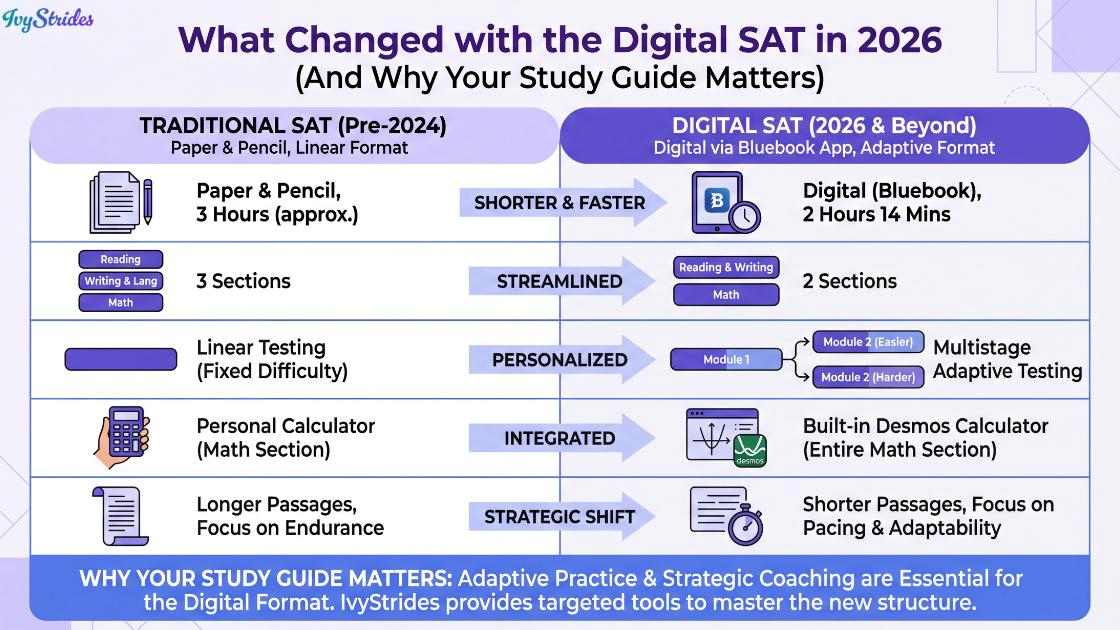
The SAT went fully digital starting in 2024 and was standardized in 2025. And this isn't just a format shift - it's a structural one.
Students now test through the College Board's Bluebook app on a computer or school-issued device. The test is shorter (just over two hours), features two main sections (Reading & Writing and Math), and uses adaptive testing, meaning your performance in one module determines the difficulty of the next.
Each section is split into two parts. If you do well in Module 1, Module 2 will be more challenging, giving you a shot at a higher score.
Time management also changes; pacing matters more than ever, especially in the Reading section, where shorter passages replace long articles.
You no longer need to bring your own calculator - the Desmos graphing calculator is built into the entire math section. But that doesn't mean you can skip mental math and strategy.
With the adaptive format, how you prep and how you pace yourself will directly affect your score.
Adaptive Testing Explained: How Module 1 Affects Your Final Score
This is the single most important concept most SAT study guides skip.
Here's how it works:
- Module 1 is the same difficulty for everyone.
- Your accuracy in Module 1 determines whether you get a harder or easier Module 2.
- The harder Module 2 has a higher scoring ceiling - meaning you can reach 700+ in that section.
- The easier Module 2 caps your score lower, even if you answer every question correctly.
What this means for your prep: Getting Module 1 right is critical. Careless mistakes early on can lock you out of a top score. That's why IvyStrides emphasizes accuracy-first strategies and Module 1 drills in every prep plan.
This is also why generic practice tests that don't simulate the adaptive structure can give you a false sense of readiness. You need practice that mirrors the real scoring mechanism.
This is why IvyStrides offers a Digital SAT Prep Guide that mimics the Bluebook interface, helps students navigate the module structure, and builds digital fluency early in the prep journey.
We've trained students from the U.S., India, UAE, and Nigeria - so we understand how to prep differently based on where and how you're testing.
How to Study for the Digital SAT: A Step-by-Step Guide
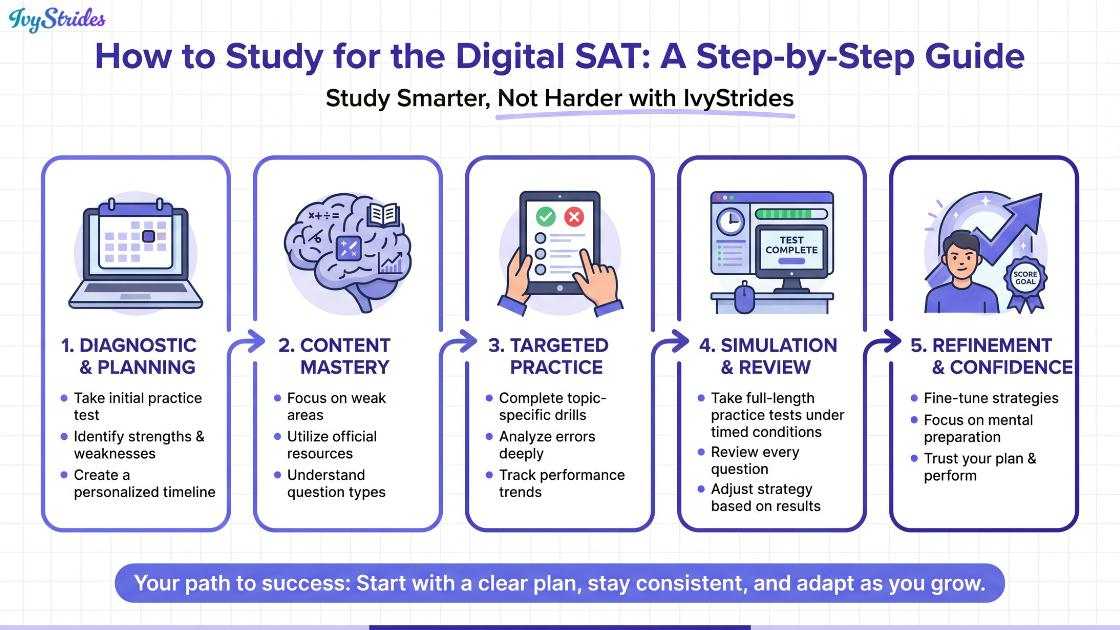
There's no single "right" way to study for the Digital SAT, but there is a smart way. Match your prep strategy to your time, strengths, and goals.
Whether you're a 10th grader just exploring the test or a senior chasing one last score bump, the key is to start with a plan.
Step 1: Take a Diagnostic Practice Test
IvyStrides helps students begin with a diagnostic test to understand current strengths and gaps. Without a baseline, you're guessing at what to study.
A diagnostic test tells you:
- Your approximate score range right now
- Which sections need the most work
- Whether your mistakes are content-based or strategy-based
- How your pacing compares to what the test demands
Don't skip this step. It's the foundation of every effective study plan.
Step 2: Choose Your Study Timeline (30-Day vs. 90-Day Plan)
From there, we recommend one of our two most popular study schedules:
- 30-Day SAT Cram Plan PDF: Ideal for students close to test day or looking to retake quickly. You'll focus on time management, core strategy, and targeted review using our adaptive tools.
- 90-Day SAT Study Plan PDF: Perfect for juniors starting early or building consistency. It balances review, practice, and full-length mock tests week by week.
No matter your timeline, tracking progress is essential. That's why IvyStrides offers SAT study calendars and mistake tracker templates in PDF format, which help you build accountability into your routine.
This isn't about doing more; it's about doing what works for you.
Step 3: Master Each Section (Math, Reading, Grammar)
To truly raise your SAT score, you need to understand how the test is structured and where your personal challenges lie. IvyStrides uses a modular prep approach, so each student can focus intensely on their weakest section without neglecting their strengths.
Download SAT Math 2026 Guide PDF
SAT Math covers algebra, functions, data analysis, and some geometry - but it's not about memorization. It's about knowing how to apply formulas quickly.
If you struggle with SAT algebra questions, start there - algebra makes up the largest portion of the math section.
That's why we created the SAT Math Formula Sheet, a printable PDF reference with all tested equations and tips for when to use them.
We also cover common pitfalls like quadratic formula mistakesandSAT word problems that trip students up.
Download SAT Grammar 2026 Guide PDF
The grammar section isn't about spelling or obscure rules. It's about punctuation, transitions, subject-verb agreement, and conciseness. IvyStrides offers a free Grammar Rules Cheat Sheet PDF so you can train rule-by-rule and start recognizing patterns faster.
Download SAT Reading 2026 Guide PDF
The new SAT favors short, information-dense reading passages. The goal? Pull key ideas fast. Our Reading Strategies Guide teaches students how to skim smartly, underline efficiently, and answer with precision - even under a tight clock.
If you want to sharpen your speed, check out our guide on SAT reading speed and timing.
For each section, IvyStrides provides targeted SAT practice test sets, timed drills, and full walkthroughs - so you're not just practicing, you're improving.
Step 4: Practice with Adaptive Mock Tests
Here's where most students go wrong: they take practice tests that don't mirror the actual exam.
The Digital SAT is adaptive. Your practice should be too.
IvyStrides mock tests simulate:
- The Bluebook app interface
- Module 1 → Module 2 difficulty routing
- Real timing constraints per module
- Score projections based on adaptive performance
Taking 2–3 full-length adaptive mock tests before your real test date is the minimum. Space them out - one every 1–2 weeks - so you have time to review and improve between each one.
Step 5: Review Mistakes and Adjust Your Plan
This is the step that separates 1400+ scorers from everyone else.
After every practice test or drill, use a mistake tracker to log:
- The question type you missed
- Whether it was a content gap, careless error, or timing issue
- The correct approach you should have used
IvyStrides provides a free Mistake Tracker Template PDF for exactly this purpose. Over time, you'll see patterns - and those patterns tell you exactly where to focus next.
One powerful technique for retaining what you learn is spaced repetition - reviewing material at increasing intervals to lock it into long-term memory.
Best SAT Prep Books & Resources for 2026 (Honest Comparison)
With so many prep materials out there, it's easy to assume more is better. But what you really need is a balanced toolkit that covers content, strategy, and feedback.
| Resource | Best For | Digital SAT Ready? | Free? | Strategy Focus |
| Official SAT Study Guide (College Board) | Real questions, test familiarity | Partially | No (book purchase) | Low |
| Khan Academy SAT Prep | Content review, extra practice | Yes | Yes | Low |
| Princeton Review SAT Prep | Comprehensive content coverage | Yes (2026 edition) | No | Medium |
| Barron's SAT Prep | In-depth math review | Partially | No | Low |
| IvyStrides SAT Prep | Strategy, adaptive practice, coaching | Yes | Free tools + paid coaching | High |
Our honest take: No single book or platform does it all. The Official SAT Study Guide gives you real questions. Khan Academy gives you free practice. But neither teaches you how to think strategically about the adaptive format. That's the gap IvyStrides fills.
Free SAT Study Resources vs. Paid Prep Programs
Free resources (Khan Academy, College Board PDFs, IvyStrides free toolkit) are enough if you're:
- Self-disciplined and can stick to a schedule
- Starting with a score above 1200
- Good at identifying your own weaknesses
Paid prep programs (IvyStrides coaching, tutoring, courses) are worth it if you're:
- Aiming for 1400+ and need targeted strategy
- Struggling to improve despite practice
- Short on time and need an efficient plan
- An international student needing region-specific guidance
IvyStrides offers both paths. Start with our free tools. If you need more, our 1-on-1 coaching is built to close the gap fast.
Here's how to think about building your toolkit:
- Official College Board SAT Study Guide: It's a solid foundation. Use it for real questions and test-day pacing. But don't stop there - you need more that reflects the 2026 digital interface or adaptive design.
- Online platforms (like Khan Academy): Great for extra practice and review videos, but they often lack personalized insight or accountability. Also, they don't always teach strategy - they just teach content.
- IvyStrides Resources: This is what we offer - a full ecosystem:
- Strategy-based digital guides
- Downloadable vocabulary flashcards
- Mistake tracker templates
- Time management worksheets
- Custom study planners
IvyStrides offers both paths. Start with our free tools. If you need more, our 1-on-1 coaching is built to close the gap fast.
Here's how to think about building your toolkit:
- Official College Board SAT Study Guide: It's a solid foundation. Use it for real questions and test-day pacing. But don't stop there - you need more that reflects the 2026 digital interface or adaptive design.
- Online platforms (like Khan Academy): Great for extra practice and review videos, but they often lack personalized insight or accountability. Also, they don't always teach strategy - they just teach content.
- IvyStrides Resources: This is what we offer - a full ecosystem:
- Strategy-based digital guides
- Downloadable vocabulary flashcards
- Mistake tracker templates
- Time management worksheets
- Custom study planners
We've also created a Best Resources by Learning Style chart that matches materials to how you process information: visually, verbally, logically, or kinesthetically.
So no, you don't need to buy 7 books. You need the right mix of updated tools, real-time practice, and strategy-focused feedback - and that's what IvyStrides delivers.
Free SAT Study Guide PDFs & Downloads (2026 Edition)
We get it - not everyone has time (or budget) to invest in a full course. That's why IvyStrides created a free, downloadable toolkit that gives students the structure, tools, and strategy support they need to study smarter.
Bookmark this section. These are the most-downloaded SAT prep PDFs for 2026:
SAT Math Formula Sheet & Guide PDF
Every formula tested on the Digital SAT - organized by topic (algebra, geometry, data analysis, advanced math). Includes tips on when to use each formula and common traps to avoid. Perfect companion for ourSAT algebra questions guide.
SAT Grammar Rules Cheat Sheet PDF
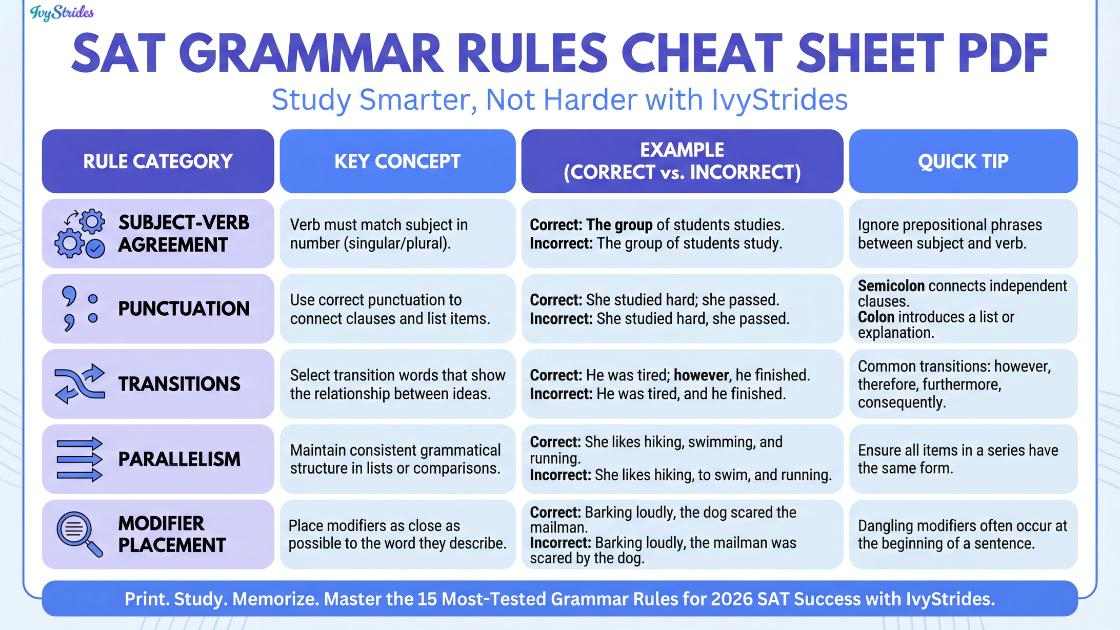
A one-page reference covering the 15 most-tested grammar rules: subject-verb agreement, punctuation, transitions, parallelism, modifier placement, and more. Print it. Study it. Memorize it.
SAT Reading Strategies Guide PDF
Step-by-step approach to the new short-passage format. Covers skimming techniques, elimination strategies, and how to handle "main idea" vs. "evidence" questions. Pairs well with our SAT reading speed guide.
SAT Study Plan PDFs (30-Day & 90-Day)
Structured, week-by-week plans that tell you exactly what to study and when. The 30-day plan is for crunch-time prep. The 90-day plan is for students who want to build skills methodically.
SAT Vocabulary Flashcards & Mistake Tracker
Even in the new SAT format, knowing precise definitions can save you from wrong-answer traps. Our vocabulary flashcards cover the most frequently tested words. The mistake tracker template helps you log errors, identify patterns, and adjust your study plan accordingly.
Here's the full list of what's inside the free toolkit:
- 30-Day SAT Cram Plan
- 90-Day SAT Study Plan
- Digital SAT Prep Guide
- Digital SAT Time Management Guide
- Parents' Guide to SAT Prep
- SAT Grammar Rules Cheat Sheet
- SAT Math Formula Sheet
- SAT Mistake Tracker Template
- SAT Reading Strategies Guide
- SAT Test Day Checklist
- SAT Vocabulary Flashcards
- SAT vs ACT - Which test is right for you?
- Scholarship Guide for High SAT Scorers
- Top 25 Colleges and Their Average SAT Score
Digital SAT Time Management: A Minute-by-Minute Pacing Guide
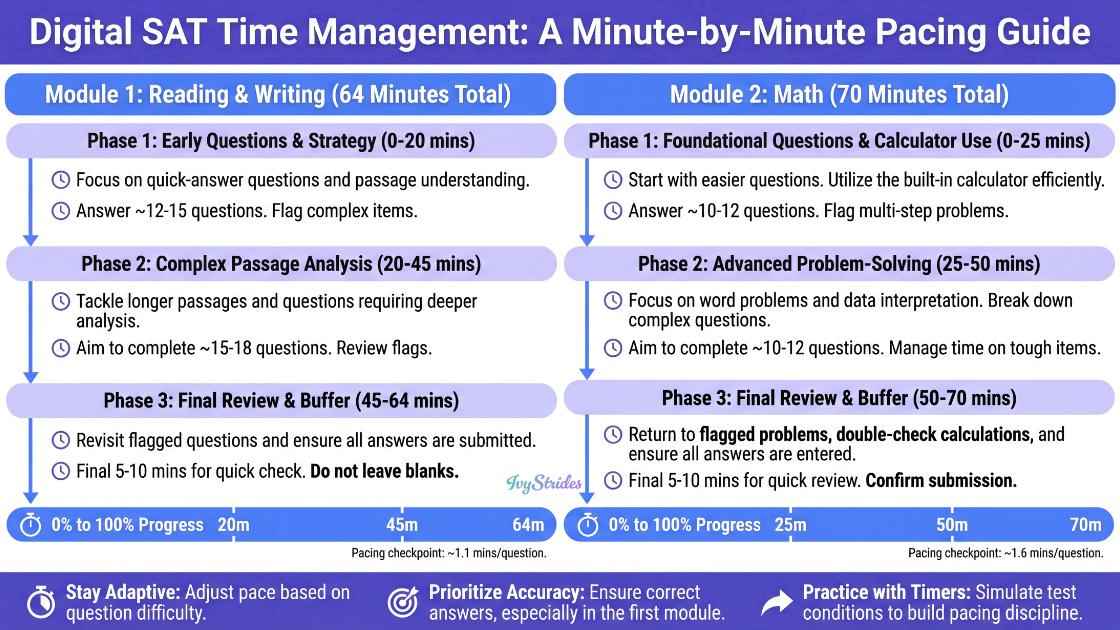
Time management is no longer a side skill; it's a core skill for the SAT, especially with the new digital format.
Because the test is now adaptive, how quickly and accurately you finish the first module determines the difficulty level (and scoring potential) of the next one. That means running out of time doesn't just leave blanks - it can actually cap your score by preventing you from entering the higher-scoring module.
Reading & Writing Module Pacing Strategy
| Module | Questions | Time | Pace |
| RW Module 1 | 27 questions | 32 minutes | ~71 seconds per question |
| RW Module 2 | 27 questions | 32 minutes | ~71 seconds per question |
Pacing tips:
- Spend no more than 60 seconds on straightforward grammar questions.
- Use the extra time on inference and "best evidence" questions.
- Flag and move on if a question takes more than 90 seconds. Come back to it.
- Don't re-read entire passages. The new short-passage format means one read should be enough.
Math Module Pacing Strategy
| Module | Questions | Time | Pace |
| Math Module 1 | 22 questions | 35 minutes | ~95 seconds per question |
| Math Module 2 | 22 questions | 35 minutes | ~95 seconds per question |
Pacing tips:
- Use mental math for simple calculations - opening Desmos for basic arithmetic wastes time.
- Use Desmos for graphing questions, systems of equations, and checking work on complex problems.
- Should you guess on the SAT? Yes - there's no penalty for wrong answers. Never leave a question blank.
- Tackle easier questions first. Flag harder ones and return with remaining time.
Here's how IvyStrides helps you master timing:
- We simulate full adaptive module drills to practice switching gears between difficulty levels
- Our Digital SAT Time Management Guide includes pacing plans down to the minute: how many questions per module, when to flag, when to move on
- We teach decision-making under time pressure: when to guess, when to pause, and when to cut your losses and move forward
- We build stamina practice into your prep, because timing isn't just about clock management - it's about mental energy
Our coaching helps you learn how to stay sharp through both modules, without second-guessing or burnout.
If test anxiety is affecting your pacing, read our guide on strategies to overcome SAT anxiety.
Common SAT Mistakes That Cost You Points (And How to Avoid Them)
There's a pattern among students who score lower than expected, and it's not usually a lack of studying. It's about forgetting key steps that can protect or boost your score.
One of the biggest is neglecting to plan for a second test attempt. Most students improve the second time around, and colleges typically consider your highest score.
Wondering how many times you can take the SAT? There's no official limit - and retaking is a smart strategy.
IvyStrides helps you map your test attempts, retake strategy, and score goals using a timeline aligned with admissions and scholarship deadlines.
Another critical oversight is not reviewing your mistakes. Practice tests aren't just for simulating the exam; they're also for identifying what's going wrong.
On test day itself, the most common errors aren't in reading or math - they're in logistics. Arriving late, forgetting documents, misusing the calculator, skipping breakfast, or burning out mid-test can derail even the most prepared student.
Pulling an all-nighter before the test? That's one of the worst things you can do - here's why all-nighters hurt your SAT scores.
IvyStrides created a SAT Test Day Checklist for exactly this reason - so nothing catches you off guard.
Top 5 mistakes to avoid:
-
Skipping the diagnostic test - You can't fix what you haven't measured.
-
Studying without a plan - Random practice doesn't build skills.
-
Ignoring the adaptive format - Practicing on non-adaptive tests gives false confidence.
-
Not reviewing errors - The mistake tracker is your most powerful tool.
-
Cramming the night before - Reduce stress while studying and get a full night's sleep instead.
What's a Good SAT Score in 2026? (Score Ranges by College Tier)
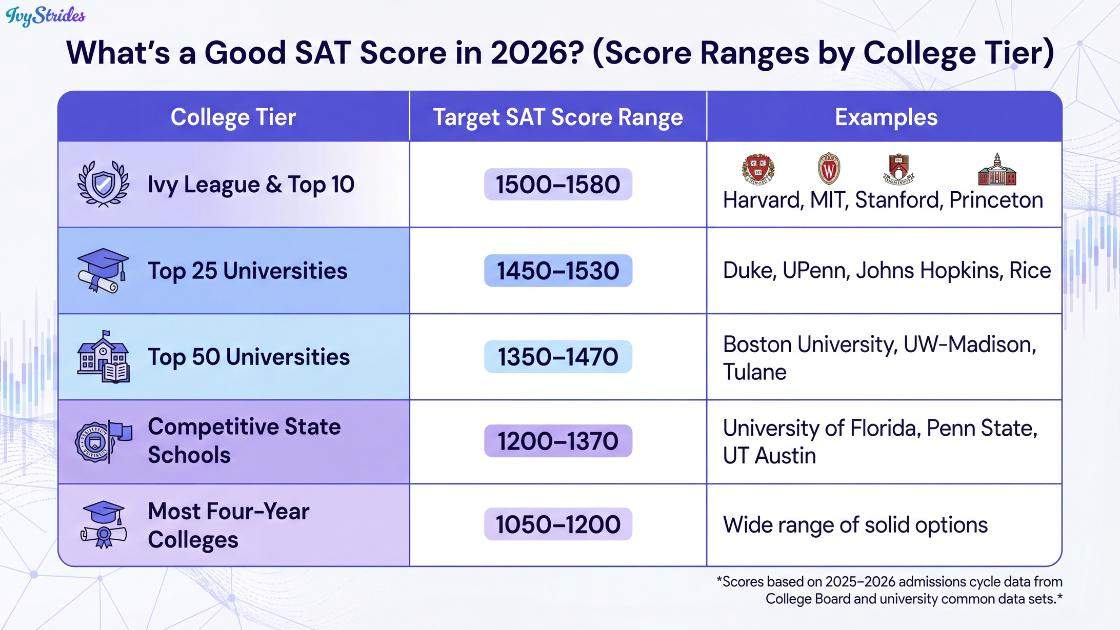
One of the most common questions we hear: "What's a good SAT score?"
The answer depends entirely on where you want to go to college. Here's a general breakdown:
| College Tier | Target SAT Score Range | Examples |
| Ivy League & Top 10 | 1500–1580 | Harvard, MIT, Stanford, Princeton |
| Top 25 Universities | 1450–1530 | Duke, UPenn, Johns Hopkins, Rice |
| Top 50 Universities | 1350–1470 | Boston University, UW-Madison, Tulane |
| Competitive State Schools | 1200–1370 | University of Florida, Penn State, UT Austin |
| Most Four-Year Colleges | 1050–1200 | Wide range of solid options |
Scores based on 2025–2026 admissions cycle data from College Board and university common data sets.
Average SAT Scores for Ivy League & Top 25 Colleges
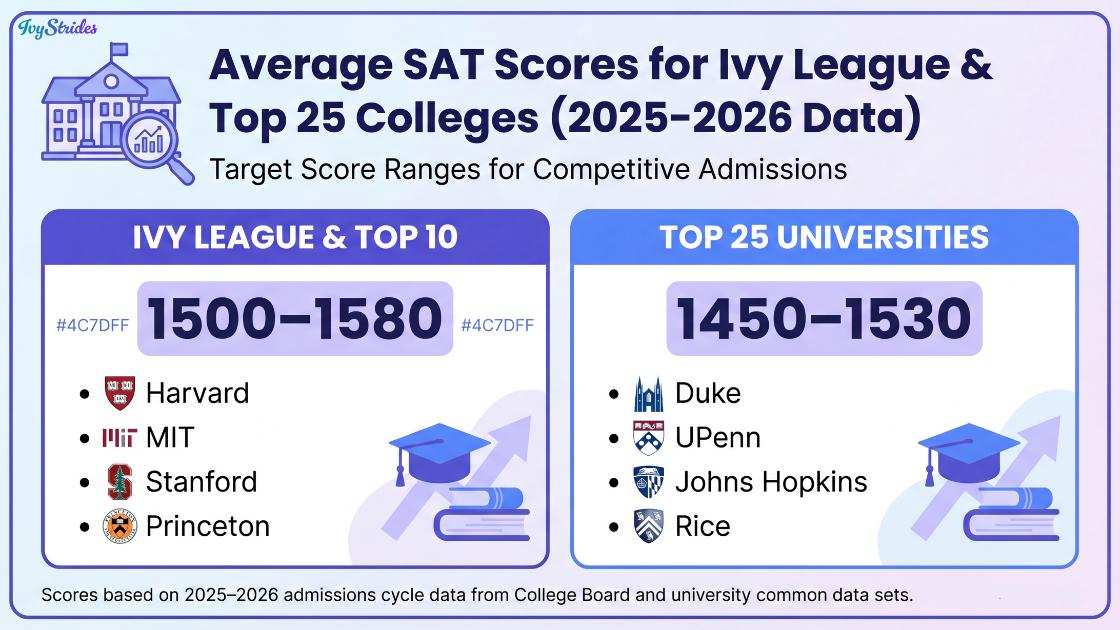
Want specifics? Here are some examples:
- Harvard: Middle 50% SAT range is approximately 1490–1580
- UPenn: UPenn SAT requirements - typically 1480–1570
- Duke: Should you apply to Duke? - middle 50% around 1470–1570
- Johns Hopkins: Should you apply to Johns Hopkins?- typically 1480–1560
- Rice: Should you apply to Rice? - middle 50% around 1470–1560
- Brown: Should you apply to Brown? - typically 1460–1560
For a full list, check out our Top 25 Colleges and Their Average SAT Score guide. Curious what a 1520 SAT scorecan get you? We break it down college by college.
How to Set Your Target SAT Score
Here's a simple framework:
-
List your top 5 target colleges.
-
Look up each school's middle 50% SAT range (available on their admissions pages or Common Data Set).
-
Aim for the 75th percentile of your top-choice school - that puts you in a strong position.
-
Work backward from that target to determine how many points you need to gain from your diagnostic score.
For example, if your dream school's 75th percentile is 1520 and your diagnostic score is 1350, you need a 170-point improvement. That's very achievable with 2–3 months of focused prep.
Use goal-setting strategies like WOOP to stay motivated and on track.
How IvyStrides Makes Digital SAT Prep Different (and Doable)
Most SAT prep programs give you practice. IvyStrides gives you a system.
And for students preparing for the Digital SAT in 2026, our SAT Prep Program is the real game changer.
Here's what we do differently:
- We don't just assign questions - we teach you how to think
- Personalized feedback isn't automated - it's human
- Strategy comes first
- Mock test simulations use adaptive scoring, real interface mimicry, and stress-tracking
- Parents stay in the loop with biweekly updates and session recaps
Whether you're testing from India, UAE, Nigeria, or the U.S., we guide you through location-based deadlines, ID requirements, and score submission windows.
Need to send SAT scores to specific schools like Yale or Carnegie Mellon? We walk you through the process.
For international students specifically:
- We help you navigate region-specific test center availability andwhat to do if SAT test centers are full.
- We advise on acceptable ID documents by country
- We align your prep timeline with international score release dates - learn when SAT results come out
- We help you understand score submission requirements for U.S. colleges
- Need to cancel or reschedule your SAT registration? We guide you through deadlines and refund policies.
SAT Study Guide FAQ (2026 Edition)
Q1. What's the best SAT study resource for 2026?
The one that helps you stay consistent. That might be a book, an app, a tutor, or IvyStrides' toolkit. We recommend starting with a diagnostic practice test, then mapping your weak areas to specific tools.
Q2. Is the official SAT study guide enough to prep for the Digital SAT?
It's a solid start, but it's not designed to simulate the adaptive digital format. Supplement with adaptive tools, updated drills, and real digital simulations. The official guide gives you real questions - IvyStrides gives you the strategy to answer them faster and more accurately.
Q3. Do I need to buy multiple prep books?
No. One core resource is fine if paired with the right strategy and digital support. IvyStrides combines tech, feedback, and planning.
Q4. What if I only have 30 days to study?
That's enough time - if you're structured. Grab our 30-Day Cram Plan, focus on high-impact areas, and review mistakes daily.
Q5. How do I start if I've never taken a practice test?
Take a full-length diagnostic first. Use the results to identify strengths and weak areas. Then choose a focused study plan - either 30-day or 90-day - and begin with your weakest section.
Q6. Is self-study enough or should I join a course?
Self-study can work if you track performance and adjust regularly. IvyStrides supports both paths with free tools and optional coaching.
Q7. How many hours a week should I study for the SAT?
It depends on your timeline. With 2–3 months, aim for 6–10 hours per week. With less time, increase intensity but plan breaks.
Avoid burnout - here's how to reduce stress while studying for the SAT.
Q8. Do colleges care how many times I take the SAT?
No. Most colleges only look at your best score. Retaking is a smart strategy, and there's no official limit. Learn more about how many times you can take the SAT.
Q9. Will they know if I retook the test?
Yes, but they usually consider the highest score.
Many colleges also allow superscoring - combining your highest Reading & Writing score from one sitting with your highest Math score from another sitting. Check each college's policy, as superscoring rules vary.
Q10. What's a good SAT score in 2026?
That depends on your target colleges. For Ivy Leagues, 1500–1580. For competitive state schools, 1200–1370 is strong. See our score ranges table above for a full breakdown.
Q11. How do I choose a target score?
Find the average SAT scores for your top-choice colleges. Set your goal at or slightly above the 75th percentile.
Our 1520 SAT score guide shows you exactly which colleges that score makes you competitive for.
Q12. What if I'm great at math but weak in reading?
Focus prep time on your weaker area, but maintain strength in math. IvyStrides provides section-specific drills.
Start with our SAT reading speed guideto build your reading efficiency.
Q13. How do I study if I'm an international student?
Use resources that reflect U.S.-based test formats. IvyStrides helps international students with region-specific advice, scheduling, test center guidance, and score submission support.
Q14. What's the biggest mistake students make?
Not reviewing errors. Ignoring pacing. Jumping into prep without a strategy.
Q15. How do I stay motivated to study?
Use short sessions. Track wins. Reward consistency.
Try goal-setting frameworks like WOOPto stay focused. Group study and IvyStrides mentoring can also help you stay on track.
Q16. What's the ideal SAT test date?
Plan backward from college deadlines. Allow at least one retake window. IvyStrides can help you choose the right date based on your prep timeline and application deadlines.
Q17. Can I study for both ACT and SAT at once?
It's possible, but not ideal. Choose one test that fits your strengths.
Read our full ACT vs SAT comparison to decide which is right for you, or check out is the SAT harder than the ACT?
Q18. Is IvyStrides good for last-minute prep?
Yes. We have 30-day plans, crash courses, and mock tests tailored for fast improvement.
Q19. What's the cost of IvyStrides tools?
Many of our core tools - flashcards, trackers, planners, study guides - are free. Custom 1-on-1 coaching is also available at competitive rates.
Q20. Can I get personal help without joining a full program?
Absolutely. Book a free planning call and we'll build a path that works for your timeline and style.
Q21. Is the official SAT study guide second edition still relevant?
The second edition was designed for the older paper-based SAT. While some content fundamentals (like math concepts) still apply, the format, timing, and adaptive structure are completely different. For 2026 prep, use the latest College Board materials through the Bluebook app and supplement with IvyStrides' digital-first resources.
Q22. Where can I download a free SAT study guide PDF for 2026?
The College Board offers a free student guide PDF on their website. IvyStrides also provides a complete free toolkit including math formula sheets, grammar cheat sheets, reading strategy guides, study plans, and more - all updated for the 2026 Digital SAT.
Q23. How does superscoring work on the SAT?
Superscoring means a college takes your highest section scores across multiple test dates and combines them for the best possible total. For example, if you scored 720 Math / 680 RW in March and 690 Math / 740 RW in May, your superscore would be 720 + 740 = 1460. Not all colleges superscore, so check each school's policy.
Q24. How many questions are on the Digital SAT?
The Digital SAT has 98 questions total: 54 in Reading & Writing (two modules of 27) and 44 in Math (two modules of 22). Learn more in our complete question breakdown.

Hemant is a seasoned entrepreneur, investor, and growth strategist with deep ground in education and technology-driven learning. His core training is in Mathematics and Physics — he authored Physics for IB Diploma: Ultimate Revision Guide, recognized as a top student resource.