
Command of Evidence by Score Band: 1200, 1400, and 1500+
On this page
- What Command of Evidence Questions Are and Why They Scale With Score
- The 1200-Band Strategy: Fix the Process Before Anything Else
- Why 1400-Band Students Keep Losing Points on Command of Evidence
- Not Sure Which Error Pattern Is Holding You Back?
- The 1500+ Strategy: Neutralizing Distractor Traps and Avoiding Over-Reading
- How to Practice Command of Evidence by Score Band
- How IvyStrides Coaches Command of Evidence in 1-on-1 SAT Prep
- FAQ
- How many Command of Evidence questions are on the Digital SAT?
- What is the difference between textual and quantitative Command of Evidence on the Digital SAT?
- Does the Digital SAT's adaptive structure affect which Command of Evidence questions I see?
- Why do I keep missing Command of Evidence questions even after reviewing the passage carefully?
- How long should I spend on a Command of Evidence question on the Digital SAT?
- Can improving Command of Evidence accuracy alone move my SAT score significantly?
- Your Next Step
- Ready to Stop Guessing on Command of Evidence?
You reread the passage. You picked the wrong quote anyway. If that loop keeps repeating on practice tests, the problem usually isn't your reading; it's that you're running one strategy against three very different versions of the same question.
The right Command of Evidence strategy depends on your current SAT score band. Students around 1200 need to fix a process problem: they pick evidence before fully understanding the claim. Students around 1400 face a precision problem: they choose evidence that's related but not specific enough. Students at 1500+ face a distractor problem: the wrong answers are deliberately close, and over-reading is the main trap. Because the Digital SAT's adaptive Module 2 routes higher-scoring students to harder evidence questions, a single generic strategy doesn't serve all three groups equally.
This article reflects the Digital SAT format as of the 2024-2025 testing cycle.
What Command of Evidence Questions Are and Why They Scale With Score
Command of Evidence sits inside the Information and Ideas domain on the Digital SAT, and College Board splits it into two subtypes: textual and quantitative.
Textual Command of Evidence asks you to pick the quote or passage detail that best supports a stated claim. You'll see a short passage, a claim about what the passage argues or what a researcher concluded, and four candidate quotes. Pick the one that directly supports the claim.
Quantitative Command of Evidence works the same way, except instead of a quote, you're picking a data point from a graph or table. The passage states a conclusion. The data either supports or challenges it. Your job is to find the row, column, or value that matches the claim with precision.
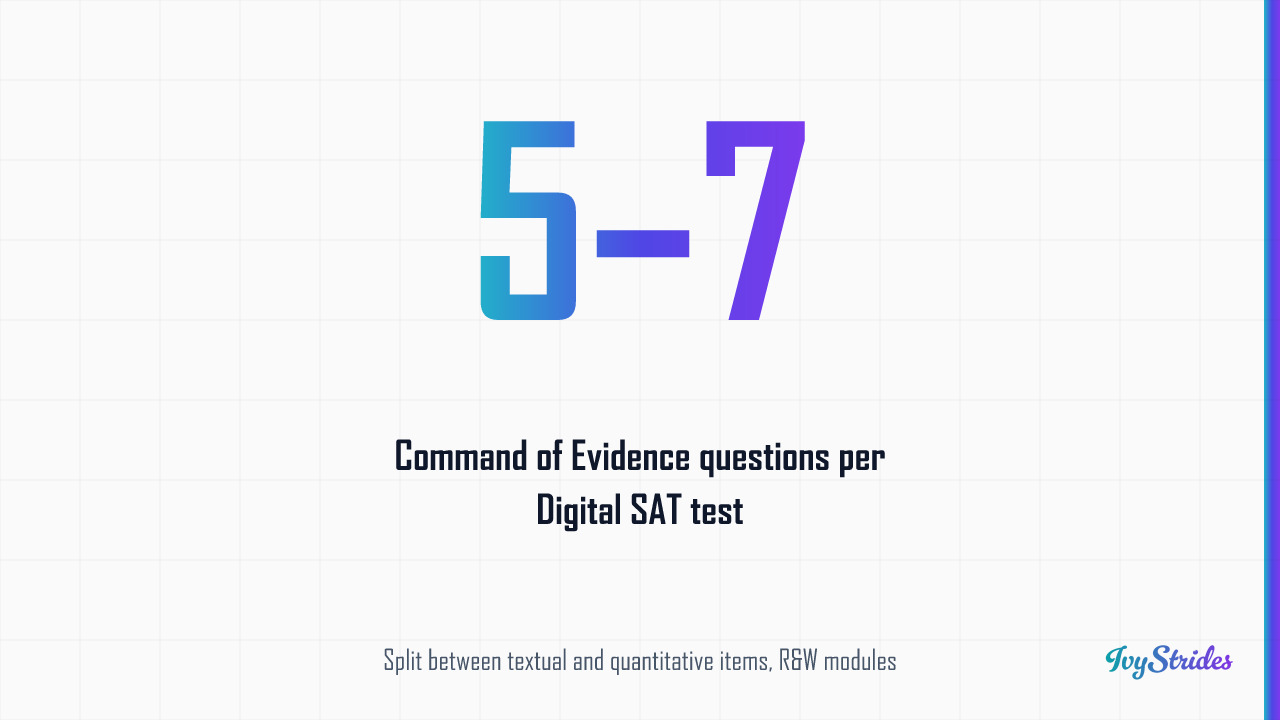
Across both Reading and Writing modules, you'll see approximately 5-7 Command of Evidence questions per test, split between textual and quantitative items. The exact count varies by form, but this is one of the higher-frequency question types in R&W, which is why accuracy here moves the score needle.
Here's the part most students miss. The Digital SAT is adaptive across two modules. Module 1 is the same difficulty for everyone. Module 2 splits into an easy path or a hard path based on Module 1 performance. A student headed for 1200 and a student headed for 1500 aren't seeing the same Command of Evidence questions in Module 2. The hard Module 2 path contains noticeably more high-difficulty evidence items, and the distractors are sharper. So if you're targeting 1400 or above, assume you'll face the hard Module 2 and prepare for distractor-heavy questions, not the warm-up versions.
Why does this matter for score-band strategy? A student moving from roughly 620 to 700 on the R&W section crosses from approximately the 72nd to the 93rd percentile, and Command of Evidence accuracy is one of the clearest levers in that range. The strategy that lifts a 1200 student doesn't lift a 1400 student, because the questions in front of them are different. For a fuller picture of how R&W feeds the composite score, see our sat scores breakdown.
The 1200-Band Strategy: Fix the Process Before Anything Else
Scoring around 1200 (roughly R&W 580-620) usually means you're in the easy or borderline Module 2 path. The questions aren't built with brutal distractors. The errors are almost always process errors.
In our coaching with students entering at 1200-1250, the most common Command of Evidence mistake is picking the first quote that mentions the topic rather than the quote that directly supports the stated claim. The student reads the passage, glances at the claim, and scans the answer choices for a quote that sounds related. That's it. The claim itself never gets fully processed. We call this a failure of claim-first discipline.
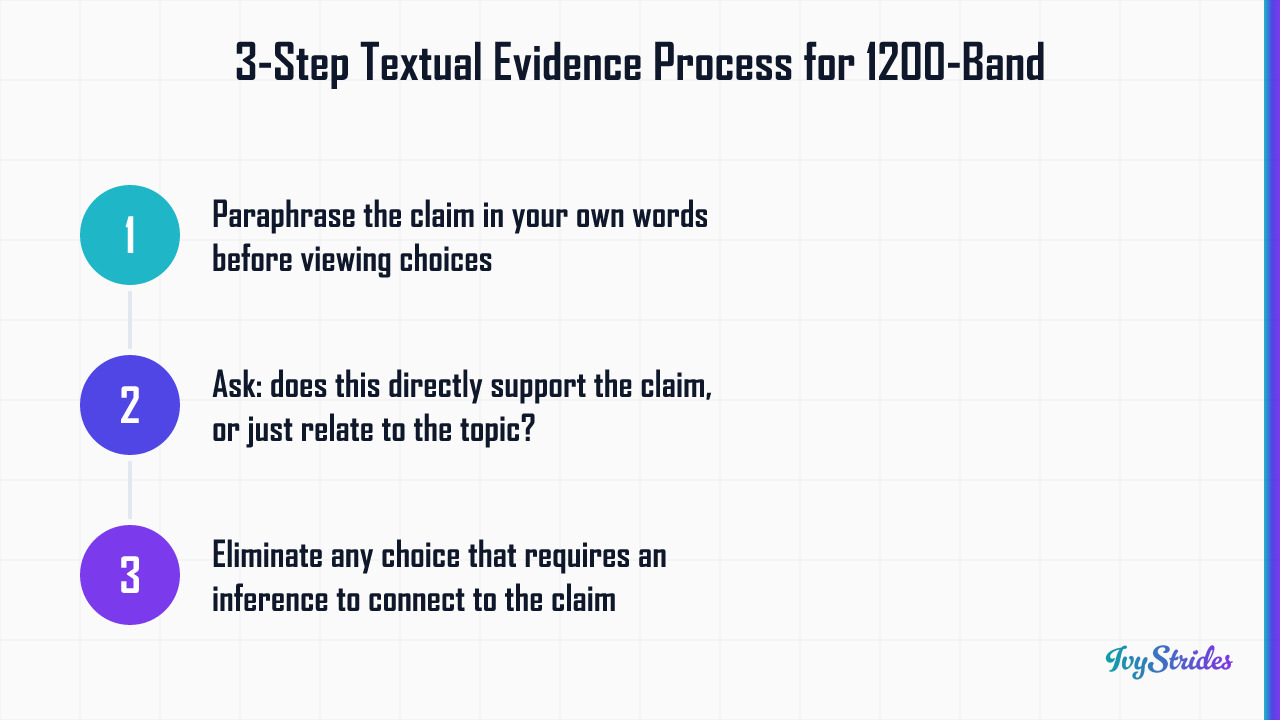
The fix is a three-step process for textual evidence.
Step 1: Paraphrase the claim in your own words before you look at any answer choice. Don't move on until you can say, in plain language, what the claim asserts.
Step 2: For each answer choice, ask one question: "Does this directly support my paraphrased claim, or does it only relate to the same topic?" Relevance to the topic isn't enough. Direct support is the bar.
Step 3: Eliminate any choice that requires an inference. If you have to reason your way from the quote to the claim ("well, if she said this, then maybe…"), the quote isn't your answer.
For quantitative Command of Evidence at this band, run a two-step process. First, identify the specific variable and the direction stated in the claim ("the claim says coffee consumption increased between 2018 and 2022"). Then go to the data and find the answer that contains that exact variable and that exact direction. Ignore the other numbers on the graph.
A pacing note. Students at this band tend to rush evidence questions because they feel "readable" compared to grammar questions. Budget 60-75 seconds per question. That sounds slow. It's the right speed. Rushing is what causes the process errors in the first place.
Why 1400-Band Students Keep Losing Points on Command of Evidence
You've solved the process problem. You read the claim. You parse it carefully. You eliminate choices that don't connect. And you still miss two or three Command of Evidence questions per test.
Welcome to the hard Module 2.
At a 1400-band performance level (roughly R&W 680-720), you're being routed to the hard Module 2 path consistently. College Board builds textual evidence questions here so that all four answer choices come from the passage and all four are plausible. There's no obviously wrong option. The error pattern shifts from process to precision.
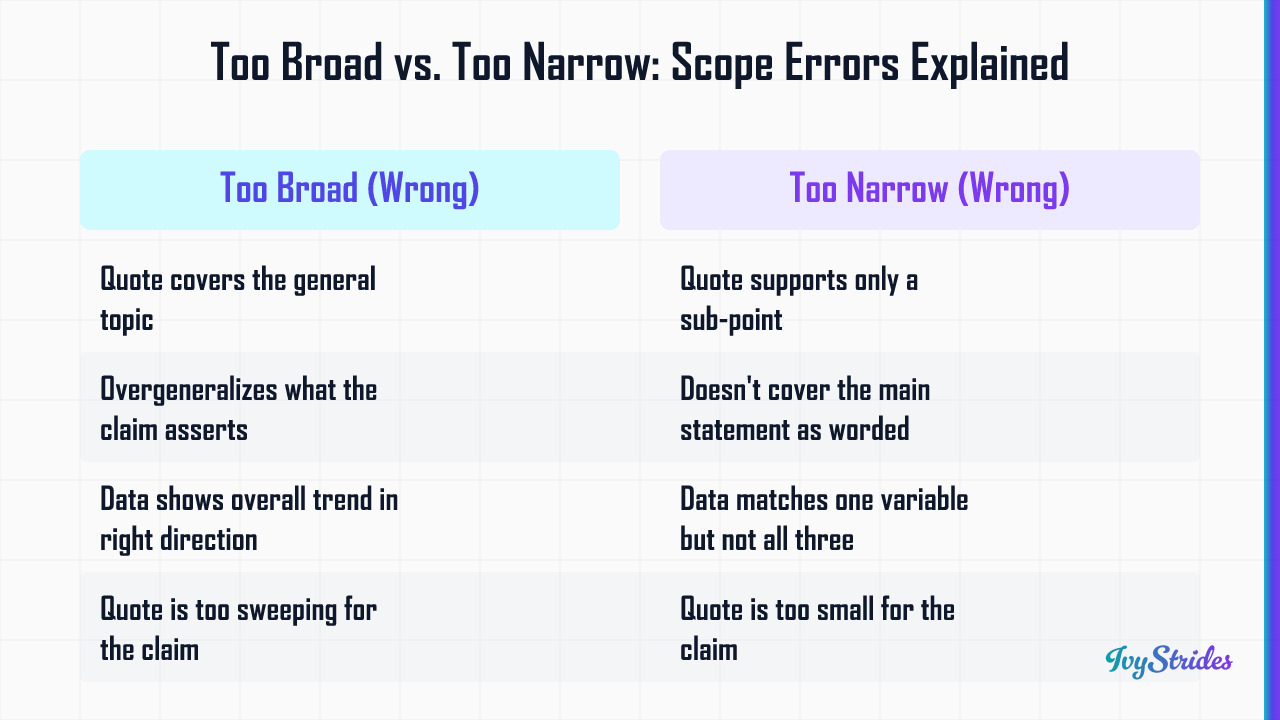
In our coaching with students at 1350-1420, the ones who miss Command of Evidence in hard Module 2 almost always pick an answer that's thematically correct but fails the scope test. Two flavors. Too broad: you pick a quote that covers the general topic but overgeneralizes what the claim actually asserts. Too narrow: you pick a quote that supports a sub-point of the claim but not the main statement as worded.
A junior we worked with last fall kept missing the same evidence-question pattern: she'd narrow correctly to two finalists, then pick the one she liked best as a reader instead of the one that matched the claim's exact scope. The scope test fixed it in three sessions.
Here's how to run it. After you've narrowed to a candidate quote, say it out loud: "Does this evidence support exactly what the claim says, or does it support a broader or narrower version?" Broader version means the quote is too sweeping. Narrower means the quote is too small. The correct answer matches the claim's scope precisely.
For quantitative items at this band, the precision error looks different. You pick a data point that trends in the right direction but doesn't match the exact comparison, population, or time period stated in the claim. Example: the claim says "between 2015 and 2020, X exceeded Y in every quarter." You pick data showing X exceeded Y overall. That's not the same statement. Before you commit, identify the exact variables, the exact comparison direction, and the exact time period or population. Match all three.
The same close-reading discipline that prevents errors on Command of Evidence also reduces mistakes on transitions questions, where students must track how one idea relates to the next across a passage. If transitions are also costing you points, our breakdown of common sat transitions mistakes covers the same precision discipline applied to a different question type.
One more thing about hard Module 2 distractor design: College Board tends to place the most tempting wrong answer as the second or third choice in difficulty order. Translation: don't trust your first instinct in this band. Run the scope test on your candidate and your top distractor before you commit.
To hold the hard Module 2 path and finish near 1400, you typically need Command of Evidence accuracy in the 70-75% range. That's a real number to test yourself against on your next practice section.
Not Sure Which Error Pattern Is Holding You Back?
In a free 15-minute strategy call, an IvyStrides R&W specialist will look at your diagnostic results, identify whether your Command of Evidence errors are process, scope, or distractor problems, and recommend the right next step for your score band. Parents are welcome on the call.
The 1500+ Strategy: Neutralizing Distractor Traps and Avoiding Over-Reading
At 1500+ (R&W 740-800), you're in the hard Module 2, and the evidence questions you're facing are the ones designed to separate 750 from 800. The wrong answers aren't careless. They're engineered to feel correct.
Two failure modes show up most often at this band: near-miss textual distractors and over-read quantitative data.
The near-miss problem. Two of the four quotes both seem to support the claim. One supports it literally. The other supports it after one small inferential step. In our coaching with students at 1480-1540, the missed Command of Evidence questions are almost always the second kind. The student picks the quote that "works if you think about it for a second." That second of thinking is the trap.
So here's the rule we drill at this band. The no-inference rule for textual evidence: if connecting the quote to the claim requires any reasoning beyond reading the quote itself, that answer is wrong at this difficulty level. The correct answer at 1500+ is a literal, on-the-page restatement of what the claim asserts.
For quantitative items, the parallel rule is the literal-match rule. The correct answer contains the exact variable, direction, and comparison stated in the claim. If you find yourself combining data from two rows or two columns to make the answer work, you're over-reading. Back up. The right answer is the one row or one cell that says exactly what the claim says.
Pacing matters more here, not less. You should average 60-70 seconds per R&W question overall, which buys you buffer for 2-3 hard evidence items at 90 seconds each. Spending two minutes on a single Command of Evidence question is a pacing risk that costs you a guaranteed point somewhere else.
One editorial position. At 1500+, process of elimination beats direct selection. Read all four choices, eliminate the two that fail the no-inference or literal-match test, then compare the remaining two against the exact wording of the claim. Direct selection is faster but less reliable when distractors are engineered to feel right on first read.
For students at this band sequencing the final weeks of prep, our sat prep study guide outlines how to layer Command of Evidence drilling against the other high-use R&W work.
How to Practice Command of Evidence by Score Band
Start with a diagnostic. The first practice step is the same for every band: take a full-length practice test and identify which band you're actually in. Don't guess based on a recent quiz. Get a real baseline.
Then build an error log. Track every Command of Evidence miss with five columns: date, question number, subtype (textual or quantitative), module (1 or 2), and error type (process, scope, or distractor). This sounds tedious. It's the single highest-use practice habit at every band. In our coaching, students who log errors by subtype and module improve Command of Evidence accuracy noticeably faster than students who review questions without categorizing the error.
Practice volume by band looks like this:
- 1200 band: 20+ Command of Evidence questions per week, with the goal of building claim-first reading as muscle memory. Focus on process, not difficulty.
- 1400 band: 15+ hard-difficulty questions per week, drilling the scope test until it's automatic.
- 1500+ band: 10-15 of the hardest available questions per week, with every miss reviewed against the no-inference and literal-match rules.
Add spaced retesting. After you work a Command of Evidence question, wait 5-7 days, then retest the same question type (not the same question) to confirm the skill transferred. Without the spacing interval, you're memorizing answers, not building accuracy.
Applying these strategies only works if you have realistic practice material that mirrors the actual difficulty split between easy and hard Module 2 items; a curated set of command of evidence practice questions with answer explanations is the fastest way to test whether your approach is working. Our sat test platform gives you full-length adaptive practice when you're ready to measure your accuracy under real timing and routing.
Once Command of Evidence accuracy is stable, the next highest-use area in the R&W section for most students is SAT Standard English Conventions, which covers punctuation and grammar rules that appear consistently across both modules.
How IvyStrides Coaches Command of Evidence in 1-on-1 SAT Prep
Our methodology for Command of Evidence: diagnostic baseline, error-type identification by subtype and module, targeted weakness drilling, spaced retesting, and section-specialist R&W coaching. That's the same documented framework behind our typical SAT 200+ score improvements.
A few specifics on how it plays out in 1-on-1 sessions.
Every student starts with a full-length diagnostic before the first coaching session. We need to see your real Module 1 and Module 2 performance, your subtype split, and your error patterns. We don't guess what to work on.
The coach you work with on R&W is a section specialist, not a generalist tutor who covers everything. Command of Evidence accuracy is a precision skill, and precision skills improve faster with a coach who teaches this question type week after week with students across all three score bands.
Once we identify whether your errors are process, scope, or distractor errors, the coach designs sessions around that specific type. A 1200-band student doesn't get drilled on distractor analysis. A 1500-band student doesn't get drilled on claim paraphrasing. Generic R&W review is what produces stalled scores. Targeted error-type work is what moves them.
Progress is confirmed with a second full-length test after 4-6 weeks of targeted work. In our coaching with students completing the program who entered at 1200-1300, Command of Evidence accuracy typically improves from 40-50% correct to 70-80% correct within 6-8 weeks of focused work on this question type. That's typical, not guaranteed; the actual delta depends on hours invested, baseline reading speed, and the rest of the R&W profile.
For more on how we structure score-band coaching, see our SAT prep overview. You can also meet the tutors who work with students at each band.
FAQ
How many Command of Evidence questions are on the Digital SAT?
Approximately 5-7 Command of Evidence questions appear across both Reading and Writing modules per test, split between textual and quantitative subtypes. The exact count varies by test form, but College Board classifies this as one of the higher-frequency question types within the Information and Ideas domain. Because the count is meaningful and the questions are missed often, accuracy here has outsized use on your R&W section score.
What is the difference between textual and quantitative Command of Evidence on the Digital SAT?
Textual Command of Evidence asks you to pick the quote or passage detail that best supports a specific claim. Quantitative Command of Evidence asks you to pick data from a graph, table, or chart that supports or challenges a stated conclusion. Both subtypes require claim-evidence alignment, but quantitative items add a data-reading layer where you have to match the exact variable, direction, and comparison stated in the claim.
Does the Digital SAT's adaptive structure affect which Command of Evidence questions I see?
Yes. Students routed to the hard Module 2 path (typically those performing well in Module 1) see more difficult Command of Evidence questions with sharper distractors. Students targeting 1400+ should assume they'll face hard Module 2 evidence questions and prepare accordingly. A student who never breaks into the hard Module 2 won't be exposed to the distractor traps that define the 1500+ band, which is one reason generic strategy advice often misses the mark.
Why do I keep missing Command of Evidence questions even after reviewing the passage carefully?
The most common reason is picking evidence that's related to the topic rather than evidence that directly supports the specific claim as stated. At higher difficulty levels, all four answer choices are from the passage and all are plausible. The correct answer is the one that matches the claim's exact scope without requiring any inference. If you're missing these questions, your error is usually one of three types: process, scope, or distractor. Identifying which one is the first step.
How long should I spend on a Command of Evidence question on the Digital SAT?
A reasonable target is 60-75 seconds for straightforward evidence questions and up to 90 seconds for hard Module 2 items. Spending more than 90 seconds on a single evidence question risks your pacing for the rest of the section. If you're stuck, use process of elimination, mark your best guess, and move on. You can flag and return if time allows.
Can improving Command of Evidence accuracy alone move my SAT score significantly?
Command of Evidence is one of the higher-frequency question types in the R&W section, so improving accuracy from 50% to 80% correct on this type can contribute meaningfully to your R&W score. That said, it works best as part of a broader diagnostic plan that identifies all your high-frequency error types across both R&W and Math. We don't recommend treating any single question type as a standalone score lever.
Your Next Step
Command of Evidence is a precision skill, and precision skills don't improve from reading about them. They improve from diagnosing your actual error type, drilling the right rule for your band, and retesting under realistic conditions. If you know your score band but not your error pattern, that's the gap to close before your next test date.
Ready to Stop Guessing on Command of Evidence?
Book a free 15-minute call with an IvyStrides section-specialist coach. We'll identify your score band, pinpoint your evidence question error type, and give you a concrete plan to close the gap before your next test date. Students and parents both welcome on the call.

Award-winning author (South Asian Book Award) and graduate of BITS Pilani and UCLA Luskin School of Public Affairs. Brings a published writer's eye to Common App essays and grammatical precision to SAT and ACT R&W instruction.