
Digital SAT Transitions: Worked Examples From Easy, Medium, and Hard Modules

On this page
- What Transitions Questions Actually Test on the Digital SAT
- The Four Logical Relationships You Must Recognize Before Looking at Answers
- A 4-Step Method for Solving Any Digital SAT Transitions Question
- Why You Keep Missing Transitions Questions Even After Studying Transition Words
- Still Missing Transitions Questions After Reviewing the Word Lists?
- Worked Example 1: Easy-Tier Transitions Question (Module 1 Level)
- Worked Example 2: Medium-Tier Transitions Question (Module 1 / Module 2 Boundary)
- Worked Example 3: Hard-Tier Transitions Question (Module 2 Hard Variant)
- How Difficulty Scales From Module 1 to Module 2: The Gap No One Talks About
- How to Get Better at SAT Transitions Questions: What Actually Moves the Score
- Transition Word Reference List by Logical Function
- FAQ
- What are Transitions questions on the Digital SAT?
- How many Transitions questions appear on the Digital SAT?
- How do I improve my Digital SAT score from the 1190-1400 range using Transitions practice?
- Is the Digital SAT harder than the old paper SAT for Transitions questions?
- Can I get an 800 on SAT Reading and Writing by mastering Transitions questions alone?
- Where can I find free Digital SAT Transitions practice questions?
- Ready to Turn Transitions Into a Reliable Point Source on the Digital SAT?
If you've been grinding transition word lists and still miss two or three of these per practice test, the problem usually isn't your vocabulary. It's the step you're skipping before you look at the choices.
Transitions questions on the Digital SAT ask you to pick the word or phrase that best shows the logical relationship between two sentences. The stem always reads: "Which choice completes the text with the most logical transition?" There are four relationship types to recognize: contrast, continuation, cause-and-effect, and exemplification. In Module 1, wrong answers come from clearly different categories. In Module 2, distractors come from adjacent categories, which makes the relationship-identification step more critical. The method is the same at every level: read both sentences, name the relationship, then match it to the answer choices.
The rest of this article shows you that method in action across three difficulty tiers, plus the one structural fact about adaptive scoring that changes how you should practice.
What Transitions Questions Actually Test on the Digital SAT
A transitions question lives inside the Expression of Ideas domain of the Reading and Writing section. That section runs two modules of 27 questions each, with 32 minutes per module, administered through the Bluebook app (College Board). Module 2's difficulty is set by how you performed in Module 1.
Across both modules, you'll see roughly 2 to 4 transitions questions, though the exact count varies by test form. Every one of them uses the same stem: "Which choice completes the text with the most logical transition?" That phrasing tells you what you're being asked to do. Not fix a comma. Not pick the most academic-sounding word. Find the connector that captures how the second sentence logically relates to the first.
Students who have already worked through Command of Evidence questions will recognize a similar skill at the core: identifying the logical relationship between two pieces of information before selecting an answer. The transferable habit is reading for meaning first, then evaluating choices second. For more on how that habit shows up across the section, see our breakdown of SAT Information and Ideas strategy.
Unlike Standard English Conventions questions, which test grammar and punctuation rules, transitions questions have no single correct rule to apply. The answer depends entirely on the meaning relationship between the two sentences. No comma rule decides between "however" and "therefore." Only the logic of the passage does.
The Four Logical Relationships You Must Recognize Before Looking at Answers
Every transitions question fits into one of four buckets. Learn the buckets, and the question type collapses from "guess which word sounds right" to "name the relationship, then match."
Contrast. Sentence 2 pushes back, qualifies, or reverses Sentence 1. Words: however, nevertheless, in contrast, on the other hand, yet, conversely, although, even so. A concession sub-type sits inside contrast and signals you're acknowledging the other side before pivoting: admittedly, granted, while it is true that, to be sure.
Continuation or addition. Sentence 2 adds to, extends, or parallels Sentence 1. Words: additionally, in addition, similarly, likewise, also, by the same token, what's more.
Cause-and-effect. Sentence 2 is the result, consequence, or logical inference from Sentence 1. Words: therefore, thus, as a result, hence, accordingly, for this reason, it follows that.
Exemplification. Sentence 2 gives a specific case, illustration, or instance of the general point in Sentence 1. Words: for example, for instance, specifically, in particular, namely, to illustrate.
Here's the part most students miss. The Digital SAT's hardest transitions traps come from adjacent-category distractors. Take "therefore" versus "in addition." Both move the argument forward. One says "and because of that," the other says "and on top of that." If you don't isolate the relationship before you read the choices, both feel plausible, and you'll pick whichever you saw most recently in your prep.
The quick mental test, phrased as a single question you ask yourself: does Sentence 2 push back on Sentence 1, add to it, result from it, or give an example of it? Pick one. Just one. If you can't commit, paraphrase the sentences again. For a deeper look at how this breaks down in practice, see our notes on sat transitions mistakes.
A 4-Step Method for Solving Any Digital SAT Transitions Question
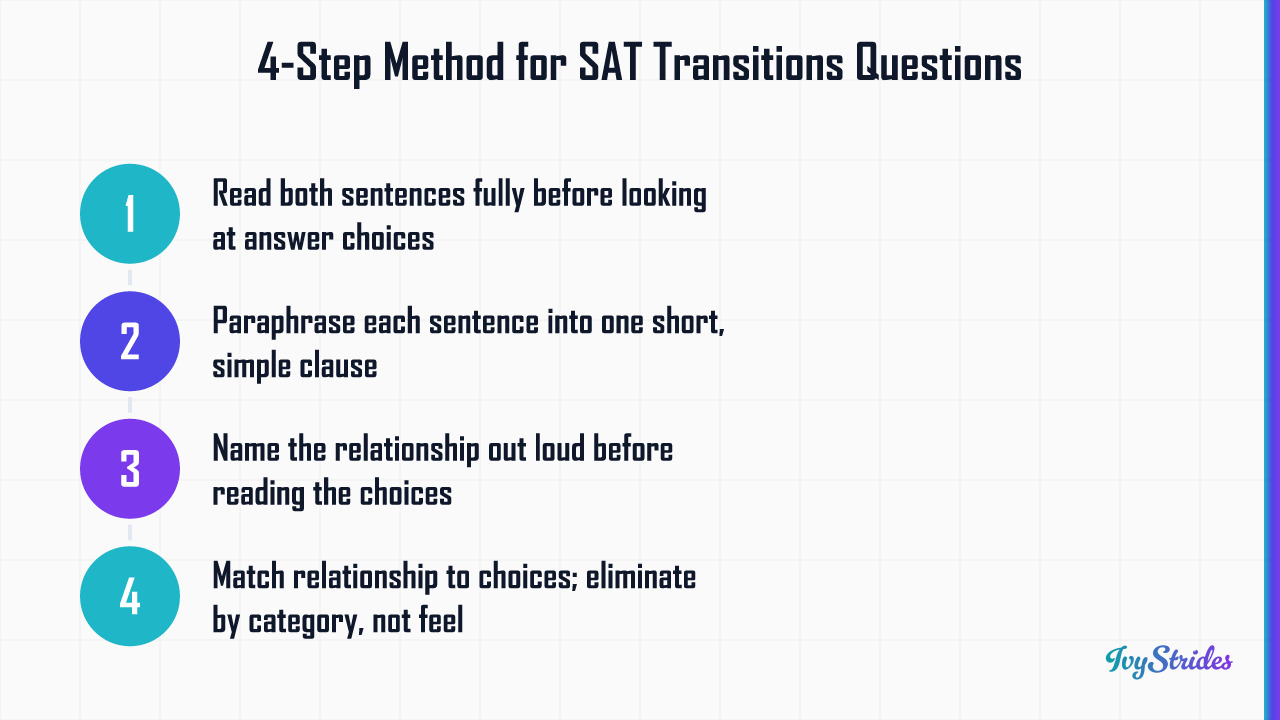
Run all four steps on every transitions question, easy or hard. The method does not change with difficulty. The passage gets denser, the distractors get cleverer, the steps stay identical.
Step 1: Read both sentences fully before looking at the answer choices. Obvious, and the most common failure point. Students glance at the sentence with the blank and start scanning options. You need both halves of the relationship to identify the relationship.
Step 2: Paraphrase each sentence in one short clause. Strip the academic vocabulary. "Although early thermodynamic models predicted X, subsequent observations indicated Y" becomes "Old model said X. New data showed Y." Paraphrasing forces you to extract meaning, not just register words.
Step 3: Name the relationship out loud before you read the choices. Say it. Contrast. Or cause-effect. Or addition. Or example. The same careful reading of sentence-level meaning that helps on Information and Ideas questions is the foundation of every transitions answer; you can't choose the right connector without first understanding what each sentence is saying. Skipping this step is the single most common error we see in our coaching observations.
Step 4: Match the named relationship to the answer choices and eliminate by category, not by feel. Each choice belongs to exactly one of the four buckets. If you've named the relationship as cause-effect, eliminate every choice that isn't cause-effect, regardless of how academic it sounds. If two choices appear to be from the same category, neither is likely correct, because the test is built to discriminate between categories.
Budget 45 to 60 seconds per transitions question. That leaves room for the harder Information and Ideas and Rhetorical Synthesis questions later in the module. If you're spending 90 seconds on a transitions question, you skipped Step 2 and you're rereading the passage four times. For a wider structural plan on pacing across all R&W question types, see our sat prep study guide.
Why You Keep Missing Transitions Questions Even After Studying Transition Words

Photo by RDNE Stock project on Pexels
So you memorized the lists. You know "however" is contrast and "therefore" is cause-effect. You still miss two per test. Why?
Three traps account for almost every miss we see during diagnostic review.
The "sounds right" trap. You read the sentence with the blank, plug in a choice, and ask whether it reads smoothly. Three of the four choices will read smoothly. The test isn't asking which sounds right. It's asking which is logically correct.
The "both could work" trap. You narrow it to two choices, can't decide, and pick the more familiar one. This happens because you didn't commit to a single relationship in Step 3. If you'd named the relationship as cause-effect, only one of those two remaining choices would belong to that category.
The "ignored the first sentence" trap. You read only the sentence containing the blank. Now you're guessing at a relationship without knowing what Sentence 1 actually said.
A junior we worked with last fall, scoring around 1290 on her baseline, was missing every adjacent-category transitions question on her practice tests. She'd memorized two full Quizlet decks of transition words. Her error pattern, on review, was almost exclusively Step 3: she was reading the choices first and reasoning backward from there.
In our coaching with students in the 1200-1400 score band, the most common transitions error is choosing a word from an adjacent category: selecting "in addition" when the passage requires "therefore," or "however" when the passage requires "nevertheless" with a concession nuance. Students who review only word lists, without practicing the relationship-identification step under real passage conditions, typically plateau on this question type. The fix begins with a diagnostic that surfaces exactly which step is breaking down for you, not generic drilling. That's the premise behind our SAT prep overview: identify the broken step, then drill that step under realistic conditions.
Still Missing Transitions Questions After Reviewing the Word Lists?
A 15-minute call with an IvyStrides R&W specialist will show you exactly which step in your solving process is breaking down and what to fix first. No commitment, just a diagnostic snapshot and a clear next step. Parents are welcome to join the call.
Worked Example 1: Easy-Tier Transitions Question (Module 1 Level)
The following examples are original illustrative items written by the IvyStrides coaching team. They are not reproduced from College Board materials.
Passage:
Most species of migratory birds rely on Earth's magnetic field to navigate during long flights. The European robin, however, also uses visual cues from the position of the sun. ______ researchers have found that when both signals are available, the robin defaults to magnetic information when the two conflict.
Question: Which choice completes the text with the most logical transition?
A) For example,
B) However,
C) In contrast,
D) As a result,
Apply the method.
Step 1: Read both sentences. Sentence 1: the European robin uses two navigation systems, magnetic and visual. Sentence 2: when the systems conflict, the robin uses magnetic.
Step 2: Paraphrase. S1: robin has two systems. S2: when they conflict, it picks magnetic.
Step 3: Name the relationship. Sentence 2 doesn't contradict Sentence 1. It doesn't add a new fact. It illustrates and specifies how the two-system setup actually behaves. Exemplification.
Step 4: Match by category. (A) For example = exemplification. (B) However = contrast. (C) In contrast = contrast. (D) As a result = cause-effect.
Answer: A.
That's what an easy-tier transitions question looks like. Notice that (B) and (C) are both contrast options, which already tells you neither is correct in a well-built question. The three wrong answers each represent a clearly different category from the right one. In Module 1, you'll see this pattern often.
Worked Example 2: Medium-Tier Transitions Question (Module 1 / Module 2 Boundary)
Passage:
Coastal erosion in the Outer Banks has accelerated significantly over the past two decades, driven by rising sea levels and increased storm intensity. Local conservation groups have invested heavily in dune restoration projects to slow this process. ______ several stretches of shoreline have continued to retreat at rates exceeding 10 feet per year, suggesting that restoration alone cannot offset the underlying climate drivers.
Question: Which choice completes the text with the most logical transition?
A) In addition,
B) Nevertheless,
C) Therefore,
D) For instance,
Apply the method.
Step 1: Read both sentences. S1: groups invested in dune restoration to slow erosion. S2: the shoreline keeps retreating fast anyway.
Step 2: Paraphrase. S1: they tried to fix it. S2: it didn't really work.
Step 3: Name the relationship. Sentence 2 pushes back on the implied expectation of Sentence 1. You'd expect restoration to slow erosion. It didn't. That's contrast, specifically with a concession flavor, acknowledging the effort while reporting a different outcome.
Step 4: Match by category. (A) In addition = continuation. (B) Nevertheless = contrast. (C) Therefore = cause-effect. (D) For instance = exemplification.
Answer: B.
Here's where it gets interesting. Choice (A) "In addition" is the adjacent-category trap. A student reading quickly might think, "groups invested, and also the shoreline kept eroding, both facts about coastal erosion." That's continuation logic. But Sentence 2 isn't an additional fact in the same direction. It's a fact that runs counter to the implied success of Sentence 1. Skip Step 3, and "In addition" reads smoothly enough to pick. Budget 60 seconds on questions like this. A second pass on Sentence 1's implied expectation is often what unlocks the contrast.
Worked Example 3: Hard-Tier Transitions Question (Module 2 Hard Variant)
Passage:
Eighteenth-century natural philosophers often treated mathematical elegance as evidence of a theory's correctness, assuming that nature itself favored symmetry and simplicity. This intuition has not disappeared from modern physics, where certain theoretical frameworks gain support partly from their aesthetic appeal. ______ contemporary string theory is often defended on grounds that include its mathematical beauty, even in the absence of direct experimental confirmation.
Question: Which choice completes the text with the most logical transition?
A) However,
B) Conversely,
C) For example,
D) Nevertheless,
Apply the method.
Step 1: Read both sentences. S1: the old aesthetic intuition still operates in modern physics. S2: string theory is defended partly on beauty, without direct experimental confirmation.
Step 2: Paraphrase. S1: physicists still use beauty as evidence. S2: string theory is a case of this.
Step 3: Name the relationship. Sentence 2 gives a specific instance of the general claim in Sentence 1. Exemplification.
Step 4: Match by category. (A) However = contrast. (B) Conversely = contrast. (C) For example = exemplification. (D) Nevertheless = contrast.
Answer: C.
Look at what the hard Module 2 variant did here. Three of the four choices come from the contrast family. (A), (B), and (D) are all variations on the same category, with (D) "Nevertheless" carrying a concession nuance that might tempt a student who reads "absence of direct experimental confirmation" as a pushback against Sentence 1. It isn't. It's part of the example itself, describing what makes string theory the relevant illustration.
In our coaching with students targeting 1450+, hard transitions questions are won or lost at Step 3 of the method. Once you name the relationship as exemplification, the three contrast options disappear instantly. Skip Step 3, and you'll spend 90 seconds bouncing between three nearly identical wrong answers.
Hard Module 2 transitions questions do not require harder vocabulary knowledge. They require more precise relationship identification under denser prose. For more on score-band-specific tactics across question types, see our piece on the command of evidence score band.
How Difficulty Scales From Module 1 to Module 2: The Gap No One Talks About
The Digital SAT is adaptive. Your Module 1 performance routes you to either an easier or a harder Module 2 (College Board). The R&W section score ranges from 200 to 800, and the upper score bands (roughly 650 and above) are accessible only through the hard Module 2 path.
Because the Digital SAT routes students to a harder or easier Module 2 based on Module 1 performance, a student who handles transitions questions confidently in Module 1 is more likely to reach the high-scoring Module 2 path where the ceiling for a 1500+ score lives.
Here's the structural fact almost no prep article spells out. The transitions question type itself doesn't get harder between modules. Same stem. Same four relationship categories. What changes is the distractor pool.
Module 1: Three wrong answers, each from a clearly different category. If the right answer is exemplification, the distractors are contrast, addition, and cause-effect. Process of elimination is fast.
Module 2, easy variant: One distractor moves into an adjacent category. If the right answer is exemplification, you might see contrast, addition, and a second exemplification-flavored distractor that doesn't quite fit the specific instance.
Module 2, hard variant: Two or even three distractors cluster around adjacent categories. Worked Example 3 above is a hard Module 2 pattern. The passage gets denser, often academic in tone, and the relationship is subtler.
In our coaching, students who practice only easy-tier transitions questions are often surprised by Module 2 hard variant distractors. The fix isn't memorizing more transition words. It's practicing the relationship-identification step under harder passage conditions. Take full-length adaptive practice tests where you actually get routed into the hard Module 2, then audit your misses by which step of the 4-step method broke down. You can find adaptive practice on our sat test platform.
How to Get Better at SAT Transitions Questions: What Actually Moves the Score
A concrete four-week plan. This works whether you're self-studying or working with a coach.
Week 1: Diagnose. Take a full-length Digital SAT practice test. Mark every transitions question. Count how many you missed, and note the difficulty tier (which module, where in the module). Don't drill yet. You need the baseline.
Week 2: Method review. Take every missed transitions question and run the 4-step method on it explicitly. Write out the paraphrase. Write out the named relationship. Identify which step broke down on the original attempt. Was it Step 1 (didn't read both sentences carefully)? Step 3 (didn't commit to a relationship)? Step 4 (picked by feel)?
Week 3: Targeted drilling. Do 10 to 15 transitions questions per session, untimed at first. Force yourself to write the named relationship before looking at choices. Move to timed sets only once you can hit 90% accuracy untimed.
Week 4: Retest. Take a second full-length practice test. Compare transitions accuracy and overall R&W scaled score against your Week 1 baseline.
In our coaching with students targeting a 1400+ score, transitions is one of the first R&W question types we address after the diagnostic, because it rewards a learnable method rather than broad reading ability. In our coaching with students in the 1200-1350 score band, targeted transitions work over 3 to 4 weeks of consistent practice typically contributes 10 to 20 points to the R&W scaled score, framed as typical for students completing the targeted practice sequence. That isn't a guarantee. It's a pattern we see when the method is applied with discipline.
If you'd rather practice with curated material than build your own sets, we keep a library of free SAT resources for self-directed students.
Transition Word Reference List by Logical Function
Bookmark this. The Digital SAT doesn't test obscure transition words. The difficulty comes from passage complexity and distractor plausibility, not from rare vocabulary. Every word you'll see falls into one of these four categories.
Contrast: however, nevertheless, in contrast, on the other hand, yet, conversely, although, even so, that said, despite this, still.
Concession sub-type (within contrast): admittedly, granted, while it is true that, to be sure, of course.
Continuation / addition: additionally, in addition, similarly, likewise, also, along these lines, by the same token, equally, what's more.
Cause-and-effect: therefore, thus, as a result, hence, accordingly, for this reason, it follows that, so.
Exemplification: for example, for instance, specifically, in particular, namely, to illustrate, as an illustration, in one case.
The most commonly confused pair in our coaching is "therefore" (cause-effect) versus "in addition" (addition). Both move the argument forward. One says "and because of that." The other says "and on top of that." If you can articulate that distinction cleanly, you've solved most of the medium-tier transitions questions you'll face.
For more on how transitions sits alongside the grammar-based question types in R&W, see our breakdown of Standard English Conventions on the SAT.
FAQ
What are Transitions questions on the Digital SAT?
Transitions questions appear in the Reading and Writing section, under the Expression of Ideas domain. The stem always reads: "Which choice completes the text with the most logical transition?" You're asked to pick the word or phrase that most logically connects two sentences or clauses by identifying whether the relationship is contrast, addition, cause-and-effect, or exemplification.
How many Transitions questions appear on the Digital SAT?
Based on College Board test specifications, transitions questions typically account for 2 to 4 questions across the two Reading and Writing modules. The exact number varies by test form, but you should expect at least one in Module 1 and at least one in Module 2.
How do I improve my Digital SAT score from the 1190-1400 range using Transitions practice?
Students in the 1200-1400 range often miss transitions questions because they choose by word familiarity rather than by identified relationship. The fix is to practice naming the logical relationship between the two sentences before reading the answer choices. In our coaching, students who apply this method consistently over 3 to 4 weeks of targeted practice typically see measurable improvement in their R&W scaled score, when paired with diagnostic review and spaced retesting.
Is the Digital SAT harder than the old paper SAT for Transitions questions?
The question type itself is similar in skill, but the Digital SAT's adaptive structure means that students routed to the hard Module 2 face transitions questions with more plausible wrong-answer choices and denser passages. The underlying skill, identifying the logical relationship, hasn't changed. The challenge is sustaining precise relationship identification under harder passage conditions.
Can I get an 800 on SAT Reading and Writing by mastering Transitions questions alone?
No. Transitions questions are one of several question types in the R&W section, which also includes Command of Evidence, Words in Context, Rhetorical Synthesis, Central Ideas and Details, and Standard English Conventions questions. An 800 requires strong performance across all of them. That said, transitions is one of the most learnable question types, and reliable accuracy here frees up cognitive load for the harder question types.
Where can I find free Digital SAT Transitions practice questions?
College Board's Bluebook app includes official Digital SAT practice tests with transitions questions at multiple difficulty tiers. For a structured practice environment with full-length adaptive tests, IvyStrides' practice platform offers official-format practice with score-band reporting.
Transitions questions reward method over memorization. Run the four steps, name the relationship before you read the choices, and let the adjacent-category trap reveal itself. Three or four reliable points per test, every test, is what this looks like at scale.
Ready to Turn Transitions Into a Reliable Point Source on the Digital SAT?
Book a free 15-minute strategy call with an IvyStrides SAT R&W coach. We'll review your diagnostic results, identify your highest-leverage question types, and give you a personalized plan to raise your Reading and Writing score. Students and parents both welcome.

Award-winning author (South Asian Book Award) and graduate of BITS Pilani and UCLA Luskin School of Public Affairs. Brings a published writer's eye to Common App essays and grammatical precision to SAT and ACT R&W instruction.