
Which Common App Prompt Should You Choose? How to Match It to Your Story
On this page
- Does It Matter Which Common App Prompt You Choose?
- What Each of the 7 Common App Prompts Is Really Asking For
- How to Pick the Right Common App Essay Prompt: A Story-First Method
- Three Mistakes Students Make When Choosing a Common App Prompt
- FAQ: Choosing a Common App Essay Prompt
- Which Common App prompt is the most popular?
- What is Prompt 5 on the Common App?
- How many Common App prompts do you have to answer?
- Does it matter which Common App prompt you choose?
- Your Next Step on Choosing a Prompt
Choose the Common App prompt that fits your strongest story, not the most popular one. All seven personal essay prompts are intentionally broad, and the prompt number matters far less than a specific story told in your own voice. Find the story first, then the prompt whose frame fits it.
The Common App personal essay is a single essay of up to 650 words, written once for every college on your list that asks for it. The seven prompts for 2026-27 are unchanged from the previous cycle. This guide covers the decision that comes before drafting: which prompt to commit to.

Does It Matter Which Common App Prompt You Choose?

Photo by Kaboompics.com on Pexels
The Common App personal essay prompt you choose matters far less than the story you tell under it. The prompt is a frame, not a topic. Common App's essay instructions ask the real question: what do you want the readers of your application to know about you apart from courses, grades, and test scores?
One essay, many colleges. You write a single personal essay for a college list that Common App caps at a maximum of 20 colleges. Common App's 2026-27 first-year application form limits that essay to 650 words and adds that "650 words is your limit, not your goal." So the choice is not "which essay per school." It's one prompt, one story, one draft that travels everywhere.
A poor fit between story and prompt does create a real problem, just not the one students fear. When you force a growth story into the challenge prompt, the opening goes to explaining why your story counts as a challenge instead of telling it. That throat-clearing is what weakens the piece, not the prompt number.
Choosing a prompt starts with having a story worth telling, so the work begins away from the application. Start with a shortlist of two or three candidate stories, drawn from the experiences actually worth writing a college essay about.
| Factor | Controlled by the prompt | Controlled by the story |
| Word count | No, 650 max for all seven | No, same ceiling applies |
| Reader's impression of you | No | Yes, through specificity and voice |
| Whether the essay feels forced | Partly, a bad frame strains it | Yes, a natural fit reads easily |
| Required or optional | Each college decides | No |
| What you actually write about | No, the prompt is a frame | Yes, you pick the moment |
One caveat: each college decides whether the personal essay is required or optional, and you may still send it to a college that doesn't require it. The essay is one part of your application; it does not decide the outcome alone.
What Each of the 7 Common App Prompts Is Really Asking For
The seven 2026-27 Common App prompts each ask for a different kind of story. Below is each prompt in plain language, the story type it rewards, and a pitfall to avoid.
| Prompt | Core question it asks | Story type it rewards | Common pitfall |
| 1 | Background, identity, interest, or talent too meaningful to leave out | A defining part of who you are | Listing traits instead of showing one |
| 2 | A challenge, setback, or failure and what you learned | Clear growth after a real stumble | Picking a loss with no lesson |
| 3 | A time you questioned or challenged a belief or idea | Honest reckoning with your own thinking | Preaching instead of reflecting |
| 4 | Something someone did for you that made you happy or thankful in a surprising way | Gratitude that changed how you think or act | Writing a thank-you note instead of showing its effect on you |
| 5 | An accomplishment, event, or realization that sparked a period of personal growth | A clear before-and-after shift | Narrating the event, skipping the shift |
| 6 | A topic, idea, or concept so engaging you lose all track of time | Genuine intellectual spark | Explaining the topic, not your pull to it |
| 7 | An essay on any topic of your choice | Anything the other six don't frame | Treating it as a last resort |
Prompt 3 is the challenge-a-belief prompt, not the challenge-and-overcome prompt, and it is easy to confuse with Prompt 2. Prompt 3 asks what prompted your thinking and what the outcome was, so a strong draft shows you changing your own mind, not winning an argument.
Prompt 5, growth over time. The official wording asks for an accomplishment, event, or realization that sparked "a period of personal growth," so Prompt 5 rewards a specific starting moment and the change that followed, not a general pattern of being hardworking. Spend most of your words on what changed in you, not on the event itself.
Prompt 7 invites you to "share an essay on any topic of your choice," including one that responds to a different prompt or one of your own design. It is the most flexible frame.
The 650-word ceiling applies no matter which prompt you land on, and using those words without padding or running short is its own skill. Once you've committed to a prompt, writing a strong essay under the one you chose is the execution problem that follows.
Get your Daily IV Dose on Instagram: quick study tips and test-day advice for high school students. Follow @ivy.strides.
How to Pick the Right Common App Essay Prompt: A Story-First Method
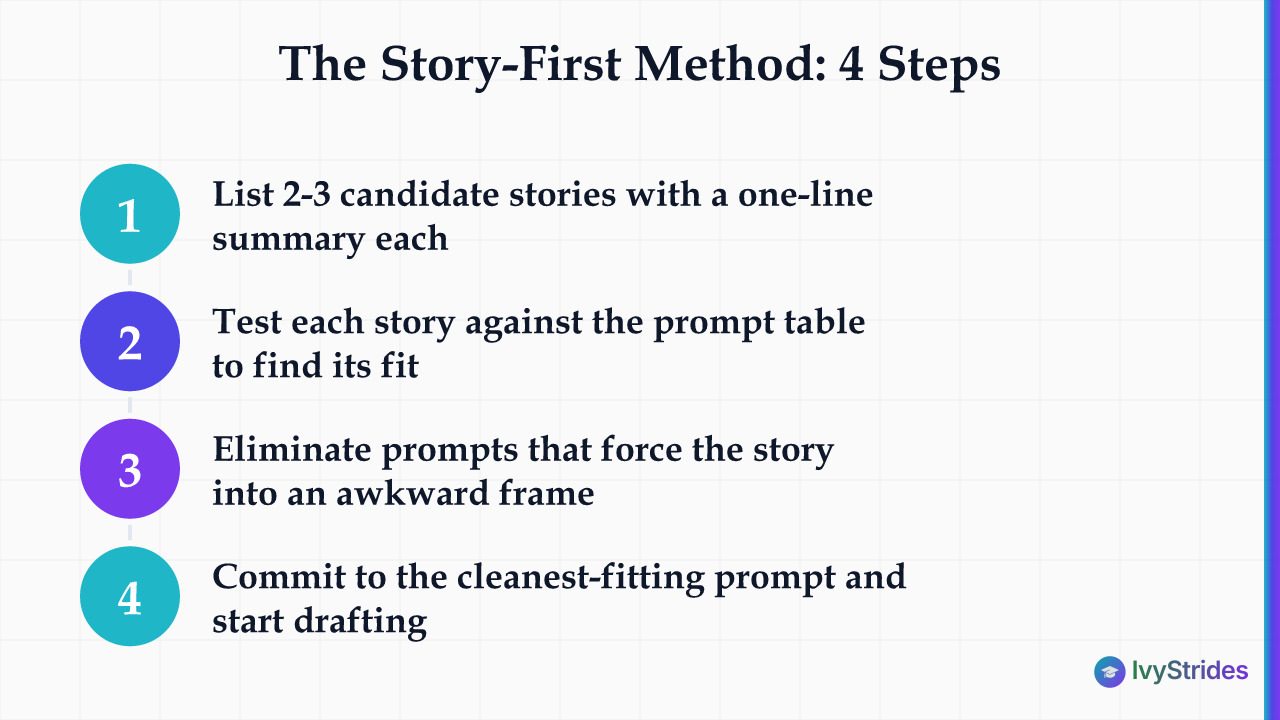
The story-first method picks your Common App prompt in reverse: you identify the story before you read the prompts, not after. Working in that order guards against a poor fit and a forced opening.
Work it in four steps.
-
List two or three candidate stories. Write a one-line summary of each: the moment, the person you were before it, the person after. No prompts yet.
-
Test each story against the prompt table above. For each story, ask which prompt's core question it answers in a single honest sentence. A story that fits two prompts is fine; a story that fits none fits Prompt 7.
-
Eliminate any prompt that forces the story into an awkward frame. If you need a paragraph to justify why your story "counts" as a challenge, that prompt is wrong for it.
-
Commit and draft. Pick the prompt whose frame your one-sentence summary slid into cleanly, and start writing. You can change course later: the Common App allows unlimited edits to the personal essay after your first submission, though applications already submitted can't be changed.
Three bad reasons to pick a prompt: it looked most popular, it looked shortest to answer, or it felt familiar from a friend's essay. None of those is about your story. If you have a story but aren't sure it fits the prompt you chose, IvyStrides offers one-on-one essay coaching in which you write every draft yourself and a coach reads each one.
Because the same essay goes to every college you send it to, your prompt choice can't be tuned per school; the school-specific work happens in supplements. Supplements don't each need to start from scratch, and adapting one strong draft across several schools saves the hours the personal essay already claimed.
Three Mistakes Students Make When Choosing a Common App Prompt
Three common mistakes in choosing a Common App prompt all come from picking the prompt before the story.
Mistake one: choosing by popularity. Common App reports that in the 2025-2026 application year the most popular prompt was Topic of your choice (Prompt 7, 28%), followed by Facing adversity (Prompt 2, 23%). Those shares show what other applicants picked, not what fits your story. The overused topics within a prompt are a separate trap, and the essay subjects admissions readers see too often are worth knowing before you draft.
Mistake two: treating Prompt 7 as a fallback. Prompt 7, an essay on any topic of your choice, isn't a consolation prize for students without a real story. It's the right frame when your best story fits none of the other six. Pick it on purpose, not by default.
Mistake three: forcing a story into the wrong frame. If a story about who you are needs a paragraph of setup to count as a setback, it probably belongs under Prompt 1 or Prompt 7, not Prompt 2. The fix is never a "better" prompt; it's the prompt whose core question your story already answers.
Keep Prompt 2 and Prompt 3 separate from the Common App's optional Challenges and circumstances question, a different field with its own 250-word maximum for context such as family obligations or housing instability. The qualities that carry an essay under any of the seven prompts, specificity and an honest voice, matter far more than the number you picked.
Run this check before you commit:
- Can I summarize my story in one sentence that answers the prompt's core question?
- Does the prompt frame my story without needing a justification paragraph?
- Is my story specific to me, not a template anyone could write?
- Am I choosing this prompt for my story, not for its popularity or length?
- If I picked Prompt 7, did I choose it on purpose rather than by elimination?
FAQ: Choosing a Common App Essay Prompt
Which Common App prompt is the most popular?
In the 2025-2026 application year, Common App reports, the most popular prompt was Topic of your choice (Prompt 7) at 28%, followed by Facing adversity (Prompt 2) at 23% and Personal growth (Prompt 5) at 20%. Popularity is a weak reason to choose: a specific, authentic story under any prompt reads stronger than a generic one under the most popular prompt.
What is Prompt 5 on the Common App?
Prompt 5 asks you to discuss an accomplishment, event, or realization that sparked a period of personal growth and a new understanding of yourself or others. It rewards a clear before-and-after shift grounded in one specific moment, not a general pattern of behavior.
How many Common App prompts do you have to answer?
You answer exactly one of the seven prompts for the personal essay, which has a 650-word maximum. That single essay is the same for every college you send it to. Supplemental essays are separate and vary by college. Once the prompt and story are settled, the essay still needs an opening, a middle, and a close that fit within 650 words.
Does it matter which Common App prompt you choose?
The prompt number itself matters far less than whether your story is specific, honest, and well-written. If the fit feels forced, choose the prompt whose frame suits your story rather than chasing a "better" prompt.
Your Next Step on Choosing a Prompt
Your Common App prompt is a frame; your story carries the essay. Settle the story first, and the right prompt usually names itself.
- Write one-line summaries of two or three candidate stories.
- Match each against the prompt table and find the frame it fits without strain.
- Eliminate any prompt that needs a justification paragraph.
- Commit to one prompt and start drafting, knowing you can still revise the essay for colleges you haven't submitted to yet.
College admissions insights on LinkedIn: follow IvyStrides for application guidance and counseling updates.

Hemant is a seasoned entrepreneur, investor, and growth strategist with deep ground in education and technology-driven learning. His core training is in Mathematics and Physics — he authored Physics for IB Diploma: Ultimate Revision Guide, recognized as a top student resource.