
What to Do With a Low SAT Score: Your Options Under 1100
On this page
- What a 1000 SAT Score Actually Means on the Digital SAT
- What Colleges Can You Get Into With a 1000 SAT Score
- The SAT Score Gap Most Students Under 1100 Can Actually Close
- Your SAT Retake and Timeline Plan Starting Under 1100
- FAQ: Raising a Low SAT Score Under 1100
- Is it hard to get a 1000 SAT score?
- How rare is a 1350 SAT score?
- How can I dramatically improve my SAT score from a 920?
- Can you get a good SAT score without studying?
- What Should You Do Next With a Sub-1100 SAT Score?
A 1000 SAT score sits 45 points below the class of 2026 mean of 1045, at the 47th percentile of recent test-takers. Whether that is enough depends on the colleges on your list. The SAT is a 2-hour-14-minute digital exam scored 400 to 1600, with two modules per section. To raise a 1000, start with a timed Bluebook diagnostic, find your larger section gap, and work Module 1 first.

What a 1000 SAT Score Actually Means on the Digital SAT
A 1000 on the Digital SAT is a below-average score, and a common one. College Board scores the Digital SAT on a 400 to 1600 scale, and the class of 2026 mean was 1045, with section means of 528 in Reading and Writing and 517 in Math. A 1000 lands inside the middle half of the class, which ran from 870 to 1220.
Here is the percentile working. College Board's user-group percentile table puts a 1000 at the 47th percentile, meaning about 47% of recent test-takers scored at or below it. IvyStrides' analysis of College Board's class of 2026 score bands, adding the 2%, 13% and 29% in the three bands under 1000, shows that 44% of the class scored below a 1000. So a 1000 is common, not rare, and the useful question is which section is holding it down.
College Board's readiness benchmarks add one more check. The section benchmarks are 480 in Reading and Writing and 530 in Math, which total 1010, so a 1000 always misses at least one. College Board also says students below the benchmarks can still be successful in college.
The adaptive structure does not decide your score on its own. The Digital SAT routes you into a more or less difficult Module 2 based on your Module 1 performance, and College Board does not publish the routing threshold. It also says a range of section scores is possible no matter which second module you see.
Module 1 still matters, because your section score is based on all the questions in both modules and Module 1 sets the difficulty of what follows, which is how the adaptive modules shape your final score. The full exam runs 98 questions through the Bluebook app.
| Benchmark | Value | What It Means for You |
| Class of 2026 mean | 1045 | A 1000 is 45 points below it |
| Class of 2026 section means | 528 Reading and Writing, 517 Math | Compare each section score |
| User-group percentile | 47th | Common, not rare |
Source: College Board percentile table and 2026 SAT Suite of Assessments Annual Report.
What Colleges Can You Get Into With a 1000 SAT Score
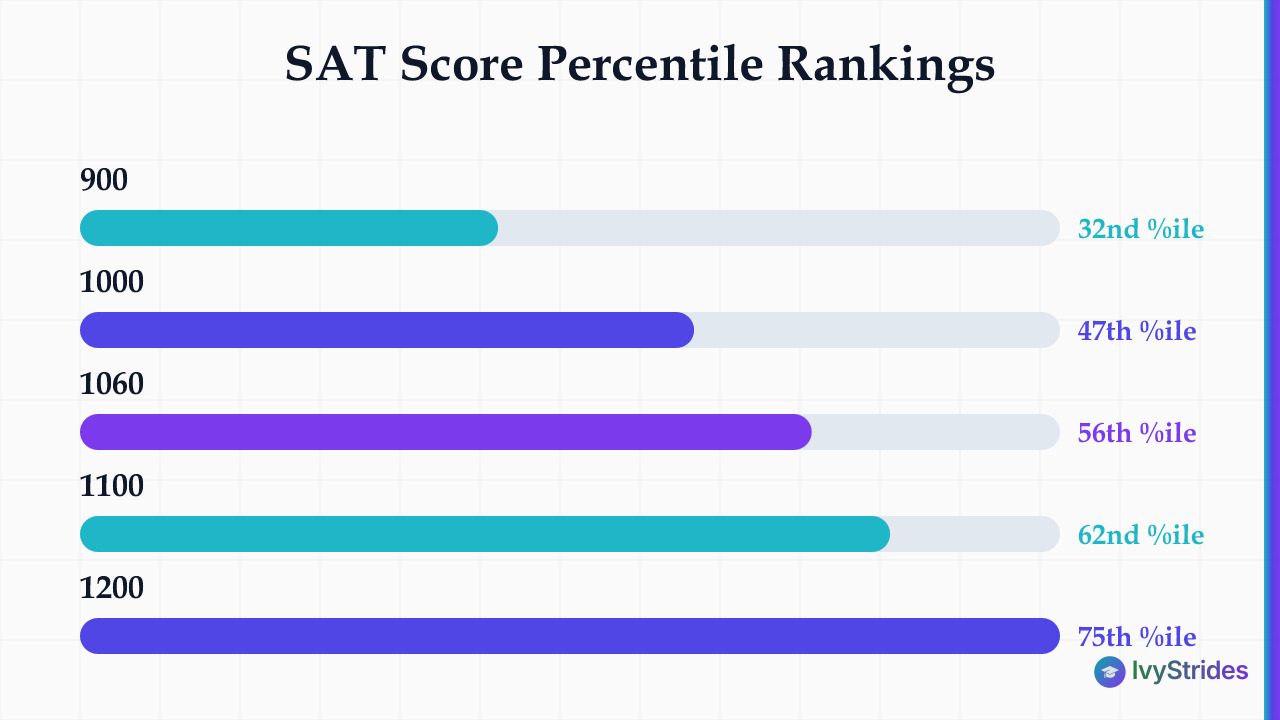
A 1000 SAT score keeps open-admission and many less-selective four-year colleges in reach, but it sits below the middle 50% range at selective schools. To test any one college, find section C9 of its Common Data Set, which gives the 25th and 75th percentile SAT scores of enrolled first-year students who submitted one, and see where a 1000 falls. The same College Board table shows what a lift changes: a 1200 reaches the 75th user-group percentile, and a 1060 the 56th.
Test-optional gives you a choice, not a free pass. FairTest reports that 90% of colleges remain test-optional or test-free for fall 2027 admission, but some selective colleges, such as Harvard, MIT and Yale, require scores for that cycle, so check each college's current policy before deciding whether to submit a score in the 1000-1100 range. Admissions outcomes depend on the full application, not the SAT alone.
Merit aid can move with the score too. Some colleges publish automatic merit scholarships with SAT score thresholds, so a higher score can change the financial picture, not just the admissions one. You can map thresholds against your list with colleges that award automatic merit scholarships by test score. Once a student clears 1200, the next question is whether a 1300 is good enough for your target school.
| SAT Total Score | Nationally Representative Percentile | User Group Percentile |
| 900 | 29th | 32nd |
| 1000 | 48th | 47th |
| 1060 | 60th | 56th |
| 1100 | 67th | 62nd |
| 1200 | 81st | 75th |
| 1350 | 94th | 89th |
Source: College Board, SAT Nationally Representative and User Percentiles.
The SAT Score Gap Most Students Under 1100 Can Actually Close
The SAT score gap to close first, under 1100, sits in the questions you already reach and miss, not in hard content you have never met. Look for Module 1 careless errors and one or two weak content domains: those are the foundational gaps at this score band.
Every plan for a student under 1100 should start with a timed Bluebook diagnostic, because the section split, not the total score, is what determines which content domains to address first.
Get your Daily IV Dose on Instagram: quick study tips and test-day advice for high school students. Follow @ivy.strides.
Reading and Writing has four content domains: Information and Ideas, Craft and Structure, Expression of Ideas, and Standard English Conventions, across 54 questions in 64 minutes. Your score report shows how you did in each, so if this section is your larger gap, study how each of the four domains asks its questions rather than chasing a raw section score.
Math also has four content domains: Algebra, Advanced Math, Problem-Solving and Data Analysis, and Geometry and Trigonometry, across 44 questions in 70 minutes. Algebra and Advanced Math each make up about 35% of SAT Math, so a student whose diagnostic shows a Math gap should start there with every SAT Math topic by domain and question type. Pacing is part of the gap too: the test allows about 71 seconds per Reading and Writing question and about 95 per Math question.
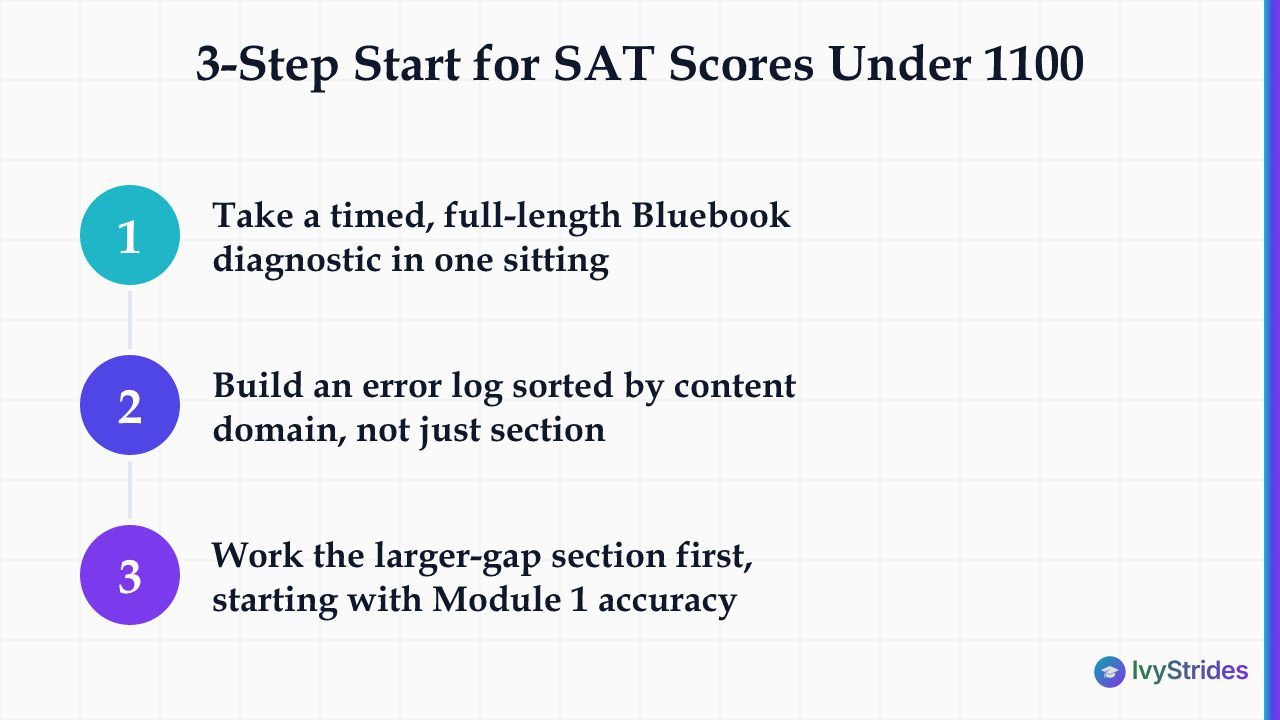
Here is the three-step start.
-
Take a timed, full-length Bluebook diagnostic. Official, timed, in one sitting, even though Bluebook lets you pause.
-
Build an error log by content domain. Score Details in My Practice shows every question, your answer and the correct one. A log sorted by domain, not just by section, is what turns a review of your SAT practice test mistakes by content domain into a plan rather than a score recap.
-
Work the larger-gap section first, starting with Module 1 accuracy. Lock in the questions you should be getting before chasing the hardest.
Keep the focus on Module 1 careless errors before Module 2 difficulty. If your log shows you rushed past questions you could answer when you slowed down, fix the rush before you fix the content, then use spaced retesting to see whether the errors shrink.
Your SAT Retake and Timeline Plan Starting Under 1100
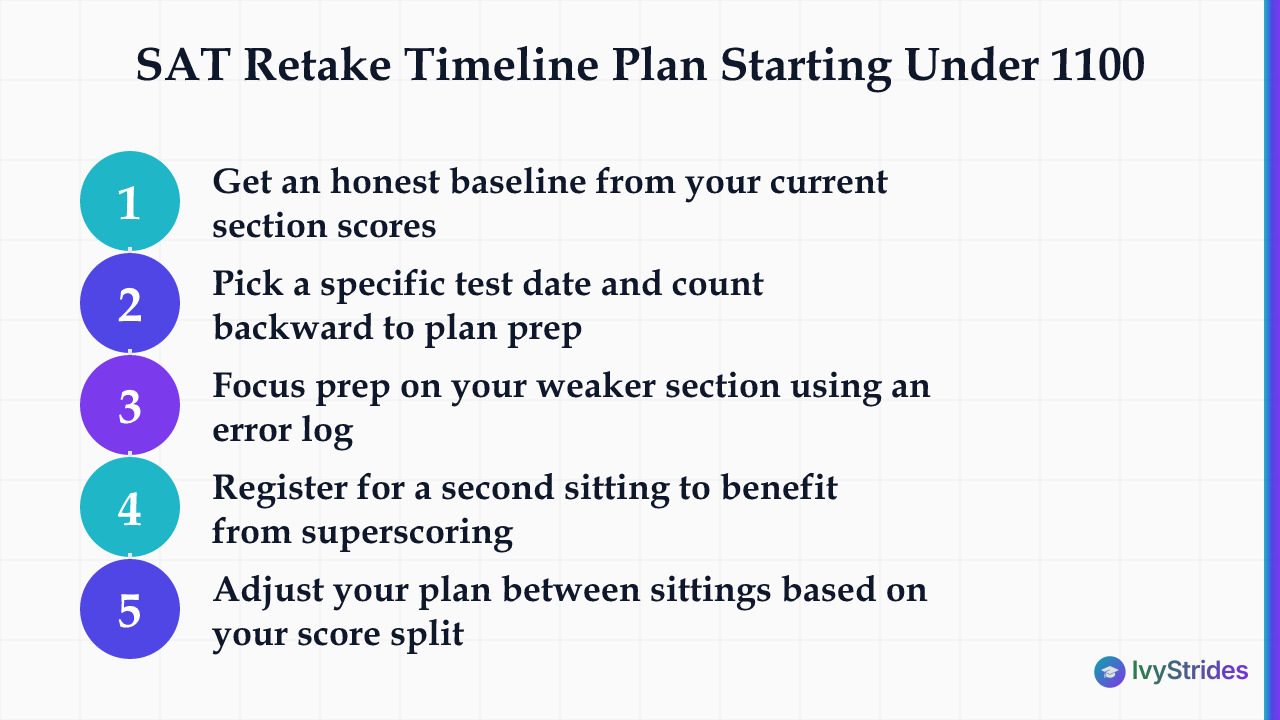
A student starting under 1100 should plan around a real test date and more than one sitting.
Start from an honest baseline. College Board's student-level growth estimates show students with a 500 in a section in spring of junior year averaging about 520 by fall of senior year, with typical ranges of 470 to 570 in Reading and Writing and 470 to 560 in Math. These are not forecasts for any one student, but a move from 500 and 500 to a 1200 sits above them, so plan for targeted work, not just another sitting.
College Board says students can take the SAT as many times as they want, recommends at least two sittings, in spring of junior year and fall of senior year, and notes that most students get a higher score the second time.
Many colleges also superscore, combining your best section scores across dates, though each college decides. At a college that does, if your R&W is already at 580, a second sitting focused on Math can raise your superscore even if R&W stays flat, so whether a second SAT sitting is worth it given superscoring often comes down to your deadlines and each college's policy.
Pick the date first. Mapping your prep timeline to a specific test date is the first concrete commitment, so count backward from the upcoming SAT test dates and registration deadlines that fit your application calendar. The 2026-27 calendar has no January, February or April dates, so the gaps are uneven.
| Test Date | Register By | Weeks Since Previous Date |
| Dec. 5, 2026 | Nov. 20, 2026 | 4 |
| March 6, 2027 | Feb. 19, 2027 | 13 |
| May 1, 2027 | April 16, 2027 | 8 |
| June 5, 2027 | May 21, 2027 | 5 |
Source: College Board; weeks counted between weekend test dates, starting from Nov. 7, 2026.
The 13 weeks between December and March are the longest gap in this table, the largest block for working through your error log before a retake.
If you want a structured plan with accountability, IvyStrides coaches build it from your section split and adjust it between sittings, which is what 1-on-1 SAT prep built around your diagnostic score is for. If you would rather run it yourself, keep your error log going and follow a step-by-step plan for improving your SAT score between sittings.
FAQ: Raising a Low SAT Score Under 1100
Is it hard to get a 1000 SAT score?
A 1000 is below the class of 2026 mean of 1045, so it is not a high score, but it is not rare either: about 47% of College Board's user group scored at or below it. Your section scores and a timed diagnostic will show where the foundational gaps are.
How rare is a 1350 SAT score?
A 1350 sits at the 89th percentile of College Board's user group, so about 11 in 100 students in that group scored above it. For a student starting at 1000, treat it as a long-term goal across more than one sitting, not a next-test target.
How can I dramatically improve my SAT score from a 920?
A 920 sits at the 35th percentile of College Board's user group. Start with a timed Bluebook diagnostic to find your larger gap. Algebra is about 35% of Math and Standard English Conventions about 26% of Reading and Writing, so those are sensible first targets unless your diagnostic says otherwise. Focus on Module 1 accuracy first, since it decides whether Module 2 is more or less difficult.
Can you get a good SAT score without studying?
Some students score above average on a first attempt without prep, but if you are starting under 1100, plan on finding your specific content gaps rather than waiting for them to close on their own. Targeted work on specific domains gives you something to measure; sitting the test again with no plan does not.
What Should You Do Next With a Sub-1100 SAT Score?
A 1000 is a starting line, not a verdict. The work from here is specific and plannable: find the larger gap, fix Module 1 first, and map weeks to a real test date.
- Take a timed, full-length Bluebook practice test as your diagnostic.
- Build an error log sorted by content domain, not just section.
- Choose the one section with the larger gap and start there.
- Pick a test date from College Board's calendar and count backward.
- Plan for at least two sittings, and check which colleges on your list superscore.
Watch the method, then try it: IvyStrides explains SAT and ACT question types on YouTube.

Hemant is a seasoned entrepreneur, investor, and growth strategist with deep ground in education and technology-driven learning. His core training is in Mathematics and Physics — he authored Physics for IB Diploma: Ultimate Revision Guide, recognized as a top student resource.