
What to Bring to AP Exam Day in 2026-27: Complete Rules, Checklist, and What to Avoid

On this page
- The Complete AP Exam Day Checklist for 2026-27 (Required for Every Subject)
- Subject-Specific Items: What to Bring to AP Calc, AP Bio, AP Chem, and More
- Do You Need a Photo ID for Your AP Exam? What Counts as Valid
- What You Cannot Bring: Prohibited Items and Why They Matter
- Is Your AP Content Prep as Ready as Your Exam Bag?
- The Night Before Your AP Exam: A Preparation Routine That Works
- What Happens If You Are Not Prepared Beyond the Checklist
- FAQ
- Is a 70 percent raw score a 5 on an AP exam?
- Can I bring a plushie or good-luck charm to my AP exam?
- Will I be given scratch paper for the AP Physics or AP Calculus exam?
- What are the hardest AP exams to score a 5 on?
- What do I do if I forget my ID on AP exam day?
- Are there any AP exams where a calculator is not allowed at all?
- Ready to Walk Into Your AP Exam Fully Prepared, Not Just Packed?
For every AP exam in 2026-27, bring a valid photo ID, at least three sharpened No. 2 pencils, two or three pens with black or dark blue ink, and a non-smart watch. If your subject requires it, add a College Board-approved calculator. Leave your phone, smartwatch, notes, mechanical pencils, and backpack outside the testing room. That's the core packing list for every AP exam administration.
These rules come directly from the College Board AP Students exam-day policy page and AP Central's administration guidance. The edge cases are where students get tripped up, and the sections below work through each one: which calculators are approved for which subject, what counts as valid ID when you're testing at a different school, whether mechanical pencils are allowed on paper exams (they aren't), and the new 2026 guidance on smart glasses.
The Complete AP Exam Day Checklist for 2026-27 (Required for Every Subject)

Photo by Andy Barbour on Pexels
Every student, regardless of subject, needs the same core kit. Pack these six things the night before:
- Valid photo ID: government-issued (passport, driver's license, state ID) or school-issued from the current school year. Prior-year school IDs remain valid through the end of December of the current school year per College Board policy.
- No. 2 pencils, sharpened, at least three or four: required for bubbling the multiple-choice section. Wooden pencils only. Mechanical pencils aren't permitted on paper AP exams.
- Black or dark blue ink pens, two or three: required for the free-response section. Ballpoint or gel is fine. No red ink, no pencil for free-response, no erasable ink.
- A non-smart watch: an analog or basic digital watch is permitted and genuinely useful, since not every testing room has a visible wall clock. Smartwatches and fitness trackers are prohibited.
- AP Student Pack or registration confirmation, if your school's AP coordinator asks you to bring it.
- An approved calculator if your subject requires or permits one (see the next section).
That's the universal list. Can you bring mechanical pencils to an AP exam? No, not on paper exams. The bubble-scanning process is calibrated for the graphite darkness of a No. 2 wooden pencil, and proctors will flag a mechanical pencil at check-in. Bring wooden pencils and be done with it.
For confirming your exact test day and reporting session, cross-check the AP exam dates 2026 schedule against what your AP coordinator has sent you.
Subject-Specific Items: What to Bring to AP Calc, AP Bio, AP Chem, and More
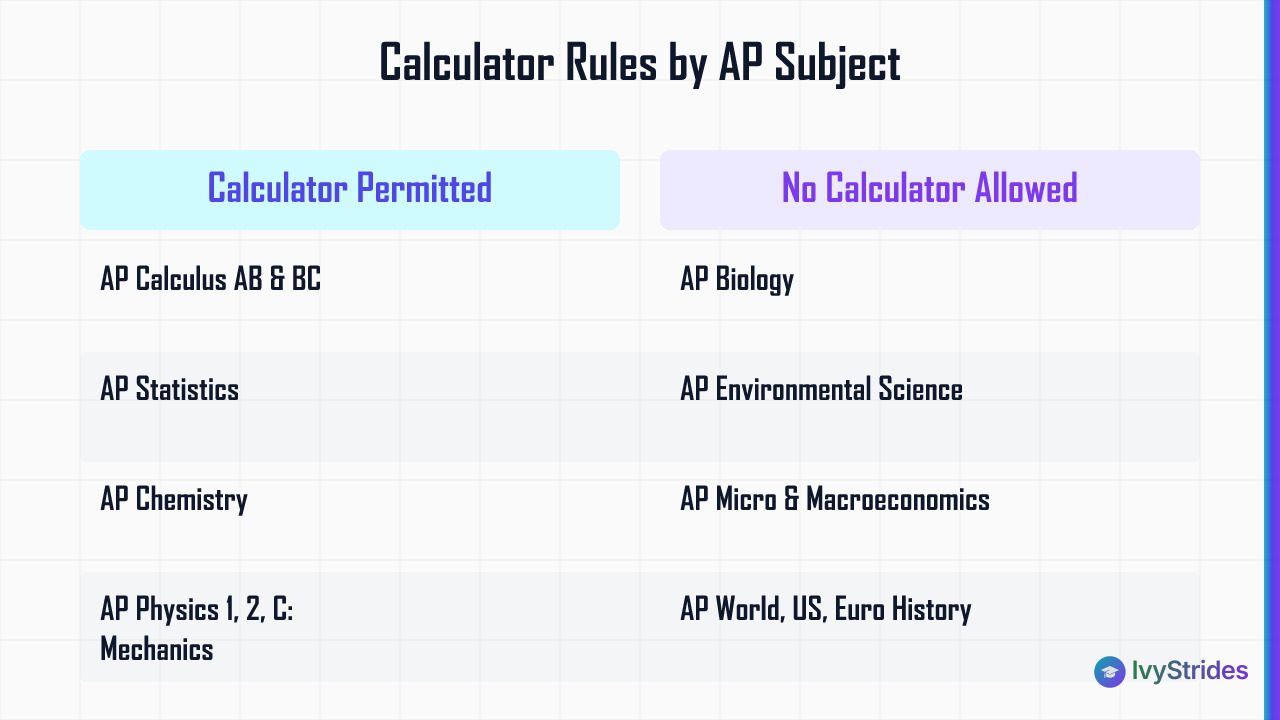
The universal checklist gets you through the door. Whether you need anything else depends entirely on your subject.
Calculators permitted (graphing calculator recommended):
- AP Calculus AB and AP Calculus BC
- AP Statistics
- AP Chemistry
- AP Physics 1, AP Physics 2, AP Physics C: Mechanics, AP Physics C: Electricity and Magnetism
For these subjects, College Board maintains a specific approved calculator list at apstudents.collegeboard.org. CAS (Computer Algebra System) calculators are permitted for AP Calculus but not for AP Statistics. Verify your exact model against the current list a week before your exam, since the list is updated annually. You don't need to clear your calculator's memory.
Calculators not permitted:
- AP Biology
- AP Environmental Science
- AP Microeconomics and AP Macroeconomics
- AP World History, AP US History, AP European History
- AP English Language and Composition, AP English Literature and Composition
If your exam is AP Bio, AP Micro, or any of the history and English subjects, leave the calculator at home. A visible calculator on your desk during one of these exams can raise a flag with the proctor.
Other subject-specific materials:
- AP Physics exams: a ruler or straightedge is permitted and useful for graph work. No protractors or compasses.
- AP Art and Design portfolio submissions: colored pencils, markers, and specific art supplies as needed for your studio work. This is handled separately from the traditional exam room setting.
- Scratch paper: don't bring your own. Proctors provide scratch work paper for AP Physics, AP Calculus AB/BC, AP Statistics, and other exams that need it. Bringing outside blank paper is a prohibited-items violation.
Quick reference by subject: AP World, AP Micro, AP US History, AP English, pencils, pens, ID, watch, nothing else. AP Chem, AP Calc AB/BC, AP Stats, AP Physics, add a graphing calculator. AP Bio, no calculator, standard kit only.
For subject-by-subject study plans that go beyond packing, see our AP exam prep by subject guide. If you're deciding whether to add structured coaching for a specific subject, our ap courses online page shows the current AP subjects we cover with dedicated specialists.
Do You Need a Photo ID for Your AP Exam? What Counts as Valid
Yes, bring photo ID. Even if the policy technically doesn't require it when you're testing at your own school, proctor discretion varies by site, and the cost of forgetting is high: you can be turned away with no refund and no makeup option in most cases.
What counts as valid photo ID for AP exams:
- Government-issued: passport, driver's license, learner's permit with photo, state ID card, or national ID card. Must be current and unexpired.
- School-issued: current-year student ID with photo. Prior-year school IDs are valid through the end of December of the current school year per College Board policy, then expire.
When ID is definitely required:
- You're testing at a school that isn't your own.
- You're an international student sitting the exam at a designated test center. Bring your passport; it's the safest option globally.
- Your AP coordinator has told you to bring it.
Edge cases we see with our students:
- Homeschool students testing at a partner school: bring government-issued ID and any registration confirmation from your AP coordinator.
- Students whose school ID expired over the summer: use a government-issued ID, or request a current-year school ID before exam week.
- Students whose legal name on ID doesn't match their registered exam name (marriage, legal name change, transliteration on a passport): contact your AP coordinator before exam day, not on exam morning.
If you're still finalizing registration or testing logistics, our guide on how to register for AP exams walks through deadlines and coordinator contact.
What You Cannot Bring: Prohibited Items and Why They Matter
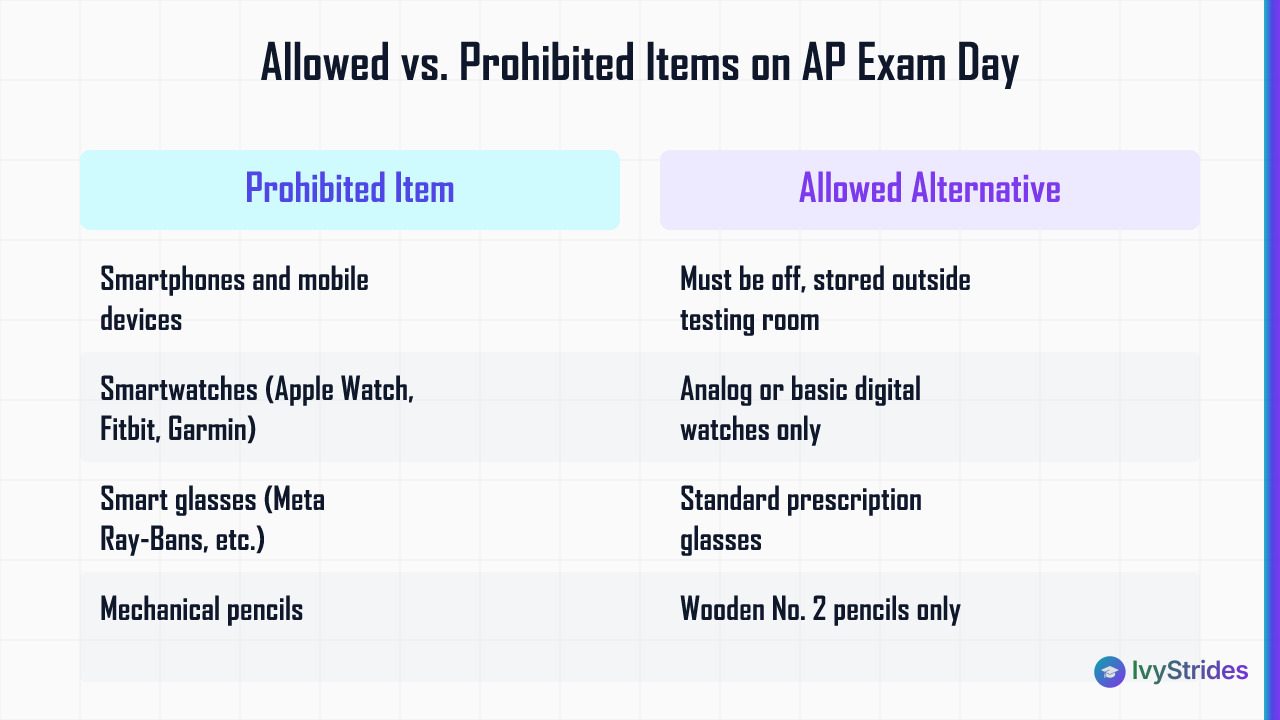
Here's the section that costs students their scores. Bringing a prohibited item, even accidentally, can result in dismissal and score cancellation. The complete list per current College Board policy:
- Smartphones and mobile devices of any kind. They must be off and stored outside the testing room. A phone that vibrates or rings during the exam can result in score cancellation, even if you never touch it.
- Smartwatches and fitness trackers, including Apple Watch, Fitbit, Garmin, and similar. Analog or basic digital watches only.
- Smart glasses: College Board's 2026 guidance explicitly prohibits smart glasses (Meta Ray-Bans and similar products) due to their recording and display capabilities. If you wear prescription lenses, bring standard glasses.
- Backpacks and bags aren't allowed inside the testing room. Most sites store them at the front of the room or in a hallway. Don't leave valuables inside.
- Notes, textbooks, flashcards, printed study materials. Nothing with content you might reference.
- Mechanical pencils on paper AP exams. Wooden No. 2 pencils only for multiple-choice bubbling. The mechanical pencil rule applies to the SAT as well; see our breakdown of whether you can use mechanical pencils on the SAT for the full policy comparison.
- Food and drink inside the testing room. Some sites permit a water bottle on the floor at your feet; this varies by proctor. Snacks are typically stored with your backpack and eaten during the break.
- Earbuds, headphones, and audio devices. Wireless earbuds count as electronic devices.
- Correction fluid (Wite-Out) or correction tape. If you make a mistake in ink on a free-response section, cross it out with a single line and continue.
- Highlighters. Not permitted during the exam.
In our coaching with students preparing for AP exams, the most common day-of mistake is leaving a phone in a pocket rather than storing it properly before entering the testing room. It doesn't feel like a violation until the phone vibrates 40 minutes in. A junior we worked with last spring, AP Chem, testing at her own school, realized her phone was in her hoodie pocket during the multiple-choice section, spent the next hour panicking about it, and lost time on units she knew cold. Take the extra 30 seconds to hand it over or drop it in your bag at the front of the room. If you also have SAT dates on your calendar, our SAT test day checklist covers the parallel rules for that exam.
Is Your AP Content Prep as Ready as Your Exam Bag?
Packing the right materials is step one. Step two is knowing the content cold. Book a free 15-minute call with an IvyStrides AP specialist, and your student gets a diagnostic snapshot of where they stand plus a clear plan for the remaining prep time. Parents welcome on the call.
The Night Before Your AP Exam: A Preparation Routine That Works
Here's the routine we give our students. It's short on purpose.
The night before:
-
Pack the bag using the checklist above. Zip it. Set it by the door. Don't open it again until morning.
-
Confirm your exam location, reporting time, and room number in writing from your AP coordinator. Morning-session reporting time is typically 7:45 a.m.; afternoon-session reporting is typically 12:00 p.m. Verify with your school.
-
Lay out the day-of essentials on top of the bag: ID, pencils, pens, calculator (if needed), watch, and a light layer in case the room is cold.
-
Light review only. Skim your one-page unit summaries or formula sheet for 20-30 minutes. Don't attempt new practice problems. Don't learn new content. If you don't know it by 9 p.m. the night before, you won't learn it by 8 a.m. the next morning.
-
Sleep. Target eight hours. Sleep deprivation measurably degrades working memory and processing speed, which is exactly what the AP free-response section tests.
Morning of:
-
Eat a real breakfast. Protein plus complex carbs. Not just coffee.
-
Arrive 15-20 minutes early.
-
Store your phone in your bag (turned off) before you enter the testing room. Don't carry it in your pocket "just to be safe." That's the exact mistake that gets students dismissed.
Before you pack your bag, confirm your exam registration is complete and your test center is locked in; see our full guide on how to register for AP exams for deadlines and step-by-step sign-up. Knowing your exact exam date and reporting time is the first step in planning what to bring; check the AP exam dates 2026 schedule to confirm your subject's day and session.
In our coaching with students preparing for AP exams, those who pack their bag and confirm logistics the night before report significantly lower morning anxiety and fewer last-minute scrambles. The routine isn't magic. It just removes the cognitive load of decisions from a morning when you need your working memory for the exam itself.
What Happens If You Are Not Prepared Beyond the Checklist
Look, packing the perfect bag doesn't earn you a 5. Students walk in with the right pencils, the right calculator, the right ID, and still score 2s and 3s because their content preparation was thin.
AP exams are scored on a 1-5 scale. A 3 is considered passing at many colleges; a 4 or 5 is typically required for credit at more selective institutions. AP credit policies vary by college, so check each of your target schools' AP credit charts directly rather than assuming a fixed policy. Across most AP subjects, fewer than 25% of test-takers score a 5 in a given year per College Board AP score distributions.
Packing the right bag matters, but it only helps if your content preparation is solid. Our guide on how to study for AP exams walks through the full method for scoring a 4 or 5.
Where do students actually lose points? In our coaching with students in AP Chemistry and AP Calculus BC, the free-response section is where the majority of point losses happen, not the multiple-choice section. Targeted unit review in the final four to six weeks, focused specifically on the unit weightings College Board publishes for each course, produces the largest score gains for students completing our program.
If you know your content prep isn't where it should be with weeks to go, structured 1-on-1 subject coaching closes the gap faster than solo review. Our ap prep courses pair each student with a subject specialist: one teacher per AP subject, not one generalist covering everything. For students targeting a 5 specifically in AP Calculus, our breakdown on how to get a 5 on AP Calculus walks through the exact unit weightings and free-response patterns that decide the score.
FAQ
Is a 70 percent raw score a 5 on an AP exam?
Not necessarily, and the threshold varies by subject and year. AP exams are scored on a 1-5 scale using a conversion table that College Board sets after each administration based on that year's difficulty. In many AP subjects, roughly 65-75 percent of available points is enough for a 5, but this varies significantly. AP Calculus BC has historically had a lower percentage threshold for a 5 than AP English Language. Check the most recent score distributions at apstudents.collegeboard.org rather than assuming a fixed percentage.
Can I bring a plushie or good-luck charm to my AP exam?
Small personal items aren't explicitly prohibited by College Board policy, but proctors have discretion and testing rooms have limited desk space. A small item that fits in your pocket is unlikely to cause an issue. Anything that could be interpreted as a storage device (a hollow object, an electronic anything) will be flagged. The safest approach is to keep good-luck rituals to items you wear, a bracelet or a specific shirt, rather than objects on the desk.
Will I be given scratch paper for the AP Physics or AP Calculus exam?
Yes. Proctors provide scratch work paper for AP exams that involve calculations, including AP Physics 1, AP Physics 2, AP Physics C, AP Calculus AB, AP Calculus BC, and AP Statistics. You don't need to bring your own, and bringing outside blank paper is a prohibited-items violation. Any scratch work you do isn't scored; only your answers in the official exam booklet or on the answer sheet count.
What are the hardest AP exams to score a 5 on?
Based on recent College Board score distributions, AP exams with historically low 5-rates include AP Physics 1 (around 7-10 percent of test-takers score a 5 in recent years), AP United States History, AP Chemistry, and AP English Language and Composition. AP Calculus BC and AP Computer Science Principles tend to have higher 5-rates. Distributions shift year to year, so check the most recent data at apstudents.collegeboard.org. If you're targeting a 5 on a high-difficulty AP, structured subject-specific prep well before exam day makes a measurable difference.
What do I do if I forget my ID on AP exam day?
Contact your AP coordinator immediately, before the exam begins. If you're testing at your own school and the coordinator can verify your identity through school records, you may be allowed to test. If you're at an outside test center, you'll likely be turned away and your exam fee won't be refunded. To avoid this: place your ID in your exam bag the night before, and don't remove it until you're seated in the testing room.
Are there any AP exams where a calculator is not allowed at all?
Yes. College Board doesn't permit calculators on AP Biology, AP Environmental Science, AP Microeconomics, AP Macroeconomics, AP World History, AP US History, AP European History, AP English Language and Composition, and AP English Literature and Composition. For these subjects, bring only pencils and pens. A visible calculator on your desk during one of these exams can raise a flag with the proctor.
Exam-day logistics are the easy part to control. Pack once, pack correctly, and none of it will cost you a point. The harder work is making sure the content is there when you sit down.
Ready to Walk Into Your AP Exam Fully Prepared, Not Just Packed?
Our AP subject specialists work 1-on-1 with students to close the exact gaps that cost points on free-response sections. Book a free 15-minute strategy call and get a personalized prep plan before your next exam date. Parents welcome on the call.

Two decades teaching quantitative and verbal aptitude on standardized tests. Rare dual expertise across Math and Verbal — particularly effective for students with gaps on both sides. Senior AP Mentor for our Calculus and English tracks.