
What Grade Is the AMC 8 For, and How to Tell If Your Child Is Ready
On this page
- What Grade and Age Make a Student Eligible for the AMC 8
- What the AMC 8 Actually Tests: Math Level and Question Style
- What a Good AMC 8 Score Looks Like by Grade Level
- Score Gap Identified. Find Out What It Takes to Close It.
- How to Tell If Your Child Is Ready for the AMC 8 Math Competition
- Checklist Done. Now Map the Prep Plan.
- FAQ: AMC 8 Eligibility, Scores, and Difficulty
- What level of math is AMC 8?
- Is AMC 8 harder than SAT?
- What is a good AMC 8 score for an 8th grader?
- What age group is AMC 8 for?
- Your Next Step With the AMC 8
The AMC 8 is a 25-question, 40-minute math competition open to students in grade 8 or below who are under 14.5 years old on exam day. There's no minimum grade, so strong 4th, 5th, and 6th graders qualify. The 2026 exam ran January 22-30.
Both conditions matter at once: your child must be in grade 8 or below and under 14.5 years old. The Mathematical Association of America (MAA) sets those rules and administers the contest. A gifted 3rd grader who meets the grade ceiling is welcome; a 9th grader is not, regardless of age.
What Grade and Age Make a Student Eligible for the AMC 8
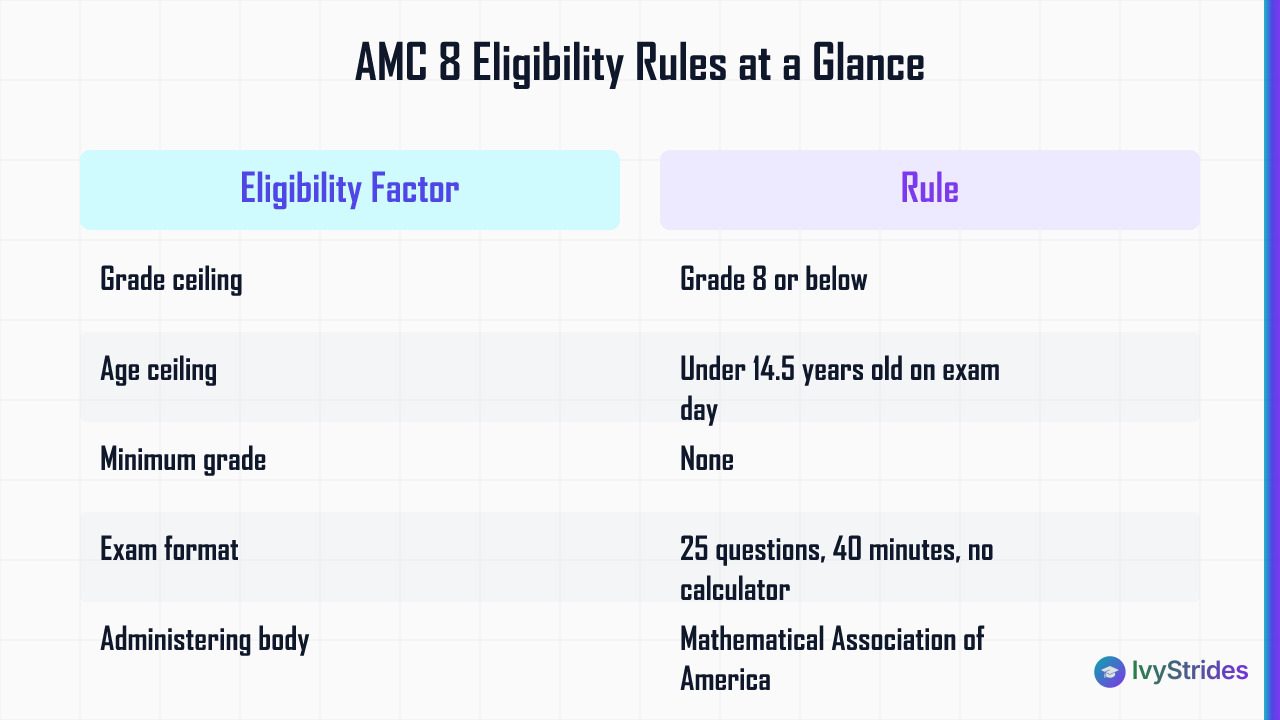
The AMC 8 is open to any student in grade 8 or below who is under 14.5 years old on the day of the competition, with no minimum grade or age. Both the grade rule and the age rule must be satisfied together. The Mathematical Association of America administers the contest and is the official source for eligibility.
No floor on grade. A mathematically advanced 4th or 5th grader who is comfortable with the material can register. Most participants land in grades 5 through 8, ages 10 to 14, but the door opens earlier for students ready to try.
The exam itself is short and fixed: 25 multiple-choice questions in 40 minutes, no calculator, no penalty for a wrong answer. That works out to about 96 seconds per question. MAA publishes the 40-minute window and the 25-question count; IvyStrides calculates the per-question average.
| Eligibility Factor | Rule |
| Grade ceiling | Grade 8 or below |
| Age ceiling | Under 14.5 years old on exam day |
| Minimum grade | None |
| Administering body | Mathematical Association of America |
| 2026 exam window | January 22-30 |
The 2026 AMC 8 ran across a window rather than a single day, a scheduling pattern schools use to fit the contest around class time. If you're weighing this against other options, our roundup of math competitions and summer camps for high schoolers maps where the AMC 8 sits in the wider ecosystem.
What the AMC 8 Actually Tests: Math Level and Question Style
The AMC 8 tests middle school mathematics through roughly the 8th grade curriculum: arithmetic, fractions, percents, ratios, basic geometry, probability, and introductory number theory. No algebra II, no trigonometry, no calculus. The content level is grades 5 to 8, but the problem-solving style runs well above a typical classroom test.
Because the content stays at middle-school level, the challenge is not what your child knows but how flexibly they apply it. AMC 8 problems are multi-step and reward logical reasoning over formula recall. A geometry question rarely asks for a plug-and-chug area; it asks the student to spot a relationship first, then compute. The last five problems, numbers 21 through 25, demand genuine insight.
Harder than class, narrower than the SAT. The AMC 8 covers simpler content than the SAT, but its hardest questions ask for more creative reasoning than most standardized tests. The SAT Math section runs 44 questions in 70 minutes across algebra, advanced math, geometry, and data analysis, with a calculator available throughout. The AMC 8 gives no calculator and rewards a different muscle.
| Topic Area | In AMC 8? | Typical Grade Level |
| Arithmetic and fractions | Yes | Grades 4-6 |
| Percents and ratios | Yes | Grades 6-7 |
| Basic geometry (area, angles) | Yes | Grades 6-8 |
| Probability and counting | Yes | Grades 7-8 |
| Introductory number theory | Yes | Grades 7-8 |
| Algebra II / trigonometry | No | Grades 10-11 |
| Calculus | No | Grades 11-12 |
The problem-solving habits built through AMC 8 prep, especially working with ratios, percents, and geometry without a calculator, are the same habits the SAT Math topics will reward in 9th or 10th grade. When a child's flexibility with those topics lags, a 1-on-1 SAT prep tutor can build the same foundations that competition math demands. Early competition math is a down payment on that later section.
What a Good AMC 8 Score Looks Like by Grade Level
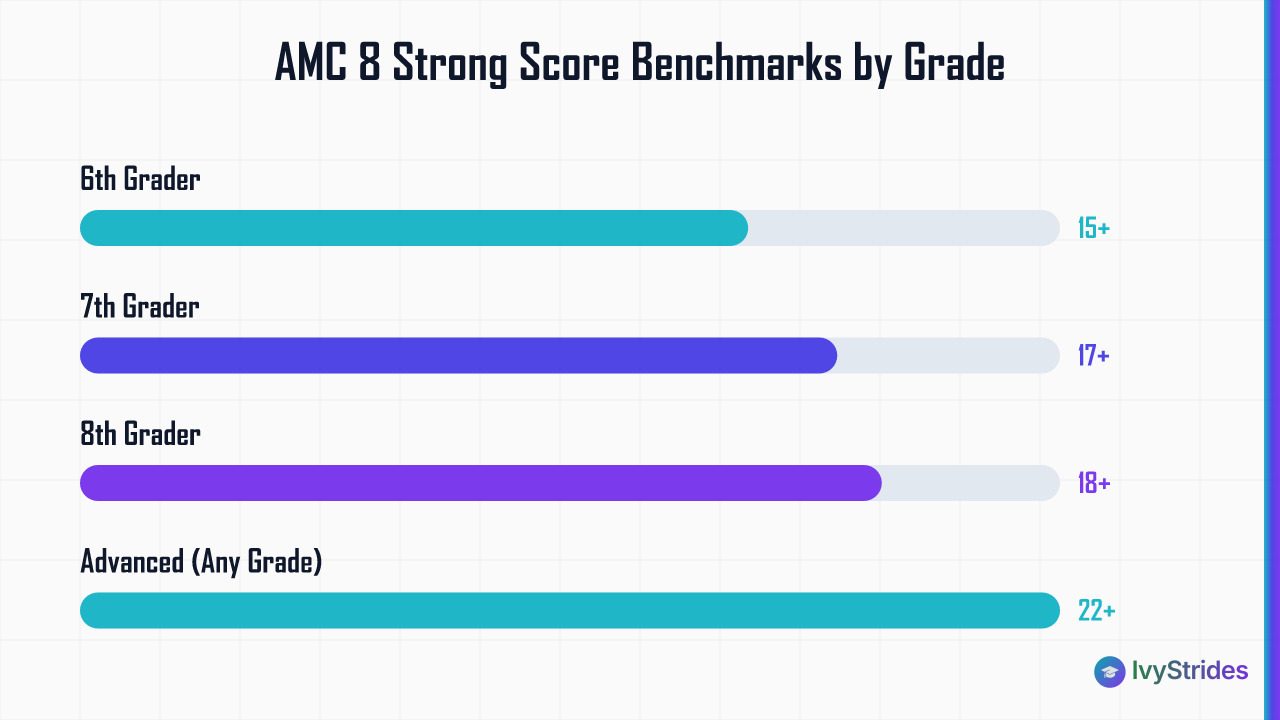
A good AMC 8 score depends on grade. For an 8th grader, a score of 18 or higher is generally considered strong, well above the typical participant average of roughly 10 to 12 correct. The contest scores on a 0-25 scale with no penalty for wrong answers, so a student should answer every question.
Building on the content picture above, the same middle-school topics separate a solid score from a strong one mostly through the harder final problems. In our coaching with students preparing for the AMC 8, the most common gap we see is comfort with multi-step ratio and percent problems, not raw content knowledge. Students who reach 15+ in 6th grade typically climb to 20+ by 8th grade with consistent competition math practice.
| Grade | Solid Score | Strong Score | Honor Roll Range (typical) |
| 6th grader | 12+ | 15+ | 19-20+ |
| 7th grader | 14+ | 17+ | 19-20+ |
| 8th grader | 15+ | 18+ | 19-20+ |
| Advanced (any) | 18+ | 22+ | 23-25 |
Honor Roll is not a fixed number. MAA awards Honor Roll to top scorers and Honor Roll of Distinction to the very highest, but the cutoffs vary by year and are published only after each exam. Honor Roll typically lands around 19 to 20, and Honor Roll of Distinction around 23 to 25, though neither is guaranteed in advance. Treat those as ranges, not thresholds you can bank on.
Students who score 20 or higher on the AMC 8 are well-positioned to attempt the AMC 10 once they reach high school, continuing the competition pathway toward AIME qualification. If you're already thinking that far ahead, our AP, SAT, and ACT testing plan for grades 9-12 lays out the full roadmap.
Score Gap Identified. Find Out What It Takes to Close It.
You have the benchmarks, your child's current score, and a registration window ahead. A free 15-minute call reviews the specific math areas holding the score back, maps a focused preparation plan, and tells you whether the timeline before the next exam is realistic.
How to Tell If Your Child Is Ready for the AMC 8 Math Competition
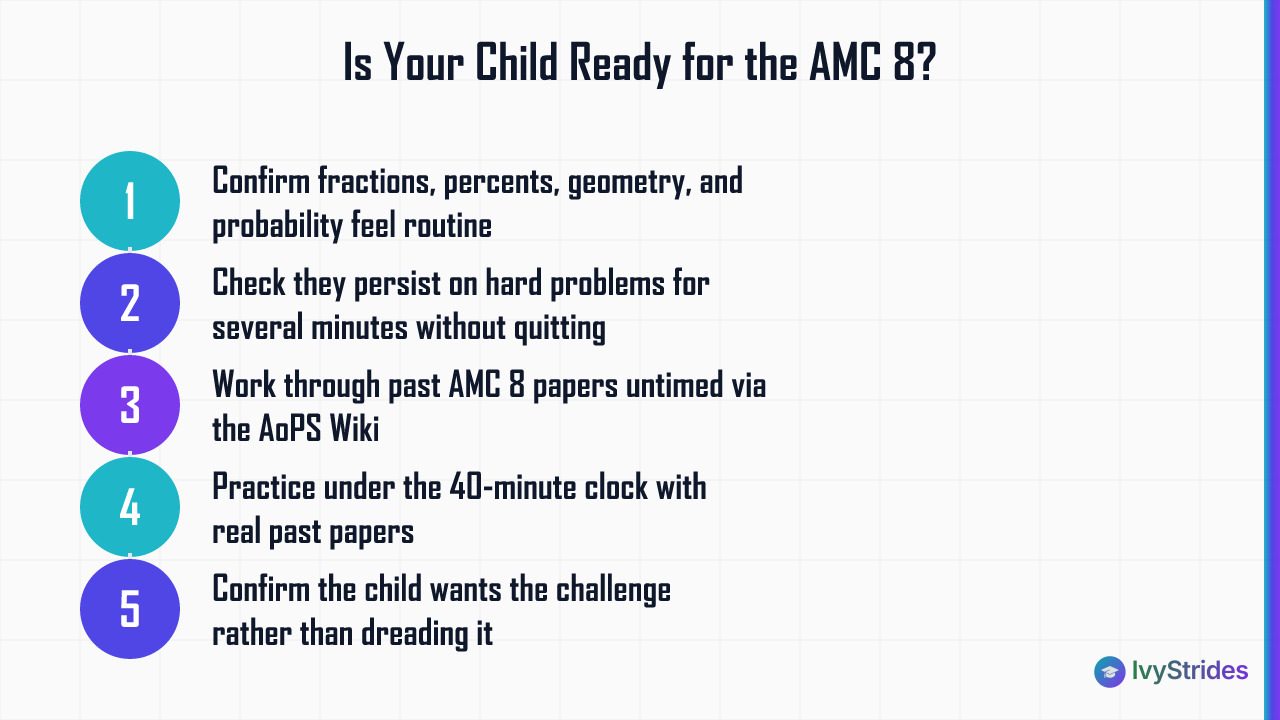
Readiness for the AMC 8 is not about advanced coursework; it's about comfort with middle-school math applied in unfamiliar ways. A child is ready if fractions, percents, basic geometry, and simple probability feel routine and multi-step word problems spark curiosity rather than shutdown. That readiness matters more than which grade they're in.
Closing the same score gap from the section above starts with honest practice on real material. The best preparation resource is past AMC 8 papers, freely available through the AoPS Wiki, worked slowly at first and then under the 40-minute clock. MATHCOUNTS is a complementary path for students who want more structured middle-school competition practice alongside the AMC 8.
Use the checklist below. If your child clears most of these, registration is worth it even at a modest target score.
- Solves multi-step fraction and percent problems without a formula sheet
- Recognizes area, perimeter, and angle relationships in unfamiliar figures
- Handles basic probability and counting questions comfortably
- Stays with a hard problem for several minutes without giving up
- Has worked at least a few past AMC 8 papers untimed
- Wants the challenge, rather than dreading it
Consistent AMC 8 participation in grades 6-8 correlates with readiness for AP Calculus AB or BC in 11th or 12th grade, a course where per-subject specialist coaching makes a measurable difference. Parents mapping that far out can see how many AP classes to take for the Ivy League.
One caveat worth stating plainly: AMC 8 performance does not directly affect college admissions. It signals quantitative aptitude and opens the door to the AMC 10 and beyond, but no college requires it and skipping it harms no application. Students targeting 20+ who want structured help can work with our 1-on-1 math tutors on competition problem-solving patterns rather than rote drills. Those same habits carry straight into how to prep for SAT Math and hit your target score a few years later.
Checklist Done. Now Map the Prep Plan.
You have the eligibility rules, the score benchmarks, and the readiness signals. Turning those into a week-by-week plan tied to your child's current math level and the next exam takes a focused conversation. A free 15-minute call does exactly that.
FAQ: AMC 8 Eligibility, Scores, and Difficulty
What level of math is AMC 8?
The AMC 8 covers middle school math: arithmetic, fractions, percents, ratios, basic geometry such as area, perimeter, and angles, probability, and introductory number theory. There's no algebra II or calculus. The problems are multi-step and reward logical reasoning over formula recall, which makes them harder than a typical classroom test even though the content itself sits at the grades 5 to 8 level.
Is AMC 8 harder than SAT?
The AMC 8 covers simpler content than the SAT but demands more creative problem-solving. The SAT Math section tests algebra, advanced math, and data analysis across 44 questions in 70 minutes, with a calculator available for most questions. The AMC 8 gives 40 minutes for 25 problems with no calculator, and its hardest questions, numbers 20 through 25, ask for insight that goes well beyond standard classroom math.
What is a good AMC 8 score for an 8th grader?
For an 8th grader, a score of 18 or higher is generally considered strong, placing the student well above the typical participant average of roughly 10 to 12 correct. Scores of 19 to 20 usually reach Honor Roll range, though cutoffs vary by year and MAA publishes them only after each exam. A score of 23 or above is Honor Roll of Distinction territory.
What age group is AMC 8 for?
The AMC 8 is for students under 14.5 years old on the day of the competition who are also in grade 8 or below. Both conditions must be met. Most participants are ages 10 to 14, spanning grades 5 to 8, but there's no minimum age, so a mathematically advanced 3rd or 4th grader who meets the grade requirement is also eligible.
Your Next Step With the AMC 8
You now have the two rules that decide eligibility, the score to aim for at your child's grade, and a readiness checklist you can apply this week. The decision comes down to whether your child clears most of that checklist and wants the challenge.
- Confirm eligibility: grade 8 or below, under 14.5 on exam day
- Check the benchmark table for your child's grade
- Work two or three past AMC 8 papers untimed, then under 40 minutes
- Decide whether to register for the next window and begin focused practice