
How to Get Into Texas A&M With Fewer Activities and More Hours in Each
On this page
- Texas A&M's Two Admission Pathways for Fall 2027
- What Texas A&M's Holistic Review Actually Weighs
- How to Write Texas A&M's Essay and Short Answers Without Repeating Yourself
- Texas A&M Application Deadlines and Documents for Fall 2027
- FAQ: Getting Into Texas A&M
- What GPA do you need to be accepted into Texas A&M?
- Is 1400 a good SAT score for Texas A&M?
- Is it hard to get into Texas A&M?
- Does Texas A&M admit top 10%?
- Your Next Step at Texas A&M
Texas A&M University College Station admits freshmen two ways for fall 2027. Texas residents in the top 10% of their high school class receive automatic admission to the university. Everyone else enters holistic review, where class rank, GPA, course rigor, extracurricular depth, and a 750-word essay, a 250-word short answer and four 100-word short answers all count.
Those pathways come straight from Texas A&M's own admissions and catalog pages, cited below. The harder question isn't whether you qualify for the automatic route. It's what a holistic-review applicant does with a decent GPA, a messy activity list, and a December 1 deadline that's closer than it looks.

Texas A&M's Two Admission Pathways for Fall 2027
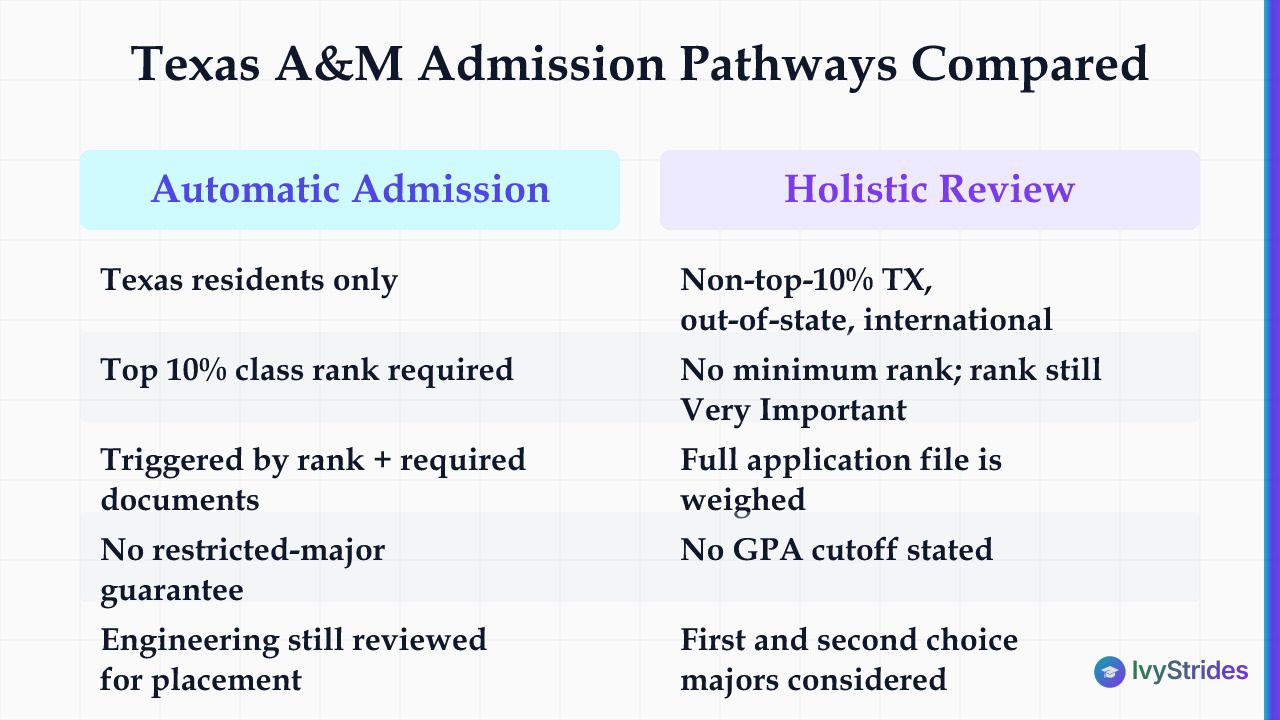
Texas A&M College Station runs two separate freshman admission pathways, and which one applies depends entirely on your residency and class rank. Automatic admission is for Texas residents in the top 10% of their graduating class who meet the State of Texas Uniform Admission Policy and get every required document in by the deadline. Holistic review is everything else.
Here's the distinction most families miss. Automatic admission gets you into Texas A&M the university. It does not guarantee a restricted-enrollment major. Business admission is competitive, per Mays Business School, and TAMU reviews every engineering applicant, top-10% admits included, for placement into General Engineering. The two-stage process for competitive majors decides whether a top-10% admit lands in the major they named or an alternate.
Major order matters. Texas A&M considers you for your first and second choice majors in College Station before any alternative pathway. Under the undergraduate catalog, Texas A&M offers a competitive applicant shut out of a restricted major the second choice; if that one is full too, you pick an alternate after admission.
| Pathway | Who qualifies | What triggers it | Caveat |
| Automatic admission | Texas residents in top 10% | Top-10% rank plus required documents | No restricted-major guarantee |
| Holistic review | Non-top-10% Texas residents | Rank below top 10% | Full file weighed, no GPA cutoff |
| Holistic review | Out-of-state and international | Residency, any rank | Class rank still Very Important |
So if you're not in the top 10%, or you live outside Texas, your admission turns on what reviewers read next.
What Texas A&M's Holistic Review Actually Weighs
Texas A&M's holistic review scores a defined set of factors, and the university names each one. Its Common Data Set 2025-2026 rates five factors "Very Important" in section C7: rigor of secondary school record, class rank, academic GPA, extracurricular activities, and talent/ability. The same section also marks interview, alumni/ae relation, and religious affiliation/commitment as "Not Considered" in the general review; a separate list of items not considered applies specifically to appeals.
Three of those five are academic, so your school record carries much of that weight. In holistic review, reviewers read every high school course you attempted and every grade you earned, your course rigor, GPA, and class rank, per TAMU's freshman page. Because Texas A&M rates rigor alongside GPA, a demanding schedule shows reviewers something the GPA number alone does not.
The nonacademic factors are specific. TAMU's freshman page names extracurricular involvement, community service, leadership, employment, and summer activities. TAMU also weighs extraordinary opportunities, challenges, and hardships you faced in high school. Reviewers look at the time commitment and duration of each activity, awards, jobs and internships with dates and weekly hours, and family educational background, household income, and household size.
| Category | Specific factors TAMU names | CDS C7 weight |
| School record | Rigor, GPA, class rank | Very Important |
| Activities | Extracurricular involvement | Very Important |
| Talent | Talent/ability | Very Important |
| Nonacademic | Service, leadership, employment, summer | Not rated in C7 |
| Context | Opportunities, challenges, hardships | Not rated in C7 |
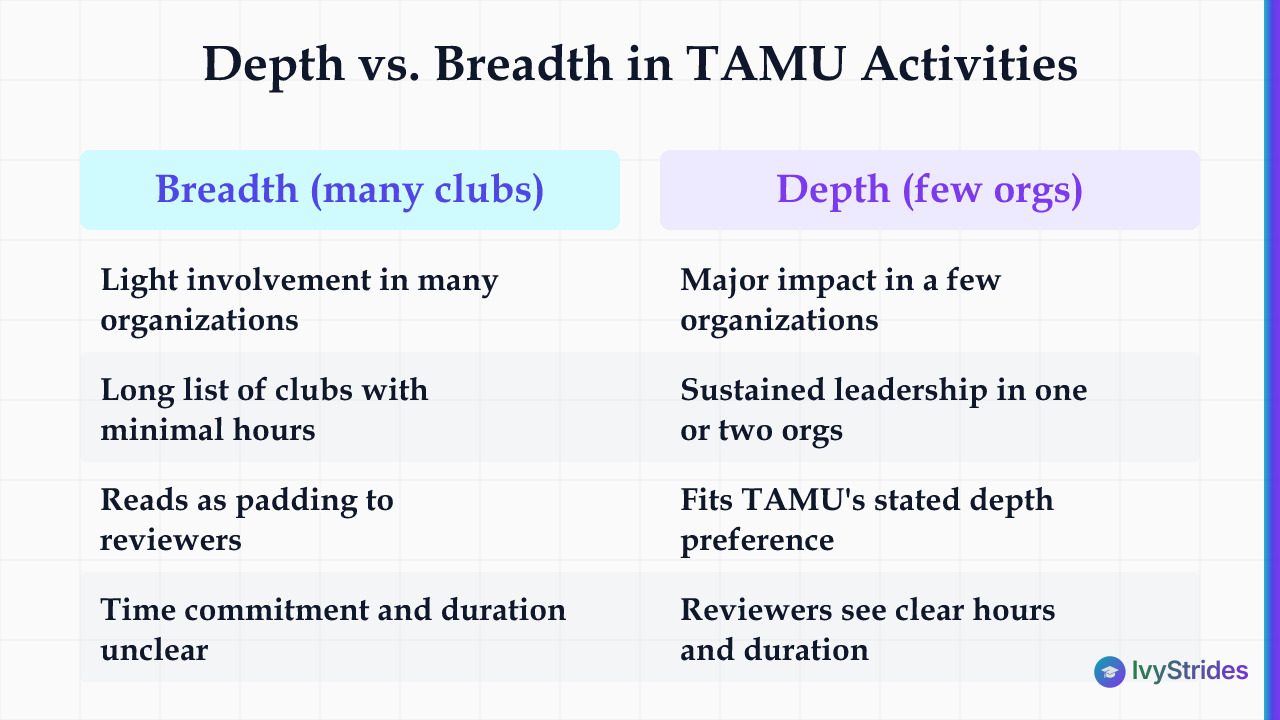
Here's the angle that changes how you build your file. TAMU's own accomplishment tips favor depth over breadth: major impact in a few organizations beats light involvement in many, which mirrors how selective colleges read an activity list. IvyStrides' admissions counselors for grades 11 and 12 audit a student's activity list against the factors Texas A&M rates Very Important in admission and flag entries that read as padding before December 1.
Sustained leadership in one or two organizations fits TAMU's stated preference better than a long list of clubs with minimal involvement.
On the test score. TAMU is test-optional for fall 2027: it does not require the SAT or ACT, but it considers scores you submit (CDS C8A). Policies shift by cycle, so confirm at admissions.tamu.edu before you apply. Whether submitting a score strengthens a holistic file depends on how it sits against the rest of your application.
How to Write Texas A&M's Essay and Short Answers Without Repeating Yourself
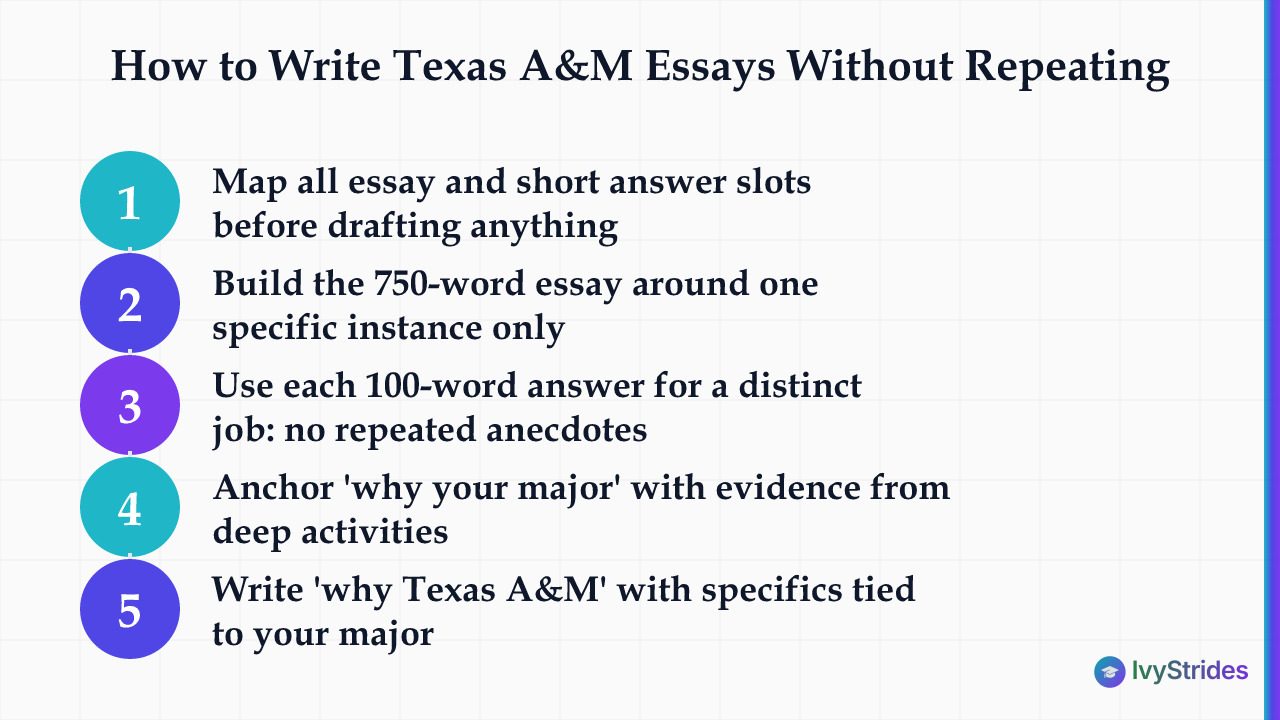
Those depth-over-breadth review factors feed directly into Texas A&M's required writing, a 750-word essay, a 250-word short answer and four 100-word short answers, plus one optional 250-word answer, because the activities you commit to are the raw material your answers draw on. An applicant who shows two years in one organization has a specific instance to build a 750-word essay around; a student with eight thin memberships has nothing to anchor it. The main essay, which TAMU calls Essay Topic A, runs up to 750 words: tell your story, the unique opportunities or challenges during high school that shaped who you are.
There is no Common App personal essay required for TAMU, so this 750-word piece is your main long essay. Mapping the activity list and writing slots together is how a focused extracurricular record becomes a coherent file. TAMU's own guidance is to not repeat what appears elsewhere in the application, so mapping every essay and short answer, including the optional one, before drafting helps you avoid two answers that tell the same story in different words. TAMU also lists an optional 250-word answer for experiences shaping your abilities or academic record that you have not written about.
| Prompt | Word limit | What it is asking for |
| Essay Topic A | up to 750 | Opportunities or challenges that shaped you |
| Short answer | 250 | A life event that prepared you for college |
| Short answer | 100 | Your life goals and objectives |
| Short answer | 100 | Why your chosen major |
| Short answer | 100 | Why Texas A&M |
| Short answer | 100 | Educational plans beyond the bachelor's |
Follow TAMU's own advice. The college-readiness page is blunt about what works: build the response around one specific instance, explain how it changed you, write in your own voice, and do not repeat what appears elsewhere. A student who committed deeply to one or two activities answers "why your chosen major" with evidence, not a wish list.
Following TAMU's own guidance, build the 750-word essay around one specific instance rather than trying to cover three formative experiences. The essays that read most clearly pick a single moment and follow it forward. The four 100-word answers are tight, and each has a distinct job to do, so a reader should never meet the same anecdote twice. Spend the "why Texas A&M" answer on specifics tied to your major, not generic praise for the campus.
Texas A&M Application Deadlines and Documents for Fall 2027
Texas A&M's fall 2027 application opens August 1, 2026 and closes December 1, 2026, with supporting documents due December 15, 2026, per the freshman admissions page. Decisions go out on a rolling basis starting in late September. Top-10% applicants usually hear within about three weeks of a complete file; most holistic-review applicants hear between January 1 and late March.
Those deadlines sit behind one task students underestimate: STARS. The Self-reported Transcript and Academic Record System is TAMU's self-reported transcript, required of all freshman applicants except GED graduates. It takes roughly 2 to 6 hours to complete and must be submitted and linked to your application by December 15. Start it early. It's not a thing you finish the night before.
Platform, letters, and resume. You apply through Common App or ApplyTexas, one application per student, and the platform does not affect the decision. ApplyTexas applicants complete a separate Extracurricular Activities Form. Recommendation letters are optional, and only the first two received count. A resume is optional and worth using only if the application runs out of space. TAMU has no Early Decision; confirm whether an Early Action option applies at admissions.tamu.edu, since its Common Data Set has historically listed a nonrestrictive Early Action option while the live admissions pages for fall 2027 show only the December 1 deadline. TAMU's fall timeline lists waitlist offers in February.
If you're also applying to UT Austin, the two schools run different timelines and test policies, so you'll track two separate document deadlines at once.
-
Start your Common App or ApplyTexas application (open since Aug 1, 2026)
-
Draft Essay Topic A around one specific instance
-
Write the 250-word and four 100-word short answers
-
Start STARS early (2 to 6 hours)
-
Request up to two recommendation letters, if submitting any
-
Submit the application by Dec 1, 2026
-
Link STARS and all documents by Dec 15, 2026
-
Decide whether to submit an SAT or ACT score, and if so, confirm the score deadline: TAMU sources differ (the CDS lists Dec 1 while the College Readiness FAQ accepts December test scores received by Dec 15), so check admissions.tamu.edu or the College Readiness FAQ before registering for a December test date
FAQ: Getting Into Texas A&M
What GPA do you need to be accepted into Texas A&M?
Texas A&M doesn't publish a minimum GPA cutoff for holistic review. The CDS 2025-26 rates academic GPA as Very Important alongside class rank and course rigor. Because reviewers read every course attempted and every grade earned, along with course rigor, the schedule behind your GPA matters, not just the number.
Is 1400 a good SAT score for Texas A&M?
Texas A&M is test-optional for fall 2027, so no score is required. If you submit, a 1400 on the digital SAT (400 to 1600 scale) sits at the 93rd percentile of recent test takers and above 1390, the 75th-percentile score among TAMU's Fall 2025 enrolled freshmen who sent SAT scores (CDS C9). Whether to send it depends on how the score reads against the rest of your file.
Is it hard to get into Texas A&M?
For Texas residents in the top 10% of their class, admission to the university is automatic. For everyone else, TAMU runs a holistic review weighing class rank, GPA, course rigor, extracurricular depth, and a 750-word essay, a 250-word short answer and four 100-word short answers. TAMU says it admits most out-of-state students through holistic review.
Does Texas A&M admit top 10%?
Yes. Texas residents who rank in the top 10% of their high school graduating class receive automatic admission to Texas A&M University. Choice of major is not guaranteed, though: business admission is competitive, and TAMU reviews every engineering applicant, top-10% admits included, for placement into General Engineering.
Your Next Step at Texas A&M
Admission to Texas A&M turns on knowing which pathway is yours and building the holistic file to match it. If you're outside the top 10%, holistic review reads your whole file, not one number.
- Confirm your class rank and residency to know which pathway applies
- Audit your activity list for depth, not length
- Draft Essay Topic A around one specific instance in your own voice
- Start STARS early and link it by December 15
- Verify TAMU's test-optional policy at admissions.tamu.edu before deciding on a score

Rajesh is a technology leader, entrepreneur, and angel investor with 28+ years in Business & Technology Leadership and Product & Solution Engineering. He is passionate about education, mentoring, and driving digital transformation.