
Is the AMC 8 Harder Than MATHCOUNTS? What Each One Actually Tests

On this page
- AMC 8 vs. MATHCOUNTS: A Round-by-Round Difficulty Comparison
- What the AMC 8 Actually Tests: Format, Difficulty, and Math Level
- What MATHCOUNTS Actually Tests: Rounds, Format, and Difficulty by Level
- How AMC 8 and MATHCOUNTS Fit Into the Broader Math Competition Pathway
- FAQ: AMC 8 Scores and Difficulty
- What is a good AMC 8 score for an 8th grader?
- How difficult is the AMC 8?
- Is AMC 8 prestigious?
- What level of math is the AMC 8 level?
- Your Next Step on the AMC 8 and MATHCOUNTS Decision
Whether the AMC 8 is harder than MATHCOUNTS depends on the round. The MATHCOUNTS School Sprint Round is easier than the AMC 8, the Chapter Sprint Round is roughly comparable, and State and National rounds are significantly harder.
Both contests ban calculators in Sprint, though MATHCOUNTS Target and Team rounds allow them. The AMC 8 is a 25-question multiple-choice math competition for students in grade 8 or below, run by the Mathematical Association of America (MAA). MATHCOUNTS is a multi-tiered competition that escalates from School to National, so the honest answer isn't a single verdict; it's a table, which the next section gives you.
AMC 8 vs. MATHCOUNTS: A Round-by-Round Difficulty Comparison
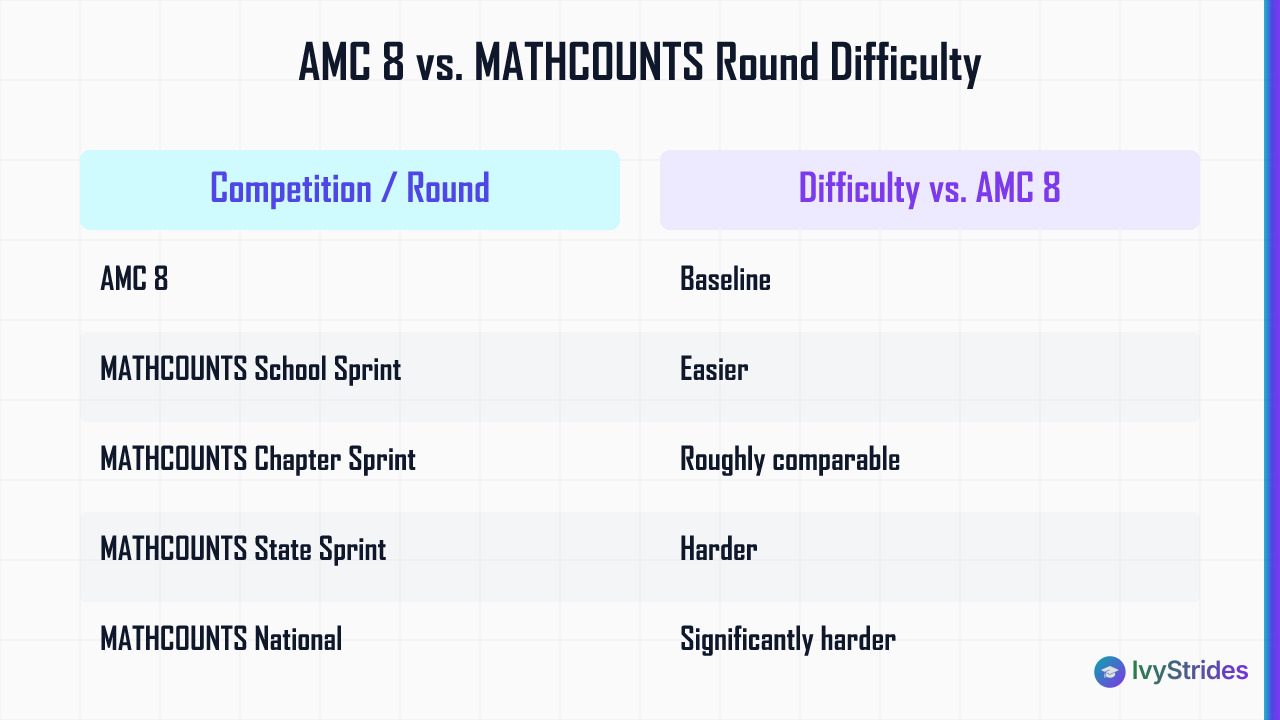
The difficulty gap between the AMC 8 and MATHCOUNTS swings by round, so any "MATHCOUNTS vs AMC 8" comparison that hands you one answer is misleading. The AMC 8 sits at a fixed introductory level. MATHCOUNTS climbs from a gentle School round to National problems that outrun anything on the AMC 8.
Where the crossover happens. School Sprint questions look like harder homework. Chapter Sprint starts to feel like the middle of an AMC 8. By State, the Sprint problems and the Countdown Round demand faster, cleaner problem-solving than the AMC 8 ever asks for. Per AwesomeMath's comparison, the two contests overlap most at the Chapter level and diverge sharply above it.
| Competition / Round | Questions | Time | Calculator | Difficulty vs. AMC 8 |
| AMC 8 | 25 | 40 min | No | Baseline |
| MATHCOUNTS School Sprint | 30 | 40 min | No | Easier |
| MATHCOUNTS Chapter Sprint | 30 | 40 min | No | Roughly comparable |
| MATHCOUNTS State Sprint | 30 | 40 min | No | Harder |
| MATHCOUNTS National | mixed rounds | varies | mixed | Significantly harder |
The other real difference is answer format. AMC 8 is multiple-choice: five options, so a smart guess still has a shot, and you can sometimes back-solve from the answers. MATHCOUNTS Sprint is free-response, meaning you write the number and get zero partial credit for a near miss.
That single format change rewards computational accuracy on MATHCOUNTS and strategic elimination on the AMC 8. A student who wants structured coaching on either format can start with our math olympiad and research program.
What the AMC 8 Actually Tests: Format, Difficulty, and Math Level
The AMC 8 is a single 25-question, 40-minute multiple-choice exam with no calculator, open to students in grade 8 or below and administered by the MAA. There's no multi-round progression, unlike the MATHCOUNTS climb from School to National: you sit one test, and your score out of 25 is the whole result.
The math level. AMC 8 problems draw on pre-algebra, introductory algebra, plane geometry, basic number theory, and elementary combinatorics. Nothing requires calculus or trigonometry. What makes it hard isn't the topic list; it's the problem-solving. The questions climb in difficulty from problem 1 to problem 25, so the first ten are accessible to a prepared 6th grader and the last five separate strong competitors from everyone else.
| Attribute | Detail |
| Questions | 25 multiple-choice |
| Time | 40 minutes |
| Calculator | Not allowed |
| Eligibility | Grade 8 or below |
| Administered by | MAA |
| Score scale | 0 to 25 |
| Difficulty | Rises from problem 1 to 25 |
That 40 minutes over 25 questions works out to about 96 seconds per question. MAA publishes the time and question count; IvyStrides does the division. But that average lies. You'll clear problems 1 through 12 in well under a minute each, banking time for the back half.
Scoring tiers, and the caveat. Honor Roll recognition starts at roughly a 19, and Distinguished Honor Roll at roughly a 23 out of 25. Treat those as approximate: the MAA sets exact cutoffs after each exam based on that year's score distribution, so the line shifts year to year. For a fuller readiness breakdown, see what grade is the AMC 8 for.
In our coaching with students preparing for the AMC 8, the most common gap isn't topic knowledge, it's problem-solving speed on problems 18 to 25. A student scoring 12 to 14 on a first practice test is typically about six to eight weeks of targeted problem-set work away from Honor Roll range.
What MATHCOUNTS Actually Tests: Rounds, Format, and Difficulty by Level
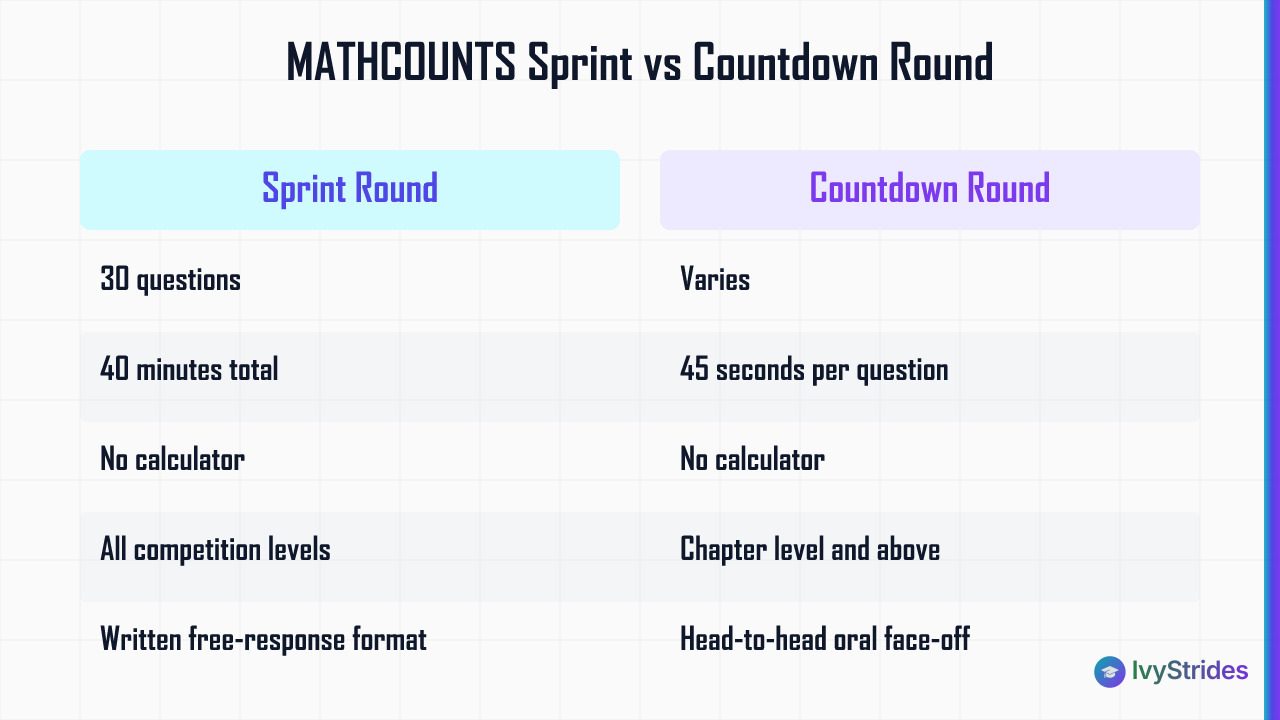
MATHCOUNTS is a four-tier competition, School, Chapter, State, and National, run by the MATHCOUNTS Foundation for students in grades 6 to 8. Because of that tiered structure, and unlike the single-sitting AMC 8, difficulty escalates sharply as students advance, so a student comfortable at School level can hit a wall at State.
Each level uses the same round types. The Sprint Round is 30 free-response questions in 40 minutes with no calculator, and it maps most cleanly onto the AMC 8. The Target Round gives 8 problems in pairs and allows a calculator. The Team Round is 10 problems, calculator allowed, solved collaboratively. The Countdown Round is a head-to-head oral face-off that runs at Chapter level and above.
| Round | Questions | Time | Calculator Allowed | Competition Level |
| Sprint | 30 | 40 min | No | All levels |
| Target | 8 (in pairs) | ~6 min per pair | Yes | All levels |
| Team | 10 | 20 min | Yes | All levels |
| Countdown | varies | 45 sec/question | No | Chapter and up |
Speed is the real filter. MATHCOUNTS rewards fast mental computation more than the AMC 8 does, especially in Sprint and Countdown. That's the part students underestimate. The topic list overlaps heavily with the AMC 8, so a strong AMC 8 student already covers most of the content; the missing piece is usually raw pace under a shorter per-question clock.
Once a student sees that State and above demand a level of speed and problem-solving depth they haven't trained, the question becomes whether to prepare alone or with a coach who runs diagnostic problem sets. A specialist coach can build a targeted weekly plan around the specific round a student is preparing for through our math olympiad and research program.
How AMC 8 and MATHCOUNTS Fit Into the Broader Math Competition Pathway
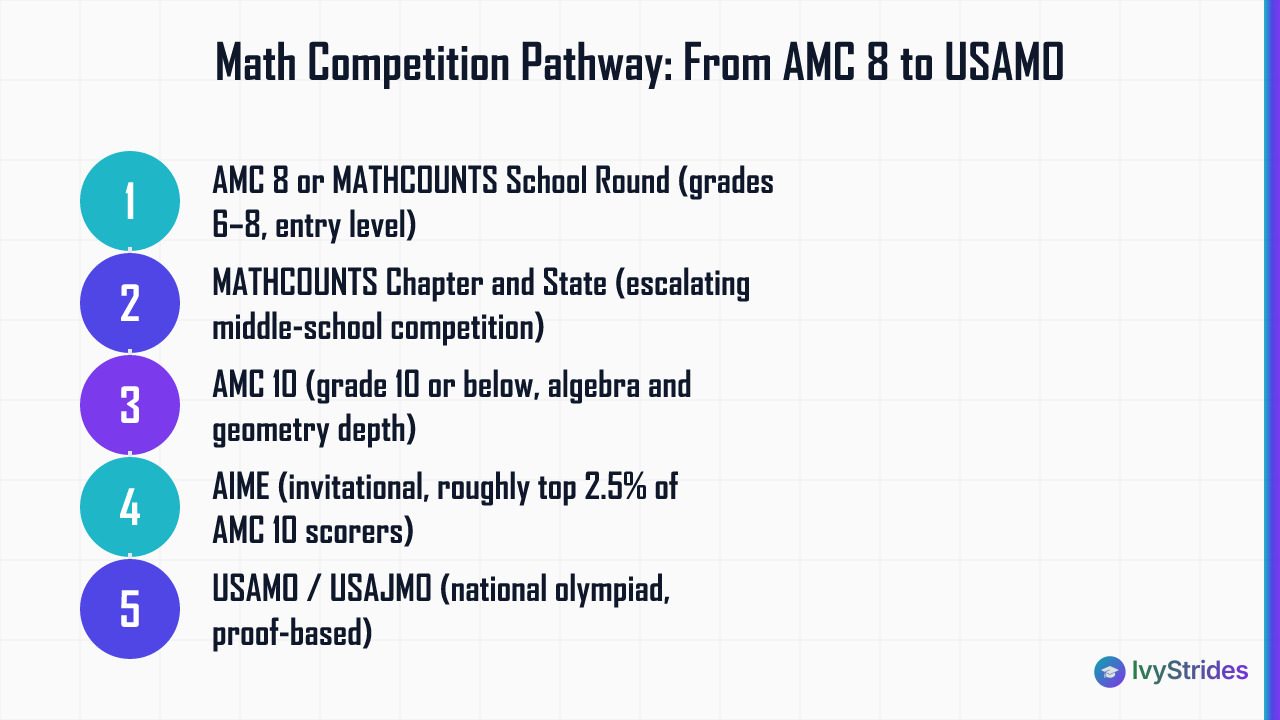
The AMC 8 and MATHCOUNTS are both entry points to a longer competition mathematics ladder that runs up through the AMC 10/12, AIME, and eventually the USAMO. Neither is the finish line. Both build the problem-solving fluency the next tier assumes you already have, which is why the choice between them matters less than starting somewhere.
Students who score in the top 1 to 2 percent on the AMC 8, or who reach MATHCOUNTS State level, are well-positioned to begin AMC 10 preparation, the next step toward AIME qualification. The AMC 10 is open to students in grade 10 or below, per the MAA, and AIME qualification requires roughly the top 2.5% of AMC 10 scorers. MATHCOUNTS State and National experience is strong preparation for that jump because it trains speed and depth at the same time.
-
AMC 8 or MATHCOUNTS School round (grades 6 to 8, entry level)
-
MATHCOUNTS Chapter and State (escalating middle-school competition)
-
AMC 10 (grade 10 or below, first serious algebra and geometry depth)
-
AIME (invitational, roughly top 2.5% of AMC 10)
-
USAMO / USAJMO (national olympiad, proof-based)
Where the practice lives. The MAA runs official practice portals for the AMC 8, and MATHCOUNTS publishes a School Handbook with hundreds of practice problems, per ACE Academy. Students who've competed in MATHCOUNTS at Chapter level typically find AMC 8 problems 1 to 20 more manageable than peers who haven't done competition math, so the two reinforce each other.
Reaching MATHCOUNTS State level or scoring in the AMC 8 Distinguished Honor Roll tier signals genuine mathematical ability to college admissions readers, particularly for students targeting engineering or math-intensive programs. It's one signal among many, not a guarantee, but a durable one. If you're mapping competition math alongside the rest of high school, our guide to an AP, SAT, and ACT testing plan for high school shows how the pieces fit.
FAQ: AMC 8 Scores and Difficulty
What is a good AMC 8 score for an 8th grader?
For an 8th grader, a score of about 15 to 18 out of 25 is solid and sits above the median. Honor Roll recognition starts at roughly 19, and Distinguished Honor Roll at roughly 23. Scoring 20 or above as an 8th grader places a student in approximately the top 5 percent of participants. Exact cutoffs shift each year, so treat these as guides.
How difficult is the AMC 8?
The AMC 8 is an introductory competition math exam. The first 10 to 12 problems are accessible to a prepared 6th or 7th grader; problems 20 to 25 need solid pre-algebra, number theory, and combinatorics skills. Most students find it noticeably harder than school math but easier than MATHCOUNTS State or National rounds.
Is AMC 8 prestigious?
The AMC 8 is a nationally recognized competition run by the MAA, and a Distinguished Honor Roll score carries real weight on a middle-school or early high-school resume. It isn't as selective as MATHCOUNTS State or National, but it's the standard entry point for the AMC 10/12 and AIME pathway that colleges do notice.
What level of math is the AMC 8 level?
The syllabus sits inside a strong middle-school curriculum: pre-algebra and early algebra, plane geometry, basic number theory, and elementary counting. A student comfortable with 7th or 8th grade math who's done some competition problem-solving practice can attempt the easier half. The hardest five problems demand deeper problem-solving fluency.
Your Next Step on the AMC 8 and MATHCOUNTS Decision
The comparison comes down to fit, not prestige. Pick the competition that matches your student's current problem-solving level, self-assess with a real practice test, then decide whether to prepare for one contest or both this school year.
- Sit a full AMC 8 practice test and a MATHCOUNTS School Sprint under timed conditions.
- Compare the raw scores against the benchmarks above to find the right entry point.
- If the student clears AMC 8 problems 1 to 20 comfortably, aim at MATHCOUNTS Chapter and beyond.
- Once either goes well, start looking toward the AMC 10 and the AIME pathway.

Two decades teaching quantitative and verbal aptitude on standardized tests. Rare dual expertise across Math and Verbal — particularly effective for students with gaps on both sides. Senior AP Mentor for our Calculus and English tracks.