
SAT Tutor vs Prep Course: How to Choose by Score Gap and Schedule
On this page
- SAT Tutor vs Prep Course: How the Two Formats Differ
- Is It Worth Getting an SAT Tutor for Your Score Gap?
- Are SAT Prep Classes Worth It for Your Schedule and Test Date?
- Should You Enroll in an SAT Prep Class or Hire a Tutor? A Decision Checklist
- FAQ: SAT Tutor vs Prep Course
- What SAT prep course is best?
- What is SAT tutoring?
- What does an SAT math tutor or SAT English tutor work on?
- What is the best SAT tutor?
- Your Next Step: Choosing Between an SAT Tutor and a Prep Course
An SAT tutor is a 1-on-1 coach working from one student's errors; an SAT prep course teaches a fixed syllabus to a group. Pick the tutor for a gap in one section or a few content domains, or an irregular week. Pick the course when the gap is broad and its class times fit.
Both halves of that answer come from documents a family can check: the latest score report or a Bluebook practice test, and College Board's 2026-27 SAT calendar. Neither format can promise a particular score, and neither replaces the student's own practice hours.

SAT Tutor vs Prep Course: How the Two Formats Differ
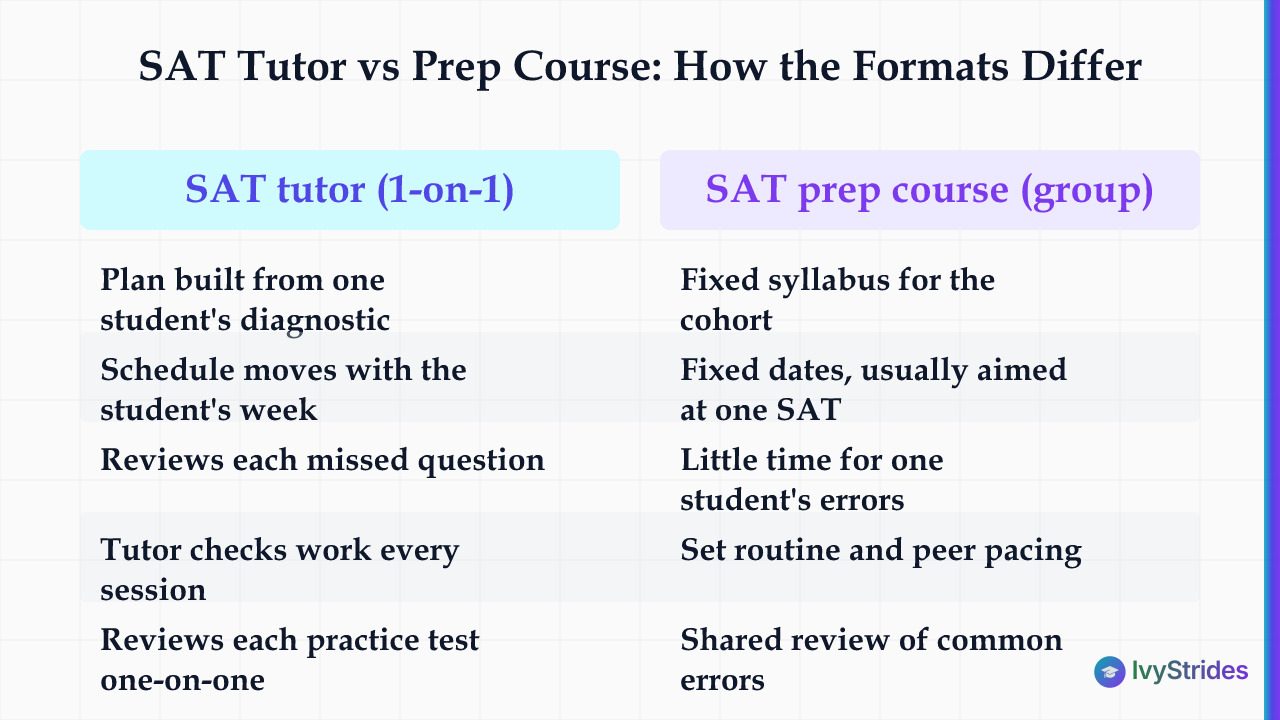
An SAT tutor and an SAT prep course differ first in who sets the plan. A tutor rebuilds each session from one student's timed diagnostic, errors and calendar; a course teaches a fixed syllabus to a cohort on fixed dates.
| Trait | SAT tutor (1-on-1) | SAT prep course (group) |
| Plan | Built from one student's diagnostic | Fixed syllabus for the cohort |
| Schedule | Moves with the student's week | Fixed dates, usually aimed at one SAT |
| Feedback on errors | Reviews each missed question | Little time for one student's errors |
| Accountability | Tutor checks work every session | Set routine and peer pacing |
| Practice-test review | Reviews each test one-on-one | Shared review of common errors |
How the adaptive modules work. The Digital SAT splits each section into two modules, with the second adapting to the first: the Reading and Writing section runs 54 questions in 64 minutes across two 32-minute modules, and the Math section runs 44 questions in 70 minutes across two 35-minute modules. That's 2 hours and 14 minutes of testing, plus a 10-minute break (College Board).
Module 1 mixes easy, medium and hard questions, and performance on it decides whether Module 2 is more or less difficult. College Board doesn't publish the routing threshold, and each student's Module 1 misses on a Bluebook practice test differ: a tutor can work through every one, while a course mostly reviews the errors a room shares.
Official tests under both formats. College Board's eight full-length practice tests, SAT Practice Tests 4 to 11, are free in Bluebook (College Board). Bluebook scores each one, and My Practice is where the student views scores, reviews questions and analyzes performance (Bluebook practice tests).
Two students with the same total can spend a tutor's first month of SAT sessions on different domains, because the plan follows each diagnostic and practice-test review.
Is It Worth Getting an SAT Tutor for Your Score Gap?
An SAT tutor is worth it when the score gap is concentrated: one section, one or two content domains, or one question type the student keeps missing. Reading each diagnostic and practice-test review for the gap's shape, not only its size, shows which kind it is.
Split the gap two ways. First by section: College Board scores each section from 200 to 800 and the total from 400 to 1600 (What Your Scores Mean). Then by domain: the report's Knowledge and Skills section shows four content areas per section, each with its approximate question count, share of the section and a performance indicator.
Reading and Writing covers Information and Ideas, Craft and Structure, Expression of Ideas, and Standard English Conventions (Reading and Writing section). Math covers Algebra, Advanced Math, Problem-Solving and Data Analysis, and Geometry and Trigonometry (Math section). Those eight domain results on an SAT score report separate a broad gap from a concentrated one.
| What the score report or diagnostic shows | What it suggests about the gap | Format that fits first |
| Low marks in one or two domains | Concentrated gap | SAT tutor |
| One section well below the other | Gap in one section | Tutor for that section |
| Same question type missed every test | Recurring, specific error | SAT tutor |
| Weak marks in most domains or untaught content | Broad gap | Prep course, then targeted work |
When the gap sits in one section, the tutor's own subject strength becomes the comparison that matters most: a Math gap needs someone who teaches SAT Math every week, not a generalist who splits the hour across both sections. IvyStrides' SAT tutor profiles by subject show which sections each tutor teaches.
College Board's Student Question Bank, with thousands of real SAT and PSAT questions, lets a student drill one domain between sessions (official SAT practice). Near the top of the scale, errors usually turn specific, so ask whether a group Digital SAT class paced for the whole room can reach them.
Making the call. So is it worth getting an SAT tutor? It is when a timed full-length diagnostic, read by section and domain, shows a concentrated gap, so read one before choosing either format. A course chosen for a concentrated gap doesn't fail loudly. It quietly spends the weeks before the next SAT on domains the student already handles.
Are SAT Prep Classes Worth It for Your Schedule and Test Date?
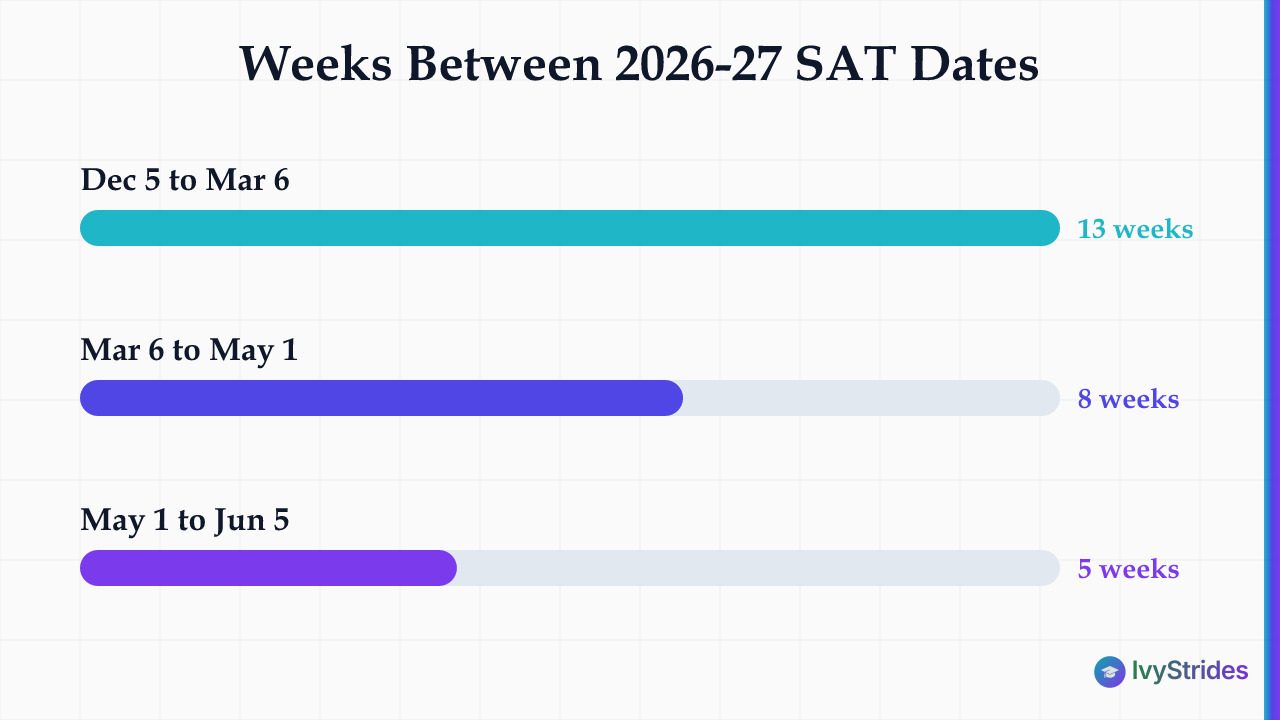
SAT prep classes are worth it when the course calendar fits the student's week and its last class lands before the target SAT date. The weeks before the next SAT are the other half of the decision: a course fixes them in advance with a set start date and set class times, while a tutor's sessions move week to week.
| SAT date | Registration deadline | Late registration and changes deadline | Student scores released |
| Dec. 5, 2026 | Nov. 20, 2026 | Nov. 24, 2026 | Dec. 18, 2026 |
| March 6, 2027 | Feb. 19, 2027 | Feb. 23, 2027 | March 19, 2027 |
| May 1, 2027 | Apr. 16, 2027 | Apr. 20, 2027 | May 14, 2027 |
| June 5, 2027 | May 21, 2027 | May 25, 2027 | June 21, 2027 |
Sources: College Board SAT dates and deadlines and score release dates. College Board applies these test dates and registration deadlines to all students, U.S. and international.
Weeks matter more than intentions here. IvyStrides' analysis of College Board's 2026-27 SAT calendar puts 13 weeks between the December 5 and March 6 SAT dates, only 8 between March 6 and May 1, and 5 between May 1 and June 5: the windows a course or a tutoring plan has to fit.
Retake timing. College Board releases scores from the December 5 SAT on December 18, nine weeks before the February 19 registration deadline for March, but scores from March 6 arrive on March 19, only four weeks before the April 16 registration deadline for May. A December tester has time to switch formats; a March tester must decide fast.
Get your Daily IV Dose on Instagram: quick study tips and test-day advice for high school students. Follow @ivy.strides.
So are SAT prep classes worth it if the student can't attend live every week? Only when the missed weeks are few, because a course sets its calendar in advance. Check its last class against the test date and the registration deadlines for every 2026-27 SAT date before enrolling.
When a class stops fitting. A sports season or exam block mid-course, a shifting week, or a May retake right after March all point to tutor sessions that can move. Before enrolling in a fixed-schedule class, check the student's weekly calendar for sports seasons and school exam weeks that fall inside the course dates.
Should You Enroll in an SAT Prep Class or Hire a Tutor? A Decision Checklist
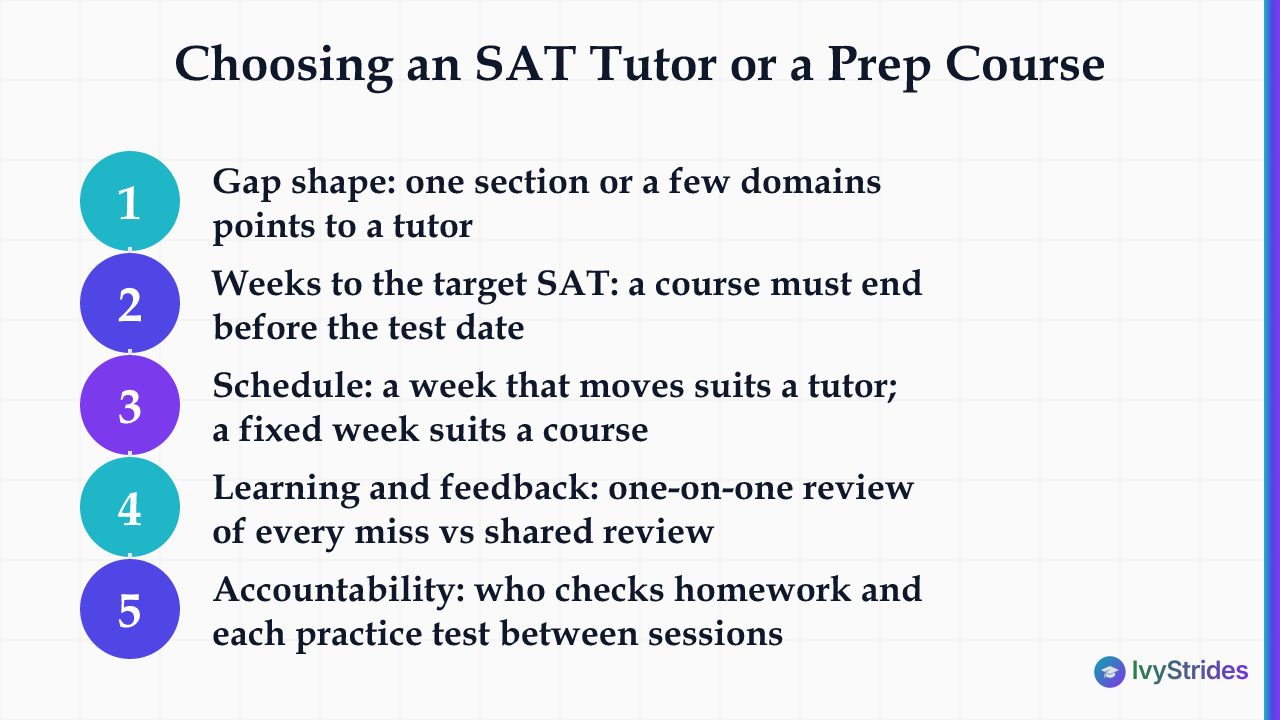
Whether to enroll in an SAT prep class or hire a tutor comes down to seven checks a student and parent answer together. Keep the weekly calendar and score report open.
-
Gap shape. Tutor if it sits in one section or a few domains; course if it spans most domains.
-
Weeks to the target SAT date. Tutor if a course would end too late; course if its calendar fits.
-
Weekly schedule stability. Tutor if sports, exams or travel move the week; course if it stays fixed.
-
How the student learns. Tutor for one-on-one explanation; course for asking questions in a room.
-
Feedback on errors. Tutor if every miss needs review; course if shared review of common errors works.
-
Accountability between sessions. Tutor if homework needs a weekly check; course if a set routine is enough.
-
Practice-test review. Tutor if each full-length practice test needs an error log reviewed together; course if class review covers it.
Who checks the work. Accountability decides more than the tutor-or-class question: a student nobody checks between sessions loses the same weeks whether the plan is live online SAT prep or self-paced study. Parents shouldn't commit before asking who checks homework, and when.
Error logs. An error log turns each full-length practice test into a plan, and reviewing SAT practice test mistakes by content domain and by module sets the focus of the next sessions in either format.
Judging the program. Once the format is settled, judge the program on its diagnostic, practice tests and progress reporting. For a concentrated gap or an irregular week, IvyStrides' 1-on-1 SAT prep starts from a diagnostic test that sets the baseline and focus areas, then re-evaluates the roadmap weekly.
The program schedules 28 live 1-on-1 sessions, 1.5 hours each, around the student's calendar and follows each of its 10 full-length Bluebook-style adaptive mock tests with a tutor review session. Tutor matching rests on the diagnostic, and questions get same-day answers by email or chat.
For a March tester, February 19 matters most: it's the March 6 registration deadline, and a week spent in the wrong format won't come back.
FAQ: SAT Tutor vs Prep Course
What SAT prep course is best?
The best SAT prep course for a student ends before their SAT date, opens with a full-length diagnostic and goes over every practice test. If the gap sits in one section, a class built for the whole room usually isn't the right tool.
What is SAT tutoring?
SAT tutoring is one-on-one prep in which the tutor plans each session from the student's own diagnostic and practice-test errors, then adjusts as results arrive. SAT tutoring online follows the same model over video.
What does an SAT math tutor or SAT English tutor work on?
An SAT math tutor works on the four Math domains, from Algebra to Geometry and Trigonometry; an SAT English tutor covers the four Reading and Writing domains, from Information and Ideas to Standard English Conventions. Both should start with the weakest domain.
What is the best SAT tutor?
The best SAT tutor teaches the section where the student loses points, starts from a timed full-length diagnostic, reviews each practice test question by question and shows the plan in writing. Ask for all four before booking.
Your Next Step: Choosing Between an SAT Tutor and a Prep Course
Three steps settle the choice, and a family can finish all three before talking to anyone:
- Read the section and domain results on the latest score report, or take a timed Bluebook practice test.
- Count the weeks to the target SAT date and its registration deadline.
- Run the seven checks together before booking or enrolling.
Watch the method, then try it: IvyStrides explains SAT and ACT question types on YouTube.

Rajesh is a technology leader, entrepreneur, and angel investor with 28+ years in Business & Technology Leadership and Product & Solution Engineering. He is passionate about education, mentoring, and driving digital transformation.