
Live Online SAT Prep vs. Self-Paced: Which Raises Your Score More?
On this page
- The Short Answer: Which Format Raises SAT Scores More?
- What Live Online SAT Prep Actually Delivers (and Where It Falls Short)
- What Self-Paced SAT Prep Actually Delivers (and Where It Falls Short)
- The Real Cost of Each Format: What You Pay vs. What You Get
- Does a Prep Course Actually Raise Your SAT Score More Than Self-Study?
- How to Decide: A Score-Band Framework for Choosing Your Format
- Is It Better to Take the SAT Online or In Person? (And Does Format Affect Prep Choice?)
- When Self-Paced SAT Prep Is the Right Choice
- A Side-by-Side Comparison: Live Online vs. Self-Paced vs. 1-on-1 SAT Prep
- Frequently Asked Questions
- Are online SAT prep courses worth it?
- What is the best SAT prep method?
- Does the Digital SAT get harder as you go through it?
- Is it better to take the SAT online or in person?
- How much does online SAT prep cost?
- Can you study for the SAT entirely by yourself?
- How does the SAT score interact with my admissions essay?
- Should I also prepare for the PSAT?
Live online SAT prep raises scores more for most students because it delivers real-time error correction, a fixed accountability structure, and coached practice on the Digital SAT's adaptive module logic. Self-paced prep works for a narrower profile: motivated students with a score gap under roughly 100 points who can accurately self-diagnose their weakest skill clusters. Cost ranges from free (the College Board's own tools) to roughly $200 to $300 for self-paced courses, around $800 or more for live group classes, and about $1,500 to $5,000+ for 1-on-1 coaching. For students chasing a 200+ point gain, 1-on-1 live coaching typically outperforms both formats in our coaching.
Digital SAT format and scoring claims in this article trace back to the College Board's Digital SAT documentation. What follows is the deeper decision guide: how each format actually works, what it costs against what it delivers, and a score-band framework so you can pick the option that matches your specific gap.
The Short Answer: Which Format Raises SAT Scores More?
Two-sentence version: live online SAT prep raises scores more for the average student because coached, real-time practice is the reliable way to train the Digital SAT's adaptive decision-making. Self-paced SAT prep wins on cost and flexibility, but the accountability gap is real, and self-diagnosis is the skill most students overestimate.
Here's the underlying mechanic. The Digital SAT is a two-section test, Reading and Writing (R&W) and SAT Math, each delivered as two adaptive modules in the Bluebook app, with a total testing time of 2 hours 14 minutes and a score scale 400–1600, per the College Board. Your performance on Module 1 sets the difficulty of Module 2. That routing decision determines your ceiling. Passive video review doesn't train the pacing and elimination habits the adaptive engine rewards; coached practice does.
Cost tiers, at a glance:
- Free: official College Board practice via Bluebook
- Self-paced courses: roughly $200 to $300
- Live online group: about $800 to $1,200
- 1-on-1 live coaching: roughly $1,500 to $5,000+
The right choice isn't the cheapest one. It's the one that closes your score gap given your schedule and your honest self-assessment of discipline. For a fuller walkthrough of the exam itself, see the official SAT study guide 2026.
What Live Online SAT Prep Actually Delivers (and Where It Falls Short)
"Live online" isn't one thing. It's three:
-
Live online group class: a scheduled cohort with one instructor teaching roughly 8 to 25 students. Real-time, but paced to the group.
-
1-on-1 live coaching: a single student with a dedicated coach, often a section-specialist (R&W or Math, not both).
-
Hybrid: recorded lessons plus scheduled live office hours or check-ins.
They aren't equivalent. Treating them as one category is where most comparison articles go wrong.
The Digital SAT's adaptive design means Module 2 difficulty is set by your Module 1 performance, so passive video review rarely builds the real-time decision-making the test rewards. In a live session, when a student misses an inference question in R&W Module 1, the coach can pause, show the error pattern (often a misread of the evidence sentence), and rerun the same skill on a fresh question inside the same hour. That feedback loop is the mechanism. It isn't the "liveness" itself. It's the ability to intercept a wrong habit before it calcifies.
Where live falls short: group live classes move at the cohort's pace, not at your weakest skill cluster. If your R&W is at 650 and your Math is at 520, a group class spends equal time on both. That's fine at 1000. It's inefficient at 1400.
This is where 1-on-1 outperforms both group live and self-paced: you can assign a Math specialist for advanced algebra and problem-solving, and an R&W specialist for evidence-based inference and rhetorical synthesis. In our coaching, students who receive real-time error correction during Module 1 practice tend to fix pacing errors (typically over-lingering on the first two hard questions) faster than students working through recorded lessons alone. If you want the section-by-section approach, this is what 1-on-1 SAT prep is built around.
For students whose main gap is comprehension speed on the R&W section, our guide to how to improve your SAT reading score unpacks the specific question types worth drilling first.
What Self-Paced SAT Prep Actually Delivers (and Where It Falls Short)
Self-paced prep has real strengths. It's cheap, it's flexible, and the best free option is genuinely good.
The College Board's own Official SAT Practice is free, includes personalized recommendations linked to your PSAT results, and is available directly through the College Board. Paid self-paced courses from major third-party providers typically run roughly $200 to $300 and bundle video lessons, drill sets, and thousands of practice questions. That's a lot of raw material for the money.
But here's the part most students miss. Self-paced prep requires you to accurately identify your own weakest skill clusters, and then discipline yourself to work on the weak ones instead of the ones that feel comfortable. That's two skills, not one. In our coaching intake diagnostics, students who used self-paced prep for 8+ weeks before seeking coaching frequently show uneven improvement: one section moved noticeably, the other stagnated. The pattern is almost always the same. They drilled the section they were already better at.
The other structural weakness is completion. Self-paced courses have no fixed session times, no coach texting to ask why you missed the practice test, no external forcing function. If your baseline is a 1420 targeting 1500, you can probably self-manage. If your baseline is 1150 targeting 1400, the honest question is: over the last twelve weeks of any subject, have you consistently studied roughly 6 to 8 hours per week on your own, without a scheduled class?
If the answer is yes, self-paced can work. Start with is free SAT prep enough to gauge fit. Layer in our official SAT practice tests to benchmark honestly every three weeks or so. If your gap between practice tests stops closing after two cycles, that's your signal to add coaching.
The Real Cost of Each Format: What You Pay vs. What You Get
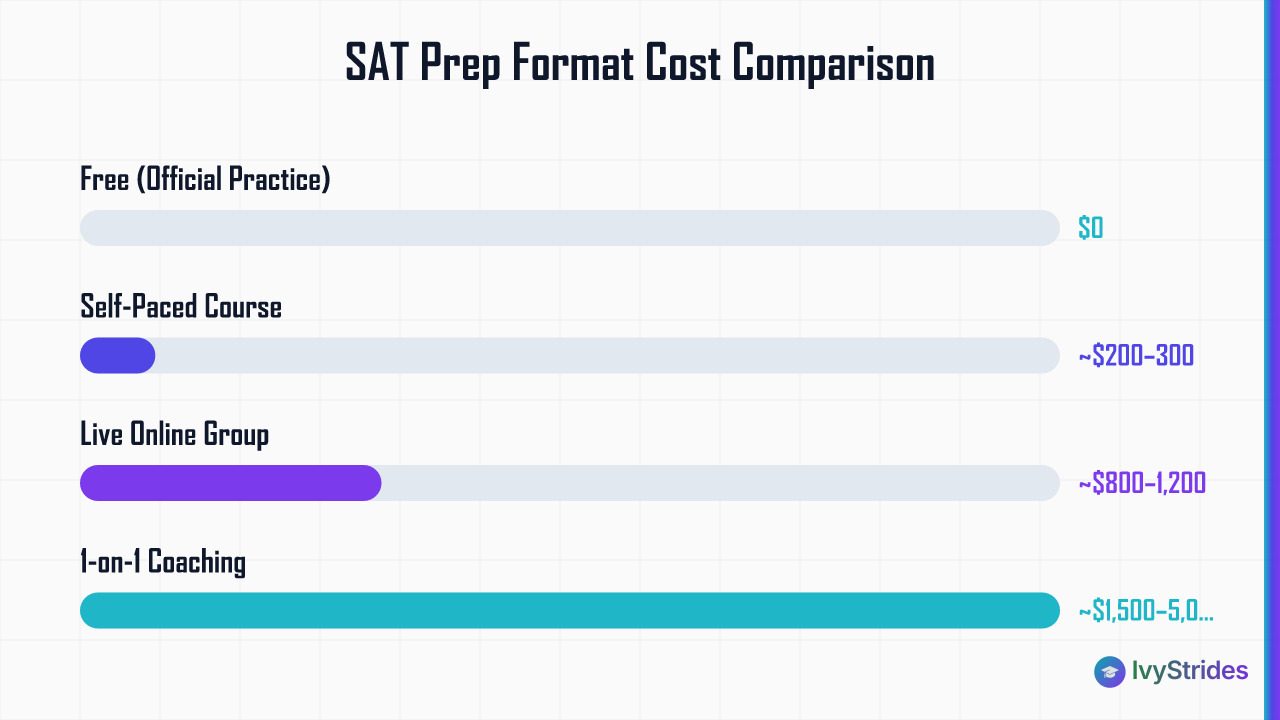
Sticker price is the wrong lens. Cost per expected score point is closer to right, though not perfectly measurable. Here's the breakdown, with all third-party figures approximate and worth verifying against current provider pricing before you commit.
- Free tier: College Board Official SAT Practice on Bluebook. Zero cost. Legitimate quality. Zero accountability, zero personalized coaching.
- Self-paced courses: roughly $200 to $300 for on-demand video, drill banks, and practice tests from mainstream third-party providers.
- Live online group: about $800 to $1,200 for typically 15 to 20 hours of scheduled live instruction with a cohort.
- 1-on-1 coaching: roughly $1,500 to $5,000+ depending on hour count and provider.
Now the ROI framing. A student who is 50 points from their target and 90 percent of the way to their consistency ceiling doesn't need a $3,000 package. Official practice plus disciplined review will do the job. A student who is 250 points from their target, with a Math score two hundred points below their R&W, has a very different calculation. Every hour of unguided practice at that gap risks reinforcing the wrong habits. The 1-on-1 investment starts to look proportional.
One caveat before you spend. Test-optional policies vary by school and year, so confirm each target college's current policy at FairTest before committing to a high-cost prep program. If your top three schools are all test-optional and you're near their non-submitter median GPA, the calculus shifts. Families routinely spend anywhere from $1,500 to $25,000+ on prep packages; that's a real financial decision, not a small line item.
For context on what score range actually matters for your target schools, check our good SAT score 2026 breakdown. If you want to see how the pieces fit together, our SAT prep overview lays out the full picture.
Does a Prep Course Actually Raise Your SAT Score More Than Self-Study?
Short answer: yes, for most students, but the reason isn't the "course." It's the methodology the course enforces.
In our coaching with students across score bands, the students who improve most consistently follow a diagnostic-first, targeted-weakness, spaced-retesting cycle, regardless of whether they start with live or self-paced prep. The reason live prep tends to win is that it forces this cycle on you. Self-paced prep permits the cycle but doesn't enforce it, and most students, understandably, drift toward practicing what feels good rather than what's weak.
The IvyStrides methodology, applied in our 1-on-1 program, has four moving parts:
-
Diagnostic full-length practice test on Bluebook to establish a real baseline, section-level and skill-level.
-
Targeted weakness work on the two or three skill clusters dragging your score most: R&W boundaries and punctuation, SAT Math advanced algebra, evidence-based inference, and so on.
-
Spaced retesting every two to three weeks to confirm gains and reroute effort.
-
Section-specialist coaching, so a Math coach coaches Math and an R&W coach coaches R&W.
In our coaching with students starting in the 1100 to 1300 band, those who follow this cycle with a section-specialist coach typically improve 200+ points across roughly 10 to 14 weeks. That's a "typical" range for students completing the program, not a guarantee. Outcomes depend on hours invested, starting score, and consistency of practice. No format credibly guarantees a specific score.
Here's the mechanistic argument for why the adaptive test punishes unguided self-study at the higher bands. A student weak in advanced algebra will land in the harder Math Module 2 only if they clear Module 1 cleanly. If they're inconsistent on Module 1 foundations, the adaptive engine routes them to the easier Module 2, and their score ceiling is capped structurally, not by knowledge. Fixing that requires diagnosing which Module 1 question types they miss under time pressure. That's not a video-lesson task.
For a deeper look at the SAT score scale, we've broken down how the adaptive scoring actually rewards performance. If your schedule is the main constraint, online SAT prep for busy students covers pacing week by week.
How to Decide: A Score-Band Framework for Choosing Your Format
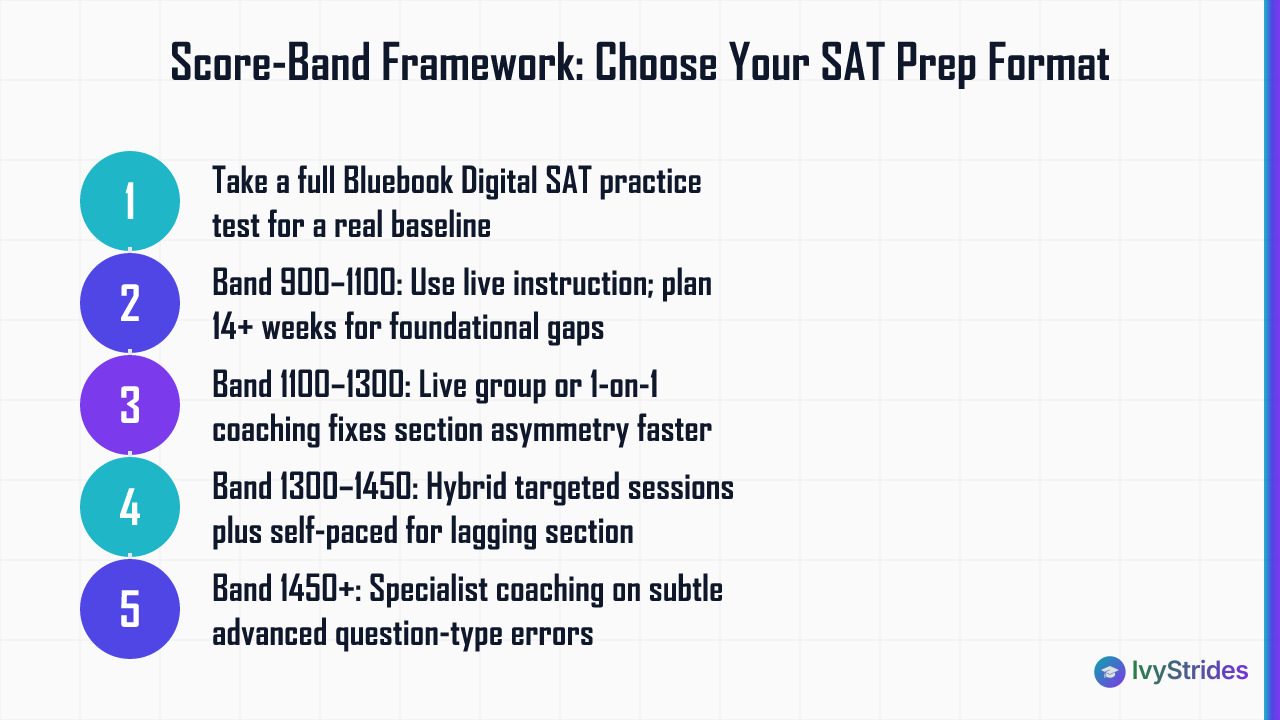
Before choosing a format, take a full-length Digital SAT practice test. Your score gap and weakest skill clusters are the single most reliable input for this decision. Everything below assumes you have a real baseline from Bluebook, not a guess.
Here's the score-band framework we use in intake calls.
Score band 900 to 1100. The gap to competitive college targets is typically 300 to 500+ points. Self-paced alone is rarely enough at this band. Foundational gaps in R&W grammar rules and SAT Math linear equations need diagnosed, sequenced instruction. Live instruction, either group or 1-on-1, is the more efficient starting point. Timeline: plan on roughly 14+ weeks of consistent work.
Score band 1100 to 1300. Gap of roughly 100 to 300 points to top-100 schools. Live online group or 1-on-1 coaching outperforms self-paced for most students in this band, based on our coaching intake patterns. The reason is diagnostic accuracy: at this band, students often have one strong section and one weak section, and self-directed practice tends to widen that asymmetry. A section-specialist coach fixes it faster.
Score band 1300 to 1450. Gap of roughly 50 to 150 points. Targeted section-specialist work (R&W or Math, whichever is lagging) is more efficient than broad self-paced review. Hybrid approaches (structured self-paced plus a handful of 1-on-1 sessions on specific question types) can work well for highly self-directed students.
Score band 1450+. Marginal gains at the top require specialist coaching on specific question types: advanced algebra with function transformations in Math Module 2, evidence-based inference and cross-text synthesis in R&W Module 2. Self-paced is rarely sufficient here because the errors are subtle and rare, and only an expert eye reliably catches the pattern.
Across all bands, the timeline that produces the most consistent improvement in our coaching cohorts is roughly 8 to 14 weeks of structured prep at 6 to 10 hours per week of focused practice. Less than 6 hours per week and gains tend to stall. More than 12 and returns diminish sharply against fatigue.
If you want a week-by-week template, our 30-Day SAT Study Plan 2026 covers the compressed version. Our digital SAT calculator helps you map raw score targets to your section goals.
Is It Better to Take the SAT Online or In Person? (And Does Format Affect Prep Choice?)
For students in the United States, this has a clear answer. The Digital SAT is the standard format. Paper-based SAT is available only in limited international contexts and specific accommodations, per the College Board. Since March 2024, if you are sitting the SAT in the US, you are sitting the Digital SAT on the Bluebook app.
That has a direct prep implication. Practice must simulate the digital adaptive environment. Working through paper-only question banks and printed practice tests, even good ones, misses two things: the on-screen annotation tools, and the psychological effect of not being able to flip back and forth across sections. Students who study only on paper often lose points on their first real Bluebook attempt purely from interface unfamiliarity.
On the "does the SAT get harder" question, which comes up often: yes, Module 2 gets harder if you performed well on Module 1, but this is the adaptive scoring mechanism per the College Board, not arbitrary difficulty ramping. Strong Module 1 performance routes you to a harder Module 2 scored on a curve that weights correct answers more generously. That's how a higher score becomes accessible. Poor Module 1 performance caps your possible score at the module-level threshold. Once students understand this, the pacing strategy on Module 1 changes: you can't afford to leave easy Module 1 questions on the table to spend extra time on the hard ones.
For the full format walkthrough, see our SAT test 2026 format and dates article, plus the exact breakdown of how many questions are on the SAT.
When Self-Paced SAT Prep Is the Right Choice
Look, we're not going to tell every student to hire a coach. There's a real profile of student for whom self-paced is the right call, and pretending otherwise would be dishonest.
Self-paced prep is a reasonable choice if all three of these are true:
-
You are within roughly 80 to 100 points of your target.
-
You can accurately identify your weakest skill clusters from a diagnostic (not just "I'm bad at Math" but "I miss function transformation questions and lose two points on system-of-equations word problems").
-
You have a consistent 6 to 8 hours per week available to study without external accountability, and a track record of finishing self-directed academic work.
If you're in this profile, our free SAT resources plus the College Board's Bluebook practice tests are a legitimate starting stack. Layer in section-specific drilling on your two or three weakest topics from our SAT math topics breakdown. Retest every three weeks or so. If gains stall for two consecutive cycles, don't sink more hours into the same approach. That's the signal to bring in an expert set of eyes, even for a one-off diagnostic review.
Honest note. Students posting on Reddit and study forums about self-paced prep often underestimate how hard it is to self-diagnose errors in advanced SAT Math topics or R&W inference questions without expert feedback. Not because they lack intelligence, but because the error patterns are subtle and often masked as "silly mistakes" that are actually structural gaps.
A Side-by-Side Comparison: Live Online vs. Self-Paced vs. 1-on-1 SAT Prep
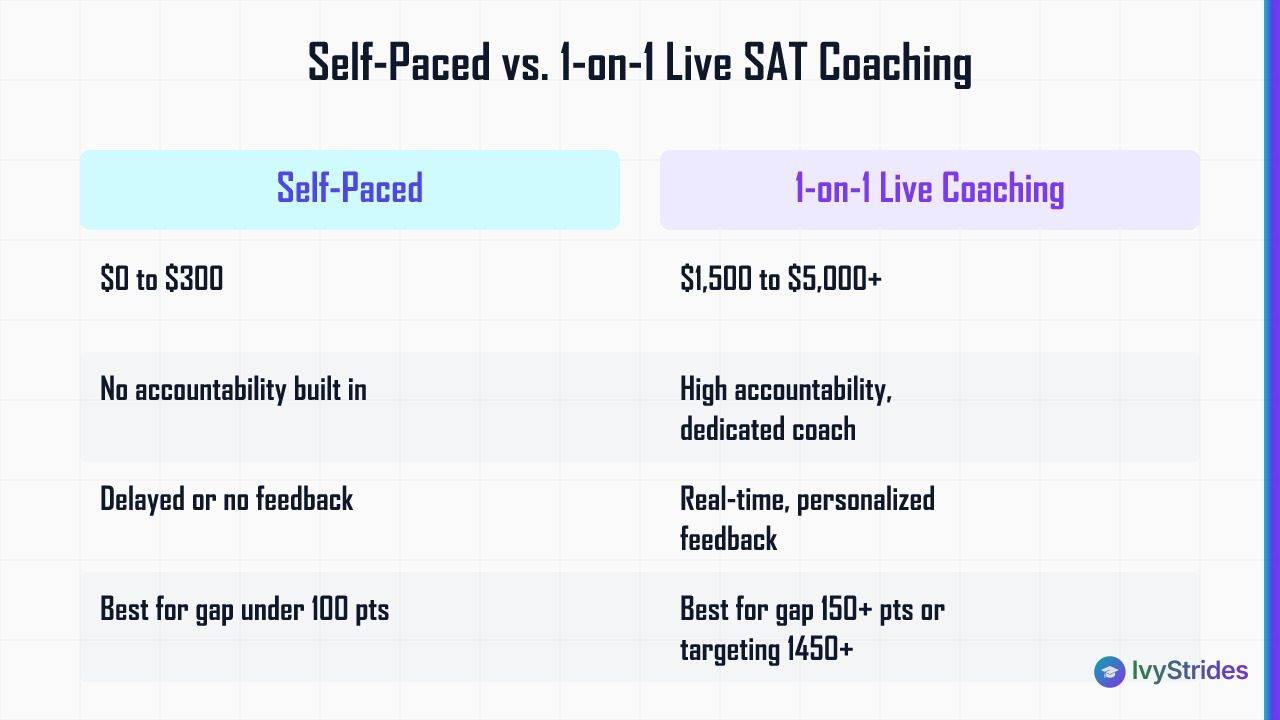
Here is the head-to-head, with all cost figures approximate and outcome ranges framed as typical rather than guaranteed.
| Format | Typical Cost | Accountability | Feedback Type | Best For | Typical Score Gain (in our coaching) |
| Self-paced | $0 to $300 | None built in | Delayed or none | Self-directed students, gap under 100 pts | Variable, uneven across sections |
| Live online group | $800 to $1,200 | Moderate, fixed schedule | Real-time, shared with cohort | Students needing structure, gap 100 to 200 pts | Moderate improvement typical |
| 1-on-1 live coaching | $1,500 to $5,000+ | High, dedicated coach | Real-time, personalized, section-specialist | Gap of 150+ pts or targeting 1450+ | 200+ point improvement typical for students completing the program |
Two things to notice. First, feedback quality scales with cost, but so does accountability, and accountability is the variable that determines whether the hours actually get in. Second, the "typical" language on outcomes is deliberate. No credible provider guarantees a specific score, and any provider that does should raise a red flag.
If you want to see when structured cohorts run, our SAT winter batch enrollment page has the current schedule. For students with a test date closing in fast, our last minute SAT tips is the compressed prep guide.
Frequently Asked Questions
Are online SAT prep courses worth it?
For most students, yes. Structured online prep with real-time feedback and accountability outperforms unguided self-study, particularly for score gaps above 100 points. The key variable is whether the program is diagnostic-driven, not whether it happens to be online. A weak online course is worse than a strong self-paced plan; a strong online course with section-specialist coaching is what moves the score.
What is the best SAT prep method?
The most effective method combines a full-length Digital SAT diagnostic test on Bluebook, targeted work on your specific weak skill clusters, spaced retesting every two to three weeks, and section-specialist instruction. Format (live vs. self-paced) matters less than whether the plan is diagnostic-driven and consistently executed. See our good SAT score 2026 breakdown for how to set the target that anchors the plan.
Does the Digital SAT get harder as you go through it?
Module 2 difficulty in each section is determined by your Module 1 performance. Strong Module 1 performance routes you to a harder Module 2, which is scored on a curve that rewards correct answers more generously and unlocks the top of the score range. This is the adaptive scoring mechanism per the College Board, not an arbitrary difficulty ramp.
Is it better to take the SAT online or in person?
For US students, the Digital SAT (administered via the Bluebook app) is the standard format as of March 2024, per the College Board. Paper-based SAT is available only in limited international contexts and specific accommodations. Prep should simulate the digital adaptive format using Bluebook or equivalent official tools.
How much does online SAT prep cost?
Costs range from free (official College Board practice) to roughly $200 to $300 for self-paced courses, about $800 to $1,200 for live online group classes, and roughly $1,500 to $5,000+ for 1-on-1 coaching. The right investment depends on your score gap, your target colleges' current policies (test-required, test-optional, or test-preferred), and your timeline.
Can you study for the SAT entirely by yourself?
Yes, if you can accurately self-diagnose your weakest skill clusters and maintain a consistent 6 to 8 hour weekly study schedule. Official College Board practice on Bluebook is a strong free starting point. Most students benefit from at least one diagnostic review with an expert to confirm their self-assessment is accurate before committing to a solo prep plan. Our SAT percentiles breakdown translates your self-diagnosed score into where you actually stand.
How does the SAT score interact with my admissions essay?
A strong SAT score and a compelling admissions essay work together. Students who address both early have more flexibility in how they position their application, particularly at test-required and test-preferred schools.
Should I also prepare for the PSAT?
If you're also targeting National Merit recognition, the prep habits you build for the Digital SAT transfer directly to PSAT/NMSQT preparation, since the two exams share the R&W and Math format structure.
The format that raises your SAT score more is the one that matches your accountability needs, your score gap, and your available study hours. Not the cheapest, not the most expensive. The one that fits. Take a diagnostic first. Then decide.

Award-winning author (South Asian Book Award) and graduate of BITS Pilani and UCLA Luskin School of Public Affairs. Brings a published writer's eye to Common App essays and grammatical precision to SAT and ACT R&W instruction.