
The Best SAT Practice Tests in 2026: What to Look For and How to Choose Wisely
On this page
- The Short Answer: Start With Bluebook, Then Supplement Wisely
- Which Bluebook SAT Practice Tests Are Most Accurate in 2026
- Can You Trust Third-Party SAT Practice Tests? An Honest Breakdown
- Not Sure Which Practice Test Score to Trust?
- How to Use Practice Tests Strategically, Not Just Frequently
- What Your Practice Test Score Actually Means: Percentiles and Target Benchmarks
- Free vs. Paid SAT Practice Tests: What You Actually Need
- When a Practice Test Score Is Not Enough: What to Do Next
- FAQ
- Which SAT practice test is the most accurate predictor of my real score?
- Is a 1500 SAT score in the top 1% of test-takers?
- Are the SAT practice tests on Bluebook easier than the real exam?
- Is getting a 1200 on the SAT hard?
- How many full-length SAT practice tests are available on Bluebook?
- Should I take a practice test the day before the SAT?
- The Next Step
- Ready to Turn Your Practice Test Score Into Real Progress?
The best SAT practice tests in 2026 are the official full-length tests inside the Bluebook app from College Board. Bluebook currently offers up to 11 full-length Digital SAT practice tests, all free, all adaptive, and delivered in the same interface as the real exam. Test 11 is widely considered the closest to current exam difficulty. Third-party tests can supplement Bluebook once you've worked through the official set, but their scoring accuracy varies, sometimes by roughly 30 to 80 points against a student's real score.
These test counts and format specs come from College Board's official practice-test portal. The harder question, and the one this article answers, is which Bluebook tests to save for later, when to trust a third-party score, and how to turn any practice test into progress instead of just a number on a report.
The Short Answer: Start With Bluebook, Then Supplement Wisely
If you're preparing for the Digital SAT and you have limited hours, here's the sequence that works:
-
Download the Bluebook app directly from College Board.
-
Take one full-length Bluebook test under timed conditions as your diagnostic.
-
Work through targeted review for roughly two to three weeks.
-
Retake a different Bluebook test to measure gain.
-
Only after you've used four or five Bluebook tests should you look at third-party full-lengths for additional volume.
Why start with Bluebook? The Digital SAT is adaptive. The exam has two sections, Reading and Writing (RW) and Math, and each section has two modules. Module 2 difficulty is determined by your performance on Module 1. Total testing time runs 2 hours and 14 minutes, and the score scale is 400 to 1600. Only Bluebook replicates this two-module adaptive structure exactly, because Bluebook is the same app College Board uses to deliver the real exam. Some free online prep platforms partner with College Board and offer strong skill-level drills, but their full-length simulations don't fully replicate the adaptive module structure.
For context on how these tests fit into a full prep sequence, see our SAT prep overview.
Which Bluebook SAT Practice Tests Are Most Accurate in 2026
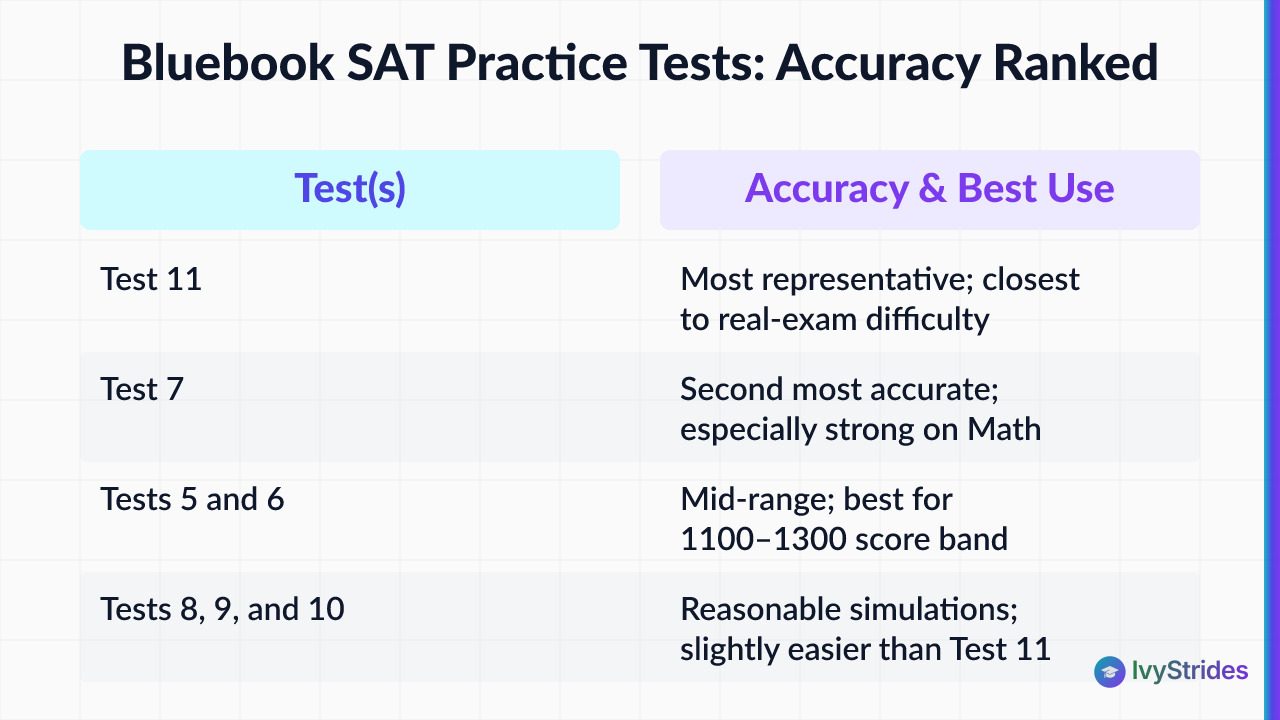
Not every Bluebook test is equally representative. In our coaching, students often score roughly 100 points higher on Test 4 than on Test 11 under identical conditions. Same student, same week. The tests are calibrated differently.
Here's how we rank them by format fidelity to the current exam:
Most representative (save for late in your prep):
- Test 11 is the closest to current real-exam difficulty. The Module 2 hard-question set on both RW and Math mirrors what students report seeing on recent test dates.
- Test 7 runs a close second, particularly on Math.
Solid mid-range (use in the middle of your prep):
- Tests 5 and 6 are useful for students in the 1100 to 1300 score band. Difficulty sits at the level where students in this range can identify weaknesses without getting demoralized.
- Tests 8, 9, and 10 are reasonable simulations, though slightly easier than Test 11.
Least representative (use for early diagnostics only):
- Test 4 is generally considered the easiest and least representative of current exam difficulty. Fine as an untimed diagnostic, but don't use it to predict your real score.
Students in our coaching who have raised their SAT score by 200 or more points typically start with a Bluebook diagnostic, identify two or three high-frequency weakness areas, and retest on a second Bluebook test four to six weeks later. That pattern holds across score bands. For the full framework, see how to raise your SAT score 200 points.
Beyond the 11 full-length tests, the College Board Question Bank inside Bluebook offers additional adaptive practice items sorted by skill. It's underused. New Bluebook tests for the 2026 to 2027 cycle are expected in late summer 2026, per College Board's Digital SAT test information site. If you're prepping for a fall 2026 test date, watch that release.
For a curated set of full-length simulations with score-band analysis, see our official SAT practice tests library.
Can You Trust Third-Party SAT Practice Tests? An Honest Breakdown
Short answer: sometimes for questions, rarely for scores.
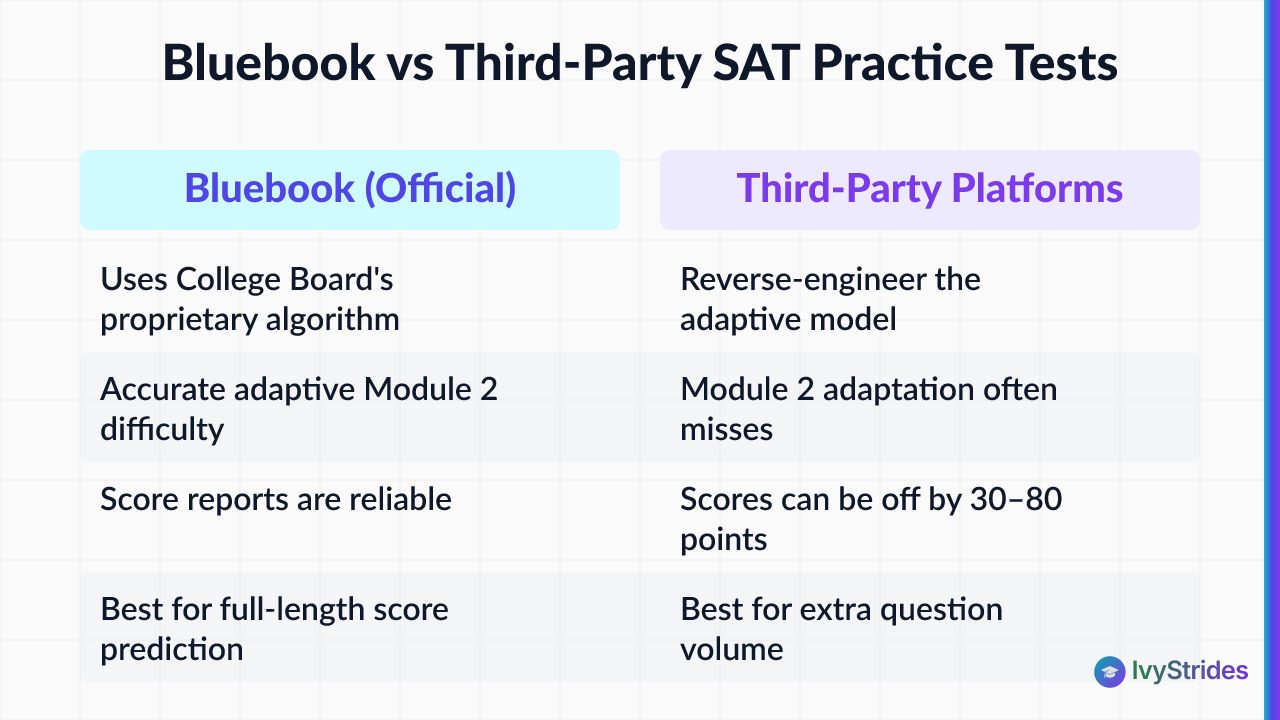
Here's why. The real Digital SAT's Module 2 difficulty is determined by your Module 1 performance through a proprietary scoring model that only College Board uses. No third-party platform has access to that algorithm. Providers reverse-engineer it. Some do a reasonable job. Others miss badly, and their scoring reports either inflate or deflate a student's projected score.
In our coaching, students at the 1100 to 1400 band who relied solely on third-party tests before their first real SAT often saw a discrepancy of roughly 30 to 80 points between their practice average and their actual score. That's a full letter grade of misdirection. A student targeting 1450 who has been scoring 1450 on a third-party platform may walk in expecting a score they haven't actually earned.
A quick honest read on the main options:
- Free platforms partnered with College Board are the closest free alternative to Bluebook outside the app itself. Strong for skill-building and targeted practice questions between full-length tests, but their full-length simulations don't fully replicate Bluebook's adaptive module structure in all practice modes.
- Major third-party prep publishers vary widely in question quality and scoring accuracy. Their timed section drills are more useful than their full-length score predictions.
- Newer adaptive platforms have recalibrated difficulty in 2025 to better match the real exam. Piqosity, for instance, updated its scoring methodology in March 2025 and now runs closer to real exam difficulty than earlier iterations. Still not Bluebook, but closer than it was.
Rule of thumb: use third-party tests for additional question volume after you've worked through Bluebook. Trust their question quality more than their score reports. If your third-party score jumps 100 points overnight, retake a Bluebook test to confirm the gain before you celebrate.
For the exact number of practice tests to plan for, see how many SAT practice tests should you take.
Not Sure Which Practice Test Score to Trust?
Book a free 15-minute strategy call. We'll review your most recent practice test score, identify your highest-leverage weaknesses, and recommend the right next step, whether that's more Bluebook tests, targeted section work, or 1-on-1 coaching. Parents and students both welcome on the call.
How to Use Practice Tests Strategically, Not Just Frequently
Look, the number of practice tests you take matters less than what happens between them. A practice test without structured review produces a score, not progress.
The first practice test should be a diagnostic: taken under timed conditions to establish a valid baseline, then reviewed slowly and untimed to identify error patterns. Every subsequent test should be a timed simulation: taken under real exam conditions to measure gain.
In our coaching, students who take a practice test every week without reviewing errors between tests show minimal score improvement. Students who space tests three to four weeks apart with targeted weakness work in between show typical gains of roughly 50 to 150 points per cycle. The tests aren't doing the work. The review is.
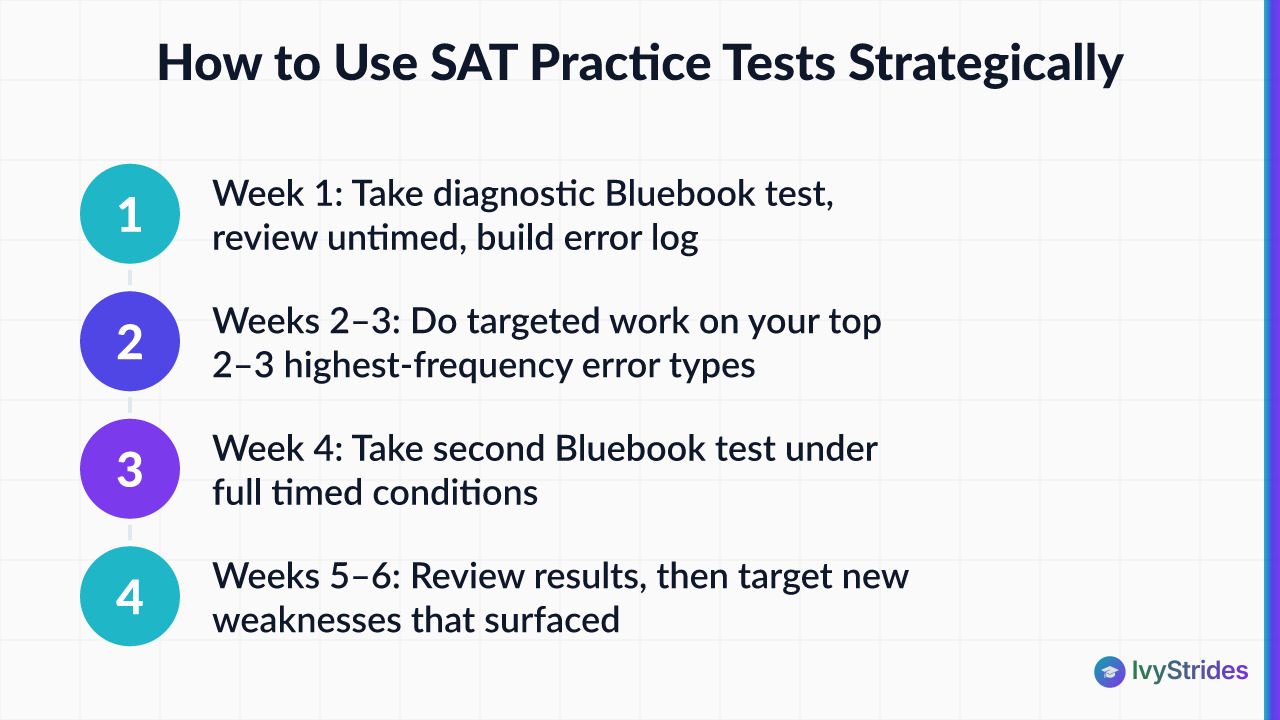
A workable structure looks like this:
- Week 1: diagnostic Bluebook test, full untimed review, error log built.
- Weeks 2 to 3: targeted weakness work on the two or three highest-frequency error types. If your RW section score is lower than your Math score, that's where the hours go.
- Week 4: second Bluebook test under timed conditions.
- Weeks 5 to 6: review, then targeted work on the new weaknesses that surfaced.
Read your section scores separately. A 1200 composite with 550 RW and 650 Math is a completely different prep problem than a 1200 composite with 620 RW and 580 Math. The first student needs Reading and Writing focus. The second needs Math. Same total score, opposite prep plans.
Before scheduling your first full-length practice test, confirm your actual sat test dates 2026 so you can space your practice tests at the right intervals. Pair your Bluebook tests with a week-by-week sat study plan to turn each diagnostic into targeted improvement. For a simple error-tracking template, grab our free sat mistake tracker.
What Your Practice Test Score Actually Means: Percentiles and Target Benchmarks
Your practice test score is a number. The percentile is what turns it into a decision.
Here are the approximate SAT score percentiles families should know:
- 1000 or above: roughly the top 50% of test-takers.
- 1200 or above: about the top 25%. Not easy without preparation.
- 1350 or above: approximately the top 10%.
- 1450 or above: around the top 1%.
- 1600: perfect score, achieved by fewer than 1% of test-takers.
One correction worth making because it appears everywhere online: a 1500 is not top 1%. It's excellent, roughly top 1 to 2%, but the top 1% cutoff typically begins around 1450 to 1480 depending on the testing year. Students often assume they need a 1500 to hit that threshold. They don't.
For context, the middle 50% SAT range at Ivy League schools typically runs from about 1500 to 1580, per each school's Common Data Set. Verify the exact range at your target schools by searching "Common Data Set [University Name]" and reading Section C9. Numbers move year to year.
Two caveats matter here. First, test-optional policies vary by school and year. A strong SAT score helps but doesn't guarantee admission, and some schools remain test-optional or test-blind for specific application cycles. Second, admissions outcomes depend on the full application: essays, transcript, activities, and context. Test scores are one input, not the whole story.
For a deeper look at score targets, see is 1500 a good sat score for ivy league. If you're still figuring out what your target should be, what is a good sat score 2026 walks through it by admissions tier. And if your practice test scores are consistently lower than expected and you're wondering whether the ACT might be a better fit, a side-by-side comparison of the two exams can help you decide before committing to a full prep cycle.
Free vs. Paid SAT Practice Tests: What You Actually Need
Here's the honest read: for most students, free is enough.
The 11 free Bluebook tests plus College Board's Question Bank provide enough full-length practice volume for a roughly three-to-six-month prep cycle. Add in official College Board partner drills for skill-level work between tests, and a typical student in the 1100 to 1400 band has more than enough material to hit their target score without spending a dollar on practice tests themselves.
Paid third-party tests add real value in two specific cases:
-
You've worked through all 11 Bluebook tests and still have prep time before your exam date.
-
You need additional volume in a specific section, like Math Module 2 hard questions, that Bluebook doesn't provide enough of.
If either applies, some third-party platforms are worth the money for the extra full-length simulations. Most students never reach that point.
One caveat on downloadable practice: College Board does publish linear (non-adaptive) paper-format practice tests as PDFs on the SAT practice test page. These are fine for content review, but they don't replicate the adaptive scoring of the real Digital SAT. Use them for question exposure, not for score prediction.
Our own SAT resource sheet points to the genuinely free tools worth your time. If you're prepping the math section specifically, our digital sat calculator guide covers how to use Bluebook's built-in Desmos calculator efficiently.
When a Practice Test Score Is Not Enough: What to Do Next
Some students take three or four Bluebook tests and their score barely moves. If that's you, the problem isn't the tests. It's usually one of three things.
Untargeted review. Students review all errors equally instead of focusing on the two or three highest-frequency question types. In our coaching, when a student's error log shows 12 mistakes across a Bluebook test, we typically find that 7 or 8 come from just two or three question types, often inference-heavy Reading passages or Module 2 nonlinear-function Math items. Fix those, and the composite score moves. Fix everything equally, and it doesn't.
Insufficient spacing. Practice tests taken three days apart don't leave room for real learning. The gap between tests is where scores grow.
Section-specific weakness that needs specialist instruction. SAT R&W Module 2 hard questions require a different tactical approach than Math Module 2 hard questions. A generalist tutor covering both often misses the section-specific patterns. Our coaches specialize by section, not across both, for exactly this reason.
Typical outcomes for students completing our diagnostic-led program: roughly 200 or more point improvement for students starting below 1300, and about 100 to 150 point improvement for students starting in the 1300 to 1450 range. These are typical gains, not guarantees. Every student's timeline depends on hours committed and starting weakness profile.
If you know you want structured support, our 1-on-1 SAT prep starts with a full-length Bluebook diagnostic and assigns a section-specialist coach based on the results. For students planning further ahead, SAT winter batch enrollment opens for the spring test cycle. For students balancing SAT prep with a heavy course load, online SAT prep for busy students covers how to structure prep around 15 to 20 hours a week of academic commitments.
FAQ
Which SAT practice test is the most accurate predictor of my real score?
Bluebook Test 11 is the most widely cited as closest to current real-exam difficulty and scoring. Any official Bluebook test will predict your real score more accurately than a third-party test, because only Bluebook replicates the adaptive two-module structure. Third-party tests can overestimate or underestimate your score by roughly 30 to 80 points depending on the provider's scoring calibration.
Is a 1500 SAT score in the top 1% of test-takers?
No. A 1500 is an excellent score, placing a student approximately in the top 1 to 2%, but the top 1% threshold typically begins around 1450 to 1480 depending on the testing year. A 1600 perfect score is achieved by fewer than 1% of students. In admissions context, a 1500 sits within the middle 50% range for many highly selective colleges, including several Ivy League schools.
Are the SAT practice tests on Bluebook easier than the real exam?
It depends which test. Some Bluebook tests, notably Test 4, are considered easier than the current real exam, while Test 11 is considered the most representative. Students sometimes score higher on easier Bluebook tests and are surprised by their real score. This is why sequencing matters: save the harder, more representative tests like Test 7 and Test 11 for late in your prep cycle, closer to your real exam date.
Is getting a 1200 on the SAT hard?
A 1200 places a student in approximately the top 25%, which means about 75% of students score below it. It's a meaningful milestone that requires solid preparation, particularly in SAT Math. For students starting in the 900 to 1050 range, reaching 1200 typically takes roughly six to ten weeks of targeted prep, based on patterns we see in our coaching. Achievable with consistent work, but not something most students reach without deliberate practice.
How many full-length SAT practice tests are available on Bluebook?
As of 2026, College Board has published up to 11 full-length Digital SAT practice tests in the Bluebook app, all free. New tests for the 2026 to 2027 testing cycle are expected to be added in late summer 2026. Bluebook also maintains a Question Bank with additional adaptive practice items sorted by skill, useful for targeted work between full-length tests.
Should I take a practice test the day before the SAT?
No. Taking a full-length practice test the day before your real SAT is counterproductive. It depletes mental energy and can increase test anxiety without providing any meaningful score benefit. Your last full-length practice test should be taken at least five to seven days before your real exam date. The day before the exam should be reserved for light review of your most common error types, logistics prep (route to the test center, IDs, snacks), and rest.
The Next Step
Picking the right practice test is straightforward once you know what to look for. Turning that practice test score into a 200-point gain is where most students stall. The diagnostic is only useful if what happens after it is targeted, specific, and taught by someone who knows the difference between an RW Module 2 inference question and a Math Module 2 nonlinear-function question.
Ready to Turn Your Practice Test Score Into Real Progress?
Our diagnostic-first approach starts with a full-length Bluebook test, identifies your exact weaknesses, and assigns a section-specialist coach to close the gap. Students completing the program typically improve by 200 or more points. Book a free 15-minute call to see what's possible for your score band. Parents welcome.
Two decades teaching quantitative and verbal aptitude on standardized tests. Rare dual expertise across Math and Verbal — particularly effective for students with gaps on both sides. Senior AP Mentor for our Calculus and English tracks.