
Is a Group Digital SAT Class Enough to Move a 1400 to 1500?

On this page
- How the Digital SAT Adaptive Structure Works at the 1400 Band
- What a Group Digital SAT Class Can and Cannot Fix at 1400
- Where a 1400 Student Loses Points on the Digital SAT Reading and Writing Section
- What the Digital SAT Math Section Requires at the 1400-to-1500 Band
- FAQ: Moving from 1400 Toward a Digital SAT 1600
- How easy is it to get a 1600 on the SAT?
- Can I prepare for SAT online?
- How do I go from a 1500 to a 1600 on the Digital SAT?
- How many hours do I need to study to get a 1600 on the Digital SAT?
- Your Next Step Toward a Higher Digital SAT Score
A group Digital SAT class can be enough when your missed points are spread across content; when they sit in a few question types, you need someone to diagnose your own errors. The Digital SAT is a two-section adaptive exam scored on the 400 to 1600 scale, and a 1400 is already the 93rd user-group percentile.
The hard part is knowing which question types are costing you points. That answer is personal to your error pattern, and a class teaching many students at once cannot read it student by student.
How the Digital SAT Adaptive Structure Works at the 1400 Band
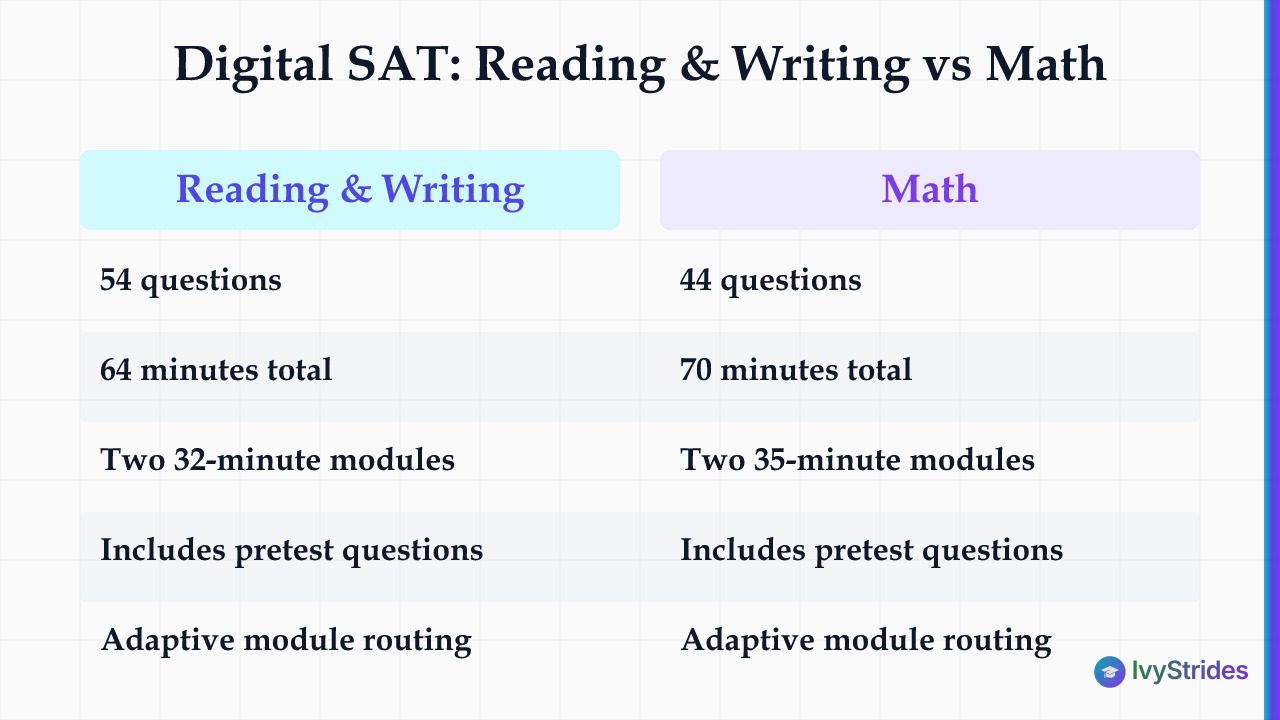
The Digital SAT uses adaptive module routing: how you perform on Module 1 of a section decides whether Module 2 serves you a harder or easier mix of questions.
Each section splits into two equal-length modules, and your section score draws on all questions in both. College Board states that a range of section scores is possible no matter which second module a student sees.
Those routing mechanics sit inside a fixed shape. The Digital SAT runs 98 questions in 2 hours and 14 minutes of testing time, with a 10-minute break between the two sections. Each module quietly includes 2 pretest questions that do not count toward your score, mixed in with the operational ones.
| Section | Questions | Time | Module Length | Adaptive? |
| Reading and Writing | 54 | 64 min | Two 32-min modules | Yes |
| Math | 44 | 70 min | Two 35-min modules | Yes |
| Full test | 98 | 2 hr 14 min | Four modules | By section |
The percentile math is why this jump feels different. A 1400 sits at the 93rd user-group percentile and a 1500 at the 97th. That reads like a 4-point percentile move, but you're now clearing students who are themselves strong testers. For the full scoring mechanics, read how adaptive modules turn into a 1600-scale score.
What a Group Digital SAT Class Can and Cannot Fix at 1400

A group Digital SAT class covers content broadly: the common question types, pacing rules, and strategies that help a wide range of students. What it cannot do is read one student's practice test and name the exact error pattern driving that student's wrong answers. At 1400, in our view, that diagnosis is most of the work.
Here's the part most students miss. The Digital SAT is scored with Item Response Theory, which means two students who answer the same number of questions correctly can earn different section scores, depending on which questions they got right. So no fixed "you need N more correct" count works for a whole class. The jump from 1400 to 1500 is about which questions, not how many.
The pattern, not the count. In our coaching, a 1400 plateau often reflects errors concentrated in two or three question types rather than broad gaps across every domain. A class built for a group can't target yours.
| Prep Type | What It Addresses | What It Cannot Address | Best For |
| Group class | Broad content, common question types, pacing | Your individual error pattern | Students building foundations |
| Individual coaching | Diagnosing the specific question types driving your errors | Broad foundational gaps across every domain | Students stuck at a known band |
A full-length timed Bluebook practice test lets you review every question afterward, so you can see which Module 2 questions you missed and why.
Official SAT score reports work differently: they show performance by content domain, not question by question. A class median can't surface that. For context on what a 1500 buys you in admissions, see whether 1500 is a strong score for Ivy League applicants. Test-optional policies vary by school and year, and a score is one factor in a full application, not the only one.
Where a 1400 Student Loses Points on the Digital SAT Reading and Writing Section
In our coaching, 1400-band students often lose Reading and Writing points in two domains: Information and Ideas and Craft and Structure. The section runs 54 questions in 64 minutes across two 32-minute modules.
Information and Ideas includes evidence questions in two flavors: textual, where you pick the quote that supports a claim, and quantitative, where you read a graph or table and choose the data point that backs an argument. Craft and Structure covers Words in Context, Text Structure and Purpose, and Cross-Text Connections, the paired-passage questions that trip up strong readers.
Pull up the review of your last Bluebook practice test and check your misses against this list.
- Textual evidence questions in Information and Ideas: did you pick the weaker support quote?
- Quantitative evidence questions in Information and Ideas: did a graph question cost you?
- Words in Context: did a second-best vocabulary choice slip in?
- Cross-Text Connections: did the paired passages confuse the two authors' views?
- Text Structure and Purpose: did you miss the function of a sentence?
For a question-by-question breakdown of what Information and Ideas demands at 1400 versus 1500, see our score-band guide. For the full domain map, start with what each Reading and Writing domain asks of you.
What the Digital SAT Math Section Requires at the 1400-to-1500 Band
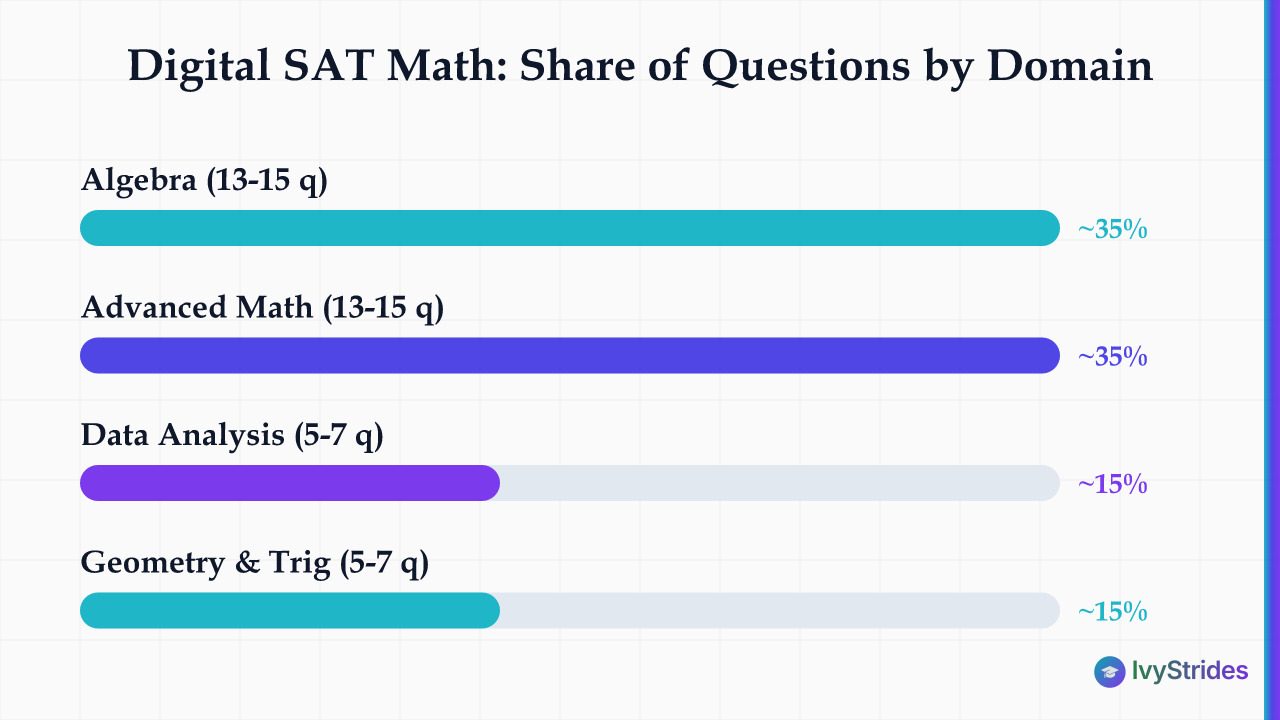
In our coaching, 1400-band students most often lose Math points in Advanced Math and Problem-Solving and Data Analysis. The section runs 44 questions in 70 minutes across two 35-minute modules. College Board publishes those two figures but not the per-question pace; IvyStrides divides them to about 95 seconds per question.
The weights differ: per College Board's assessment framework, Advanced Math is about 35% of the section (13 to 15 questions) and Problem-Solving and Data Analysis about 15% (5 to 7). The built-in Desmos graphing calculator, available for the entire Math section, can graph a nonlinear system in seconds, which is faster than solving by hand and may leave more time for later questions.
| Domain | Common Miss at 1400 | What to Practice |
| Algebra | Occasional slip under time | Bank time here for harder items |
| Advanced Math | Miss nonlinear functions | Graph it in Desmos, verify roots |
| Problem-Solving and Data Analysis | Misread ratios, rates, data | Translate the prompt first |
| Geometry and Trigonometry | Forget a formula | Use the reference sheet fast |
The middle column reflects patterns IvyStrides sees in coaching, not College Board data.
Diagnostic first, always. IvyStrides' approach starts with a timed Bluebook practice test as a diagnostic, reviewing which Module 2 Math questions a student missed and why. Once the specific domains are named, the work is targeted, not general.
The full topic list walks through every Math topic, domain by domain. If your misses are spread across content, our SAT prep classes cover it with a cohort. If they sit in two domains, a coach who builds the plan around your weakest domains is the closer fit.
FAQ: Moving from 1400 Toward a Digital SAT 1600
How easy is it to get a 1600 on the SAT?
A 1600 means an 800 on both the Reading and Writing section and the Math section.
In practice, that requires answering nearly every operational question correctly across all four modules, though IRT scoring means the exact threshold can vary slightly. At the 1400-to-1500 band, the path to 1600 runs through eliminating every remaining error type, one at a time. It takes sustained, targeted work after you first reach 1500.
Can I prepare for SAT online?
Yes. The Digital SAT is taken on a computer, and official adaptive practice runs through College Board's Bluebook app. Online prep ranges from free self-directed resources to live one-on-one coaching. At the 1400 band, the format of prep matters less than whether it addresses your specific error pattern.
How do I go from a 1500 to a 1600 on the Digital SAT?
A 1600 means an 800 on both sections. In our coaching, misses at that band tend to be the hardest questions: nonlinear functions in Math, and Cross-Text Connections or quantitative evidence questions in Reading and Writing. Each wrong answer needs a root-cause review, not just more practice of the same type.
How many hours do I need to study to get a 1600 on the Digital SAT?
There's no single hour count, because it depends on your starting score and which question types you're missing. IvyStrides doesn't publish an hour figure for a score outcome. Moving from 1500 toward 1600 means working on the hardest question types in both sections.
Your Next Step Toward a Higher Digital SAT Score
A group class gets you the content. Working on a 1400-to-1500 gap takes a map of your own errors, which a class median can't give you. Start where the signal is clearest.
- Take one timed full-length Digital SAT in Bluebook.
- Review it question by question, sorting misses by domain.
- Flag your top two Reading and Writing domains and your top two Math domains.
- Decide whether a class or one-on-one work fits that pattern before your next test date (after October 3, the 2026 dates are November 7 and December 5).
Two decades teaching quantitative and verbal aptitude on standardized tests. Rare dual expertise across Math and Verbal — particularly effective for students with gaps on both sides. Senior AP Mentor for our Calculus and English tracks.