
SAT or ACT With ADHD: Which Test Fits, and How to Get Accommodations
On this page
- Is the SAT or ACT Better for ADHD? How the Formats Compare
- Which Test Is Easier With ADHD, SAT or ACT? Pace and Breaks Decide
- Does ADHD Get Extra Time on the SAT and ACT? Accommodations Compared
- Before Choosing With ADHD, Take a Practice ACT Test and a Bluebook SAT
- FAQ: SAT or ACT With ADHD
- Is it easier to get accommodations for the ACT than the SAT?
- ACT or SAT for a student with accommodations?
- Do colleges prefer the ACT or the SAT?
- How do you overcome undiagnosed ADHD while reviewing for the SAT or ACT?
- Your Next Step on the SAT or ACT With ADHD
Neither the SAT nor the ACT is better for ADHD as a rule. The digital SAT is a two-section adaptive exam allowing about 82 seconds per question; the Enhanced ACT core allows about 57. Extended time and extra breaks need approval on both, so compare them at the timing a student will get.
Those pace figures divide the minutes and questions on College Board's How the SAT Is Structured page and ACT's exam sections and timing page. Each test maker approves accommodations separately, with the next request deadlines in January 2027.
Is the SAT or ACT Better for ADHD? How the Formats Compare
The digital SAT and the Enhanced ACT fit students with ADHD differently, and neither is better for ADHD as a fact. So, is the SAT or ACT better for ADHD? That's a question of time per question, timer length, break placement and attention across a sitting.
| Feature | Digital SAT | Enhanced ACT |
| Questions and time | 98 questions in 2 hours 14 minutes | 131 core questions in 125 minutes |
| Timed parts | Two 32-minute Reading and Writing modules, two 35-minute Math modules | English 35, Math 50, Reading 40 minutes |
| Calculator | Built-in Desmos for the entire Math section | Allowed on Math |
| Optional sections | None; two sections only | Science, 40 questions in 40 minutes; Writing, one 40-minute essay |
What each test maker claims. College Board's BigFuture comparison says the SAT gives between 41% and 44% more time per question than the ACT, depending on Science. ACT's ACT vs. SAT page says questions on the two tests have very similar levels of average difficulty.
Pace, block length and breaks are the parts of the SAT and ACT comparison that change most for a student with ADHD. The SAT vs ACT differences in scoring, calculators and Science matter once the timing question is settled.
Which Test Is Easier With ADHD, SAT or ACT? Pace and Breaks Decide

Photo by RDNE Stock project on Pexels
Which test is easier, SAT or ACT, with ADHD? Neither the SAT nor the ACT is easier for every student with ADHD, because the same format comparison lands differently on different students. The National Institute of Mental Health describes ADHD as a neurodevelopmental disorder characterized by inattention, hyperactivity and impulsivity.
NIMH notes that inattention is strongest for some people and hyperactivity and impulsivity for others, which is one reason no single test format suits every student with ADHD.
| What you notice in timed practice | Format feature | Digital SAT | Enhanced ACT |
| Unfinished questions | Time per question | Reading and Writing about 71 sec; Math about 95 | English 42 sec; Math, Reading about 67 |
| Focus fades midway | Longest single timer | 35-minute Math module | 50-minute Math section |
| Needing a reset | Scheduled break | 10 minutes between sections | Short break after the second test |
| Losing the thread | Reading load | Short passages, one question each | Passage sets; paired passages |
| A rough start snowballs | Adaptive design | Module 1 sets the adaptive second module | Linear, not adaptive |
Sources: College Board Assessment Framework; ACT Test Day page. Seconds per question divide each part's minutes by its questions.
Is the ACT easier than the SAT? Only for a student whose rows in that table favor it, and forum reputation can't show that; a timed official test of each can. Once the timing is known, pacing practice has to match it, section by section.
Does ADHD Get Extra Time on the SAT and ACT? Accommodations Compared
ADHD doesn't bring extra time automatically on the SAT or the ACT, because College Board's Services for Students with Disabilities (SSD) and ACT must each approve accommodations before testing. The timing that pacing practice should match, section by section, comes from that approval.
So does ADHD get extra time on SAT test day? Only with approval, and College Board's extended time guidance says to request it only when a disability causes slower work. The same page says a small group setting may help students with ADHD reduce distractions, and College Board's breaks page says extra breaks help some who struggle to focus for extended periods.
SAT timing with accommodations. With time and one-half, the SAT takes 3 hours and 21 minutes plus breaks, and double time 4 hours and 28 minutes plus breaks (College Board's SAT accommodations page). Extended time includes extra breaks, and approval in reading covers the whole test. Extra breaks add two 5-minute breaks, extended breaks give one 20-minute break, and breaks as needed are the only type with a pause button.
ACT timing with accommodations. ACT's accommodated timings sheet sets one and one-half time at 52 minutes and 30 seconds for English, 75 minutes for Math and 60 each for Reading, Science and Writing. IvyStrides' analysis of that 2026 sheet puts the time-and-a-half ACT core at 187.5 minutes, or 247.5 with Science, against College Board's 3 hours 21 minutes plus breaks for the SAT.
ACT gives one and one-half time and small group testing in a national test center's extended time room; stop-the-clock breaks mean an individual room (ACT) and, per the timings sheet, up to 90 minutes of total break time. Special testing, usually at school, covers multiple-day testing.
Get your Daily IV Dose on Instagram: quick study tips and test-day advice for high school students. Follow @ivy.strides.
| Question | SAT (College Board SSD) | ACT |
| Who usually submits? | School SSD coordinator, in SSD Online | School official, in the Test Accessibility and Accommodations System (TAA) |
| IEP or 504 plan? | Not automatic; sometimes nothing more needed | Current plan suffices for same allowable accommodations |
| ADHD documentation | DSM diagnosis, testing, functional limitations; medical note usually not enough | Without a plan: licensed, qualified professional's letter or report; DSM-5 |
| Review time | Up to seven weeks after documentation | Varies; ask the school after 10 business days |
| Next weekend-test deadline | January 15, 2027 (March 6 SAT) | January 22, 2027 (February 27 ACT) |
The forms behind each request. College Board needs a parent or guardian's consent form for a school request, or a family's own Student Eligibility Form with documentation. ACT asks for a MyACT registration with Yes selected and a Consent to Release Information form sent to the school official.
Approval carries forward. College Board says approved students need not reapply for each College Board exam, so a student approved for the PSAT usually needs no new SAT request for the same accommodations; College Board advises checking with the school's SSD coordinator. A fall PSAT accommodations approval that carries to the SAT lasts until one year after high school graduation, and ACT wants no new request for previously approved accommodations.
Colleges receiving SAT scores won't know about accommodations, and ACT doesn't indicate them on score reports sent to colleges. Under the ADA, testing entities must offer exams in a manner accessible to people with disabilities, and Justice Department guidance treats flagging accommodated scores as prohibited.
The deadline is the real risk. The request clock starts before the family picks a test. Missing the January deadlines risks testing without accommodations, or waiting for the May 1 SAT (requests by March 12, per College Board's deadline table) or the April 10 ACT (by March 5, per ACT's accommodations deadlines).
Before Choosing With ADHD, Take a Practice ACT Test and a Bluebook SAT
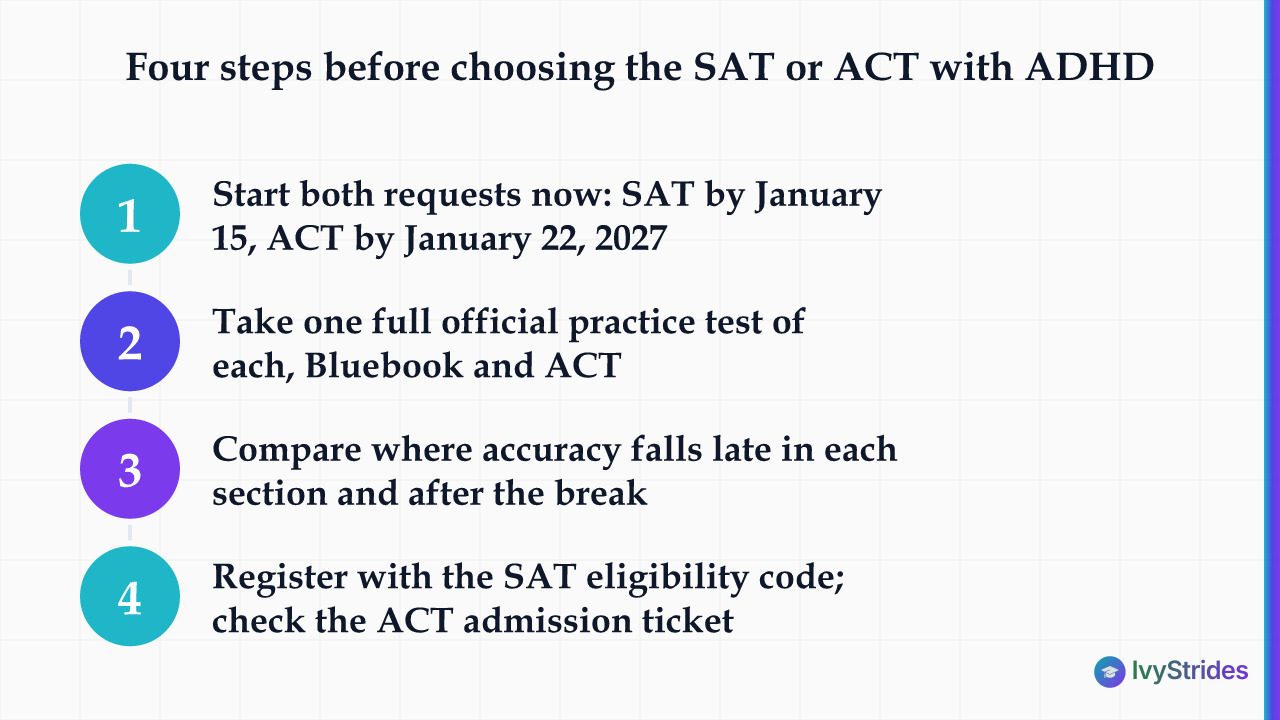
Choose between the SAT and the ACT with ADHD only after one timed official practice test of each. Because SAT and ACT requests run on deadlines, they come first. A full official practice test shows how a student's focus holds across a whole sitting, which is the evidence this decision needs.
-
Start both requests now. Ask the SSD coordinator to file with College Board by January 15, 2027, for the March 6 SAT; register in MyACT for the February 27 ACT with Yes selected, so the school official can submit by January 22, 2027.
-
Take one full official test of each. Bluebook lets a student select an accommodation for practice, though that isn't approval (College Board). ACT's free practice tests include untimed versions of each section, so a student can keep an accommodated clock.
-
Compare where accuracy falls. Look late in each section and after the break, not just the total, and weigh whether ACT Science is worth the longer sitting.
-
Register and check. Enter College Board's eligibility code at SAT registration; on the ACT, make sure the admission ticket shows the accommodations.
Because adaptive Bluebook practice tests route the second module like the real SAT, one sitting shows how a slow first module plays out.
A student who already has an SAT score and is weighing whether to switch from the SAT to the ACT can run the same comparison.
Where IvyStrides fits. In IvyStrides 1-on-1 tutoring, an SAT or ACT plan starts from a diagnostic test and a custom roadmap that set the baseline and focus areas, and every hour is built around the student's baseline and target. In IvyStrides 1-on-1 SAT tutoring, a tutor review session follows each Bluebook-style mock.
If the ACT fits better, Enhanced ACT tutoring built around a diagnostic follows each full-length practice test with a detailed performance review and includes the strategic call on whether to take Science.
Whether to send the score at all still depends on each college's testing policy, which varies by school and year. But order matters most: requesting after choosing can cost a student the February 27 ACT and March 6 SAT at the needed timing.
FAQ: SAT or ACT With ADHD
Is it easier to get accommodations for the ACT than the SAT?
Neither test maker says one is easier to get. The paperwork differs: ACT accepts a current IEP or 504 plan for the same allowable accommodations, while College Board still needs an SSD request, though same-plan requests sometimes need nothing more.
ACT or SAT for a student with accommodations?
Compare them at the approved timing. At time and a half, College Board lists the SAT at 3 hours 21 minutes plus breaks; the ACT core totals 187.5 minutes, plus 60 for Science.
Do colleges prefer the ACT or the SAT?
Both test makers say no: ACT says all accredited U.S. colleges and universities accept both tests equally, and College Board says colleges don't have a preference. Each college's own testing policy decides whether it requires a score.
How do you overcome undiagnosed ADHD while reviewing for the SAT or ACT?
Both test makers approve accommodations for documented disabilities, so documentation comes first. College Board's ADHD guidelines want a diagnosis from someone with appropriate professional credentials, supported by testing; ACT's documentation policy asks for a licensed, qualified professional's letter or report when there's no IEP or 504 plan. Talk to the school counselor early.
Your Next Step on the SAT or ACT With ADHD
For a student with ADHD, the SAT or ACT choice runs paperwork first, practice second.
- Ask the school to start both requests now.
- Put January 15 and January 22 on the family calendar.
- Take one timed Bluebook SAT and one official ACT practice test.
- Choose where accuracy holds latest, then register with accommodations attached.
Watch the method, then try it: IvyStrides explains SAT and ACT question types on YouTube.

Rajesh is a technology leader, entrepreneur, and angel investor with 28+ years in Business & Technology Leadership and Product & Solution Engineering. He is passionate about education, mentoring, and driving digital transformation.