
Online AP for Homeschoolers: How to Take and Pass AP Exams in 2026

On this page
- The Short Answer: Can Homeschoolers Take AP Exams?
- How to Register for AP Exams as a Homeschooler: The Step-by-Step Process
- Not Sure Which AP Courses to Take or How to Prep Without a School Behind You?
- How to Choose an Online AP Course as a Homeschooler
- Which AP Subjects Work Best for Homeschoolers in 2026
- Are AP Exams Harder Than the SAT? Understanding the Difficulty Difference
- How AP Scores Fit Into a Homeschooler's College Application
- How to Actually Pass AP Exams: A Prep Framework for Homeschoolers
- Homeschool AP Transcripts: How to Document Your Coursework
- FAQ
- Can homeschoolers take AP exams without taking an AP course?
- Is there a minimum age to take an AP exam?
- How do I find a local school that will let my homeschooled student take AP exams?
- Do AP scores from homeschoolers carry the same weight as AP scores from traditional school students?
- What is a good number of AP courses for a homeschooled student applying to selective colleges?
- When are AP exam scores released in 2026?
- Ready to Build a Real AP Plan for Your Homeschooler?
Yes, homeschoolers can take AP exams in 2026, and no traditional school enrollment is required. To sit for an official exam, contact a local school authorized to administer AP exams in September or October, before the November ordering deadline, and ask the school's AP Coordinator to add your student to the exam order. For the course itself, enroll in an online AP course listed in the College Board's AP Course Ledger, or self-study using official College Board materials. Scores of 3, 4, or 5 can earn college credit at hundreds of universities, though credit policies vary by institution.
Format and policy details throughout this article come from College Board AP Program documentation. The harder question is how homeschoolers handle the pieces a school normally handles for them, and that's where the next section starts.
The Short Answer: Can Homeschoolers Take AP Exams?
Yes. The College Board sets no minimum age for AP exam participation and no enrollment requirement. A homeschooled sophomore, a 13-year-old prodigy, and a senior transferring in from a co-op are all equally eligible to sit for any of the 38 AP subjects offered in 2026.
Two pieces to get right. First, the course. The College Board expects that a student sitting for an AP exam has covered the corresponding curriculum framework, and if you want the label "AP" to appear on a transcript, the course itself must be authorized through the AP Course Ledger. Second, the exam. Because parents cannot administer AP exams at home, homeschoolers must find a local authorized school willing to seat their student on exam day. That's the piece most families underestimate.
Format-wise, 2026 is a transition year. Twenty-eight AP exams will be delivered digitally in the May 2026 window; the remaining exams stay in hybrid or paper format. Check the official AP exam schedule for your specific subjects, because digital and paper subjects have different day-of logistics. IvyStrides' AP classes online are built around the 2026 format for each subject.
How to Register for AP Exams as a Homeschooler: The Step-by-Step Process
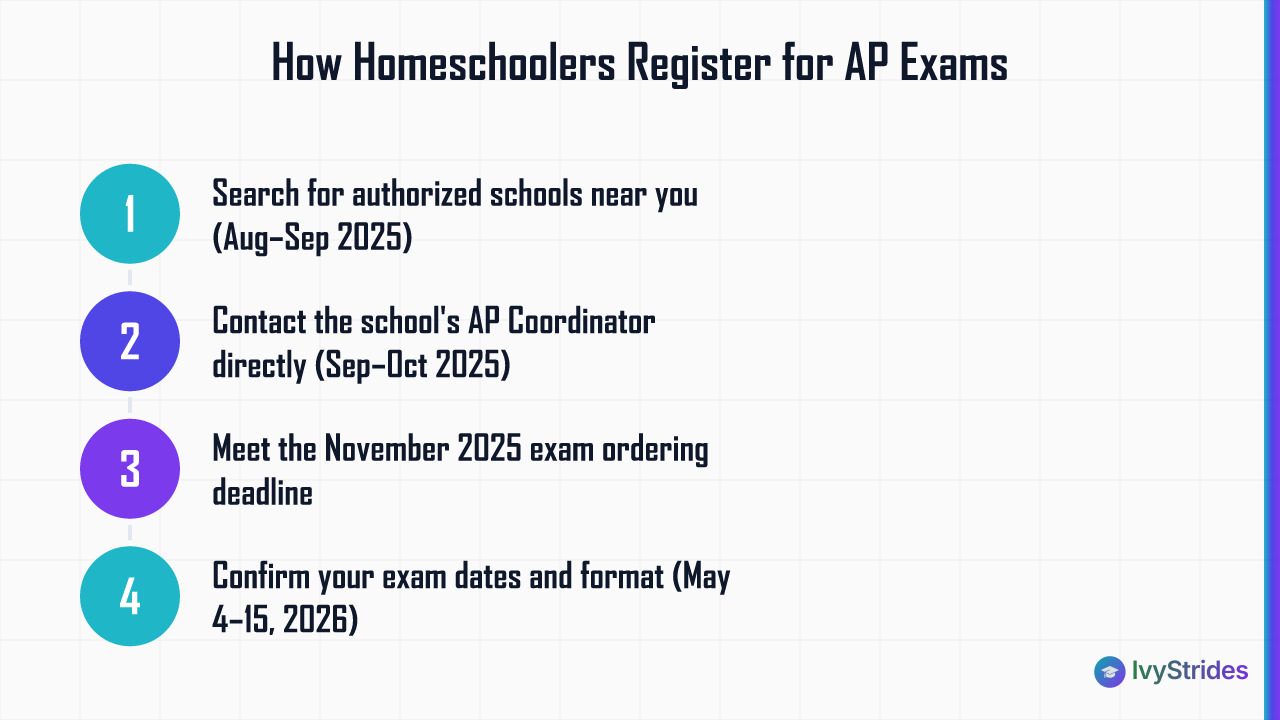
Here's the part most homeschool families miss until it's too late: there's no automatic registration for you. In a traditional high school, the AP Coordinator handles ordering, scheduling, and payment for every student on the roster. As a homeschooler, you are your own coordinator until an authorized school agrees to fold your student into theirs.
The registration sequence works like this.
Step 1: Search for authorized schools near you (August-September 2025). Use the College Board's AP Course Audit search or contact your state's homeschool association for a list of schools that have historically welcomed outside students. Public schools, private schools, and district testing centers all qualify if they're authorized to give AP exams.
Step 2: Contact the school's AP Coordinator directly (September-October 2025). Don't wait until November. Coordinators finalize their exam orders in the fall, and adding a homeschooler after the order is locked is far harder than adding one before. Ask three questions: Will you seat an outside student? What is your registration deadline? What are your fees, including any administrative fee on top of the College Board exam fee?
Step 3: Meet the November 2025 ordering deadline. The College Board's fall ordering deadline for the May 2026 exams closes in early November 2025 for most schools. Missing this triggers a late order fee. The late ordering window then runs through mid-March 2026, with an additional per-exam fee. Confirm the current fee schedule at apstudents.collegeboard.org before you write the check, as College Board updates fees annually. Fee reductions are available for eligible students through the school's AP Coordinator.
Step 4: Confirm exam dates and format. The May 2026 exam window runs Week 1 May 4-8 and Week 2 May 11-15. Digital exams and paper exams sit at different times; your AP Coordinator will hand you a specific schedule once your student is added to the order.
One freshness note. The College Board is updating the setup process in AP Registration and Ordering starting 2026-27. If you're planning ahead for a sophomore who'll take exams in May 2027 or later, watch that page for changes to how outside students are added to school orders.
For families outside the United States, exam fees and registration logistics carry additional considerations covered in our breakdown of AP exam fees for international students.
Not Sure Which AP Courses to Take or How to Prep Without a School Behind You?
In a free 15-minute strategy call, an IvyStrides AP specialist will review your student's goals, recommend the right AP subjects, and outline a prep plan built around your homeschool schedule.
How to Choose an Online AP Course as a Homeschooler
Not every online course calling itself "AP" is actually AP. The College Board authorizes providers through a course audit process, and only authorized courses can carry the AP designation on a transcript. The AP Course Ledger is the searchable database of every authorized provider, and it's the first place to look before you pay anyone.
Authorization confirms that the syllabus meets the College Board's curriculum framework for that subject. It doesn't tell you whether the course is well taught, whether the teacher is a per-subject specialist, or whether instruction is live or asynchronous video. Those quality questions are on you.
A few distinctions worth understanding before you enroll.
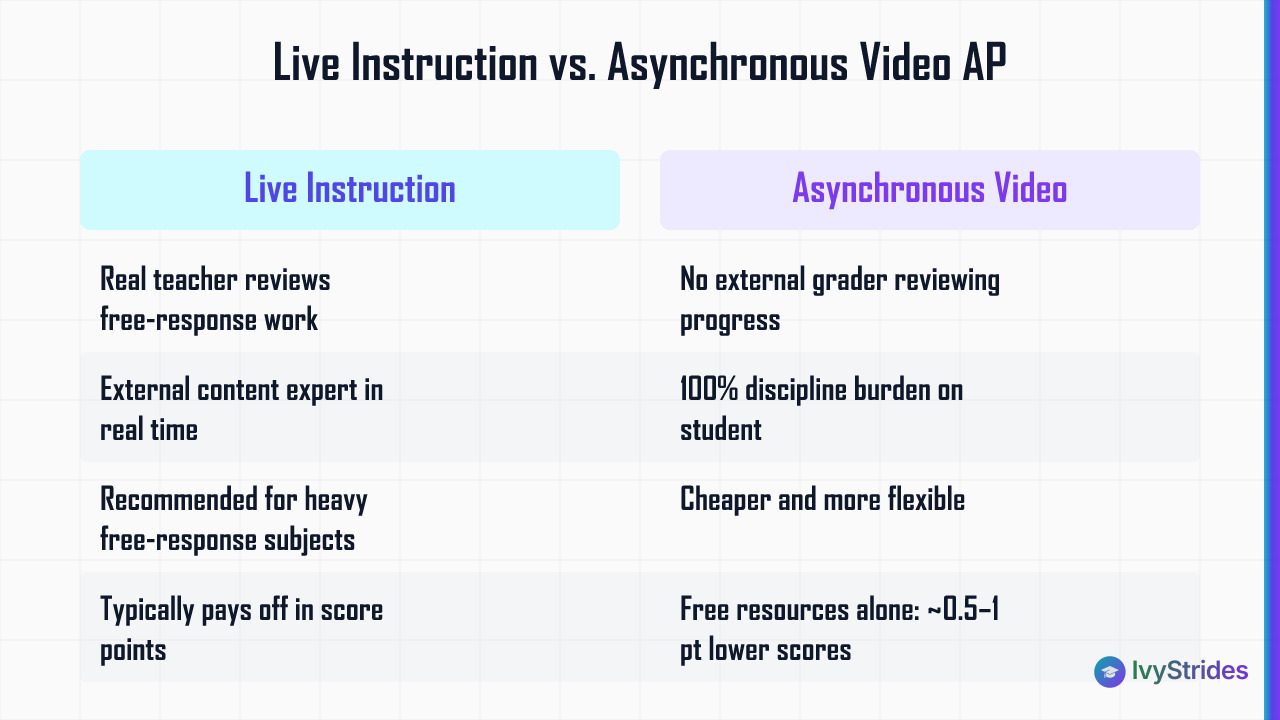
Live instruction vs. asynchronous video. Live weekly classes with a real teacher who grades your student's free-response work give homeschoolers something they otherwise lack: an external content expert reviewing progress in real time. Asynchronous video courses are cheaper and more flexible but put 100 percent of the discipline burden on the student. For AP Chemistry, AP Physics 1, AP Physics 2, and any subject with a heavy free-response component, live instruction typically pays for itself in score points.
Generalist vs. per-subject specialist. Some providers assign one teacher to cover multiple AP subjects. IvyStrides' AP Classes Online uses a per-subject specialist model instead, one teacher per AP subject, because the free-response scoring on AP Calculus BC and the free-response scoring on AP English Literature reward very different skills, and no single teacher is elite at both.
Free resources are legitimate, within limits. The College Board publishes free-response questions, scoring guidelines, and course descriptions for every AP subject at apstudents.collegeboard.org. Several free AP-aligned practice platforms exist as supplements. In our coaching, students who rely on free resources alone without any structured instruction typically underperform by roughly half a point to a full score point on the 1-5 scale, particularly on free-response sections that reward an experienced grader's eye.
Before choosing a provider, it helps to understand exactly which colleges accept online AP credit and under what conditions, a question we answer in depth in our companion guide on whether online AP courses count for college credit. If you're still deciding whether online AP instruction is the right format for your student, our article on whether you can you take AP classes online covers what the College Board actually says about course delivery options.
Well-known authorized providers for homeschoolers include PA Homeschoolers AP Online for full-year homeschool-only courses, HSLDA Academy, and our own best online AP courses for students who want per-subject specialist coaching alongside standard AP curriculum.
Which AP Subjects Work Best for Homeschoolers in 2026
Subject choice matters more than count. In our coaching with homeschooled students, those who take 3 to 5 AP courses across high school and score 4 or 5 on each are consistently more competitive at selective colleges than students who take 8 to 10 courses and score 2 or 3 across the board. Depth beats breadth.
A few subjects earn their spot for most homeschool families.
AP Human Geography. Widely recommended as a first AP because the content scope is accessible and the exam rewards clear analytical writing over deep prior knowledge. A strong choice for a sophomore or a motivated freshman testing the waters. This is the entry point for most homeschool AP journeys.
AP World History: Modern. One of the most commonly self-studied AP subjects among homeschoolers, and one where a structured course pays for itself in the document-based question and long essay question sections. These free-response sections have specific rubrics that reward practice with a coach who's seen dozens of scored samples.
AP English Language and AP English Literature. Homeschool curricula often produce strong readers and writers. English Language is the more accessible of the two and typically taken in junior year; Literature is a senior-year option for students committed to humanities.
AP Calculus AB and AP Calculus BC. For any student targeting STEM programs at selective colleges, AP Calculus AB is the baseline signal. BC covers a superset of AB material and is the stronger choice for students confident in their algebra and precalculus foundation. If precalculus is shaky, address that first with AP Precalculus online before jumping to BC.
AP Chemistry. This course and AP Physics require lab components. Online providers handle labs differently: some run virtual labs, some ship kits, some require students to document self-designed experiments. Confirm the lab documentation approach before enrolling, because some colleges scrutinize this for STEM credit.
AP Computer Science A and AP Computer Science Principles. AP Computer Science A is a full-year Java-based course and the stronger signal for CS-intended majors. CS Principles is broader and more accessible, often a good sophomore option.
AP Physics 1 and 2. Algebra-based physics with a heavy conceptual free-response component. Best paired with specialist coaching, because homeschoolers without a physics teacher tend to underprepare for the qualitative "explain your reasoning" questions that make up most of the free-response section.
Are AP Exams Harder Than the SAT? Understanding the Difficulty Difference
Different tests, different jobs. The SAT is a broad readiness measure. Each AP exam is a subject-specific mastery test. Comparing them on a single difficulty axis misses the point.
Structurally, the Digital SAT runs about 2 hours 14 minutes, adapts across two modules per section, and scores 400 to 1600 on a combined Reading & Writing and Math scale, per College Board Digital SAT documentation. Any given AP exam runs roughly 3 hours, mixes multiple-choice with free-response, and scores on a 1 to 5 scale.
Within the AP program itself, difficulty varies enormously. AP Physics C: Mechanics and AP Physics C: Electricity and Magnetism sit among the most demanding exams offered. AP Human Geography and AP Environmental Science sit at the other end.
Here's what actually matters for a homeschooler in junior year: the SAT and AP prep windows overlap. In our coaching, students who prepare for the SAT and AP exams simultaneously in junior year benefit from overlapping skill work, particularly the algebra and data-analysis overlap between AP Calculus and SAT Math, and the analytical reading overlap between AP English and the SAT Reading & Writing section. A coordinated plan across both is more efficient than treating them as separate projects. See our SAT prep overview for how we sequence that work.
How AP Scores Fit Into a Homeschooler's College Application
For homeschoolers, AP scores do something distinctive. Because a homeschool transcript isn't backed by an accredited school registrar in the way a public school transcript is, colleges look for external validation of rigor. A 4 or 5 on AP Chemistry from a homeschooled student is that validation. It's an independent, standardized signal that the coursework was real.
How many APs are competitive? Ivy League and equivalent admits typically complete somewhere between 8 and 14 AP courses by graduation at traditional schools. For homeschoolers, the expectation calibrates differently, and 4 to 6 AP courses with scores of 4 or 5 is a strong profile. Selective schools including Harvard, MIT, Stanford, and Princeton all admit homeschooled students; the admissions decision depends on the full application including essays, recommendations, extracurriculars, and standardized test scores where required.
On credit: most colleges award credit for scores of 3 or higher, but selective schools often require a 4 or 5, particularly in STEM subjects where the credit displaces a foundational course. Never assume credit will transfer without checking the target college's published credit policy. AP credit policies vary by school and by subject and change year to year.
On test-optional: FairTest maintains a running list of test-optional and test-blind schools. Even at test-optional schools, a strong AP score record doesn't fully substitute for a strong SAT or ACT score at schools that continue to weight test scores when submitted. Test-optional policies vary by school and by year, so verify the current policy at each target school. Our take on the submission question for ACT specifically lives in should you submit ACT scores if test-optional.
Strong AP scores work best alongside a competitive SAT or ACT score; families building a full admissions profile often address both in the same junior-year prep window. If you're a parent navigating this alongside your student, how to support your child's SAT prep covers the parent-side logistics.
AP coursework can also supply compelling material for college admissions essays, particularly when a student has pursued a subject independently as a homeschooler. A homeschooled student who taught themselves AP Computer Science A and built something original with what they learned has essay material that a traditional-school student rarely has.
How to Actually Pass AP Exams: A Prep Framework for Homeschoolers
Content review is the least important part of AP prep. Practice with the real question types is the most important. This is doubly true for homeschoolers, who typically have less exposure to the specific rhythm of AP free-response sections.
A prep framework that works for most homeschooled students.
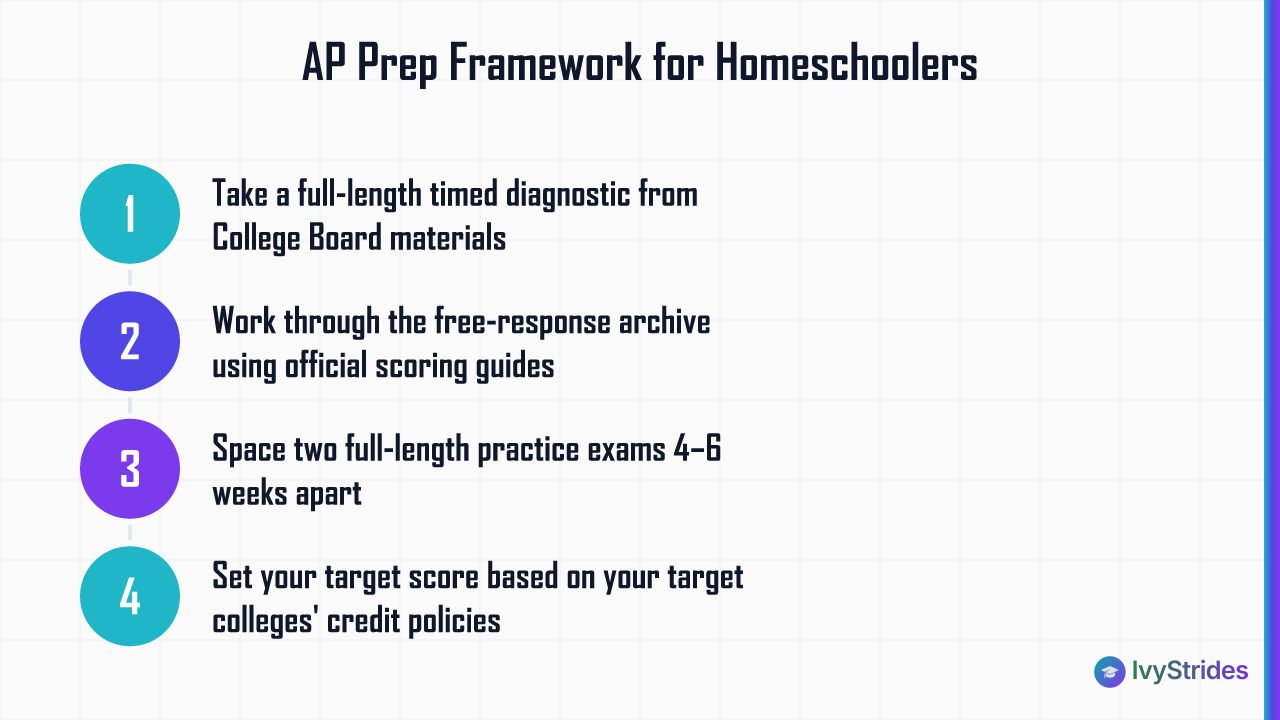
Start with a diagnostic. Take a full-length, timed practice exam from the College Board's official released materials at apstudents.collegeboard.org. This tells you which units are weak and how far you are from the score you want. Skip the diagnostic and you're guessing at what to study.
Work the free-response archive. The College Board publishes free-response questions from prior years, along with the actual scoring guidelines examiners use. These are the single most reliable practice resource for AP. For AP Physics 1 and AP Chemistry in particular, the free-response section demands written scientific reasoning, not just calculation. Homeschoolers without a lab teacher benefit most from specialist coaching on these sections, because "show your reasoning" scoring is unforgiving of the shortcuts a self-studying student naturally develops.
Space your practice, don't cram. In our coaching with homeschooled AP students, those who complete at least two full-length timed practice exams before May score on average roughly half a point to a full point higher on the 1-5 scale than those who only review content. Two full-lengths, spaced 4 to 6 weeks apart, with targeted weakness work in between, outperforms binge-studying every time.
Know what each score means. A 3 is the minimum for credit at most colleges. A 4 is the threshold at more selective schools. A 5 is often required for STEM credit at highly selective schools. Set your target score based on the credit policy at your target colleges, not on a generic "get a 5" goal.
The IvyStrides methodology for AP prep courses is diagnostic-first: identify the unit clusters where the student is weakest, target those with spaced practice, and retest before the May window. Subject-specialist teachers handle the specific content, whether that's AP Physics 1 mechanics, AP Calculus BC series and parametric equations, or AP CS Principles performance tasks.
Homeschool AP Transcripts: How to Document Your Coursework
A homeschool transcript that lists "AP Biology" with no supporting documentation raises questions in admissions. A homeschool transcript that lists "AP Biology" with a course description, a grade, an external teacher's name, and a reported AP exam score of 4 raises none.
Colleges expect a homeschool transcript to include, at minimum: course title, credit hours, grade earned, and a brief course description covering topics studied and materials used. For AP courses specifically, list the exam score alongside the course grade once the score is released.
Enrolling in a College Board-authorized online AP course strengthens the transcript in two ways. It provides an external instructor of record who can supply a course description and grade, and it confirms the course actually met the AP curriculum framework. Self-studied AP courses are entirely legitimate, but the AP exam score becomes the primary evidence of mastery. Without a strong score, a self-studied AP listing on the transcript is weak.
The Common App allows homeschooled students to submit a school profile explaining the homeschool context, curriculum philosophy, grading rubric, and any external instruction or dual enrollment. Use this space. In our coaching, homeschooled students who pair strong AP exam scores with clear course descriptions and a well-written school profile face fewer admissions questions about rigor than students who submit thin documentation.
Parents navigating the essay side of this work will find guidance in how can parents help with the college essay.
FAQ
Can homeschoolers take AP exams without taking an AP course?
Yes. The College Board allows any student to register for and sit for an AP exam without having taken a formal AP course. Self-study is a legitimate path, and homeschoolers regularly use it for subjects like AP Human Geography, AP Psychology, and AP World History. The student still needs to arrange testing at a local authorized school. Self-study works best for motivated students with strong content foundations. In our coaching, self-studying students without a structured plan typically underperform on free-response sections compared to students on a guided plan.
Is there a minimum age to take an AP exam?
The College Board sets no minimum age for AP exam participation. If a younger student is prepared and an authorized school is willing to administer the exam, the student can sit for it. Most AP exam takers are in grades 10 through 12, but motivated younger homeschoolers have successfully completed AP exams. The practical constraint is finding a testing site willing to seat a younger outside student, not the College Board's rules.
How do I find a local school that will let my homeschooled student take AP exams?
Search the AP Course Audit database for authorized schools in your area. Contact the AP Coordinator directly in September or October, well before the November ordering deadline. Some schools welcome homeschoolers as a matter of policy; others have limited capacity. Having a backup school in mind is wise. The College Board help center also provides guidance for students not enrolled in a school that offers AP.
Do AP scores from homeschoolers carry the same weight as AP scores from traditional school students?
Yes. Admissions offices and college credit offices evaluate the AP exam score itself, not where the student took the course. A 5 on AP Calculus AB from a homeschooled student earns the same credit as a 5 from a student at a traditional high school. The transcript context differs, but the score is standardized and portable.
What is a good number of AP courses for a homeschooled student applying to selective colleges?
There's no single correct number. Traditional-school applicants to selective colleges typically complete 8 to 14 AP courses. For homeschoolers, 4 to 6 AP courses with scores of 4 or 5 each is a strong profile. Taking 10 courses and scoring 2 or 3 on most is less compelling than taking 5 and scoring 5 on each. Admissions outcomes depend on the full application, not AP count alone.
When are AP exam scores released in 2026?
AP scores for the May 2026 exam window are typically released in July 2026, distributed through each student's My AP account at apstudents.collegeboard.org. Exact release dates get announced by the College Board closer to the exam window. Verify the current schedule on the official AP site before planning college application timelines, particularly if you're applying early decision or early action with fall-semester deadlines.
Homeschoolers have every path to college credit and admissions that traditional-school students do. The difference: you handle the logistics yourself, which means students who plan early, choose subjects deliberately, and prepare with specialist instruction consistently outperform students who improvise.
Ready to Build a Real AP Plan for Your Homeschooler?
IvyStrides AP Classes Online pair your student with a per-subject specialist teacher, not a generalist. Book a free 15-minute call and leave with a subject list, a timeline, and a clear next step.

Two decades teaching quantitative and verbal aptitude on standardized tests. Rare dual expertise across Math and Verbal — particularly effective for students with gaps on both sides. Senior AP Mentor for our Calculus and English tracks.