
What Counts as a Good AMC 8 Score, and What Each Band Actually Means

On this page
- What Each AMC 8 Score Band Actually Means
- What a Good AMC 8 Score Looks Like by Grade Level
- What AMC 8 Score Bands Signal About Your Next Competition Step
- How to Move Your AMC 8 Score Into the Next Band
- FAQ: AMC 8 Scores and Award Tiers
- What is a good AMC 8 score for an 8th grader?
- What are the AMC 8 cutoff scores for 2026?
- What is a good AMC score?
- Is 17 a good AMC 8 score?
- Your Next Step With Your AMC 8 Score
A good AMC 8 score is 15 or above out of 25. The AMC 8 is a 25-question, 40-minute middle-school competition scored 0 to 25, with 1 point per correct answer and no wrong-answer penalty. The national average sits near 10 to 12, so 15 clears most participants.
Those award tiers and averages come from the Mathematical Association of America and get tracked annually across online math forums that publish the results. The number that trips families up isn't the raw score, it's the grade context. A 17 is exceptional for a 5th grader and merely competitive for an 8th grader, and the award tier cutoffs shift a little every year.
What Each AMC 8 Score Band Actually Means
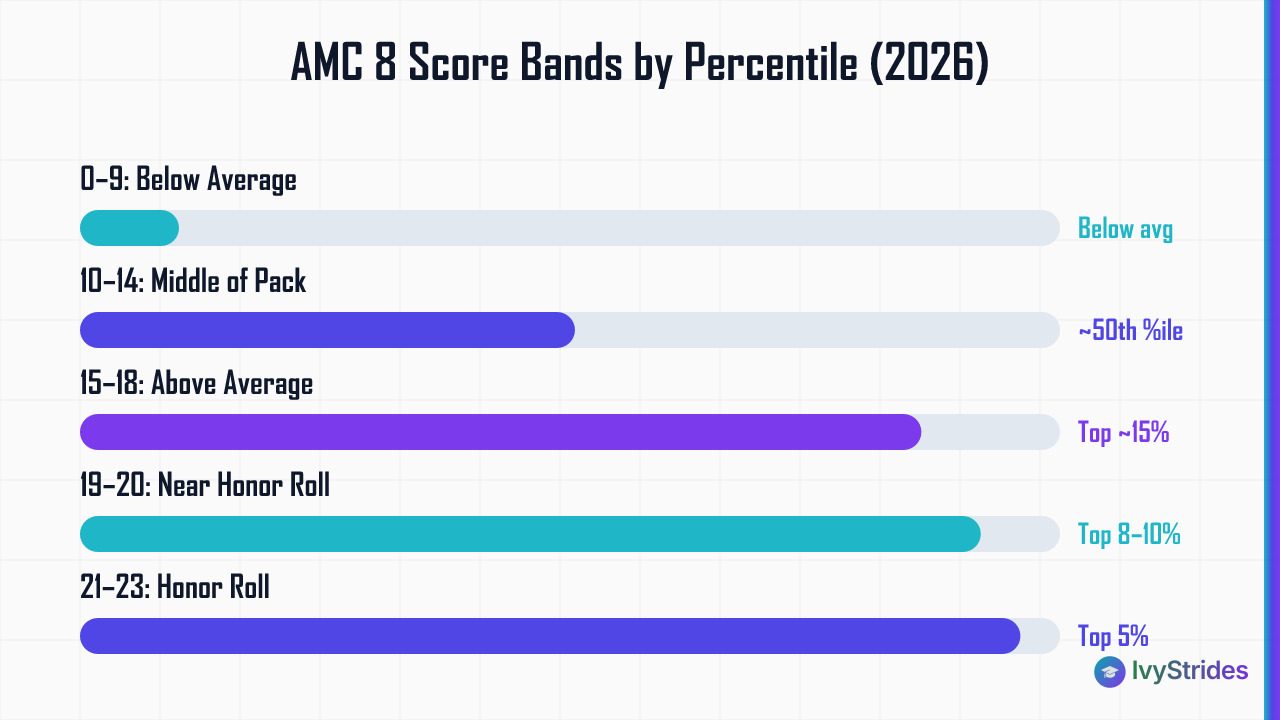
The AMC 8 score scale runs from 0 to 25, and a score of 15 or above is the first meaningful benchmark. The Mathematical Association of America awards 1 point per correct answer, subtracts nothing for wrong answers or blanks, and gives students 40 minutes for 25 questions. Because there's no wrong-answer penalty, every blank you leave hands back a point for no reason.
The national average is the anchor most people miss. In 2026, roughly 80,977 students sat the AMC 8, and the average score was about 12.42, up from 11.74 in 2025. So more than half of all participants finish below 15. Internalize that before you judge a number harshly.
Three official tiers define "good." The Achievement Roll recognizes students in grade 6 and below who score 15 or above. The Honor Roll marks the top 5% nationally, and the Distinguished Honor Roll, sometimes called Distinction, marks the top 1%. Because those top tiers are percentile-based, the exact cutoff moves each year with exam difficulty.
| Score Range | Approximate Percentile | Award Tier | What It Signals |
| 0–9 | Below average | None | Foundational gaps to close |
| 10–14 | Middle of the pack | None | Solid base, near national average |
| 15–18 | Above average | Achievement Roll (grade 6 and below) | Strong problem-solving skills |
| 19–20 | Roughly top 8–10% | Near Honor Roll | Competitive, close to the top-5% line |
| 21–23 | Top 5% (2026) | Honor Roll (IvyStrides) | Elite among participants |
| 24–25 | Top 1% (2026) | Distinguished Honor Roll | Nationally exceptional |
Cutoffs are not fixed. In 2025 the Honor Roll line sat at 19 and Distinction at 21; in 2026 those rose to 21 and 24. The MAA sets these percentile thresholds after each administration, so treat any single year's number as a snapshot, not a permanent bar. If you're still working out whether your child should sit the exam at all, our guide to what grade the AMC 8 is for covers eligibility and readiness.
One derived figure worth holding onto: 5% of about 80,977 participants is roughly 4,049 students, so that's the approximate size of the 2026 Honor Roll cohort (IvyStrides calculates this from the MAA participant count and the top-5% definition).
What a Good AMC 8 Score Looks Like by Grade Level
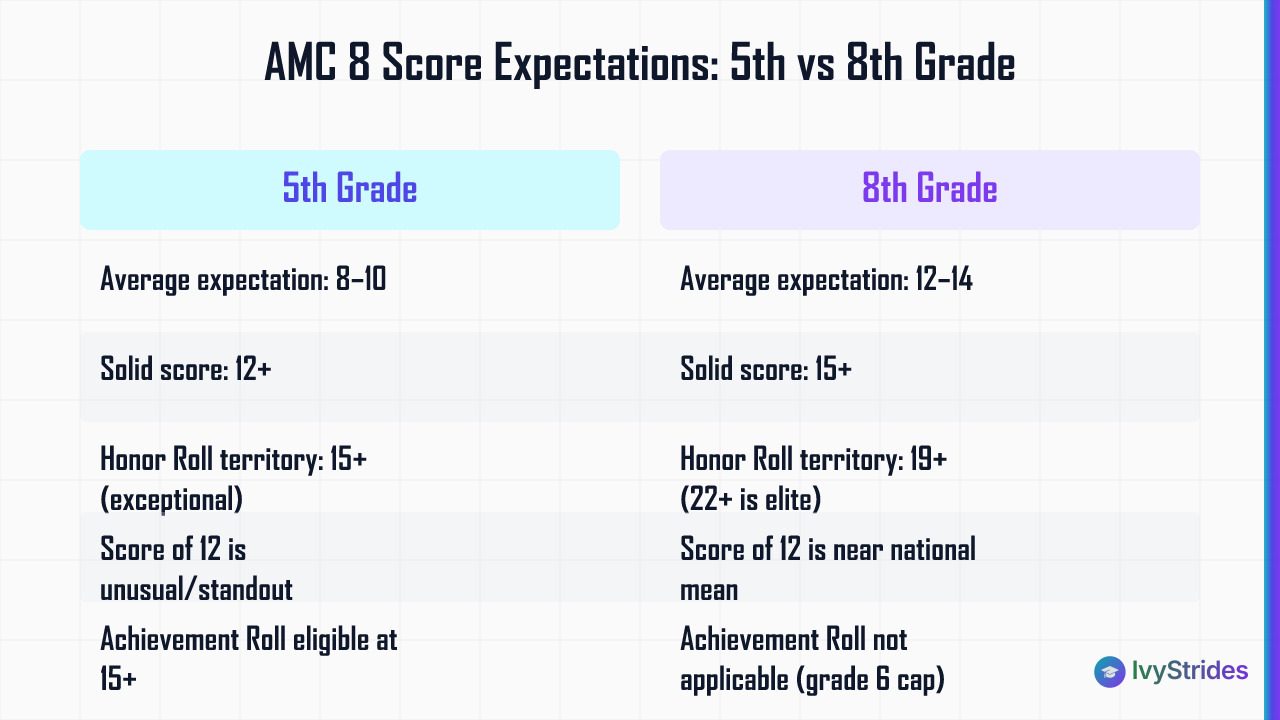
A good AMC 8 score depends heavily on grade, because the same raw number carries different weight for a 5th grader than for an 8th grader. Percentile and cutoff both bend with the field. The MAA restricts the Achievement Roll to students in grade 6 and below who score 15 or above, precisely because a 15 from a younger student is a stronger result. The Honor Roll, by contrast, stays open to all grades at the top-5% cutoff.
Grade-relative reading matters most in the 14 to 19 range. A 17 that earns a younger student genuine standout status is, for an 8th grader, a competitive score with room to push toward the top-5% tier. Neither student did anything wrong. They're just measured against different fields.
| Grade | Average Expectation | Solid Score | Honor Roll Territory |
| 5th grade | 8–10 | 12+ | 15+ (exceptional) |
| 6th grade | 10–12 | 14+ | 15+ (Achievement Roll) |
| 7th grade | 11–13 | 14–16 | 19+ |
| 8th grade | 12–14 | 15+ | 19+ (22+ is elite) |
These grade benchmarks come from patterns we see across student cohorts in our AMC 8 coaching, calibrated against the national average. A 5th grader scoring 12 is doing something unusual; an 8th grader scoring 12 sits right at the national mean. Same number, opposite readings.
What AMC 8 Score Bands Signal About Your Next Competition Step
Your AMC 8 score band tells you where your current standing sits, band by band, not just where you rank on a single list. Reading the bands right means holding the percentile and the cutoff together. A score below 15 signals foundational gaps against the national average; a 15 to 18 places a younger student on the Achievement Roll and any student above the mean.
The top bands are percentile claims, not ribbons. Because the Honor Roll marks the top 5% and the Distinguished Honor Roll the top 1% nationally, a 19 to 21 tells a student they've reached or nearly reached the Honor Roll line, and a 22 to 25 confirms Distinguished Honor Roll standing. Each band restates the same score against a national field, so the band is really a statement about how many participants a student has cleared.
| Score Band | Recommended Next Step |
| Below 10 | Rebuild arithmetic and number-theory fundamentals |
| 10–14 | Solid base; drill targeted problem types to reach 15+ |
| 15–18 | Achievement Roll level; structured prep toward Honor Roll |
| 19–21 | Honor Roll; confirm the current-year cutoff |
| 22–25 | Distinguished Honor Roll; top-1% standing |
Look, the gap between a 16 and a 21 isn't five random points. It's the distance between the middle of the pack and the top-5% cutoff, and closing it means a specific set of problem types a raw score can't name for you.
How to Move Your AMC 8 Score Into the Next Band
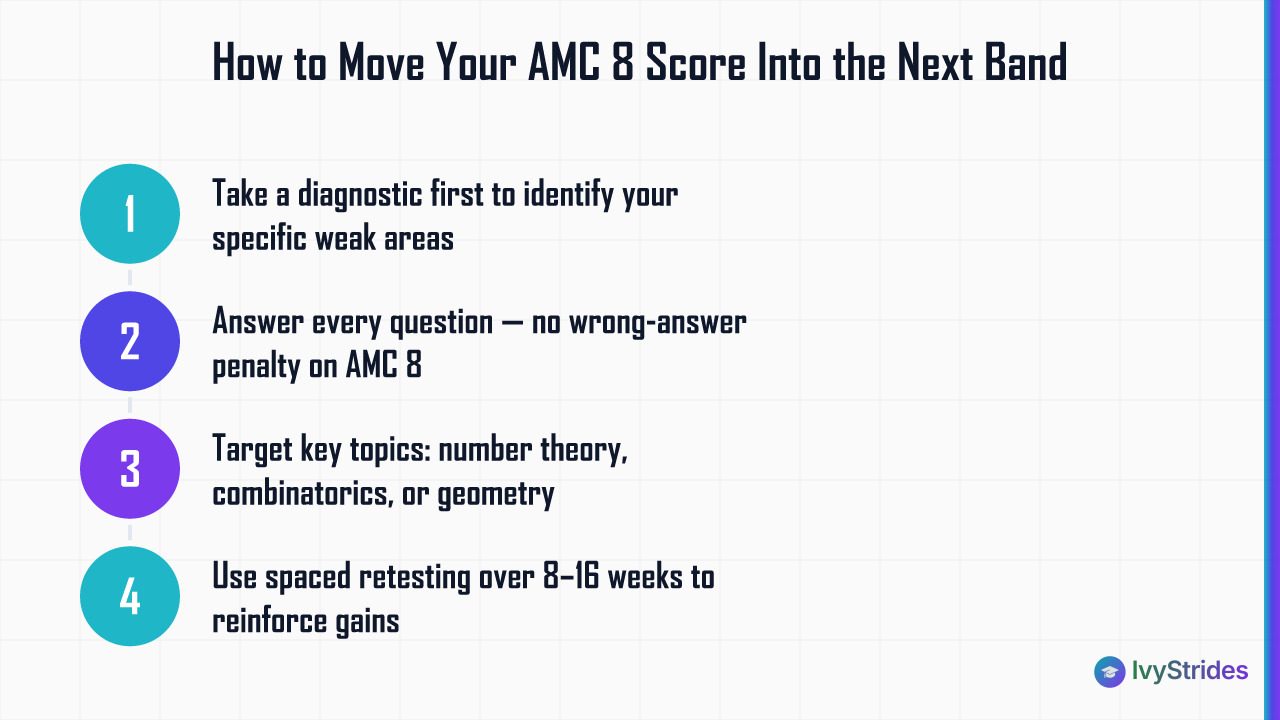
Moving your AMC 8 score into the next band means closing the specific percentile gap the bands already define, not adding random practice. A student sitting at a 12 to 16 is near the national average, and the jump to the Honor Roll cutoff usually runs through number theory and combinatorics rather than algebra, which is why undirected work often stalls at the same band.
Retest, don't just review. Because the exam carries no wrong-answer penalty, the first points are strategic: answer every question. Beyond that, in our coaching, students who complete a diagnostic-first program with targeted weakness work and spaced retesting typically gain 3 to 5 points within about 10 to 14 weeks, which is often enough to move one band. Students aiming for the Honor Roll or Distinguished Honor Roll tier typically benefit from structured problem-set work across number theory, geometry, and combinatorics, the exact content covered in math olympiad prep.
| Current Score | Primary Weak Areas to Target | Typical Prep Duration |
| Below 10 | Arithmetic, basic number theory | About 12–16 weeks |
| 10–14 | Number theory, combinatorics | About 10–14 weeks |
| 15–18 | Geometry, harder combinatorics | About 8–12 weeks |
| 19+ | Problem-15-to-25 speed and edge cases | About 8–10 weeks |
FAQ: AMC 8 Scores and Award Tiers
What is a good AMC 8 score for an 8th grader?
For an 8th grader, 15 or above is above average, and 19 or above reaches the top-5% Honor Roll. Because 8th graders are the oldest eligible participants, the bar sits higher: a score that would be exceptional for a 5th grader is only solid at grade 8. In our coaching, 8th graders targeting Honor Roll typically need about 8 to 12 weeks of focused problem-type work.
What are the AMC 8 cutoff scores for 2026?
In 2026, the average was about 12.42, the Honor Roll (top 5%) cutoff was 21, and the Distinguished Honor Roll (top 1%) cutoff was 24. The MAA publishes these figures annually. Cutoffs shift slightly each year with exam difficulty and the participant pool, so don't treat any single year as a fixed threshold.
What is a good AMC score?
On the AMC 8, a good score is 15 or above out of 25. On the AMC 10, a score around 90 out of 150 is competitive; on the AMC 12, around 85 is strong. Each exam uses its own scale and difficulty level, so "good" means something different across the three competitions.
Is 17 a good AMC 8 score?
Yes, 17 out of 25 is a solid AMC 8 score, placing a student well above the national average of roughly 12. It doesn't reach the 2026 Honor Roll line of 21, but it signals strong fundamentals. For a 5th or 6th grader, 17 is an excellent result; for an 8th grader, it's competitive with room to push toward the top-5% tier.
Your Next Step With Your AMC 8 Score
You now know where a score sits nationally, which award tier it reaches, and how grade level changes the reading. The number on the report is a starting point, not a verdict.
- Find your score in the band table and check it against your grade.
- Confirm which award tier, if any, it reaches this year, remembering cutoffs move annually.
- Identify one weak problem type (number theory and combinatorics are the usual culprits at 12 to 16).
- Set a retest date and practice under real 40-minute conditions before the next sitting.

Two decades teaching quantitative and verbal aptitude on standardized tests. Rare dual expertise across Math and Verbal — particularly effective for students with gaps on both sides. Senior AP Mentor for our Calculus and English tracks.