
How Long Does High School Research Take, From Topic to Submission?
On this page
- How Long a High School Class Research Paper Takes
- How Long an Independent High School Research Project Actually Takes
- Where High School Research Gets Published and How Long That Takes
- How High School Research Fits Your College Application Timeline
- FAQ: High School Research Timelines
- How long should a high school research paper take?
- Is doing research in high school good for college admissions?
- How long do research studies usually take for high school students?
- How long does it take to write a research paper in high school?
- Your Next Step on a Research Timeline
There is no single standard, so plan by track: a class paper runs on your teacher's deadline, an independent or mentored project often takes many months and sometimes a year or more, and journal publication adds several months after the manuscript is done. The track you choose decides the calendar.
For a sense of scale, the Regeneron Science Talent Search FAQ says its entrants' research frequently spans a year or more, though some students have completed research in as little as six weeks. The biggest variable is project type: a literature review for class and an original experiment aimed at Regeneron STS are different commitments entirely.

How Long a High School Class Research Paper Takes
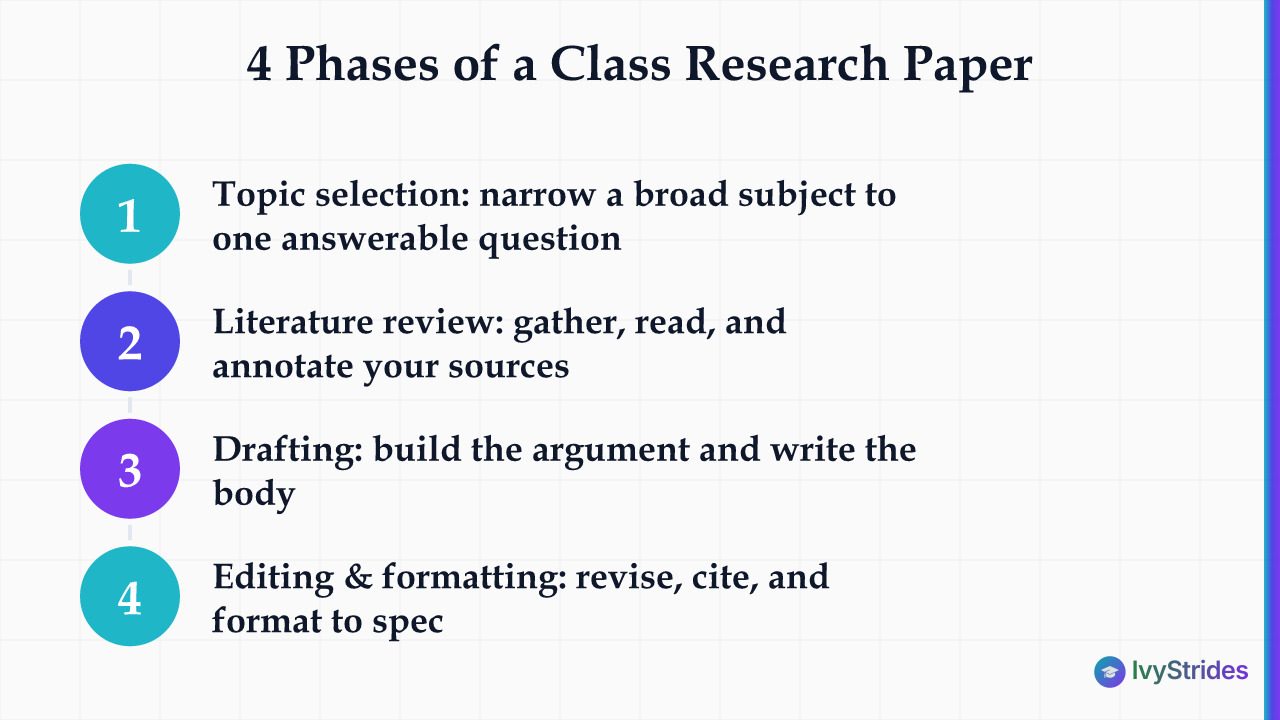
A high school class research paper takes as long as your teacher's deadline allows, whether that is a few weeks or a full term. In this guide, a class research paper is a literature-based assignment with a fixed teacher deadline and no original data collection, which is why its timeline is usually the shortest of the three tracks.
The real driver is the deadline your teacher set, not the ambition of the question. Four phases fill whatever window you have: topic selection, the literature review, drafting, and editing. A workable plan gives the reading and the drafting the largest blocks and keeps topic selection and editing short.
Protect the reading time. It is tempting to hand most of the window to drafting, but the reading has to happen first: if you have not scoped the sources, the draft stalls on page two.
| Phase | Share of Your Window | What Happens |
| Topic selection | Short, at the start | Narrow a broad subject to one answerable question |
| Literature review | One of the two largest blocks | Gather, read, and annotate sources |
| Drafting | One of the two largest blocks | Build the argument and write the body |
| Editing and formatting | Short, at the end | Revise, cite, and format to the assignment spec |
A shorter deadline means trimming every phase, not skipping the reading. Students who want to go beyond a class paper and enter a contest usually need a longer runway than a class assignment allows, which is where the science competitions and research programs worth entering start to shape the calendar.
How Long an Independent High School Research Project Actually Takes

Photo by Poddar Group of Institutions on Pexels
Plan on many months, possibly a year or more, for an independent research project from an original research question to a finished manuscript. That runway dwarfs the class-paper window above, because an independent or mentored research project is original work: you pose a question, collect or analyze your own data, and write it up, often with a mentor or faculty supervisor. That original work is what stretches the timeline.
Three phases carry that time: finding a mentor and scoping the question, data collection or archival research, and analysis and manuscript writing. Each can take weeks or months, and the key variables below decide which.
| Phase | Rough Length | Key Variable |
| Find mentor, scope question | Weeks to months | Mentor availability and topic clarity |
| Data collection | Weeks to many months | Scope of the experiment or archive |
| Analysis and manuscript | Weeks to months | Complexity of results |
Mentor outreach is the sleeper. Busy researchers may take weeks to answer a cold email, or never answer, so start outreach early. A well-scoped question makes both this phase and the data-collection one easier to plan, so settle how to find a math research topic a high schooler can actually finish before you email anyone.
Data collection is the hardest phase to predict: a delayed survey response or a failed experimental run can add weeks you did not plan for, so build slack into this stage first.
Competition deadlines anchor the whole calendar. The Regeneron Science Talent Search 2027 application, open to eligible students in their last year of secondary school, closes at 8 p.m. ET on November 5, 2026, so finish the research report well before that date. Regeneron ISEF 2027 is in Los Angeles in May 2027, students qualify through a Society-affiliated fair, and its rules allow no more than 12 months of continuous research, none before January 2026. The Concord Review, a quarterly journal of history papers by secondary school students, accepts essays on a rolling basis.
Verify each program's current-year dates before you build a schedule around them, because they shift annually. A STEM researcher juggling both a project and a math contest has to line up two deadlines at once, and the AMC and AIME dates that sit alongside a research manuscript decide how tight that overlap gets.
Where High School Research Gets Published and How Long That Takes
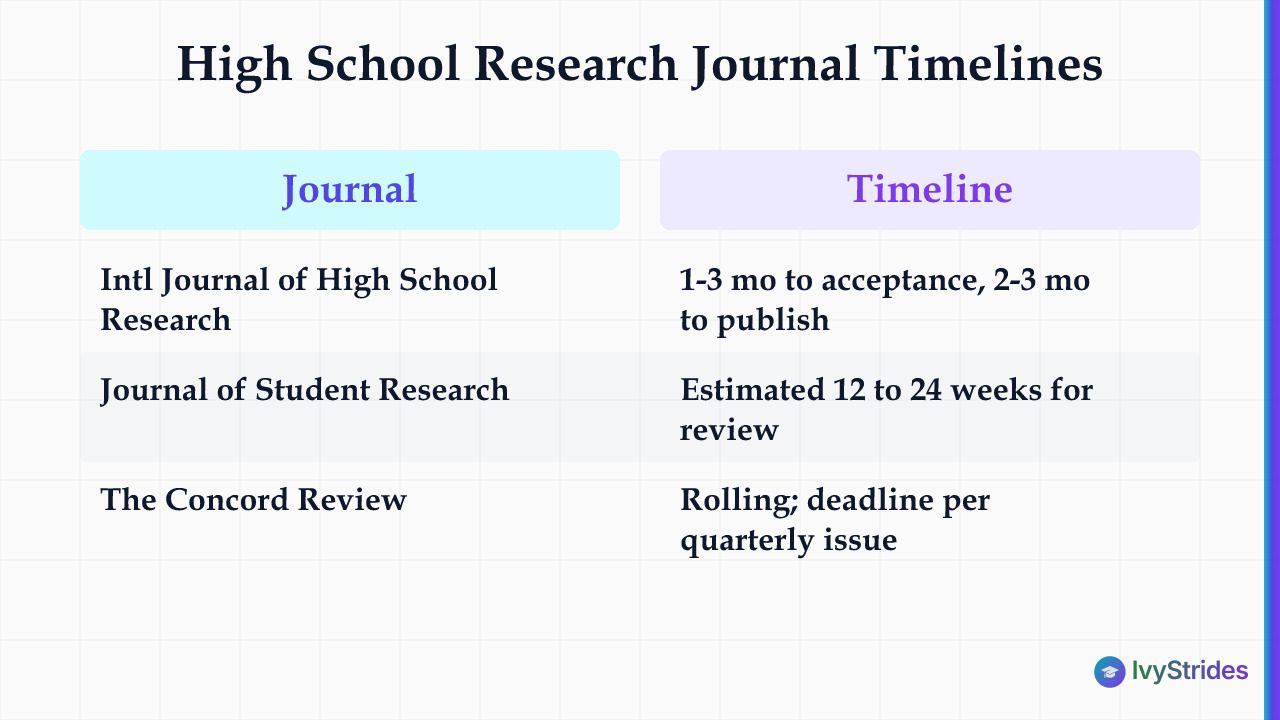
Journal publication adds months, not weeks, after your manuscript is complete. High school research publication is the process of submitting a finished manuscript to a journal, surviving peer review, and seeing it appear in print or online, and it needs its own place in any plan that works backward from an application deadline.
Two things drive the timing: the journal's own process and revision rounds. The International Journal of High School Research puts its average time to acceptance at about one to three months, plus two to three months to publication, and the Journal of Student Research estimates 12 to 24 weeks for review. Plan for at least one revision round, since reviewers can ask for changes before accepting a paper.
| Outlet | Who Can Submit | Timeline the Outlet States |
| International Journal of High School Research | High school students and their mentors | About 1 to 3 months to acceptance, then 2 to 3 months to publication |
| Journal of Student Research, High School Edition | First author must be a high school student with a teacher or advisor | Estimated 12 to 24 weeks for review |
| The Concord Review | History papers completed before finishing secondary school | Rolling submissions, with a set deadline for each quarterly issue |
The International Journal of High School Research describes itself as peer-reviewed by faculty and professionals, and the Journal of Student Research describes itself as faculty-reviewed with a double-blind review. Journal choice decides the delay. Each outlet sets its own scope and review process, and a paper sent outside a journal's scope can lose months to rejection and resubmission.
A finished manuscript still needs a home, and how long the publication phase runs depends on matching your paper to an outlet that actually reviews student work, which is the whole point of knowing which journals accept high school research and which to avoid.
How High School Research Fits Your College Application Timeline
Research fits the application timeline most easily when you start early enough to finish before senior fall. Common App launched its 2026-2027 season on August 1, per Common App, but each college's own deadlines are the dates you plan backward from. If your project could take a year, the summer before junior year is the latest start that leaves a full year of runway before senior applications.
Working backward shows the squeeze: a ten-month project started in June after sophomore year yields a manuscript in April of junior year, about four months before an August 1 opening like this season's, enough for a first journal submission but not always for review to finish. Start later and publication may land after your applications go in, though the project itself can still go on your activities list.
| Grade Level | Project Type | Latest Start to Finish Before Senior Applications |
| Grade 9 to 10 | Class paper, early exploration | Any time; fits a single term |
| Summer before Grade 11 | Independent project | June after sophomore year |
| Grade 11 | Mentored project | Early junior fall for a spring manuscript |
| Grade 11 to 12 | Publication submission | Junior spring, so a first review round can start before fall |
Plan the research so it reads as a demonstrated intellectual interest, part of an admissions spike rather than a standalone activity-list entry. IvyStrides counselors map a student's grade level, project scope and available months against the high school research timeline and the earliest application deadline to judge which track is still feasible. If you write about the research in an essay, describe a concrete result or setback rather than the fact of participation.
That sequencing is easier to hold when one person maps research against test prep and essays, which is what a counselor who sequences each activity into a single application calendar does. Research is also easier to explain when it forms part of a coherent spike rather than an isolated line on the activities list. One caveat holds across every selective college: admissions outcomes depend on the full application, and no project guarantees a result.
FAQ: High School Research Timelines
How long should a high school research paper take?
A class-assigned research paper runs on the teacher's deadline, often a few weeks to a full term; split that window across topic selection, reading, drafting and editing, and a shorter deadline compresses every phase. An independent project is a different commitment: plan for many months, possibly a year or more, from topic selection to a finished manuscript.
Is doing research in high school good for college admissions?
It can be, when it forms a coherent part of your academic story. Original research can show intellectual initiative, especially when it connects to your intended major, but colleges read it as part of the full application, and research alone does not decide an admission.
How long do research studies usually take for high school students?
There is no single standard. The Regeneron Science Talent Search FAQ says its entrants' research frequently spans a year or more, though some finish in as little as six weeks. For planning, budget many months, possibly a year or more, from question to manuscript, plus several months for journal review if you plan to publish.
How long does it take to write a research paper in high school?
Separate from the research itself, give drafting one of the two largest blocks of a class-paper window; in an independent project, analysis and writing can take weeks to a few months, and data collection often takes longer.
Your Next Step on a Research Timeline
Pick your track first, then count backward from the deadline that matters. The math decides whether a project is realistic before your application season, not your enthusiasm for the topic.
- Decide which track fits: class paper (your teacher's deadline), independent project (plan on many months, possibly a year or more), or a project you also plan to publish (add several months for journal review).
- If you hope to submit to a journal before senior-year applications, start the independent project no later than the summer before junior year.
- Confirm this year's dates for Regeneron STS, ISEF, and any journal before you build a schedule around them.
- Line up a mentor early, since a busy researcher may take weeks to reply or may not reply at all.

Rajesh is a technology leader, entrepreneur, and angel investor with 28+ years in Business & Technology Leadership and Product & Solution Engineering. He is passionate about education, mentoring, and driving digital transformation.