
Does the PSAT Count for College? The Straight Answer (and What to Do Next)
On this page
- Do Colleges Ever See Your PSAT Scores?
- When the PSAT Does Count: The National Merit Scholarship Path
- What Your PSAT Score Actually Does for Your College Prep
- What Happens If You Miss the Junior-Year PSAT/NMSQT?
- FAQ: Does the PSAT Count for College
- Do colleges get PSAT scores before students?
- Is a 1200 a bad PSAT score?
- Is a 750 a bad PSAT score?
- Does the sophomore PSAT count for National Merit?
- Your Next Step With Your PSAT Score
No, colleges do not count the PSAT in admissions. The PSAT/NMSQT is a College Board practice test and the only qualifying test for National Merit, and College Board never sends its scores to colleges. Your junior-year score carries the one real stake: entry into National Merit recognition and scholarships.
That score-sending policy comes straight from College Board's own parent help center. Admissions offices never read the number, so stop weighing it against your application. The question that matters is whether your grade and your section scores put you near the National Merit threshold.

Do Colleges Ever See Your PSAT Scores?
Colleges never see your PSAT scores. College Board does not send PSAT/NMSQT results to any college, before or after you get them, so no admissions officer reads your number as part of your application. College Board sends the PSAT score report to your school and, in many cases, your district and state.
That holds for every version of the test. The PSAT/NMSQT reports on a 320 to 1520 scale, with each section scored 160 to 760. The PSAT 8/9 uses a 240 to 1440 scale, sections 120 to 720, per College Board's score-meaning page. None of them reaches a college.
Test-optional does not apply here. Test-optional policies govern the SAT and ACT scores you submit on an application; they have no bearing on the PSAT, which colleges never receive. Whether a school requires, allows, or ignores the SAT shifts by college and by year, so confirm current policy on each college's admissions site. The PSAT sits entirely outside that conversation.
Each version of the PSAT sits on the same common scale but serves a different grade and purpose, and the differences between PSAT 8/9, PSAT 10, and PSAT/NMSQT decide which sitting carries weight.
| PSAT Version | Typical Grade | Score Scale | Sent to Colleges? | Qualifies for National Merit? |
| PSAT 8/9 | Grades 8–9 | 240–1440 | No | No |
| PSAT 10 | Grade 10 | 320–1520 | No | No |
| PSAT/NMSQT | Grade 11 | 320–1520 | No | Yes |
When the PSAT Does Count: The National Merit Scholarship Path

Photo by Nacho Gomez on Pexels
The junior-year PSAT/NMSQT counts for one thing: entry into the National Merit Scholarship Program. NMSC treats the PSAT/NMSQT as the sole qualifying test for National Merit, and it does not consider the PSAT 10 or PSAT 8/9 for entry, whatever the score. That is the single high-stakes use of this exam.
National Merit doesn't rank you on your total score. The National Merit Scholarship Corporation uses the NMSC Selection Index, calculated by doubling your Reading and Writing section score, adding your Math section score, and dividing by 10. It runs on a 48 to 228 scale.
IvyStrides' analysis of the NMSC Selection Index formula applied to a sample score pair, 700 in Reading and Writing and 680 in Math, puts the Selection Index at (2 × 700 + 680) / 10 = 208. That 208 is the figure NMSC compares against cutoffs, not the combined section total.
One caveat worth stating plainly. NMSC sets Semifinalist cutoffs by state and by year, and College Board does not publish them. Any Selection Index cutoff you see before NMSC announces it is an estimate, so knowing the number of PSAT attempts and which sitting counts matters more than chasing a number nobody has confirmed yet.
Here is how the stages run, all figures from NMSC:
-
NMSC uses Selection Index scores to identify roughly 50,000 high scorers from the junior-year PSAT/NMSQT.
-
About 16,000 of those 50,000 reach Semifinalist standing, and NMSC notifies them through their high schools in early September, about eleven months after the qualifying test.
-
NMSC names about 34,000 others as Commended Students in late September.
-
About 95% of Semifinalists are expected to become Finalists after meeting the additional requirements, and NMSC notifies Finalists in February.
Get your Daily IV Dose on Instagram: quick study tips and test-day advice for high school students. Follow @ivy.strides.
- NMSC will award some 6,700 National Merit Scholarships and approximately 620 Special Scholarships in 2028, with a combined value over $30 million.
Commended Student status is a recognition, not an admissions guarantee, and Semifinalist standing does not promise a scholarship; awards stay competitive beyond Finalist. Knowing your Selection Index is worth doing before you commit hours to prep. IvyStrides runs live online PSAT prep for grades 8 to 11, with a diagnostic, progress reports and Digital PSAT-aligned adaptive mock tests, so a PSAT prep plan built around your section scores starts from the domains that need work.
What Your PSAT Score Actually Does for Your College Prep
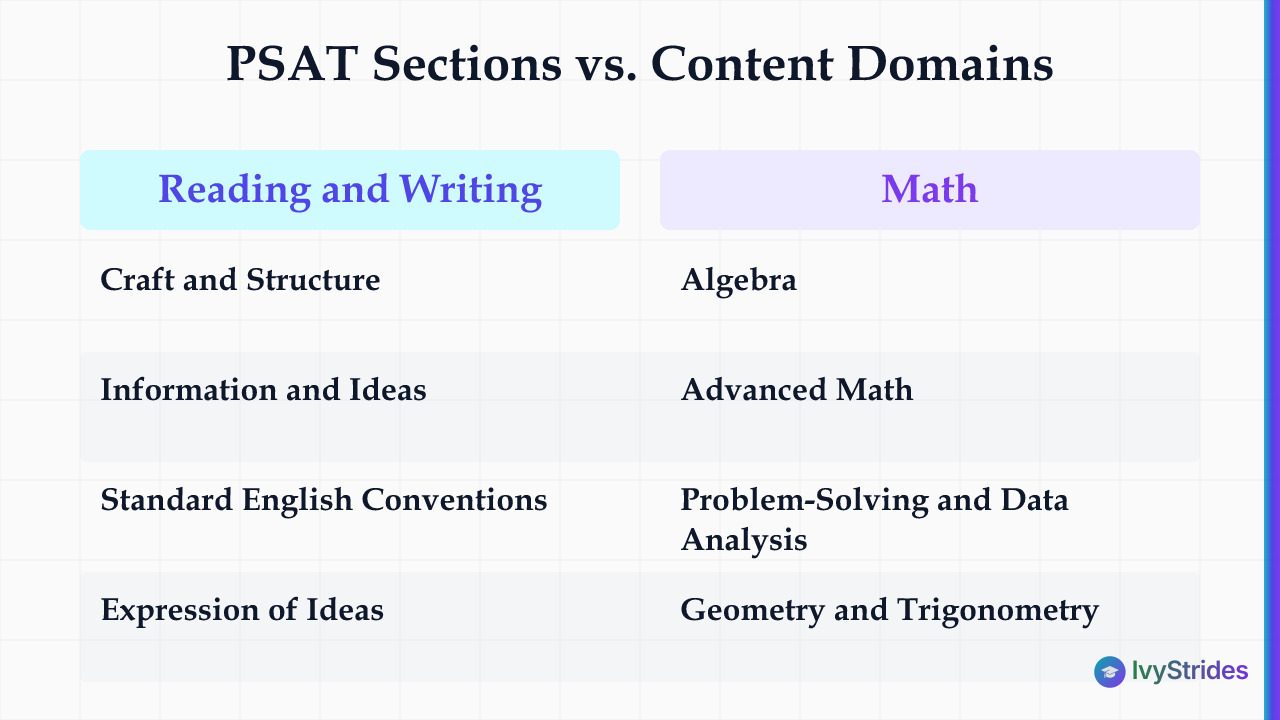
Your PSAT score is a diagnostic for the SAT, and for most students that is its real value. Because the PSAT/NMSQT and the SAT share a common score scale, your section scores in Reading and Writing and Math point directly to the areas that need the most work before your first SAT sitting. The SAT Suite is vertically scaled, so a student is expected to earn the same score on two of its tests taken the same day.
The score report earns its keep in the Knowledge and Skills section. It shows a graphic of your performance on each of eight content domains, four in Reading and Writing and four in Math. The four Math domains are Algebra, Advanced Math, Problem-Solving and Data Analysis, and Geometry and Trigonometry. A low band in one domain tells you where your SAT hours belong.
Format you can trust. The PSAT/NMSQT runs 98 questions in 2 hours 14 minutes of testing time, split into a Reading and Writing section (54 questions, 64 minutes) and a Math section (44 questions, 70 minutes), per College Board's structure page. Each section has two equal-length modules, and the test is multistage adaptive, so your Module 1 performance routes you to an easier or harder Module 2.
| Section | Content Domain | What a Low Band Signals for SAT Prep |
| Reading and Writing | Craft and Structure | Weak on word meaning in context |
| Reading and Writing | Information and Ideas | Trouble with inference and evidence |
| Reading and Writing | Standard English Conventions | Punctuation and sentence boundaries |
| Reading and Writing | Expression of Ideas | Transitions and rhetorical synthesis |
| Math | Algebra | Linear equations and systems |
| Math | Advanced Math | Nonlinear functions, quadratics |
| Math | Problem-Solving and Data Analysis | Ratios, percentages, data reading |
| Math | Geometry and Trigonometry | Angles, area, right-triangle rules |
A sophomore score that disappoints is not a college concern, since colleges never see it, but it does flag domains worth closing before junior year. Settle on one or two domains to prioritize rather than reviewing everything equally.
Compare your result with good PSAT score benchmarks by grade first. Once you know which domains to target, turn them into an SAT strategy built from your PSAT score.
What Happens If You Miss the Junior-Year PSAT/NMSQT?
Miss the junior-year PSAT/NMSQT for a valid reason, and NMSC offers an Alternate Entry route. A student who misses the test because of illness, an emergency, or another extenuating circumstance must write to NMSC no later than April 1 of the following year to request alternate entry. Miss that deadline and the National Merit door closes for that class year.
The sophomore sitting does not qualify, so there is no second chance through the PSAT 10. For four-year students, only the 11th-grade PSAT/NMSQT counts for National Merit, which makes the one fall window the thing to protect. Students register through their school, not directly with College Board, so the first step is confirming that your school has set its test date.
Mark the calendar. The fall 2026 in-school testing window for the PSAT/NMSQT and PSAT 8/9 ran October 1 to October 30, 2026, so current juniors have already had their qualifying sitting. Students who are sophomores in 2026–27 take their qualifying PSAT/NMSQT in fall 2027. The spring 2027 window, March 1 to April 30, 2027, covers SAT School Day, the PSAT 10 and the PSAT 8/9, and neither PSAT counts for National Merit. Some districts and schools cover all or part of the PSAT/NMSQT fee.
Here is the checklist I give students heading into their qualifying year:
- Ask your counselor when your school plans to give the fall 2027 PSAT/NMSQT.
- Ask whether the school covers the test fee or whether you owe part of it.
- Take one full-length practice test now to get a current Selection Index estimate.
- Rank your two weakest content domains from the score report and build prep around them.
- If you already missed the junior sitting for a valid reason, note the April 1 Alternate Entry deadline.
Juniors who missed the October 2026 sitting for a valid reason can still use National Merit Alternate Entry after a missed junior-year PSAT, which starts with a written request to NMSC by April 1, 2027. Because each student gets one qualifying fall sitting, line up the fall 2027 test against the PSAT test dates and registration steps your school controls.
FAQ: Does the PSAT Count for College
Do colleges get PSAT scores before students?
No. College Board does not send PSAT scores to colleges at any point, before or after you receive them. Your school, and in many cases your district and state, receive the score report. Colleges have no access to PSAT results, so the timing question doesn't arise.
Is a 1200 a bad PSAT score?
A 1200 on the PSAT/NMSQT (scale 320–1520) cannot hurt you with colleges, since they never see it, and the percentiles on your score report show how it compares with other test-takers. Whether 1200 is competitive for National Merit as a junior depends on its Selection Index and your state's cutoff, which NMSC sets each year and College Board does not publish.
Is a 750 a bad PSAT score?
A 750 on the PSAT/NMSQT (scale 320–1520) is not a college admissions concern, since colleges never see PSAT scores, and your score report percentiles show where it stands among test-takers. It does signal meaningful gaps in one or both sections worth addressing before the SAT.
Does the sophomore PSAT count for National Merit?
No. For four-year high school students, only the PSAT/NMSQT taken in 11th grade qualifies for the National Merit Scholarship Program. NMSC does not consider the PSAT 10 (10th grade) or PSAT 8/9 (8th or 9th grade) for National Merit entry, no matter how high the score.
Your Next Step With Your PSAT Score
The PSAT never reaches a college, so stop asking whether it will help or hurt your application. It won't do either. What it can do is open the National Merit door in junior year and hand you a clean diagnostic for the SAT at every grade.
- If you're a sophomore: note your two weakest domains, treat them as your SAT starting line, and plan for the fall 2027 PSAT/NMSQT, your qualifying sitting.
- If you're a junior who tested in October 2026: estimate your Selection Index from your section scores and watch for NMSC's Semifinalist notice through your school in September 2027.
- If you missed the junior sitting for a valid reason: write to NMSC no later than April 1, 2027 to request Alternate Entry.
Daily SAT and ACT prep on YouTube: short strategy videos from IvyStrides. Subscribe to IvyStrides on YouTube.

Rajesh is a technology leader, entrepreneur, and angel investor with 28+ years in Business & Technology Leadership and Product & Solution Engineering. He is passionate about education, mentoring, and driving digital transformation.