
Brown PLME Class of 2030: 4,687 Applied, 50 Enrolled, and What Gets You Read
On this page
- What Brown PLME Is and Why the Acceptance Rate Is So Low
- What Brown PLME Requires in the Application
- The PLME Essays: Three 250-Word Prompts That Separate Similar Files
- What a Competitive Brown PLME File Actually Shows
- FAQ: Brown PLME Acceptance Rate and Requirements
- How many people get into Brown PLME?
- Does Brown PLME require the MCAT?
- Is the Brown PLME program worth it?
- Does applying to Brown PLME hurt your chances of regular Brown admission?
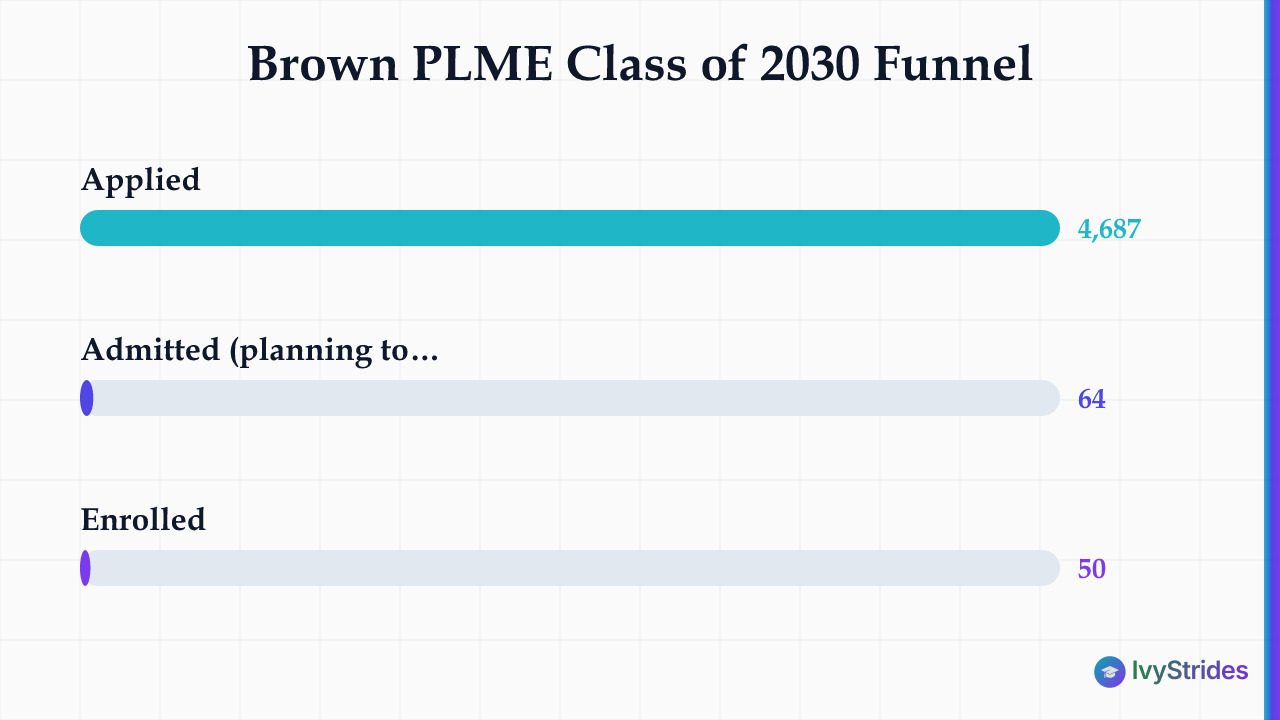
Brown does not publish a PLME acceptance rate. The Program in Liberal Medical Education is Brown's eight-year combined baccalaureate-MD program. Its most recent published counts, from the previous cycle for the Class of 2030 (fall 2026 entry), show 4,687 applicants and 50 enrolled, and Brown announced 64 admitted students planning to enroll in the PLME. Brown has published no PLME figures yet for the 2026-27 cycle.
The applicant and enrollment counts come from Brown's latest counselor newsletter, which reports the previous cycle's figures, and the 64 admitted students planning to enroll in the PLME from its announcement of admitted students. The program's own PLME Facts and Figures page still shows its "2019 Class Statistics" (2,641 applicants, 94 offered admission, 61 matriculants), so treat any 94-offer figure as dated. The harder question isn't the count. It's what a file has to show to get past the first read.
What Brown PLME Is and Why the Acceptance Rate Is So Low
The Program in Liberal Medical Education is an eight-year combined baccalaureate-MD program at Brown: four years of undergraduate study followed by four years at the Warren Alpert Medical School. Brown describes it as the only combined baccalaureate-MD program in the Ivy League, and approximately 50 students enroll in it each year.
The funnel is the whole story. Brown reports a 6% admit rate for its Class of 2030 as a whole; for the PLME it reports counts (4,687 applicants, 50 enrolled, and 64 admitted students planning to enroll) but no rate. Every PLME applicant is, in Brown's words, by definition an applicant to Brown University, considered for admission to both the College and the PLME.
Because the review runs through Brown's undergraduate process, every factor Brown rates Very Important for all applicants, including standardized test scores, course rigor, and essays, applies to PLME files too. Brown rates those same factors across its general undergraduate review, which a PLME file sits inside rather than beside.
| Stage, Class of 2030 (fall 2026 entry) | Count |
| PLME applicants | 4,687 |
| Admitted, planning to enroll in PLME | 64 |
| Enrolled in PLME | 50 |
| PLME acceptance rate | Not published by Brown |
The MCAT waiver is the structural draw. Brown's PLME FAQ says PLME students are not required to take the MCAT to matriculate into the Warren Alpert Medical School, though they must maintain strong academic standing and uphold professionalism standards in both the College and the PLME.
What Brown PLME Requires in the Application

Photo by cottonbro studio on Pexels
Brown PLME requires everything a standard Brown application does, plus three PLME-specific essays.
Test policy first. Brown is test-required for the 2026-27 cycle, entry fall 2027. Brown evaluates scores in context of your educational background and school, publishes no minimums, and says below-average scores should not deter you from applying. Brown superscores within the SAT and within the ACT, and accepts Score Choice.
All first-year applicants, PLME included, use the Common App, and there is no separate PLME application. Brown's 2025-26 Common Data Set rates these factors Very Important: rigor of secondary school record, class rank, academic GPA, standardized test scores, application essay, recommendations, talent/ability, and character. Brown says it would always prefer the more rigorous route, which at many high schools means the AP or IB version of a course over a potentially less rigorous Honors option.
| Item | Notes |
| Common App | Required platform for all first-year applicants |
| SAT or ACT | Required for 2026-27 (fall 2027 entry); superscored; Score Choice accepted |
| Two teacher recommendations | From major academic subjects; PLME applicants should include a math or science teacher |
| Counselor recommendation + school report | Required |
| Brown's standard essays | Four listed for 2026-27, though the PLME section says three; confirm the count in the Common App |
| Three PLME essays | 250 words each |
| Video introduction | Strongly encouraged for PLME applicants; no interviews this cycle |
| Midyear grades | All applicants; ED also sends first-quarter grades |
| Arts supplement (optional) | Via SlideRoom; ED Nov 4, RD Jan 7 |
| Early Decision | Binding; deadline November 1 |
Note that the SlideRoom arts supplement deadline (November 4 for ED) falls three days after the binding Early Decision application deadline (November 1), so treat them as two separate dates rather than the same one.
Brown's binding Early Decision round closes November 1, and Regular Decision closes January 5. Brown's PLME pages are explicit: if Brown admits you through ED, you must enroll whether or not the PLME admits you, and applicants who do not want that outcome are encouraged to apply Regular Decision. Across all of Brown, the fall 2025 entering class drew 5,062 ED applications and admitted 907. A binding commitment means you can't compare offers later, so settle whether Early Decision fits your full college list before November 1.
The PLME Essays: Three 250-Word Prompts That Separate Similar Files
Brown PLME requires three additional essays of 250 words each, on top of Brown's standard application essays. The 2026-27 prompts ask "Why medicine?" and "Why PLME?", and the third asks for something about yourself, beyond your interest in medicine, that you think will make you a great doctor. Brown's application instructions list four essays for all first-year applicants but say the PLME essays come "in addition to the three essays required of all first-year applicants," so count the essays in the live 2026-27 Common App's Brown questions before you draft, and do not plan on a total until you have.
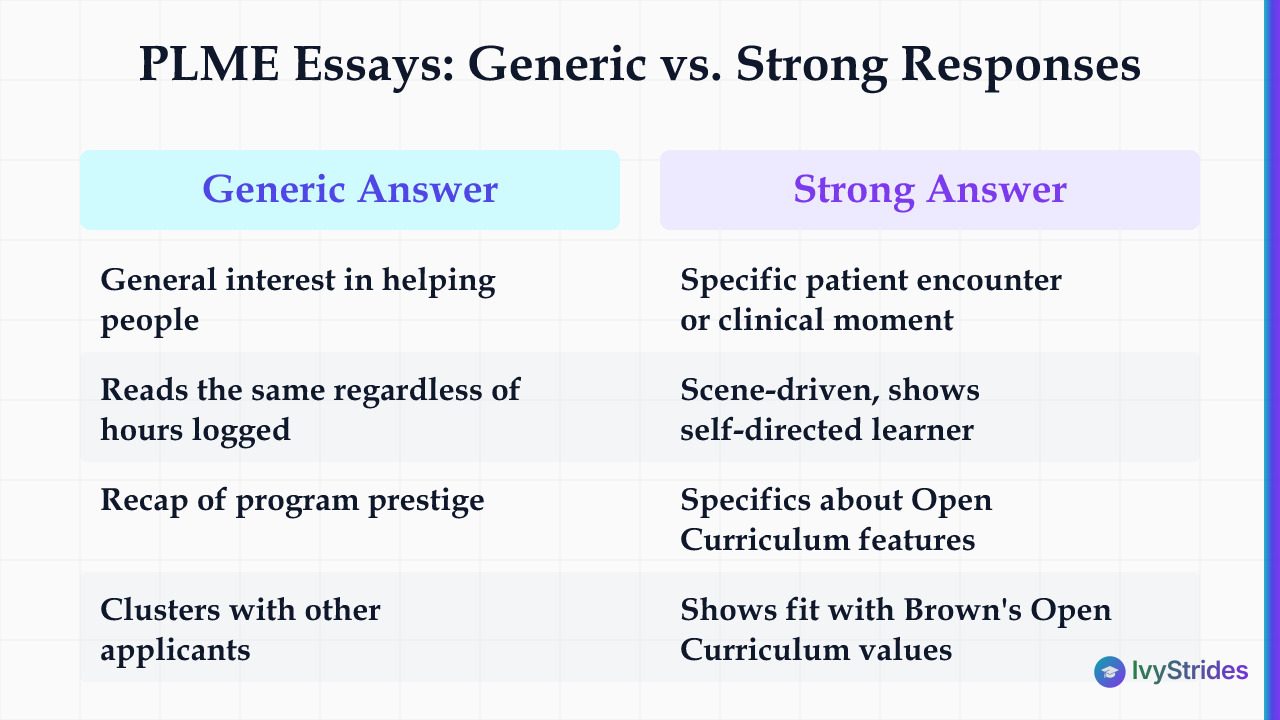
Two applicants can carry the same GPA and the same scores; the writing is where they stop looking alike. A generic "why medicine" answer reads the same no matter how many clinical hours a student has logged, while a specific, scene-driven response shows the kind of self-directed learner Brown's Open Curriculum is built for.
The Open Curriculum is the lens. Brown has no core requirements outside a student's concentration, and it looks for students who can be "architects of their own educational journey." The "why PLME" prompt is structurally a Why This College essay, and it rewards the same specificity about the program's actual features, not a recap of its prestige.
| Essay | Word Limit | What a Strong Answer Shows |
| Why medicine | 250 | Depth and authenticity of medical motivation |
| Why PLME | 250 | Fit with the Open Curriculum and program specifics |
| Beyond medicine: what will make you a great doctor | 250 | Character, curiosity, self-direction |
On the "why medicine" prompt, generic responses tend to cluster. The strongest essays name a specific patient encounter, a research moment, or a clinical observation rather than a general interest in helping people. IvyStrides coaches check each PLME draft against Brown's stated Open Curriculum values, which is where supplemental essays that show genuine fit earn their read.
What a Competitive Brown PLME File Actually Shows
A competitive Brown PLME file shows sustained academic rigor, a medical motivation tested through real experience, and three essays that cohere around that motivation. Brown states plainly that high school performance and preparedness is the most important consideration in its admission process, which places the transcript ahead of everything else in the read.
Course load, by Brown's own guidance. Brown wants at least four, preferably five rigorous academic courses each year, across English, math through calculus where possible, lab sciences, history or social studies, and a world language. Brown treats senior-year courses and grades as important indicators and reviews admitted students' grades to confirm they continue at the same level. The number and rigor of your AP courses reads as a direct signal.
Brown reads teacher recommendations for curiosity, problem-solving, openness to other viewpoints, written and spoken expression, and work ethic. A generic medical narrative is unlikely to differentiate a file at the initial read, regardless of GPA or test scores, so a clear and specific medical motivation matters.
| Factor | Brown's Rating | What It Means for PLME Applicants |
| Rigor of secondary record | Very Important | Choose the more rigorous option, often AP or IB; keep it through senior year |
| Academic GPA | Very Important | Earned in demanding courses, not protected ones |
| Standardized test scores | Very Important | Required for 2026-27 (fall 2027 entry); read in context; no minimums |
| Application essay | Very Important | Three PLME essays must cohere with the standard file |
| Recommendations | Very Important | Read for curiosity and work ethic |
| Character/personal qualities | Very Important | The "beyond medicine" essay speaks here |
| Interview | Not Considered | No interviews in the current cycle |
| Level of interest | Not Considered | Applying is itself taken as serious interest |
On scores: Brown requires them for 2026-27 (fall 2027 entry) and evaluates them in context, so a result well above the middle range can strengthen a file even though Brown publishes no minimums. Building this profile takes all four years, not senior year alone. A student in 9th or 10th grade still has time to set the course plan and extracurricular direction that PLME expects.
Before you apply, check four things against Brown's own guidance: four or five rigorous courses a year, SAT or ACT scores for the 2026-27 requirement, three 250-word PLME essays tied to specific experiences, and whether a binding Early Decision commitment fits your certainty about medicine and Brown.
FAQ: Brown PLME Acceptance Rate and Requirements
How many people get into Brown PLME?
For the Class of 2030 (fall 2026 entry), Brown counted 4,687 PLME applicants, announced 64 admitted students planning to enroll in PLME, and enrolled 50. Brown does not publish a PLME acceptance rate, and it has released no PLME figures for the 2026-27 cycle yet.
Does Brown PLME require the MCAT?
No. PLME students do not need the MCAT to matriculate into the Warren Alpert Medical School, but they must keep strong academic standing and meet professionalism standards in both the College and the PLME.
Is the Brown PLME program worth it?
For a student certain about medicine and drawn to the Open Curriculum, PLME offers a path into the Warren Alpert Medical School without the MCAT, the choice of any Brown concentration, and a dedicated PLME advising dean through all four undergraduate years. The trade-off is committing to medicine at 17 or 18 and meeting PLME requirements and standards throughout college. It fits students who have already tested their interest through sustained clinical or research experience, not those still exploring.
Does applying to Brown PLME hurt your chances of regular Brown admission?
Brown says PLME applicants are, by definition, applicants to Brown University and are considered for admission to both the College and the PLME, so a file the PLME does not admit can still be admitted to the College. The one catch is Early Decision: if Brown admits you through ED without a PLME offer, you are still bound to enroll.

Hemant is a seasoned entrepreneur, investor, and growth strategist with deep ground in education and technology-driven learning. His core training is in Mathematics and Physics — he authored Physics for IB Diploma: Ultimate Revision Guide, recognized as a top student resource.