
How to Study for AP Calculus AB/BC and Score a 5: Your 2026 Game Plan
On this page
- What the AP Calculus Exam Actually Looks Like in 2026
- AP Calculus AB vs. BC: Which Course Is Right for You?
- AP Calculus AB Unit-by-Unit Study Guide
- AP Calculus BC: What the Extra Units Add and Why They Are Harder
- Why So Many Students Stall Before the Exam (and How to Break Through)
- A Realistic Study Timeline: 8, 12, and 16 Weeks to the May Exam
- Should You Self-Study AP Calculus or Work With a Coach?
- How AP Calculus Fits Into Your College Admissions Strategy
- FAQ
- Is AP Calculus BC the same as Calculus 1 and 2 in college?
- What is the hardest part of AP Calculus BC?
- Is a 3 on AP Calculus AB a bad score?
- Can I skip AP Calculus AB and take BC directly?
- What free resources are best for AP Calculus prep?
- How is the AP Calculus exam scored?
- Your Next Step
To score a 5 on AP Calculus AB or BC in 2026, start with a full-length diagnostic practice exam to identify your weakest units, then work through the College Board's Course and Exam Description unit by unit. AB covers limits, derivatives, integrals, and differential equations across 8 units. BC adds parametric equations, polar coordinates, and infinite series in Units 9 and 10. The exam runs 3 hours 15 minutes: 45 multiple-choice questions and 6 free-response questions, each worth 50% of your score. Most students need roughly 10 to 16 weeks of consistent, targeted prep to move from a 3 to a 5.
Those unit numbers and exam specs come straight from the College Board AP Calculus Course and Exam Description. The harder question is how to spend the weeks you have left before May in a way that actually moves your score, and that's what the rest of this article maps out.
What the AP Calculus Exam Actually Looks Like in 2026
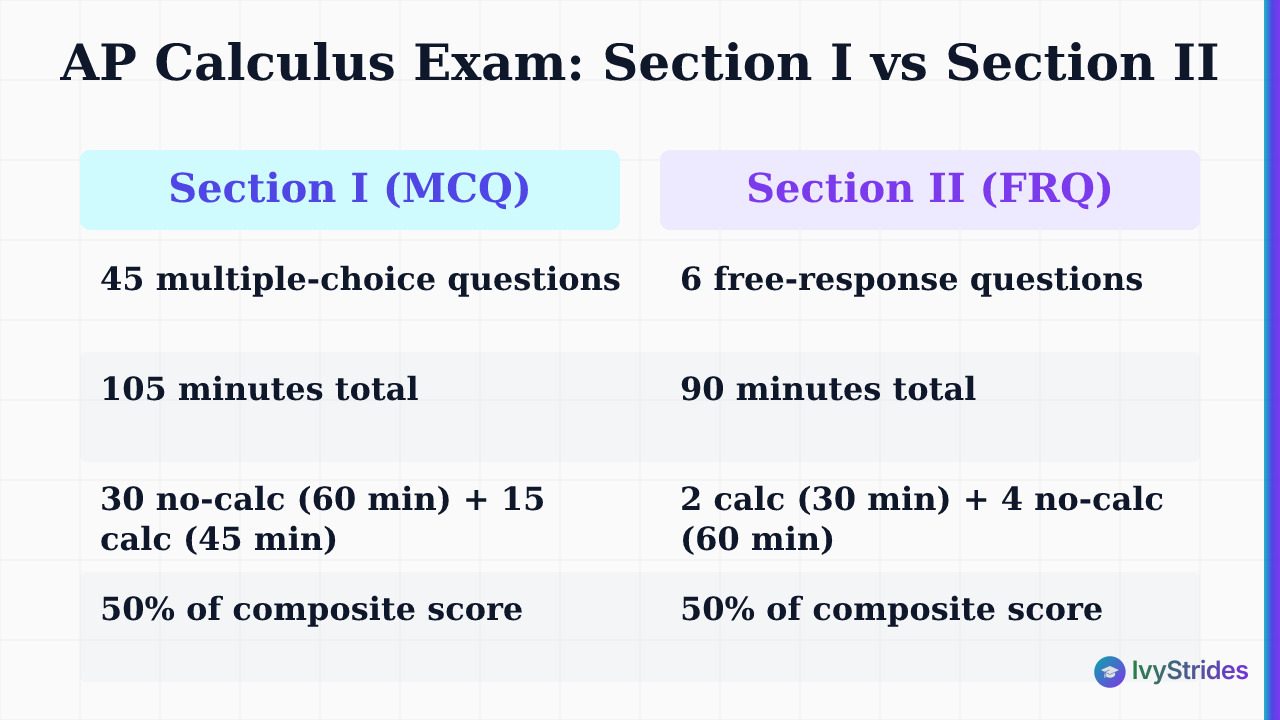
The AP Calculus AB and BC exams share an identical structure: two sections, 3 hours 15 minutes total, and a composite score scaled 1 to 5. Section I is 45 multiple-choice questions worth 50% of your score: 30 no-calculator questions in the first 60 minutes, then 15 calculator-permitted questions in the next 45 minutes. Section II is 6 free-response questions worth the other 50%: 2 calculator-permitted FRQs in the first 30 minutes, then 4 no-calculator FRQs in the next 60 minutes. These specs come from the College Board AP Calculus CED.
Here's the strategic wrinkle most BC students don't fully use. The BC exam reports both a BC composite score and a separate AB subscore, which reflects your performance only on the AB-content questions inside the BC exam. Some colleges accept the AB subscore for Calculus I placement even when the BC composite doesn't clear their threshold for Calculus II credit. That's a real safety net worth knowing about.
Two things to internalize before you plan any prep hours. First, there's no penalty for wrong answers on the MCQ section, so you should answer every question, even the ones you guess on. Second, FRQ scoring is rubric-based, with partial credit awarded on each part. That means your written work matters as much as your final answer, and it's why FRQ practice under real conditions is non-negotiable.
For deeper unit-level walk-throughs, see our dedicated pages for AP Calculus AB and AP Calculus BC.
AP Calculus AB vs. BC: Which Course Is Right for You?
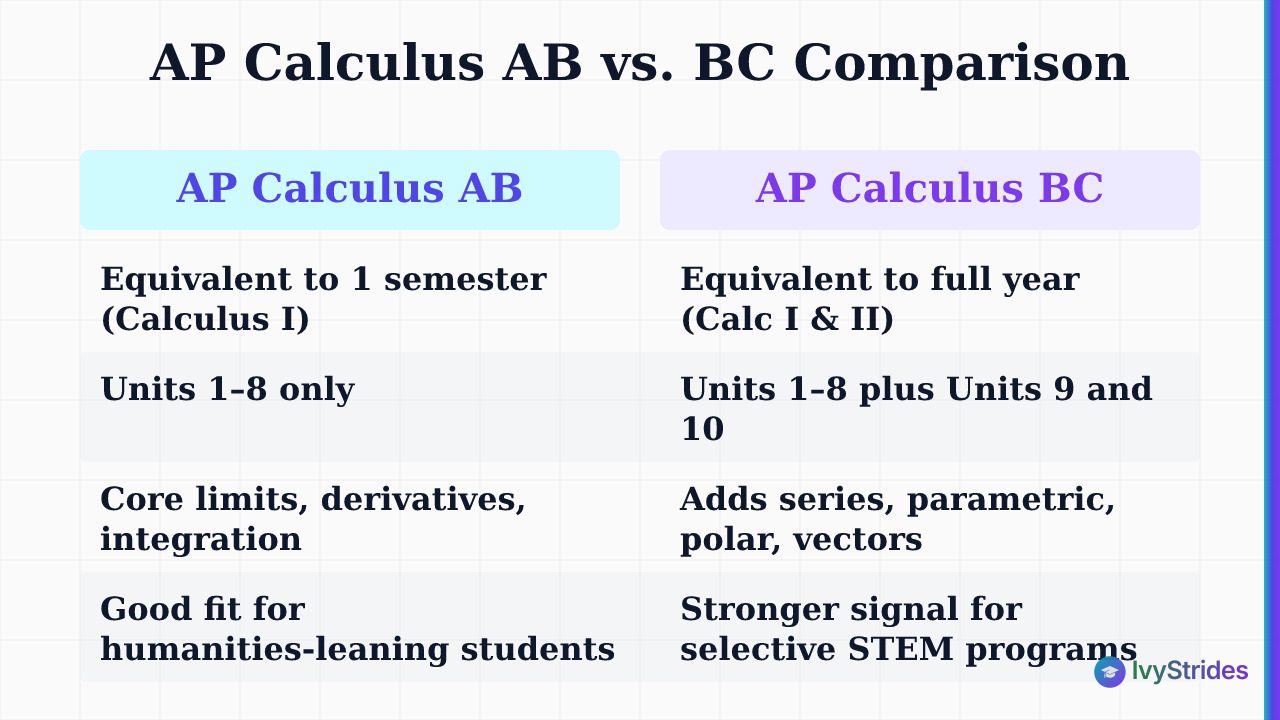
Short version. AP Calculus AB is equivalent to one semester of college calculus (Calculus I). AP Calculus BC is equivalent to a full year (Calculus I and II combined). BC covers everything AB covers, then adds two units on top: Unit 9 (parametric equations, polar coordinates, vector-valued functions) and Unit 10 (infinite sequences and series, Taylor and Maclaurin polynomials). BC also folds in integration by parts, improper integrals, arc length, and logistic differential equations.
Should you skip AB and take BC directly? For students with a strong precalculus and algebra II foundation, yes, this is a viable path. BC moves through the Units 1-8 material quickly and expects you to already be comfortable with limits, derivatives, and basic integration by the time series content begins in the spring. If your precalculus is shaky, skipping AB is high-risk. Students who are still building their calculus foundation may want to explore AP Precalculus online before committing to the AB or BC course load.
Which should you take if you have the choice? If you're aiming at selective STEM programs, BC is the stronger transcript signal and the more efficient use of your calendar, because the AB subscore protects you at colleges that only grant Calculus I credit anyway. If you're a humanities-leaning student who needs one math AP to round out rigor, AB is the sensible call.
AP Calculus AB Unit-by-Unit Study Guide
Per the College Board CED, AP Calculus AB is organized into eight units, each with defined exam weighting. Here's what you're actually studying, in order.
Unit 1: Limits and Continuity. Definition of a limit, one-sided limits, limits at infinity, continuity, and the Intermediate Value Theorem. This is the conceptual foundation for everything after it.
Unit 2: Differentiation, Definition and Fundamental Properties. The derivative as a limit, power rule, product rule, quotient rule, and the derivatives of trigonometric, exponential, and logarithmic functions.
Unit 3: Differentiation, Composite, Implicit, and Inverse Functions. Chain rule, implicit differentiation, and derivatives of inverse functions. This is where students first hit real trouble.
Unit 4: Contextual Applications of Differentiation. Related rates, linearization, L'Hopital's Rule, and rectilinear motion. In our coaching, Unit 4 consistently produces the most student errors in AB, especially related rates problems where students misidentify which variable is changing with respect to what.
Unit 5: Analytical Applications of Differentiation. Mean Value Theorem, Extreme Value Theorem, first and second derivative tests, optimization, and curve sketching. Unit 5 alongside Unit 6 carry the highest exam weighting in AB.
Unit 6: Integration and Accumulation of Change. Riemann sums, the Fundamental Theorem of Calculus, definite and indefinite integrals, and u-substitution.
Unit 7: Differential Equations. Slope fields, separation of variables, and exponential growth and decay models.
Unit 8: Applications of Integration. Area between curves, volumes of solids of revolution (disk, washer, shell), and average value of a function.
The algebraic fluency you build in AP Calculus AB, particularly in Units 1 and 2, directly reinforces the advanced math skills tested on the Digital SAT Math section. If you're prepping both, see our breakdown of SAT math topics.
Priority for a 5: master Units 4, 5, and 6 first. Those three units account for the largest share of both MCQ and FRQ content.
AP Calculus BC: What the Extra Units Add and Why They Are Harder
BC students carry everything above, then add Unit 9 and Unit 10. Unit 10 is where the exam separates 4s from 5s.
Unit 9: Parametric Equations, Polar Coordinates, and Vector-Valued Functions. Derivatives and integrals of parametric and vector-valued functions, arc length in parametric and polar form, and area enclosed by polar curves. Unit 9 is mechanical. Once you learn the formulas and practice them, the questions become predictable.
Unit 10: Infinite Sequences and Series. This is the hardest unit in either course. You need to select the correct convergence test from among the ratio test, comparison test, limit comparison test, alternating series test, integral test, and p-series test. Then you need to apply it correctly, justify your reasoning in writing on FRQs, and, for Taylor and Maclaurin series, construct polynomial approximations and calculate Lagrange error bounds.
Why so much harder? Every earlier unit builds on algebraic manipulation. Unit 10 requires abstract reasoning about infinite processes, and the FRQ scoring rubric penalizes students who apply the right test but justify it poorly. The BC exam typically includes 2 to 3 MCQs and at least 1 FRQ directly testing series.
Is AP Calculus BC hard? Yes. Roughly 40 to 45% of BC test-takers earn a 5 in a typical year, compared with around 20 to 25% of AB test-takers, per College Board AP score distribution reports. Those percentages vary year to year, and the higher BC pass rate reflects a self-selection effect: BC students are, on average, stronger math students to begin with. Not a signal that BC is easier.
Practical implication. Allocate at least roughly 20 to 25% of your BC prep hours to Unit 10 alone, and inside that block, spend most of your time on convergence test selection logic and on Taylor series FRQ writing under timed conditions.
Why So Many Students Stall Before the Exam (and How to Break Through)
Here's the pattern that shows up over and over. A student walks in with a full binder of notes, a stack of watched videos, and a diagnostic score of 3. They've been "studying" for months. Their score won't move.
Why? Because they've been doing passive review. Re-reading chapter summaries. Watching someone else solve problems. Highlighting textbook pages. None of that trains the skill the exam actually tests, which is generating correct calculus work under time pressure on questions you haven't seen before.
The breakthrough comes from three shifts:
Diagnostic first, then unit review. Take a full-length practice exam under real timing before you open a single textbook. In our coaching, students who take a full-length diagnostic before starting unit review consistently identify 2 to 3 high-use units that account for most of their lost points. Studying units in order is a waste of your calendar. Study units in order of point-loss.
Active FRQ practice under rubric-aware conditions. Don't just solve FRQs. Solve them, then score them against the official College Board scoring guidelines yourself. In our coaching, students who practice writing rubric-aligned FRQ solutions typically score around 1 to 2 points higher per question compared with students who only check final answers. That's often the difference between a 4 and a 5.
Official College Board past FRQs as your primary practice. The College Board releases decades of past FRQs with scoring guidelines free at apcentral.collegeboard.org. Nothing else on the market matches them for exam accuracy. Third-party prep books are useful supplements. They are not substitutes.
If you're weighing whether personalized coaching is worth the investment for AP Calculus, the breakdown in our guide on AP tutoring is it worth it covers exactly when it pays off versus when self-study is sufficient.
A Realistic Study Timeline: 8, 12, and 16 Weeks to the May Exam

Photo by cottonbro studio on Pexels
The AP Calculus exam is administered in the first two weeks of May each year. Working backward, here's how to think about your calendar. Realistic weekly commitment for meaningful score improvement is about 5 to 8 hours per week. Students aiming to move from a 3 to a 5 typically need the higher end of that range. At 5 to 8 hours per week across 16 weeks, that's roughly 80 to 130 total study hours; across 8 weeks, roughly 40 to 65.
16-Week Plan (start in January). Weeks 1-2: diagnostic exam and error analysis. Weeks 3-10: unit-by-unit coverage in order of diagnostic point-loss, roughly one unit per week for AB, or covering Units 9 and 10 across three weeks for BC. Weeks 11-13: first review cycle, retesting each unit about 2 to 3 weeks after initial study to confirm retention. Weeks 14-15: second review cycle plus full-length timed practice exams. Week 16: FRQ rubric review and light practice.
12-Week Plan (start in February). Week 1: diagnostic. Weeks 2-8: unit coverage prioritized by diagnostic results, not by textbook order. Weeks 9-10: one review cycle with retesting. Weeks 11-12: two full-length timed practice exams plus FRQ review.
8-Week Plan (start in March). This is triage. Week 1: diagnostic. Weeks 2-5: cover only the highest-weighted units and your two weakest units. For AB, that's typically Units 4, 5, 6, plus whichever unit you scored lowest on. For BC, add Unit 10 no matter what your diagnostic said. Weeks 6-7: FRQ practice under timed conditions. Week 8: one full-length practice exam and final rubric review.
One rule across all three timelines. Complete at least two full-length timed practice exams before the real exam. In our coaching, students who do so consistently outperform students who only practice at the unit level. The exam tests stamina and pacing as much as it tests content.
The scheduling logic here mirrors what we use in our SAT study plan framework: diagnostic first, then prioritize by point-loss, then confirm retention with spaced retesting.
Should You Self-Study AP Calculus or Work With a Coach?
Honest answer. Self-study works for a real subset of students, and coaching is high-value for a different subset. Here's how to tell which you are.
Self-study is a good fit if: you scored a 3 or higher on your diagnostic, your algebra and precalculus foundation is strong, you can hold yourself to 5 to 8 hours a week without external accountability, and you're disciplined about writing rubric-scored FRQ solutions on your own. The core self-study stack is free: College Board AP Classroom (accessed through your school's College Board account) for official unit progress checks, plus the College Board's public library of past FRQs with scoring guidelines. Some third-party online video platforms also offer AP Calculus AB and BC content aligned to the CED and can supplement the official materials.
Coaching adds the most value if: you're stuck at a 2 or 3 after honest self-study, you're a BC student who can't get traction on Unit 10 convergence tests or Taylor series, you need feedback on FRQ writing rather than just answer-checking, or you're preparing for BC after limited AB exposure and need someone to compress the AB material fast.
The IvyStrides approach is per-subject specialists, not generalist tutors. Your AP Calculus coach teaches AP Calculus. You can see how we staff ap prep courses on our dedicated page. Our documented methodology is diagnostic-first: baseline practice exam, unit-level error analysis, targeted weakness work, and spaced retesting.
Third-party prep books can be useful supplementary review material. Neither they nor any video course replaces official College Board past FRQs as your primary practice.
How AP Calculus Fits Into Your College Admissions Strategy
AP Calculus scores matter for two reasons in college admissions, and it's worth being precise about which is which.
Rigor signal on your transcript. Selective colleges evaluate the strength of your course selection. Taking AP Calculus BC and earning a solid score signals STEM readiness in a way that no test score alone can. This shows up during admissions review, before your AP scores from May are even released.
College credit and placement after admission. This is where policies vary widely, and where you need to check individual schools. Some colleges grant a semester of calculus credit for a 4 or 5 on AB, some require a 5, some grant no credit regardless. BC credit typically requires a 4 or 5 for two semesters of credit at institutions that offer it, with some using the AB subscore for partial credit. Always verify with the specific college's registrar or Common Data Set before assuming credit.
Is a 3 on AP Calculus AB a bad score? No, a 3 is passing-level mastery per the College Board. Whether it earns credit depends entirely on your target schools. Many selective STEM programs require a 4 or 5. If your top choices sit in that category, treat a 4 as your floor and a 5 as your target.
Two important caveats. First, AP scores from May exams arrive in July, well after most Regular Decision application deadlines have passed, so your senior-year AP scores affect credit and placement, not admissions decisions. Timing your AP Calculus exam alongside your college application deadlines matters; see our guide on college application deadlines for the full picture. Second, AP Calculus scores are one piece of a larger admissions picture; your SAT or ACT score and college essays carry equal weight in how selective colleges evaluate your application. Our SAT prep overview walks through how score-band strategy fits into an application timeline.
Finally, per College Board policy, students choose which AP scores to send to colleges, and self-reporting rules vary. A low score doesn't automatically appear on a college application.
FAQ
Is AP Calculus BC the same as Calculus 1 and 2 in college?
Yes. AP Calculus BC is equivalent to a full year of college calculus, covering both Calculus I (limits, derivatives, basic integrals) and Calculus II (advanced integration techniques, series, parametric and polar functions). AP Calculus AB covers only the Calculus I portion. Students who earn qualifying scores on BC can often place out of two semesters of college math, though credit policies vary by institution and should be confirmed with each college's registrar.
What is the hardest part of AP Calculus BC?
Infinite series and Taylor polynomials (Unit 10) are consistently the most difficult part of BC prep. Unlike earlier units that build on algebra and precalculus, series require you to select the correct convergence test from among six or so options, apply it correctly, and, in FRQ questions, calculate and interpret Lagrange error bounds. In our coaching, students who allocate at least roughly 20 to 25% of their BC prep time to Unit 10 alone see the largest score gains.
Is a 3 on AP Calculus AB a bad score?
A 3 is not a failing score; per the College Board, it demonstrates passing-level mastery. Whether it earns college credit depends entirely on the institution. Many selective universities and STEM programs require a 4 or 5 for placement credit, while some non-selective schools accept a 3. Always check the specific college's AP credit policy before assuming a 3 will count. If your target schools require a 4 or 5, that's your prep benchmark, not the pass threshold.
Can I skip AP Calculus AB and take BC directly?
Yes, skipping AB and going directly to BC is a viable path for students with a strong precalculus and algebra II foundation. BC covers all AB content in the first eight units before adding the BC-only material in Units 9 and 10. Students who skip AB should confirm they're comfortable with limits, derivatives, and basic integration before the course begins, since BC moves through that material quickly and expects fluency by the time Unit 10 begins.
What free resources are best for AP Calculus prep?
The two highest-quality free resources are the College Board's official past FRQs with scoring guidelines (available at apcentral.collegeboard.org) and AP Classroom, which is accessed through your school's College Board account and provides official unit-by-unit progress checks. Together they cover the full exam content without any cost. Third-party video platforms and prep books can supplement these but shouldn't replace them as your primary practice material.
How is the AP Calculus exam scored?
The AP Calculus exam is scored on a 1-5 scale. The multiple-choice section (45 questions) and the free-response section (6 questions) each account for 50% of the composite score. There's no penalty for wrong answers on the MCQ section, so answer every question. FRQ responses are scored by trained AP readers using a detailed rubric; partial credit is available on each part of each question, which is why writing organized, justified work matters as much as arriving at the correct final answer.
Your Next Step
You now have the exam format, the unit map, the hardest topics, a realistic timeline for three different starting points, and an honest framework for deciding between self-study and coaching. What separates students who score a 5 from the ones who don't is rarely raw ability. It's whether they diagnosed early, prioritized correctly, and practiced FRQs the way they'd be graded.

Two decades teaching quantitative and verbal aptitude on standardized tests. Rare dual expertise across Math and Verbal — particularly effective for students with gaps on both sides. Senior AP Mentor for our Calculus and English tracks.