
SAT Test 2026: Everything You Need to Know (Dates, Format, Scores & Prep)
On this page
- Is the SAT Still Relevant in 2026?
- Colleges That Require SAT Scores in 2026
- Why Submitting SAT Scores Still Helps at Test-Optional Schools
- What Is the SAT? A Quick Overview
- 2026 SAT Test Dates and Registration Deadlines
- Why SAT Scores Still Matter in 2026
- Digital SAT Format and Structure in 2026
- What's New or Changed in the 2026 Digital SAT?
- SAT Test Structure for 2026
- When Is the Best Time to Take the SAT in 2026?
- How to Register for the SAT in 2026: Step-by-Step
- SAT Registration Fees for 2026
- For International Students
- How the SAT Is Scored in 2026
- What Can Affect Your SAT Score?
- What Is a "Good" SAT Score in 2026?
- What Is a Perfect SAT Score?
- How Long Are SAT Scores Valid?
- What Is Superscoring and Which Colleges Use It?
- SAT vs ACT: Which College Admission Test Should You Take in 2026?
- Can Anyone Take the SAT?
- How to Start SAT Prep the Right Way
- What Makes the IvyStrides Prep Method Different?
- Expert Tips to Improve Your SAT Score in 2026
- How Parents Can Support Their Child's SAT Preparation
- Frequently Asked Questions (FAQs)
- Final Thoughts
If you're a high school student aiming for college, or a parent helping your child plan for the next big step, you've probably heard about the SAT. But with all the changes in college admissions lately, it's totally fair to ask: Is the SAT still relevant in 2026?
Here's the clear, no-fluff answer: Yes - and for many students, it matters more than ever.
The SAT (Scholastic Assessment Test) is a standardized college admissions test designed to measure your readiness for college-level work. It focuses on two key areas: Reading & Writing and Math. For decades, colleges have used SAT scores to compare students from different schools and backgrounds.
While the test has evolved - most recently, the SAT went fully digital in 2024 - the purpose remains the same: to give colleges a fair, consistent way to evaluate applicants.
Is the SAT Still Relevant in 2026?
Now, here's the big question: Do you still need to take the SAT in 2026? The answer depends on where you're applying but the trend is clear.
In recent years, many colleges adopted test-optional policies, especially during the pandemic. However, for the 2026–27 admissions cycle, several top schools now require the SAT as part of their admissions process.
Colleges That Require SAT Scores in 2026
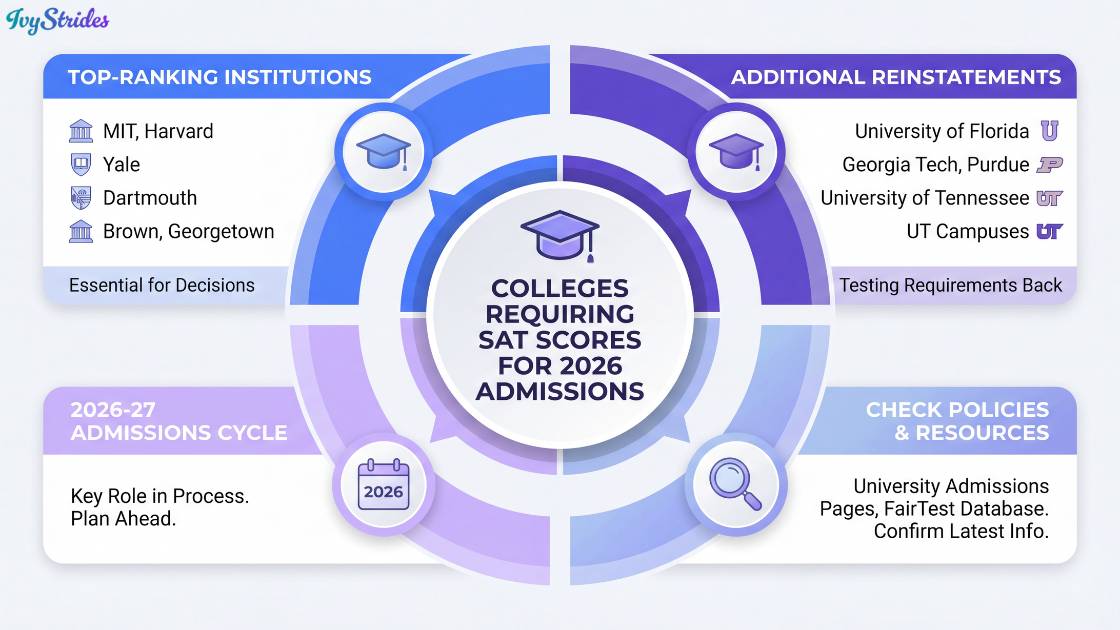
MIT, Harvard, Yale, Dartmouth, Brown, Georgetown, the University of Florida, and Georgia Tech have all confirmed that SAT scores will once again play a key role in admissions decisions. For these schools, a strong SAT score is not just helpful - it's essential.
Other schools - including Purdue, the University of Tennessee, and several University of Texas campuses - have also reinstated testing requirements. You can check the latest policies on each university's admissions page or use theFairTest database for a full list.
Why Submitting SAT Scores Still Helps at Test-Optional Schools
Even at schools that remain test-optional, submitting a great SAT score can give your application a real boost. It shows admissions officers that you're prepared for college-level work.
Plus, a strong score can help you:
- Balance out a lower GPA
- Stand out in a competitive applicant pool
- Land merit-based scholarships - some of which are based entirely on test performance
- Qualify for honors programs and special academic tracks
This is especially true for international students, where standardized tests help level the playing field across different education systems.
If you're planning to take the SAT, the good news is that prep is more accessible than ever. IvyStrides' Digital SAT prep course is shorter, more focused, and designed to be student-friendly. You can prep using realistic practice tests and the Bluebook app, or work with tutors who specialize in digital strategies. Starting early and practicing regularly can make a big difference in your final SAT score.
Our counselors work closely with students and families daily to simplify the SAT journey and reduce stress while studying for the SAT. Think of this guide as your personalized starting point to understand the SAT with more clarity, less confusion, and a lot more confidence.
What Is the SAT? A Quick Overview
The SAT is a standardized college admissions test created and administered by the College Board. It measures your preparation for college-level studies and is accepted by virtually all U.S. universities.
The Digital SAT is administered seven times a year, giving you several opportunities to take the exam and target your best score. The test covers two main areas:
- Reading & Writing - grammar, reading comprehension, vocabulary-in-context, sentence logic
- Math - algebra, geometry, advanced math, data analysis, and problem-solving
Alongside your GPA, personal essays, and recommendation letters, your SAT score plays an important role in telling admissions officers more about your academic strengths. A strong SAT score can boost your chances - whether it's getting into a competitive school, standing out from other applicants, or qualifying for scholarships.
2026 SAT Test Dates and Registration Deadlines
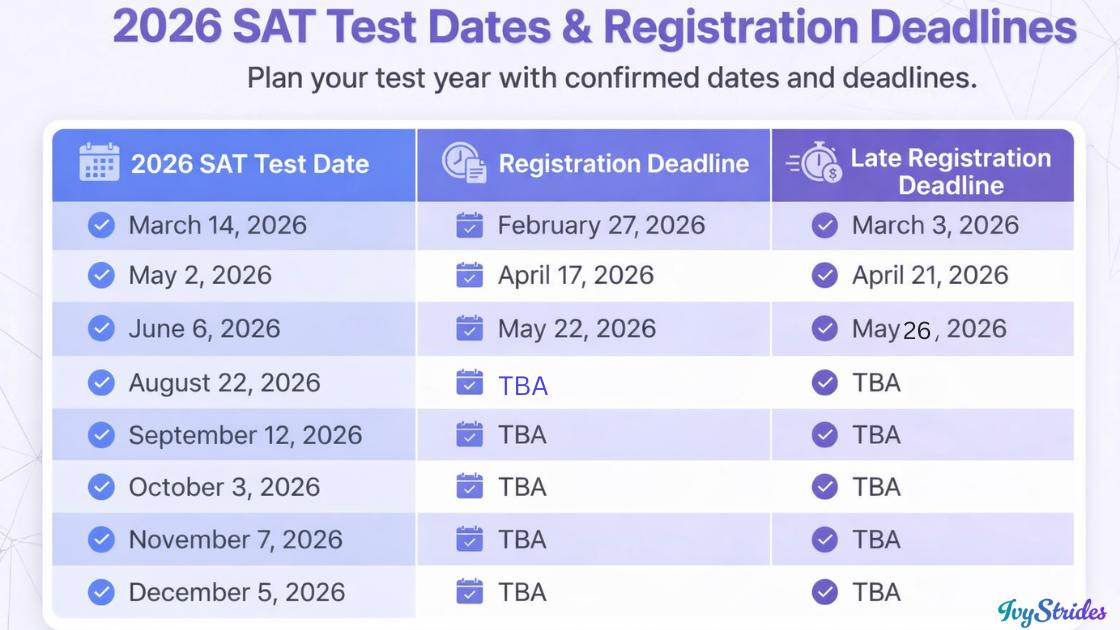
Planning your SAT around the right test date is one of the most important early decisions you'll make. Below are all confirmed 2026 SAT test dates along with registration and late registration deadlines, according to the College Board's official SAT dates page.
| 2026 SAT Test Date | Registration Deadline | Late Registration Deadline |
| March 14, 2026 | February 27, 2026 | March 3, 2026 |
| May 2, 2026 | April 17, 2026 | April 21, 2026 |
| June 6, 2026 | May 22, 2026 | May 26, 2026 |
| August 22, 2026 | TBA | TBA |
| September 12, 2026 | TBA | TBA |
| October 3, 2026 | TBA | TBA |
| November 7, 2026 | TBA | TBA |
| December 5, 2026 | TBA | TBA |
These dates are consistent for both U.S. and international students.
Why SAT Scores Still Matter in 2026
As more colleges shift back toward requiring or recommending test scores, the SAT continues to open doors - especially at selective universities.
- Top U.S. colleges such as MIT, Georgia Tech, and the University of Florida require SAT scores for 2026–27 admissions.
- Many competitive universities that are test-optional still recommend submitting scores if they are strong.
- SAT scores can improve your eligibility for merit-based scholarships, especially at public universities.
- Honors programs and special academic tracks often use SAT scores for selection.
- For international students, the SAT helps colleges fairly compare applicants from different education systems.
- A good SAT score can strengthen your application even if your GPA is not perfect.
Digital SAT Format and Structure in 2026
What's New or Changed in the 2026 Digital SAT?
One of the most common questions we hear: Is the SAT changing in 2026? The short answer is no major changes. The Digital SAT format introduced in 2024 remains in place for 2026. The core structure, adaptive testing model, and scoring system are all the same.
The Digital SAT format is designed to be faster, smarter, and more flexible for students like you. Here are the key features you should know:
- You will finish the test in about 2 hours and 14 minutes instead of over 3 hours.
- The test is adaptive, which means your performance on the first module of questions affects the difficulty of the second module.
- The Reading and Writing sections are merged into one single section.
- You can use an on-screen calculator for all math questions.
- Built-in tools include a timer, notepad, and math reference sheet to help you stay organized.
- You will get your results in just a few days instead of waiting for weeks.
The Digital SAT is taken on a laptop or tablet using the Bluebook app from the College Board. At IvyStrides, we give you access to realistic digital SAT practice tests and hands-on support to help you feel confident and ready on test day.
SAT Test Structure for 2026
Understanding the structure of the SAT can help you feel more confident and prepared on test day. In 2026, the SAT follows a streamlined digital format with two main sections that test your reading, writing, and math skills.
Here is the complete breakdown of the 2026 Digital SAT structure:
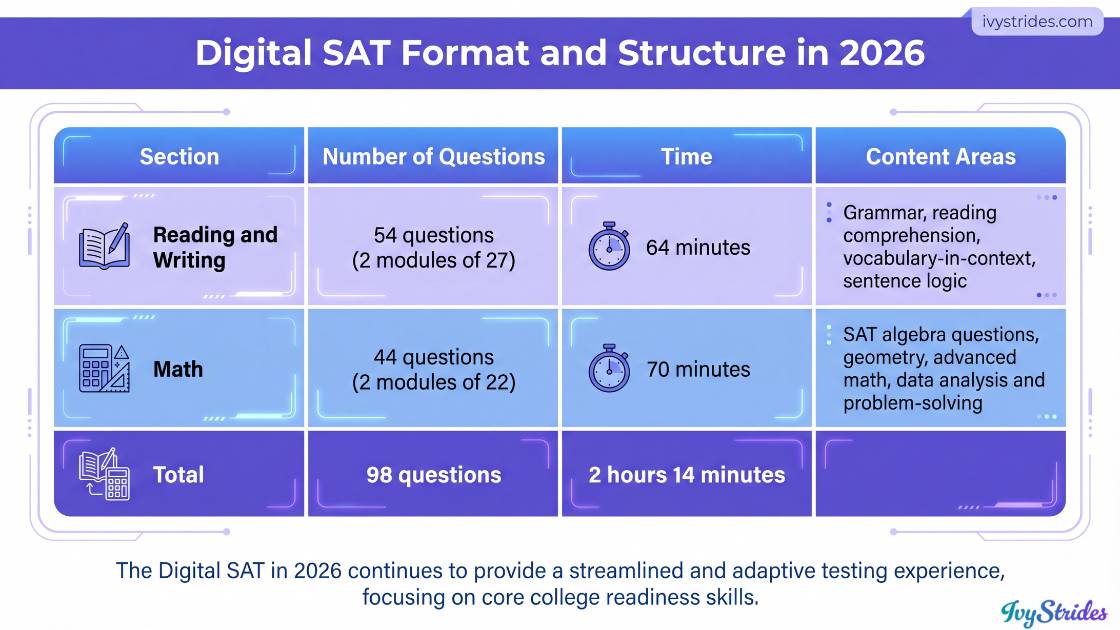
| Section | Number of Questions | Time | Content Areas |
| Reading and Writing | 54 questions (2 modules of 27) | 64 minutes | Grammar, reading comprehension, vocabulary-in-context, sentence logic |
| Math | 44 questions (2 modules of 22) | 70 minutes | SAT algebra questions, geometry, advanced math, data analysis and problem-solving |
| Total | 98 questions | 2 hours 14 minutes |
Key points to know:
- Each section is split into two modules.
- Your performance in the first module affects the difficulty level of the second.
- The test is fully adaptive, helping deliver a more personalized and accurate score.
- You can use an on-screen calculator for all math questions.
- The digital format is designed to reduce test time and improve efficiency without compromising accuracy.
Knowing what to expect makes a big difference, so take time to practice with digital tools and get used to the test environment in advance.
When Is the Best Time to Take the SAT in 2026?
Planning ahead can seriously change the game when it comes to your SAT journey. Taking the Digital SAT at the right time means less pressure, more opportunities to improve, and a better shot at hitting your college goals.
- Aim to take your first SAT in Grade 11, ideally in the spring (March to May) or early summer (June or August). This gives you enough time to review your results and retake the test in Grade 12 if needed.
- The SAT is offered 7 times a year: March, May, June, August, October, November, and December.
- International dates often match the U.S. test calendar for students in India and other countries.
- Early planning lets you align test dates with your college application deadlines.
Wondering how many times you can take the SAT? Most students take it two or three times. Colleges accept your best score, and many use superscoring - so multiple attempts can only help.
IvyStrides recommends starting your prep in Grade 10 or early Grade 11. Our summer batch is designed to help students build momentum ahead of their first attempt. Talk to our counselor to know more about the SAT 2026 exams.
How to Register for the SAT in 2026: Step-by-Step
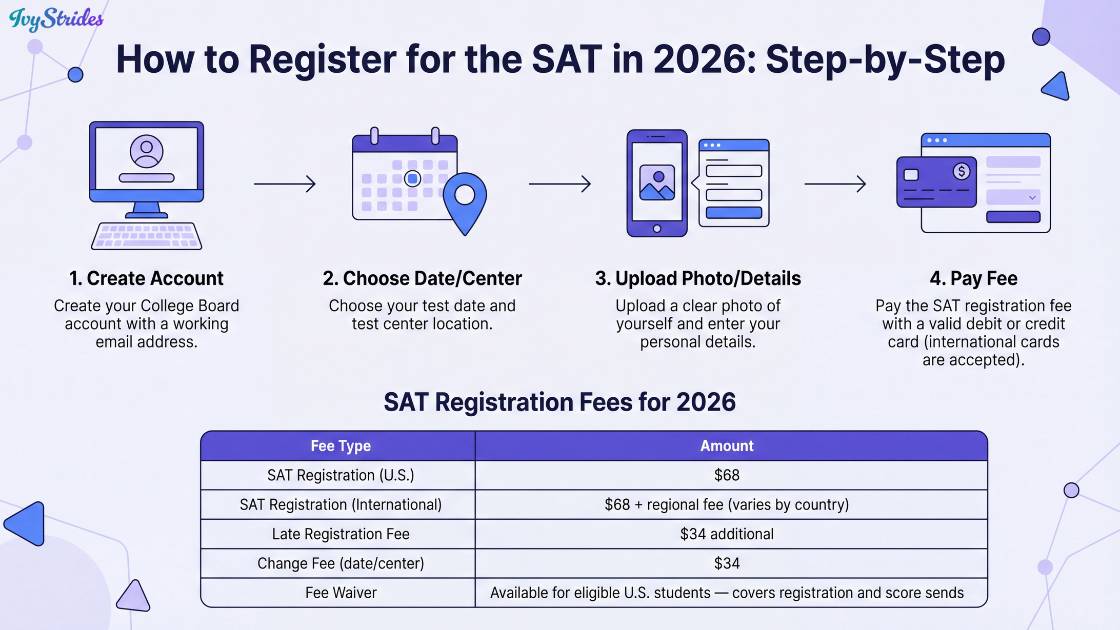
Before you can take the SAT, you need to register online. It's a simple process, but it's important to get everything right to avoid delays or issues at the test center.
Head to satsuite.collegeboard.org and follow these steps:
-
Create your College Board account with a working email address.
-
Choose your test date and test center location.
-
Upload a clear photo of yourself and enter your personal details.
-
Pay the SAT registration fee with a valid debit or credit card (international cards are accepted).
SAT Registration Fees for 2026
| Fee Type | Amount |
| SAT Registration (U.S.) | $68 |
| SAT Registration (International) | $68 + regional fee (varies by country) |
| Late Registration Fee | $34 additional |
| Change Fee (date/center) | $34 |
| Fee Waiver | Available for eligible U.S. students - covers registration and score sends |
Fee waivers are available for students who demonstrate financial need. Ask your school counselor or contact IvyStrides for help determining eligibility.
For International Students
- Make sure your passport is valid. It is usually required for ID verification at test centers.
- Book your slot early, as international centers may have limited seating.
If your preferred center is full, here's what to do when SAT test centers are full.
Each test date has its own registration and late registration deadlines - refer to the 2026 SAT dates table above for specifics.
It's important to note that late registration incurs an additional $34 fee. Need to cancel instead? Learn about how to cancel your SAT registration and what refunds are available.
IvyStrides counselors are available to guide you through the entire SAT registration process.
How the SAT Is Scored in 2026
The SAT isn't graded like your school tests. Instead, it uses a composite scoring system that adds together your performance in two main sections.
Your Total Score: 1600
This is the sum of:
- Reading & Writing section (scored out of 800)
- Math section (also scored out of 800)
Score Range: 400 to 1600
What Can Affect Your SAT Score?
Each correct answer adds to your score. There's no penalty for wrong answers, so it's always better to guess than to leave a question blank!
Not sure whether guessing is worth it? Here's why you should guess on the SAT every single time.
The test is adaptive in the digital format, meaning your performance in the first module affects the difficulty of the next, which in turn impacts your final score.
You also get subscores that show how you performed in specific areas, such as command of evidence, words in context, algebra and problem-solving, and data analysis. These don't affect your total score but give you insights into your strengths and areas for improvement.
What Is a "Good" SAT Score in 2026?
While "good" depends on the college you're aiming for, here are the general score tiers for 2026:
- 1000–1200 - Solid for many public universities and less selective schools.
- 1200–1350 - Competitive for well-regarded state flagships and mid-tier private colleges.
- 1350–1500 - Strong for top-50 universities and merit scholarship consideration.
- 1500+ - Puts you in range for Ivy League and other highly selective schools.
Curious what a 1520 can do for you? See our breakdown of what a 1520 SAT score means for admissions.
The national average SAT score typically hovers around 1060 (based on the College Board's most recent Total Group report).
Most colleges will consider your highest total score. Some schools use a superscore policy, which means they combine your best Reading & Writing score from one sitting with your best Math score from another - giving you the highest possible composite.
What Is a Perfect SAT Score?
A perfect SAT score is 1600 - that's an 800 in Reading & Writing and an 800 in Math. Fewer than 1% of all test-takers achieve this score in any given year, placing them at the 99th+ percentile nationally.
While a perfect score is impressive, it's not required - even for the most selective colleges. Scores in the 1530–1580 range are typically viewed just as favorably by admissions committees.
How Long Are SAT Scores Valid?
SAT scores are valid for five years from the date you take the test. This means if you took the SAT in March 2026, colleges will accept that score through the 2030–31 admissions cycle.
This is especially relevant if you're considering a gap year or plan to transfer colleges later. Just keep in mind that some individual programs or scholarships may have their own score freshness requirements, so always double-check with the institution.
What Is Superscoring and Which Colleges Use It?
Superscoring means a college takes your highest section score from each SAT sitting and combines them into a new, higher composite. For example, if you scored 680 Reading & Writing / 720 Math on one test and 740 Reading & Writing / 700 Math on another, your superscore would be 740 + 720 = 1460.
Many top schools superscore, including:
- MIT
- Yale
- Duke
- Cornell
- University of Michigan
- Georgia Tech
- University of Florida
Superscoring is one of the biggest reasons to take the SAT more than once. Learn more about how many times you can take the SAT and how to plan your retake strategy.
Always check each college's SAT score policy to plan your testing strategy. Need to send scores to a specific school? See our guides for sending SAT scores to Yale and sending SAT scores to Carnegie Mellon.
SAT vs ACT: Which College Admission Test Should You Take in 2026?
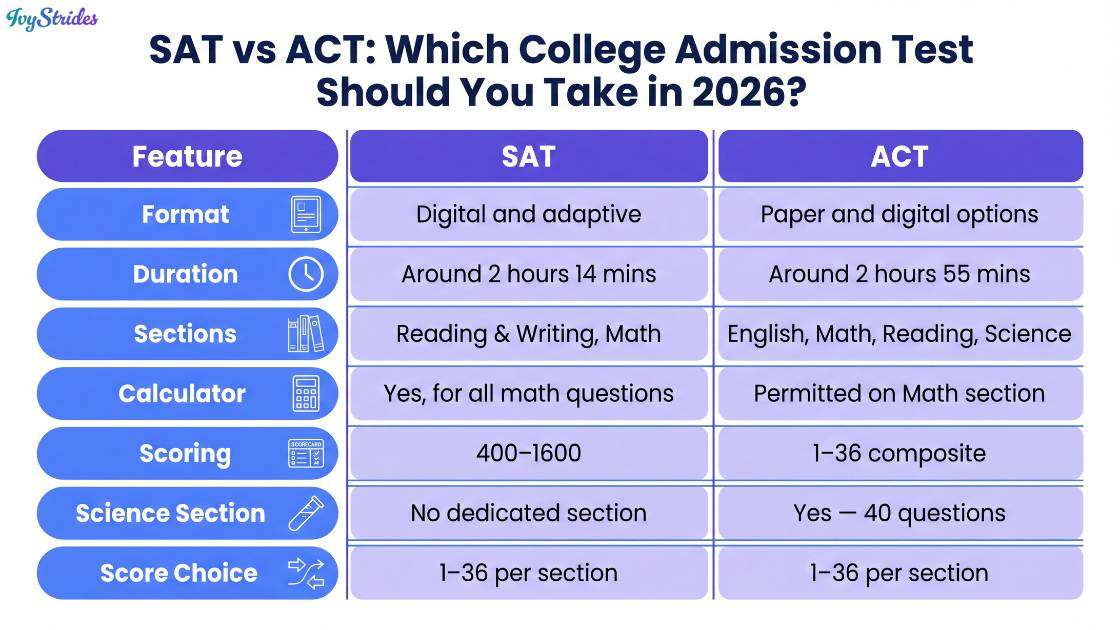
Many students ask whether they should take the SAT or the ACT. U.S. colleges accept both equally, but they differ in format and content. Understanding the differences can help you choose the test that matches your strengths.
| Feature | SAT | ACT |
| Format | Digital and adaptive | Paper and digital options |
| Duration | Around 2 hours 14 mins | Around 2 hours 55 mins |
| Sections | Reading & Writing, Math | English, Math, Reading, Science |
| Calculator | Yes, for all math questions | Permitted on Math section |
| Scoring | 400–1600 | 1–36 composite |
| Science Section | No dedicated section | Yes - 40 questions |
| Score Choice | 1–36 per section | 1–36 per section |
Choose the SAT if you:
- Prefer reasoning-based reading and writing.
- Are comfortable with SAT algebra questions and data analysis.
- Want a shorter test with fewer sections.
Choose the ACT if you:
- Excel at science and interpreting charts.
- Are a fast test-taker and prefer more straightforward questions.
Want to learn more? Read our full ACT vs SAT comparison for 2026 or explore whether the SAT is harder than the ACT.
Can Anyone Take the SAT?
Yes , there are no age or grade restrictions for the SAT. Here's who can register:
- High school students in any grade (most take it in Grade 11 or 12).
- Homeschooled students - you register the same way and test at a local center.
- Adults and post-high-school test-takers - you can absolutely take the SAT after graduating. This is common for students pursuing a GED-to-college path or applying as transfer students.
- International students - the SAT is offered at test centers worldwide. You'll need a valid passport for registration and ID verification.
The SAT is designed to be accessible to anyone planning to pursue higher education, regardless of when you graduated or where you live.
How to Start SAT Prep the Right Way
Starting your SAT prep the right way can save you time and improve your results. With a clear strategy, the process becomes less overwhelming and more effective.
- Take a diagnostic test to identify your strengths and weak spots.
- Set a target score based on the colleges you want to apply to.
- Create a personalized study schedule (at least 3–6 months long).
- Break prep into small, consistent sessions: concept review, section practice, and timed mock tests.
If you're short on time, our 30-day SAT study plan can help you make the most of every session.
Use spaced repetition to retain what you learn - it's one of the most effective study techniques backed by science. Learn how in our guide to improving SAT scores with spaced repetition.
What Makes the IvyStrides Prep Method Different?
At IvyStrides, we don't just teach to the test - we coach students to perform with confidence, clarity, and strategy. Our SAT prep method is built around personalization, expert guidance, and innovative tools that set students up for real success.
Here's what sets our program apart:
Small-Group, Live Classes with SAT Experts
Students learn in intimate group settings (5–10 per class) led by seasoned SAT instructors. This structure ensures personal attention, room for discussion, and a better chance for each student to ask questions and get targeted feedback.
GTKYT (Get to Know Your Test) Mentorship Webinars
These webinars go beyond solving questions - they're designed to build confidence, reduce test anxiety, and sharpen strategy. Students learn how to approach the SAT with the right mindset, manage their time, and avoid common traps.
Struggling with nerves? Explore our strategies to overcome SAT anxiety.
AI-Powered Vocabulary Builder
We use an AI-based vocabulary tool that adapts to each student's learning pace. It helps them master high-impact words often seen in the Reading and Writing sections, boosting both speed and accuracy in comprehension.
Biweekly Parent Progress Reports
We know that parents are key partners in a student's journey. That's why we send biweekly email updates that highlight your child's progress, strengths, and areas for growth - so you always know how things are going without having to ask.
Expert Tips to Improve Your SAT Score in 2026
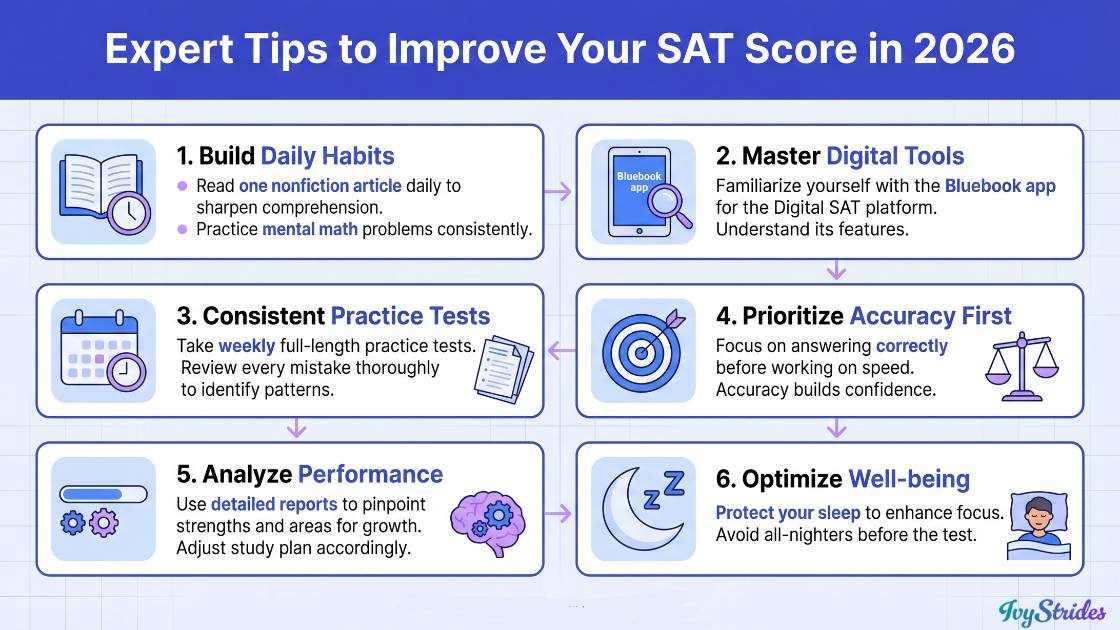
If you're just getting started, simple habits can significantly impact your SAT score. Focus on building consistency and core skills.
- Read one nonfiction article a day to sharpen your comprehension.
Want to know exactly how fast you need to read? Check our SAT reading speed guide.
- Practice mental math with daily problems on percentages, ratios, and algebra.
Watch out for common quadratic formula mistakes that cost students easy points.
- Use the Bluebook app to familiarize yourself with the Digital SAT platform.
- Do weekly practice tests and review your mistakes.
- Focus on accuracy first, then work on improving your speed.
Protect your sleep - pulling all-nighters before the SAT does more harm than good. Here's why all-nighters hurt your SAT scores.
How Parents Can Support Their Child's SAT Preparation
Parents are essential in helping teens stay motivated and organized during SAT prep. Your support can create a more positive and focused study environment.
- Help set a regular study schedule that works with school and rest time.
- Avoid pressure, but stay informed about your child's goals and progress.
- Promote balance by encouraging sleep, healthy habits, and breaks.
- Offer encouragement, especially after mock tests or stressful days.
For practical ideas, read our guide on how to reduce stress while studying for the SAT.
Help your teen set meaningful goals - our WOOP goal-setting framework for college success is a great place to start.
At IvyStrides, we partner with parents by providing regular performance updates, strategy calls, and expert insights to guide your teen toward success.
You've now seen the complete picture of the SAT - how it works, and why it still matters in 2026. From understanding the digital format to creating a personalized prep plan, this guide is meant to simplify a process that often feels overwhelming.
Whether you're just starting or already deep in your prep journey, remember this: the SAT is not a test of intelligence. It is a skill-based exam you can master with the right guidance, practice, and mindset.
IvyStrides counselors are here to help you every step of the way if you're looking for extra support. Whether you need help registering, creating a 30-day SAT study plan, or understanding your score goals, we are here to guide you personally.
Frequently Asked Questions (FAQs)
What is the full form of the SAT?
SAT stands for Scholastic Assessment Test. It is a standardized college admissions test created and administered by the College Board.
Is the SAT required for U.S. colleges in 2026?
It depends on the school. Many colleges remain test-optional, but top schools like MIT, Harvard, Yale, Dartmouth, Brown, Georgetown, the University of Florida, and Georgia Tech now require or strongly recommend SAT scores for the 2026–27 admissions cycle.
Is the SAT changing in 2026?
No major structural changes are expected for the 2026 Digital SAT. The format - two adaptive sections (Reading & Writing + Math), approximately 2 hours and 14 minutes, taken via the Bluebook app - remains the same as the version introduced in 2024. College Board may make minor content updates, but the overall test experience is stable.
Can I take the SAT more than once?
Yes. Most students take it two or three times. Colleges accept your best score, and many superscore across sittings. Learn more about how many times you can take the SAT.
How long are SAT scores valid?
SAT scores are valid for five years from the test date. If you take the SAT in 2026, your scores will be accepted through the 2030–31 admissions cycle.
What is the difference between SAT and the Digital SAT?
The Digital SAT replaced the paper-based SAT in 2024. It's shorter (about 2 hours 14 minutes), adaptive (difficulty adjusts based on your performance), and taken on a laptop or tablet using the Bluebook app.
How long is the Digital SAT in 2026?
The Digital SAT takes approximately 2 hours and 14 minutes to complete - 64 minutes for Reading & Writing and 70 minutes for Math, with a 10-minute break in between.
What is a good SAT score for Ivy League colleges?
To be competitive at schools like Harvard, Princeton, or Yale, you should aim for a score of 1500 or higher. However, admissions is holistic - your essays, extracurriculars, and recommendations matter too.
Is 1200 a good SAT score?
A 1200 places you around the 74th percentile, meaning you scored higher than roughly three-quarters of all test-takers. It's a solid score for many state universities and can qualify you for merit scholarships at less selective schools. For more competitive colleges, aim for 1300+.
Is 1400 enough for Harvard?
A 1400 is a strong score overall (approximately 95th percentile), but it falls below the typical admitted-student range at Harvard, where the middle 50% of scores is roughly 1500–1580. It's not impossible, but you'd need exceptionally strong extracurriculars, essays, and recommendations to compensate. Consider retaking to push above 1500.
What is a perfect SAT score?
A perfect SAT score is 1600 - 800 in Reading & Writing and 800 in Math. Fewer than 1% of test-takers achieve this in any given year.
Do SAT scores really matter in 2026?
Yes, especially if you're applying to selective universities. Even at test-optional schools, submitting a strong SAT score can differentiate your application, offset a lower GPA, and unlock merit-based scholarships. For international students, the SAT remains one of the most recognized ways to demonstrate academic readiness.
Is the SAT a standardized test?
Yes. The SAT is a standardized college admissions test, meaning every student takes the exam under the same conditions and is scored on the same scale. This allows colleges to compare applicants from different schools, curricula, and countries on a level playing field.
What is the purpose of the SAT?
The SAT measures your readiness for college-level work in reading, writing, and math. Colleges use it alongside your GPA, essays, and extracurriculars to evaluate your academic potential and make admissions decisions.
How can international students register for the SAT?
Go to satsuite.collegeboard.org, create an account, choose an international test center, and upload a valid passport photo. International students pay an additional processing fee on top of the base registration cost.
When do SAT scores come out?
SAT scores are typically released 10–14 days after your test date. You can check your scores by logging into your College Board account. For specific score release dates by test, see our guide on when SAT results come out.
When should I start studying for the SAT?
Start 3 to 6 months before your test date. Ideally, begin in Grade 10 or early Grade 11 to give yourself time for a diagnostic, focused prep, and at least one retake.
What tools are allowed during the Digital SAT?
You can use an on-screen calculator, timer, notepad, and math reference sheet - all built into the Bluebook app. No external calculators or devices are needed.
How do I choose between the SAT and ACT?
Take a diagnostic test for each, or speak to a counselor to determine which test format fits your strengths better.
Our detailed ACT vs SAT comparison can help you decide.
How many questions are on the SAT?
The Digital SAT has 98 total questions - 54 in Reading & Writing and 44 in Math. For a full breakdown, see our guide on how many questions are on the SAT.
Final Thoughts
The SAT continues to be an important part of college admissions in 2026, especially for competitive universities and scholarship opportunities.
While the format is now shorter and fully digital, the goal remains the same: to help colleges evaluate academic readiness in a fair and consistent way.
The good news is that the SAT is a skill-based test, which means your score can improve significantly with the right strategy, consistent practice, and enough time to prepare.
Whether you're a student planning your first attempt or a parent helping guide the journey, starting early and staying consistent can make all the difference.
At IvyStrides, we’re here to help you approach the SAT with clarity, confidence, and a personalized plan.

Hemant is a seasoned entrepreneur, investor, and growth strategist with deep ground in education and technology-driven learning. His core training is in Mathematics and Physics — he authored Physics for IB Diploma: Ultimate Revision Guide, recognized as a top student resource.