
Last-Minute SAT Tips: Your Complete Guide to Scoring Higher with Less Time (2026)
On this page
- How Much Can You Really Improve Last Minute?
- Last-Minute SAT Math Tips That Actually Move Your Score
- Master the Desmos Calculator (Your Secret Weapon)
- High-Yield Math Formulas to Review Right Now
- Plug-In, Backsolve, and Elimination: Fast Math Strategies
- Last-Minute SAT Reading & Writing Tips for Quick Gains
- The "Question First" Method for Reading Passages
- Grammar Rules That Show Up Every Single Test
- Your Last-Minute SAT Study Plan by Time Remaining
- 2 Weeks Before the SAT: Structured Sprint Plan
- 1 Week Before the SAT: Mini Bootcamp Mode
- 3 Days Before the SAT: High-Yield Compression
- SAT 2026 Reading & Writing Tips
- The Night Before the SAT: What to Do (and What to Skip)
- Morning of the SAT: Your 30-Minute Activation Routine
- SAT Last-Minute Cheat Sheet (Quick Reference)
- Digital SAT 2026: Know Exactly What You're Walking Into
- What NOT to Do the Day Before the SAT
- Last-Minute PSAT Tips: Does This Advice Apply?
- FAQ: Last-Minute SAT Questions Answered
- Final Words: You're Not Behind. You're Right On Time.
So the SAT exam is just around the corner, and you're searching for last-minute tips. You might feel behind, unsure, or even guilty for not starting sooner. But here's the truth: the final days before the SAT are not about covering everything. They're about doing only what moves your score forward. And yes, you still have time to make that happen.
At IvyStrides, we guide students not only through months of planning but also through the last 72, 24, even 2 hours before test day. This isn't a motivational speech. It's your actionable and precise last-minute SAT prep plan for 2026.
Why trust this guide? IvyStrides tutors have coached 500+ students through last-minute SAT prep. Based on our 2025–2026 cohort data, students who followed a structured final-week plan gained an average of 40–80 points. Every tip below is tutor-verified and updated for the 2026 Digital SAT.
Have a full month? Start with our 30-day SAT study plan instead. This guide is built for students with two weeks or less.

How Much Can You Really Improve Last Minute?
This is the first question every stressed student asks - and the answer is more encouraging than you think.
Research from the College Board and internal IvyStrides data show that focused, strategic prep can move your score 40–80+ points in the final 1–2 weeks. The key word is focused. Randomly reviewing everything gains you nothing. Targeting your weakest high-frequency question types gains you everything.
Here's a rough breakdown based on IvyStrides student performance data (2025–2026 cohorts):
| Time Remaining | Realistic Score Gain | What to Focus On |
| 2 weeks | 60–100 points | Full strategy + content review |
| 1 week | 40–70 points | High-yield topics + timed drills |
| 3 days | 20–50 points | Test tactics + error correction |
| 24 hours | 10–30 points | Mindset + formula/grammar refresh |
The takeaway: you can still move your score. But only if you stop trying to learn everything and start doing what's strategic.
Last-Minute SAT Math Tips That Actually Move Your Score
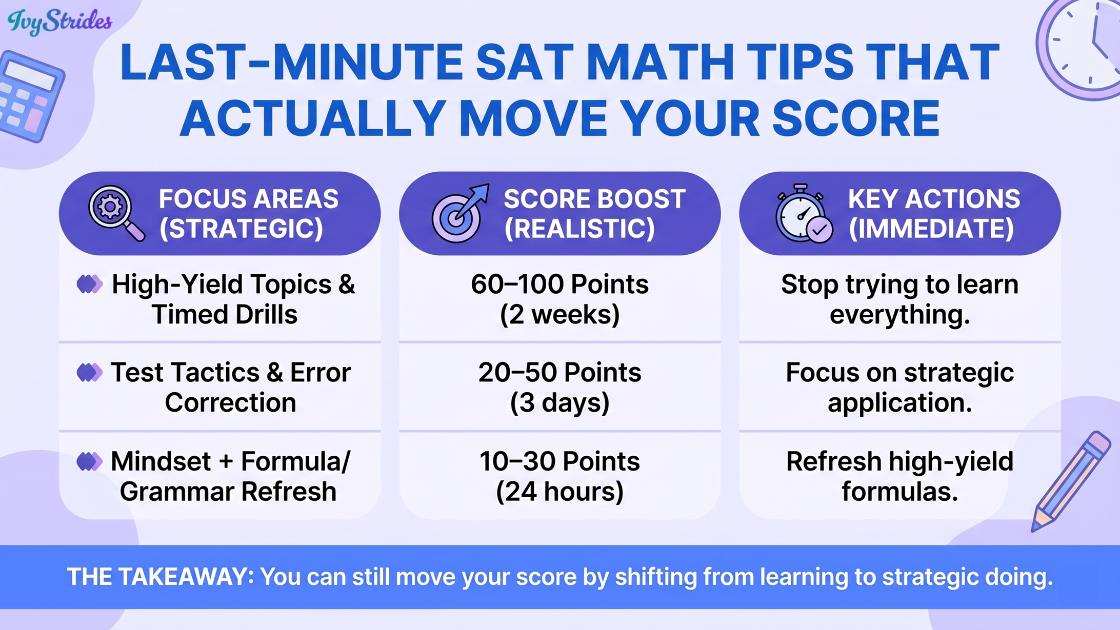
Math is where most students gain the fastest points last minute - if you know where to aim. These are the highest-yield strategies for the 2026 Digital SAT Math section.
Master the Desmos Calculator (Your Secret Weapon)
The Digital SAT gives you a built-in Desmos graphing calculator for the entire Math section. If you haven't practiced with it, spend 30 minutes right now. It can solve problems faster than algebra.
What Desmos can do for you:
- Graph equations instantly - type in both sides of an equation and find the intersection point visually
- Solve systems of equations - graph both lines and click the intersection
- Check your algebra - plug your answer back in and verify
- Find zeros/roots of quadratics - graph the equation and read the x-intercepts
- Evaluate expressions - use it as a super-powered calculator for complex arithmetic
Quick Desmos drill: Open desmos.com/calculator, type y = 2x + 3 and y = -x + 9, and find where they cross. That's a systems-of-equations problem solved in 10 seconds.
Practice this with common SAT algebra questions to build speed.
High-Yield Math Formulas to Review Right Now
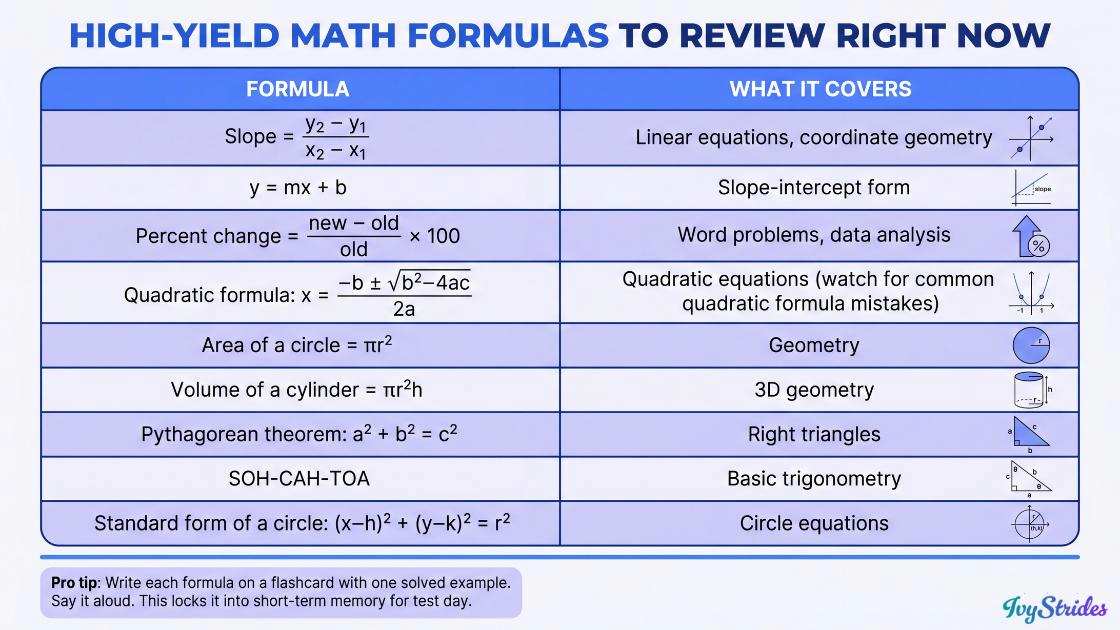
The Digital SAT provides a reference sheet, but it doesn't cover everything. Memorize these high-yield formulas that appear on nearly every test:
| Formula | What It Covers |
| Slope = (y₂ − y₁) / (x₂ − x₁) | Linear equations, coordinate geometry |
| y = mx + b | Slope-intercept form |
| Percent change = (new − old) / old × 100 | Word problems, data analysis |
| Quadratic formula: x = (−b ± √(b²−4ac)) / 2a | Quadratic equations (watch for common quadratic formula mistakes) |
| Area of a circle = πr² | Geometry |
| Volume of a cylinder = πr²h | 3D geometry |
| Pythagorean theorem: a² + b² = c² | Right triangles |
| SOH-CAH-TOA | Basic trigonometry |
| Standard form of a circle: (x−h)² + (y−k)² = r² | Circle equations |
Pro tip: Write each formula on a flashcard with one solved example. Say it aloud. This locks it into short-term memory for test day.
Plug-In, Backsolve, and Elimination: Fast Math Strategies
You don't need to solve every problem algebraically. These three tactics work on 30–40% of SAT Math questions:
- Plug-In: When the question uses variables, pick a simple number (like 2 or 5), plug it in, and test the answer choices.
- Backsolve: Start with answer choice C (the middle value). Plug it into the problem. If it's too big, go smaller. If it's too small, go bigger.
- Elimination: Cross out answers that are clearly wrong. On many questions, you can eliminate 2 options immediately - then guess between 2 instead of 4.
Remember: there is no penalty for guessing on the Digital SAT. Never leave a question blank. Even a random guess gives you a 25% chance. Should you guess on the SAT? Absolutely - every single time.
Last-Minute SAT Reading & Writing Tips for Quick Gains
The Reading & Writing section on the 2026 Digital SAT uses short passages (one per question). This is good news for last-minute preppers - you don't need to master long-passage stamina. You need sharp tactics.
The "Question First" Method for Reading Passages
Go "Question First": Read the question before reading the passage. This tells your brain exactly what to look for.
Use the "Slash & Predict" method: slash two obviously wrong options before fully analyzing the remaining two. This saves time and reduces second-guessing.
Why this works last minute: You're not building a new skill - you're applying a filter. Most students waste time re-reading passages because they didn't know what they were looking for. Question-first fixes that instantly.
Want to sharpen your reading speed? Check out our guide on SAT reading speed and timing.
Grammar Rules That Show Up Every Single Test
You can gain 4–8 raw points just by memorizing these grammar rules that appear on every Digital SAT:
- Semicolons join two complete sentences. If what's on either side can't stand alone, the semicolon is wrong.
- Colons introduce a list or explanation. What comes before the colon must be a complete sentence.
- Subject-verb agreement - watch for tricky phrases between the subject and verb (e.g., "The group of students is" not "are").
- Transition words - know the difference between contrast (however, nevertheless), cause (therefore, consequently), and addition (moreover, furthermore). The SAT tests whether you pick the logical transition.
- Pronoun clarity - if a pronoun could refer to more than one noun, the answer likely replaces it with the specific noun.
Review 10 transition word examples in context. This alone can net you 2–3 extra correct answers.
Your Last-Minute SAT Study Plan by Time Remaining
Whether you have two weeks, one week, three days, or just hours left, here's your exact plan. Pick your starting point and go.
2 Weeks Before the SAT: Structured Sprint Plan
Two weeks is actually a solid amount of time. You can cover real ground here.
Week 1: Diagnose and Target
- Day 1: Take one full-length practice test on the Bluebook app. Score it. Identify your 3 weakest question types in Math and 3 in R&W.
- Days 2–3: Deep-dive into your top 2 Math weaknesses. Use Desmos practice, formula drills, and targeted problem sets (15–20 questions per type).
- Days 4–5: Deep-dive into your top 2 R&W weaknesses. Drill grammar rules, transition logic, or evidence-based questions depending on your gaps.
- Days 6–7: Take another timed practice test. Compare scores. Adjust your target list for Week 2.
Week 2: Sharpen and Simulate
- Days 8–9: Drill your remaining weak areas with timed mini-sections (15 questions in 18 minutes).
- Days 10–11: Focus on pacing. Do full modules under timed conditions. Practice the adaptive mindset: accuracy in Module 1 matters most (it determines whether you get the harder, higher-scoring Module 2).
- Day 12: Light review. Flashcards, formula sheet, grammar rules. No new content.
- Days 13–14: Follow the "3 Days Before" and "Night Before" plans below.
Need a longer runway? Our 30-day SAT study plan gives you the full roadmap.
1 Week Before the SAT: Mini Bootcamp Mode
Just one week left? Perfect. You still have time for a compact but powerful review. Treat this as a mini bootcamp, focused only on high-scoring SAT topics.
Tips for SAT Math Focus
- Days 1–2: Nonlinear equations + systems of equations. Watch 15-minute crash videos on YouTube, then solve 10 problems and tag each for confidence (green/yellow/red).
- Practice solving systems using Desmos alongside algebra so you have two methods ready.
- Day 3: Geometry & Trigonometry. Flashcards for area/volume formulas; drill 10 angle and triangle problems each day. Highlight traps (e.g., misused formula, unit conversion).
- Day 4: Problem-solving/Data. Practice interpreting scatterplots and ratio graphs. Use one chart per set and explain what story the data tells.
Review standard deviation concepts if you keep missing statistics questions.
- Day 5: Recap with a mini full-section drill (35 mins Math), then review why you missed what you missed.
Tips for SAT Reading & Writing Focus
- Day 1: Text Structure & Tone. Read 3 SAT-style paragraphs and label tone and structure (cause/effect, compare/contrast).
- Day 2: Grammar Mastery. Memorize rules for punctuation, subject-verb, and transitions. Practice 10 questions/day with explanations.
- Day 3: Command of Evidence. Read one nonfiction and one fiction passage. Write down 1 sentence as "evidence" for each question.
- Day 4: Simulate 1 R&W module. Review your performance by question type, not just score.
- Days 5–7: Transition into the "3 Days Before" plan below. Shift from learning to locking in.
3 Days Before the SAT: High-Yield Compression
In the last 3 days, we compress the plan. Less theory, more tactics. If this is your starting point, focus only on high-yield moves.
SAT 2026 Math Tips
- Use a formula chart: Spend 15 minutes turning 10 formulas into flashcards with visuals. Focus on key formulas: percent change, slope, system of equations, volume of cylinder/cone. Write and say each one aloud with one solved example.
- Practice error-spotting by examining solved problems and identifying mistakes. Using an SAT mistake error tracker can help identify consistent issues and allow you to focus on them.
- Focus on time hacks: Circle numbers first in word problems, and underline what you're solving for. Instead of solving randomly, do grouped drills by question type (linear equations, word problems, percent/proportions). Identify which types are still slowing you down.
- Desmos speed round: Spend 15 minutes solving 5 problems using only Desmos. Build muscle memory for the interface so it's automatic on test day.
SAT 2026 Reading & Writing Tips
- Go "Question First": Read the question before reading the passage.
- Use the "Slash & Predict" method: slash two options before fully analyzing.
- Review 10 transition word examples in context (however, therefore, moreover).
- Zero in on the highest-yield concepts: Punctuation rules (especially semicolons and colons), transition logic, and text structure.
- Do one 15-question R&W module each day. After each, label every incorrect answer: 'Grammar Rule', 'Inference Error', or 'Structure Confusion'. Fix only one type per drill.
The Night Before the SAT: What to Do (and What to Skip)
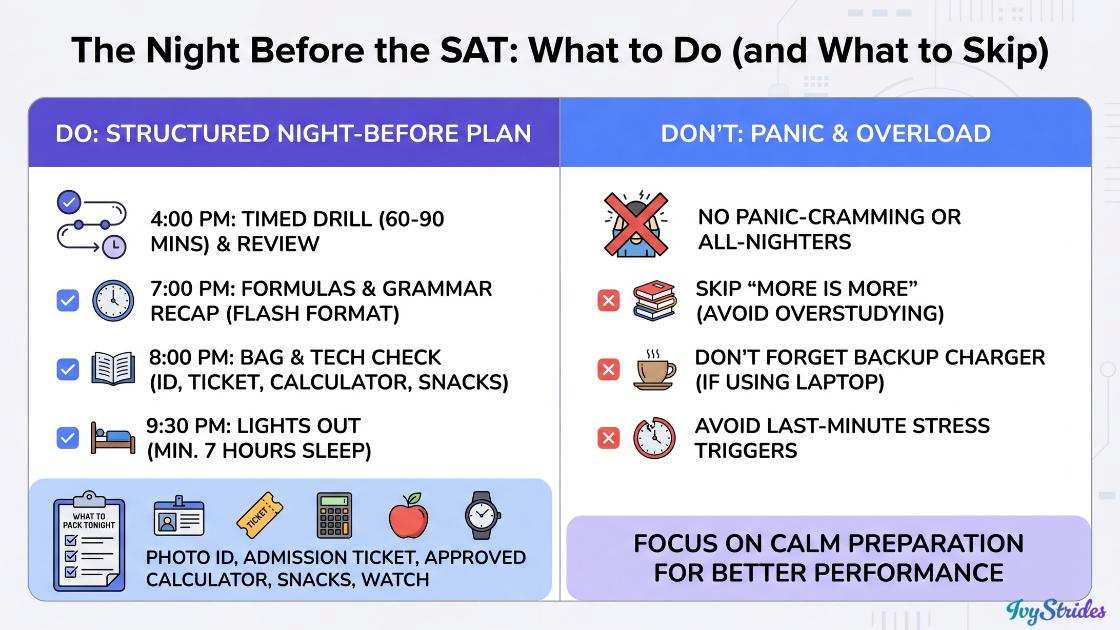
Even if this is your starting point, one calm night of guided preparation can make a real difference.
Based on IvyStrides tutor experience, students who follow a structured night-before routine score 10–30 points higher than those who panic-cram.
The IvyStrides Night-Before SAT Plan
Let's make this real. If your test is tomorrow, here's your timeline:
- 4:00 PM: One timed drill per section (max 60–90 mins)
- 6:00 PM: Review missed questions only
- 7:00 PM: Recap formulas and grammar in flash format
- 8:00 PM: Bag check, tech check, ID, snacks, clothes ready
- 9:30 PM: Lights out. Non-negotiable. Minimum 7 hours of sleep. No "more is more."
What to pack tonight:
- Photo ID (school ID or government-issued)
- Admission ticket (printed or on your phone)
- Approved calculator (fully charged or with fresh batteries)
- Snacks for breaks (granola bar, banana, water)
- Backup charger for your testing device if testing on your own laptop
- A watch (phones aren't allowed during the test)
Rapid Review Plan (60 mins total)
- 10 grammar questions, 5 math problems, 2 short passages.
- Review answers immediately. Focus on why the correct answer works.
- Use a "Decision Map": draw or mentally walk through how you'll attack each section.
For a deeper dive into calm-under-pressure techniques, see our guide to reduce stress while studying for the SAT.
Morning of the SAT: Your 30-Minute Activation Routine
The morning of the SAT test isn't for study marathons; it's for steady focus and practical mental prep. Even if this is your first moment of preparation, you can still start strong.
Your Morning Power-Up Routine (30–40 mins total)
Wake-Up Mental Activation (10 mins)
- Open a short SAT-style passage and read for tone, purpose, and structure. Don't answer all the questions - just get your comprehension muscles moving.
- Solve one warm-up math question involving percentages or equations - preferably something you're already comfortable with.
Formula & Grammar Flashback (10 mins)
- Math formula list: percent change, slope formula, volume of the cylinder.
- English grammar convention rule (e.g., punctuation with semicolons and colons). Say the rule aloud and mentally apply it to a sample sentence.
- Quick vocabulary flashcard revision.
Fuel Right (5–10 mins)
- Eat something balanced: a banana or an apple with peanut butter, or a protein bar and water.
- Avoid caffeine if you're not used to it.
Bonus Tips for Confidence & Efficiency
- Don't check forums, last-minute tips, or TikTok. This is your zone.
- Glance at your "Test Strategy Map" if you created one.
- Remind yourself of your pacing checkpoints.
- Walk into the exam with a mantra like: "Calm is clarity. I've got this."
Module 1 mindset: Tell yourself: "Accuracy first in Module 1. That's what unlocks the harder, higher-scoring Module 2."
SAT Last-Minute Cheat Sheet (Quick Reference)
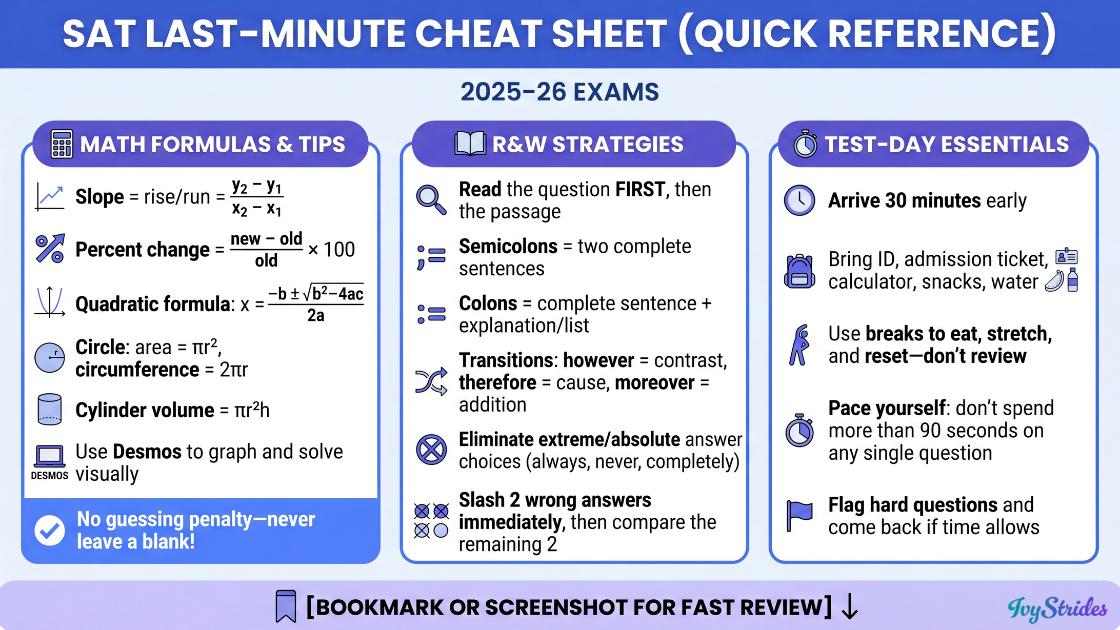
Bookmark this section or screenshot it for a fast review. This is your SAT last-minute cheat sheet for 2026.
Math Cheat Sheet
- Slope = rise/run = (y₂ − y₁) / (x₂ − x₁)
- Percent change = (new − old) / old × 100
- Quadratic formula: x = (−b ± √(b²−4ac)) / 2a
- Circle: area = πr², circumference = 2πr
- Cylinder volume = πr²h
- Use Desmos to graph and solve visually
- No guessing penalty - never leave a blank
R&W Cheat Sheet
- Read the question FIRST, then the passage
- Semicolons = two complete sentences
- Colons = complete sentence + explanation/list
- Transitions: however = contrast, therefore = cause, moreover = addition
- Eliminate extreme/absolute answer choices (always, never, completely)
- Slash 2 wrong answers immediately, then compare the remaining 2
Test-Day Cheat Sheet
- Arrive 30 minutes early
- Bring ID, admission ticket, calculator, snacks, water
- Use breaks to eat, stretch, and reset - don't review
- Pace yourself: don't spend more than 90 seconds on any single question
- Flag hard questions and come back if time allows
Digital SAT 2026: Know Exactly What You're Walking Into
Let's be crystal clear. If you're sitting the SAT now, you're taking the Digital SAT. No more paper tests. No more bubble sheets. And definitely no guessing strategies from 2018.
Your SAT test will be 2 hours and 14 minutes long. Here's the full breakdown:
| Feature | Details |
| Format | Entirely digital via the Bluebook app |
| Sections | Reading & Writing (2 modules), Math (2 modules) |
| Timing | 64 mins for Reading & Writing, 70 mins for Math |
| Adaptive | Your performance in Module 1 shapes Module 2 difficulty |
| Calculator | Built-in Desmos allowed throughout Math |
| Guessing Penalty | None - answer every question |
Why the adaptive format matters for your strategy: If you nail Module 1 with high accuracy, you'll get a harder Module 2 - which is where the higher scores live. This means accuracy in Module 1 is more important than speed. Take your time, get questions right, and the scoring algorithm rewards you.
Still reviewing paper-based questions? You're prepping for the wrong exam. IvyStrides makes sure every student reviews with Digital SAT-based drills, interface practice, and adaptive logic simulations.
Want to know how many questions are on the SAT? That breakdown will help you plan your pacing.
What NOT to Do the Day Before the SAT
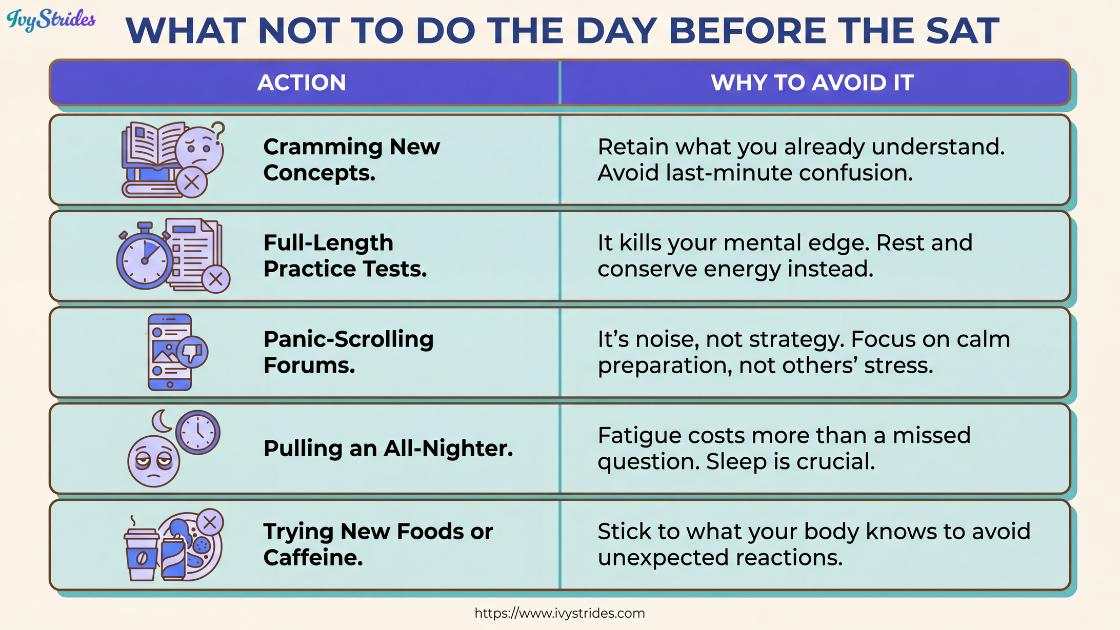
This might be the most important section.
- Don't cram new concepts. Retain what you already understand.
- Don't do full-length tests the night before. It kills your mental edge.
- Don't panic-scroll forums or Reddit threads. It's noise, not strategy.
- Don't pull an all-nighter. Here's exactly why all-nighters hurt your SAT scores. Fatigue costs more than a missed question.
- Don't try new foods, new caffeine, or new supplements. Stick to what your body knows.
- Don't change your answer strategy mid-test. Trust the methods you've practiced.
Feeling overwhelmed? Read our full guide on strategies to overcome SAT anxiety. It's written for exactly this moment.
Last-Minute PSAT Tips: Does This Advice Apply?
Short answer: yes, about 90% of it.
The PSAT (including the PSAT/NMSQT) uses the same Digital SAT format - adaptive modules, Desmos calculator, short reading passages, and no guessing penalty. The main differences:
- The PSAT is slightly shorter (2 hours 14 minutes for SAT vs. 2 hours 14 minutes for PSAT/NMSQT - nearly identical in 2026).
- The difficulty ceiling is lower. The hardest PSAT questions are roughly equivalent to medium-difficulty SAT questions.
- The scoring scale is different. PSAT scores range from 320–1520, not 400–1600.
What this means for last-minute PSAT prep: Every strategy in this guide works. Focus especially on grammar rules and Desmos - these are the fastest point-gainers on the PSAT too. If you're a junior using the PSAT to qualify for National Merit, accuracy matters even more than speed.
All the study plans, cheat sheets, and test-day tips above apply directly. Just adjust your score expectations to the PSAT scale.
FAQ: Last-Minute SAT Questions Answered
Can I still improve my score?
Yes. Focused last-minute prep can gain you 20–80+ points depending on your time remaining. Stop trying to study everything and target your weakest high-frequency question types.
Should I take a mock test today?
Not a full one if your test is tomorrow. Do mini mocks or timed sections (one module at a time). If you have 3+ days, one full practice test is valuable for diagnostics.
Is reviewing notes better than practice?
Review what you missed in your last few drills. Skip general summaries. Active practice beats passive reading every time.
What if I feel underprepared?
Shift into test strategy mode. Focus on pacing, mindset, and accuracy - not perfection.
Remember: the Digital SAT has no guessing penalty. Should you guess on the SAT?Always. Answer every single question.
Should I eat anything special?
Stick to food you know works well for you. Nothing new. Keep it light and balanced.
What should I bring to the SAT?
Photo ID, admission ticket, approved calculator (or rely on the built-in Desmos), snacks and water for breaks, and a watch. Leave your phone in your bag - it must be off during testing.
How does the adaptive scoring work?
Module 1 is the same difficulty for everyone. If you perform well, Module 2 is harder but offers higher scoring potential. If you struggle, Module 2 is easier but caps your score lower. Takeaway: go slow and accurate in Module 1.
Can I retake the SAT if I don't do well?
Absolutely. Find out how many times you can take the SAT and plan accordingly. Most students improve on their second attempt.
When will I get my scores back?
Digital SAT scores typically come out within 2–3 weeks. Check our guide on when SAT results come out for exact dates.
Final Words: You're Not Behind. You're Right On Time.
You don't need a miracle. You need a method.
Last-minute prep isn't about catching up. It's about showing up with the right mental state, the right pacing, and the right energy to convert what you already know into real points.
At IvyStrides, we've walked with students into test day from every angle: fully prepared, semi-prepared, and just-barely-prepared. Whether you're preparing last minute or starting early, working with the best online SAT tutoring can help you avoid common mistakes and improve faster with the right strategy.
One of our students improved 80 points in the final week by focusing exclusively on Desmos strategies and grammar rules. Another gained 50 points in just 3 days by switching to the "Question First" method for R&W. These aren't outliers - they're what happens when you stop cramming and start being strategic.
You don't need more time. You need a better plan. Start it now.

Two decades teaching quantitative and verbal aptitude on standardized tests. Rare dual expertise across Math and Verbal — particularly effective for students with gaps on both sides. Senior AP Mentor for our Calculus and English tracks.