
What Grade Should You Take the SAT In? A 2026-27 Grade-by-Grade Plan
On this page
- Why 11th Grade Is the Right Year to Take the SAT for Most Students
- Should You Take the SAT in 10th Grade or Wait Until 11th Grade
- What SAT Test Dates Are Available in 11th and 12th Grade
- How to Build Your SAT Sitting Plan by Grade and Application Deadline
- FAQ: SAT Grade Timing and Sitting Plans
- What grade do you take the SAT in high school?
- Should I take the SAT in 10th grade?
- What grade do you take the SAT and ACT?
- What grade level is the SAT designed for?
- Your Next Step on SAT Timing
Most students take the SAT for the first time in 11th grade, then retake it in the fall of 12th grade if needed. The SAT is a digital exam scored 400 to 1600, built around two sections, each delivered in two modules, with your Module 1 results routing you to an easier or harder Module 2, across 2 hours 14 minutes. A junior-year sitting leaves time to prep, see your score, and retake before deadlines.
College Board's own advice points the same way: it recommends taking the SAT at least twice, in the spring of junior year and the fall of senior year. For the 2026-27 cycle, the SAT weekend dates still ahead are December 5, 2026, then March 6, May 1 and June 5, 2027. The harder decision isn't whether junior year works. It's what to do in 10th grade, and how to line the last sitting up with your earliest application deadline.

Why 11th Grade Is the Right Year to Take the SAT for Most Students
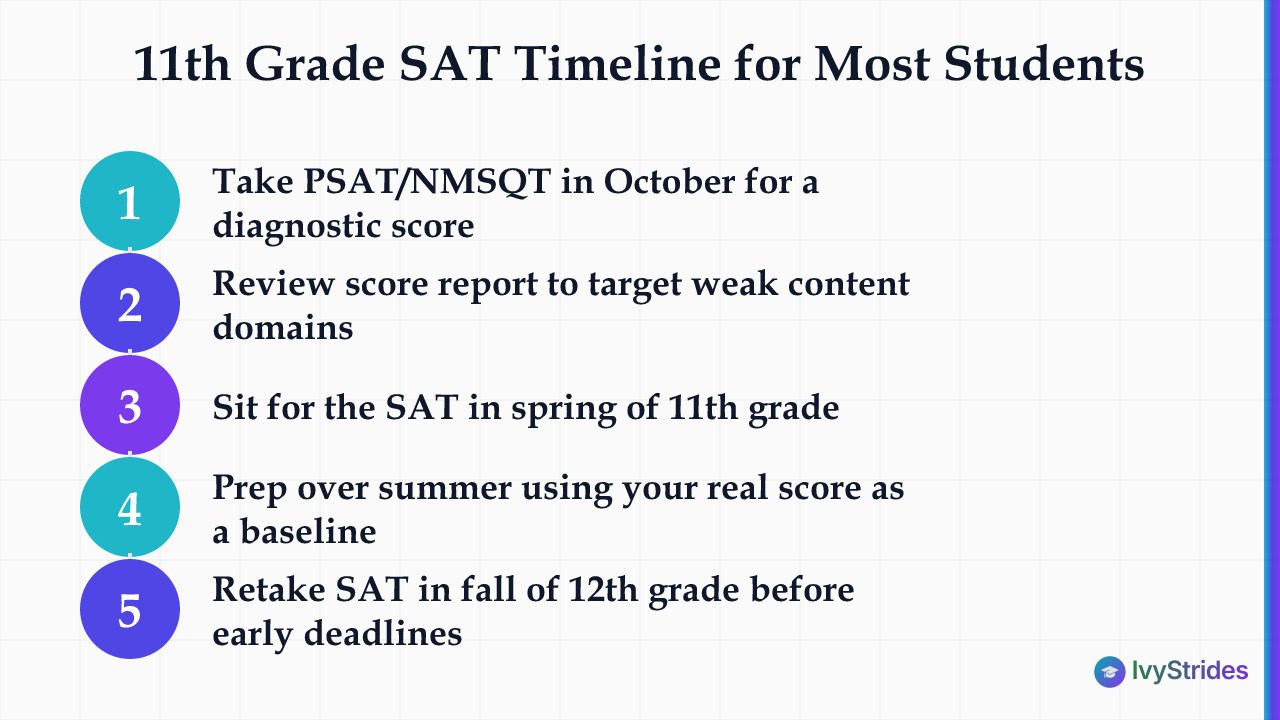
Junior year is the standard first-sitting year because it gives you prep time, a real score, and a retake window before any senior-year deadline. The SAT is scored on a 400 to 1600 scale, and College Board says most scores from weekend tests are released 2–4 weeks after test day. That release window is the whole reason timing matters.
Here's the sequence. A student who sits in spring of 11th grade sees a score by early summer, preps over the summer, and retakes in the fall of senior year. Many early decision and early action deadlines fall in November, so that fall retake has to land scores before them.
The PSAT/NMSQT is your built-in rehearsal. In 11th grade, the PSAT/NMSQT your school gives in October is both the National Merit qualifying test and the best diagnostic you have before your first SAT sitting. Like the SAT, it has 98 questions in 2 hours and 14 minutes and a multistage adaptive design, and it is scored 320 to 1520. The National Merit Scholarship Corporation screens entrants with its Selection Index; Semifinalist qualifying scores vary from state to state and from year to year, so any state cutoff you see before NMSC names that year's Semifinalists is an estimate.
Read that score report before you choose a first SAT date. It shows your performance in each of the eight content domains the PSAT/NMSQT measures, four in Reading and Writing and four in Math, so you know where prep time should go. Students weighing the ACT face the same grade-timing question, and the grade-by-grade logic is nearly identical for both tests.
| Reason | What It Means for You |
| Most weekend scores release in 2–4 weeks | A spring score arrives before summer prep begins |
| Senior fall stays open for a retake | A second sitting can come before early deadlines |
| PSAT/NMSQT lands in October | Diagnostic plus National Merit screening |
| More coursework done | Algebra II topics in Advanced Math are fresh |
Should You Take the SAT in 10th Grade or Wait Until 11th Grade

Photo by Pavel Danilyuk on Pexels
A 10th-grade SAT sitting is diagnostic, not strategic. Take it to find weak spots, not to produce a score you submit. The SAT has 98 questions, 54 in Reading and Writing and 44 in Math, and sophomores rarely have the full content base yet. National Merit screening uses the junior-year PSAT/NMSQT, so a sophomore's early score does not enter that competition.
That leaves one honest reason a 10th grader sits: diagnosis. A baseline score shows which domains lag before junior-year prep starts. Score Choice lets you pick which SAT scores you send to colleges, but some colleges and scholarship programs require all of them, so sit early only if you're comfortable with that score on record.
The PSAT 10 is the lower-stakes version. Like the PSAT/NMSQT, it has 98 questions in 2 hours and 14 minutes, is scored 320 to 1520, and runs at school, so you get the diagnostic without a Saturday morning. Before deciding whether any 10th-grade score is worth submitting, you need to know what a good SAT score looks like for your target colleges, because a sophomore baseline is a starting point, not the score you aim to send.
| Situation | Recommended Action |
| Wanting an early baseline | Sit once as a diagnostic, do not submit |
| You want low-stakes diagnosis | Take the PSAT 10 at school instead |
| You plan to submit the score | Wait for junior year |
| You want to skip junior-year prep | No, keep junior year as the main sitting |
What SAT Test Dates Are Available in 11th and 12th Grade
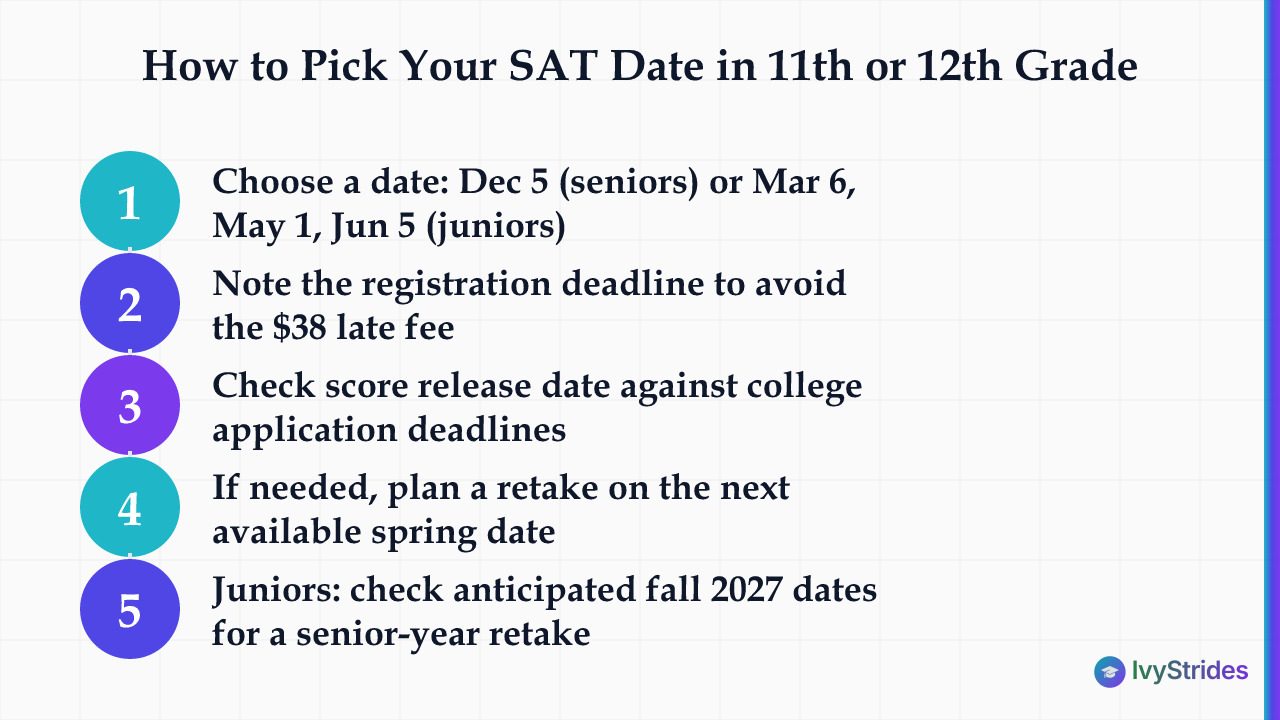
From mid-November 2026, four SAT weekend dates remain in the 2026-27 calendar: December 5, the last one seniors can still use this fall, and three spring 2027 dates that suit juniors. Juniors use March, May or June for a first sitting and a possible retake. For the senior-year retake that follows, current juniors can look at College Board's anticipated fall 2027 dates: August 28, September 18, October 9, November 6 and December 4, 2027.
Here are the remaining dates College Board lists for 2026-27, with the student score release date it publishes for each. The registration fee is $68, and registering after the regular deadline, up to the late deadline, adds a $38 late registration fee. Students testing outside the United States pay the $68 registration fee plus a $43 international fee, so international families should register early and confirm that a nearby test center offers their chosen date.
| SAT Date | Registration Deadline | Changes, Cancellation and Late Registration Deadline | Best For | Scores Released |
| December 5, 2026 | November 20, 2026 | November 24, 2026 | Senior retake, last 2026 date | December 18, 2026 |
| March 6, 2027 | February 19, 2027 | February 23, 2027 | Junior first sitting | March 19, 2027 |
| May 1, 2027 | April 16, 2027 | April 20, 2027 | Junior first sitting or retake | May 14, 2027 |
| June 5, 2027 | May 21, 2027 | May 25, 2027 | Junior first sitting or retake | June 21, 2027 |
For a senior, December 5 is the last chance to retest in 2026. College Board schedules its score release for December 18, 2026, so compare that date with each college's regular decision deadline and score-sending rules before the November 20 registration deadline; the next sitting after it is March 6, 2027. Juniors have more room: a March 6 first sitting, with scores released March 19, still leaves May 1 and June 5 open for a retake within the same spring.
College admissions insights on LinkedIn: follow IvyStrides for application guidance and counseling updates.
Once you've picked a date, put its registration deadline and score release date on your calendar. Registering for the SAT on the College Board site before the regular deadline avoids the $38 late fee.
How to Build Your SAT Sitting Plan by Grade and Application Deadline
Map your current grade to a sitting year, then count backward from your earliest application deadline. College Board recommends at least two sittings, and spacing them leaves room for targeted prep between each one. For seniors, December 5, 2026 is the last sitting of the year, and with scores released December 18, the buffer before a January deadline is thin.
Once the score is in, the question shifts from when to sit to whether one more sitting will move your number enough to matter. How many times to take the SAT before your application deadline depends on the gap between your score and your target band. Testing policies also vary by college and by entry year, so confirm each college's current policy on its own admissions site; where a college considers scores, one sent on time can still help your application.
The grade-by-grade version, in four steps:
-
9th grade: No SAT. Build coursework strength and take the PSAT 8/9 if your school offers it.
-
10th grade: Optional diagnostic SAT or the PSAT 10, treated as practice.
-
11th grade: PSAT/NMSQT in October, first official SAT sitting in spring.
-
12th grade: Retake in the fall if your score sits below your target band; this cycle's last 2026 date is December 5.
Name your earliest application deadline before you choose a sitting date, because the score release date decides whether a same-cycle retake is still possible. For students working a tight retake window, IvyStrides' 1-on-1 SAT tutoring pairs a dedicated tutor with a diagnostic test and a custom roadmap, re-evaluated weekly as data comes in.
Scores have to reach colleges before each round closes, so match your last sitting to the early and regular decision deadlines on your college list. For context on targets, the College and Career Readiness benchmarks are 480 for Reading and Writing and 530 for Math, well below selective-college bands. Once your calendar is set, the next move is figuring out how to study for the SAT in the weeks you have.
FAQ: SAT Grade Timing and Sitting Plans
What grade do you take the SAT in high school?
Most students take the SAT for the first time in 11th grade, and College Board recommends at least two sittings: the spring of junior year and the fall of senior year. Some students sit a diagnostic in 10th grade and treat that score as practice, though some colleges and scholarship programs require all scores.
Should I take the SAT in 10th grade?
A 10th-grade sitting works as a diagnostic to flag weak areas before junior-year prep begins. It isn't typically a score you would submit. The PSAT 10, taken at school, is a lower-stakes option that serves the same purpose without a Saturday test.
What grade do you take the SAT and ACT?
Both tests are usually taken for the first time in 11th grade, with a retake in 12th grade if the first score falls short. The grade-by-grade logic holds for either. Students comparing the two should take a diagnostic for each before committing to one.
What grade level is the SAT designed for?
The SAT is built for high school students, and College Board recommends sitting it in the spring of 11th grade and the fall of 12th grade. Its 98 questions cover Reading and Writing plus Math, where the domains are Algebra, Advanced Math, Problem-Solving and Data Analysis, and Geometry and Trigonometry. Younger students start with the PSAT 8/9, and the PSAT/NMSQT is typically taken in grades 10 and 11.
Your Next Step on SAT Timing
You now know which grade to sit in and why the calendar, not the test itself, drives the decision. The move from here is to pin your sitting to your current grade and register before the deadline.
- Identify your current grade and the matching sitting year above.
- If you're a junior, use your October PSAT/NMSQT score report to pick a spring 2027 first sitting: March 6, May 1 or June 5.
- If you're a senior below your target band, register by November 20 for the December 5, 2026 SAT.
- Check your earliest application deadline against the score release date for your sitting.
Daily SAT and ACT prep on YouTube: short strategy videos from IvyStrides. Subscribe to IvyStrides on YouTube.

Hemant is a seasoned entrepreneur, investor, and growth strategist with deep ground in education and technology-driven learning. His core training is in Mathematics and Physics — he authored Physics for IB Diploma: Ultimate Revision Guide, recognized as a top student resource.