
Timed vs. Untimed SAT Practice: Build Accuracy First, Then Speed
On this page
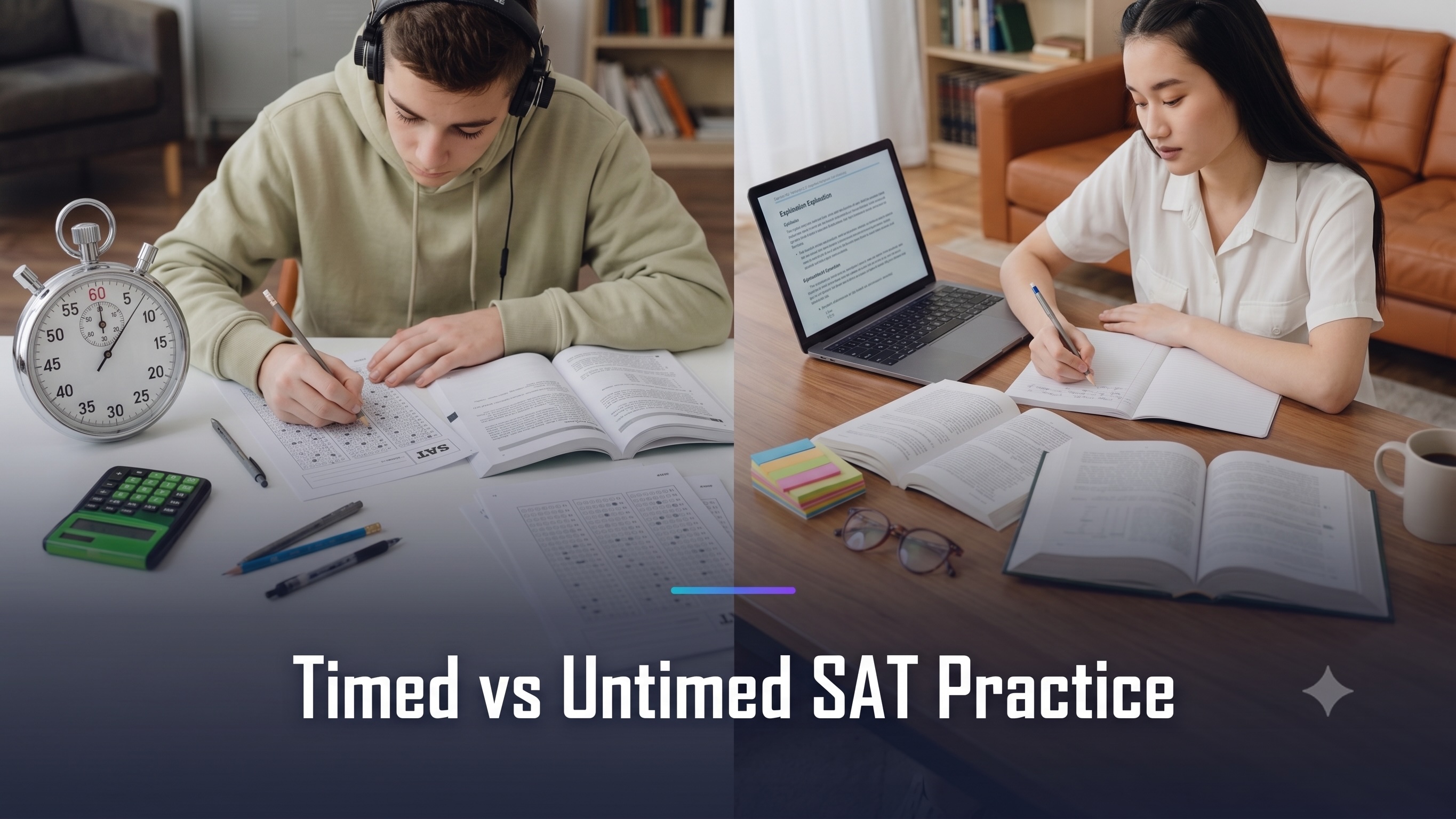
Practice untimed first, then add the clock. Untimed practice is how you build accuracy and the correct method for each question type — you learn to get it right when nothing is rushing you. Timed practice is how you build pacing and stamina under the real conditions of test day. The sequence matters: master a question type without a timer, and only turn the clock on once your accuracy is solid. Doing everything timed from day one bakes in rushed, sloppy habits; never doing anything timed leaves you blindsided by pacing on the real exam. The right answer is almost always "both, in order."
Why accuracy has to come first
You cannot pace something you cannot do. If you do not yet know the fastest correct way to solve a linear-equation word problem or how to spot the main-idea trap in a Reading passage, a timer just forces you to guess faster.
Untimed practice removes the single biggest source of noise: the fear of running out of time. With that pressure gone, you can slow down, try the proper method, check your work, and actually understand why an answer is right or wrong. This is where real learning happens.
Think of it as separating two different skills. One skill is knowing how to solve the problem correctly. The other is solving it fast enough to finish the section. If you train both at once before either is solid, you get the worst of both — shaky method and rushed execution. Build the first skill clean, then layer the second on top.
This is the logic behind deliberate practice: isolate the specific thing you are trying to improve, work on it with full attention, and get feedback. Untimed work gives you the room to do exactly that.
Why timed practice still matters
Accuracy alone will not save you if you only finish two-thirds of the section. The Digital SAT is a real-time test with hard module cutoffs, and pacing is a scored skill whether you like it or not.
Timed practice teaches your brain what the right pace feels like. It builds the internal clock that tells you when to commit to an answer and move on, when a question is a time sink worth skipping, and how to manage the last five minutes without panicking.
It also builds stamina. Sitting for a full adaptive module — then doing it again — is physically and mentally taxing. Students who only ever practice in short untimed bursts often fade in the second module of a section, not because they got harder questions, but because their focus ran out. You train that stamina the same way you train anything: by rehearsing it under load.
The goal of timed practice is not to prove you are fast. It is to make the pace automatic so that on test day, the clock is a background fact rather than a threat.
Know your pacing target
You cannot practice pacing without a target. On the Digital SAT, each section is split into two adaptive modules, and the raw time-per-question works out to roughly:
| Section | Time per question (approx.) |
|---|---|
| Reading and Writing | ~1 min 11 sec |
| Math | ~1 min 35 sec |
These are averages, not rules for every single question. Easy items should take far less, which banks time for the harder ones. But the average is the anchor: if a Reading question is eating three minutes, you are borrowing from questions you have not seen yet. You can confirm the current module structure and timing on the College Board's Digital SAT page.
Once you internalize these numbers, timed practice stops being abstract. You are no longer "trying to go faster" — you are training toward a concrete per-question budget.
Diagnose the real problem: accuracy or timing?
Before you decide how to practice, figure out why you are losing points. The fix is completely different depending on the cause, and most students misdiagnose themselves.
Run one section untimed and one section timed, then compare. This is the cleanest diagnostic. If your untimed accuracy is high but your timed score drops, you have a pacing problem — you know the material and lose points to the clock. If your accuracy is low even with unlimited time, you have an accuracy problem, and no amount of speed drilling will fix it.
Here is the rule of thumb:
- Missing questions you could get right with more time → accuracy is fine, pacing is the issue → do more timed work.
- Missing questions even untimed → method or content gap → go back to untimed work on those specific types.
- Rushing and making careless errors on questions you clearly know → often a pacing-induced accuracy problem → slow down first untimed, rebuild the clean method, then re-introduce the clock.
The mistake-log method makes this diagnosis far sharper, because it forces you to label why each miss happened. Our guide on building a mistake tracker walks through how to categorize errors so the accuracy-versus-timing pattern jumps out at you. Pairing that with a disciplined practice-test review is how you turn a raw score into a to-do list.
How to transition from untimed to timed
Once a question type is solid untimed, add the clock gradually rather than all at once. A jarring jump straight to full-speed testing tends to collapse the clean method you just built.
A practical progression looks like this:
- Untimed, method-focused. Solve the question type slowly and correctly. Explain your steps out loud or in writing. Do this until you are getting them right consistently.
- Untimed but timed-aware. Keep no hard limit, but glance at a clock and note how long each one took. You are just building awareness, not pressure.
- Generous time cap. Give yourself, say, 50 percent more than the target per-question time. Hit the accuracy bar at that pace before tightening.
- Real pacing. Move to the actual per-question budget — about 1:11 for Reading and Writing, about 1:35 for Math — on a set of mixed questions.
- Full timed sections and full mocks. Rehearse the real thing, module cutoffs and all.
The key signal for moving to the next step is accuracy holding steady. If your accuracy drops when you tighten the clock, you moved too fast — step back and rebuild. Speed that costs accuracy is not progress; it is just a lower score arriving sooner.
Full-length, adaptive SAT practice tests belong at the top of this ladder. Once individual question types are automatic, Bluebook-style mocks are where you rehearse pacing across a whole section and build the stamina for two modules back to back.
The two mistakes to avoid
Mistake one: everything timed from day one. This feels productive because it mimics the test, but it trains you to rush before you can solve. You reinforce guessing, skip the step of understanding why an answer is correct, and normalize careless errors. Months of this can leave a student fast and inaccurate — the worst combination.
Mistake two: never practicing timed. The opposite failure. A student drills untimed for weeks, feels confident, and then meets the clock for the first time on test day. Pacing is a skill that has to be rehearsed; discovering it under real conditions almost always means an ugly surprise in the second module.
The fix for both is the same discipline: accuracy first, then pacing, in that order, one question type at a time. A structured 30-day study plan can help you sequence this so you are not guessing at when to flip the clock on.
How a platform makes this easier
Doing this by hand — solving untimed, tracking accuracy, then re-running the same question types under a timer — is a lot of manual bookkeeping. A platform that lets you toggle the clock removes most of that friction.
The IvyStrides portal offers both timed and untimed quizzes drawn from SAT, ACT, PSAT, and AP question banks, so you can build accuracy on a question type untimed and then switch the clock on for the same material without hunting for new questions. That makes the accuracy-first, speed-second progression the default path rather than something you have to engineer yourself. You can see how it fits into a full SAT prep program, and layer in adaptive SAT practice tests once your per-question method is automatic. If you are not sure where your points are leaking, a free consultation and diagnostic can tell you whether accuracy or pacing is your bigger opportunity.
Frequently asked questions
Should a total beginner ever practice timed?
Not at first. If you are still learning the question types and the correct methods, a timer only adds noise and reinforces guessing. Spend your early weeks untimed, build accuracy on each type, and introduce the clock once you can consistently get questions right without it.
How do I know when I'm ready to add the clock to a question type?
When your untimed accuracy on that type is reliably high and the method feels automatic rather than effortful. If you still have to stop and think about how to start a problem, you are not ready. Add a generous time cap first, confirm your accuracy holds, then tighten toward the real per-question budget.
What if my accuracy is fine untimed but I keep running out of time?
That is a pacing problem, not a content problem, and it is good news — it means the hard part is done. Shift your practice toward timed sets at the target pace (about 1:11 for Reading and Writing, about 1:35 for Math), and full timed sections. Also review which specific questions ate your time, since one or two time sinks per module often cause the whole shortfall.
How much of my practice should be timed versus untimed?
It shifts over time. Early on, most of your work should be untimed and method-focused. As individual question types solidify, the balance tips toward timed sets and full mocks. In the final weeks before the test, the majority of your practice should be under real conditions to lock in pacing and stamina.
Does untimed practice make me slow on test day?
No — as long as you eventually transition to timed work. Untimed practice builds the efficient, correct method, which is what actually makes you fast; sloppy methods are slow. The speed comes from mastering the method first and then rehearsing it under the clock, not from rushing before the method is solid.

Rajesh is a technology leader, entrepreneur, and angel investor with 28+ years in Business & Technology Leadership and Product & Solution Engineering. He is passionate about education, mentoring, and driving digital transformation.