
After the SAT Practice Test: Turn Your Score Report Into a Study Plan

On this page
The number at the top of a practice-test score report is the least useful thing on it. The score tells you where you are; the question-by-question review tells you why — and only the "why" tells you what to study next. A good review turns one practice test into a study plan in about 45 minutes: read the section and skill breakdown, review every question you missed and every one you guessed right, label each mistake by type, drill the two or three skills that keep costing points, then re-test. Students who review this way routinely gain more from five reviewed mocks than from twenty un-reviewed ones.
This is the method that separates students who plateau from students who keep climbing. It works on any platform — a paper answer key, a spreadsheet, or a tool that does the bookkeeping for you. Here's how to run it.
Why the score alone is a trap
A score is a lagging indicator. "I got a 1280" tells you nothing you can act on. Two students can both score 1280 for completely different reasons — one is losing points to careless math slips, the other to a specific reading question type — and they need completely different study plans. Chasing the score directly ("study harder, take another test") is how students grind for weeks and watch the number sit still.
The fix is to stop treating the test as a grade and start treating it as data. Every question you answered is a labeled data point about your test-taking. The review is where you read the data.
The 5-step review method
Step 1 — Read the section and skill breakdown, not just the total. Start with where the points actually leaked: which module, which skills. On the Digital SAT that means looking at Reading and Writing vs. Math, then the skill tags underneath (e.g., "Words in Context," "Linear equations," "Command of Evidence"). Two or three skills usually explain most of the lost points. Those are your targets.
Step 2 — Review every wrong answer with the explanation. For each miss, don't just see the right letter — read why the right answer is right and, just as important, why your answer was wrong. The wrong-answer trap you fell for is often more instructive than the correct choice. This is the single highest-value 20 minutes in all of test prep.
Step 3 — Review the questions you guessed right, too. A question you got right by luck is a future miss waiting to happen. Flag anything you were unsure of and review it exactly like a wrong answer. Students skip this step and wonder why a "known" score band keeps wobbling.
Step 4 — Tag each mistake by type. Every miss is one of four things, and each has a different fix:
| Error type | What it looks like | The fix |
|---|---|---|
| Content gap | You didn't know the rule/concept | Learn it, then drill that skill |
| Careless slip | You knew it but misread or mis-clicked | Slow down on Step 1 of the problem; checklists |
| Timing | Right idea, ran out of time | Pacing drills; strategic skipping |
| Misread the question | Solved the wrong thing | Underline what's actually asked |
Most students assume every miss is a content gap and over-study material they already know. The tag tells the truth: careless and timing errors are often the fastest points to recover.
Step 5 — Drill the two or three weak skills, then re-test. Turn the tags into targeted practice: short skill drills on the exact question types you missed, then a fresh full-length mock two to three weeks later to confirm the fix held. Re-testing is not optional — it's how you know the plan worked.
How to tell the error types apart
The tagging in Step 4 is where most self-review goes wrong, so be honest with yourself:
- If you read the explanation and think "I didn't know that rule," it's a content gap. This is the only type that needs new learning.
- If you think "I knew that — I just rushed," it's a careless slip. The fix is process, not content.
- If you ran out of time and guessed, it's timing. Drill pacing, and learn which questions to skip and return to.
- If the right answer makes you think "wait, that's not what I thought it was asking," you misread. Train yourself to underline the actual task before answering.
A pile of "content gaps" means study material. A pile of careless and timing errors means the points are already yours — you just have to stop giving them away. That distinction alone can be worth 30–50 points.
Where a platform does the bookkeeping for you
You can run this method with a printed answer key and a notebook. What a purpose-built platform adds is the tedious bookkeeping — so you spend your time learning, not filing. In the IvyStrides portal, each practice test becomes a question-by-question review: your answer vs. the correct one, with a full written explanation for every question, not just a score.
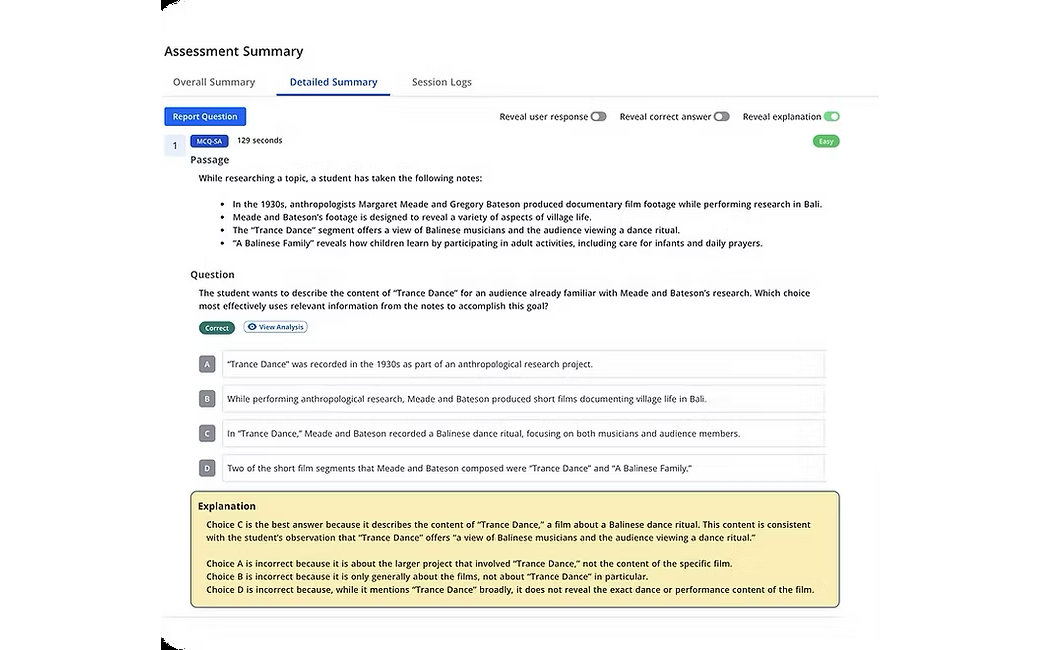
From there, the platform closes the loop automatically: every question you miss is saved to a personal Mistake Tracker so your weak spots collect in one place, and topic drills pull from SAT, ACT, PSAT, and AP question banks so Step 5 — drilling the exact skills you missed — is one click, not an afternoon of hunting for questions. The review stops being a chore and becomes the fastest part of your week. You can try a Bluebook-style adaptive mock and see the review flow for yourself.
How often should I review?
After every full-length practice test, without exception — the review is the point of taking the test. Budget roughly 45–60 minutes: a mock you don't review is mostly wasted time. Space your full-length mocks about two to three weeks apart so there's time to actually fix what the last one revealed; our 30-day SAT study plan shows how to slot reviews and drills between mocks.
Frequently asked questions
Should I review right after the test or the next day? Within a day, while the questions are fresh enough that you remember your reasoning. Same-day is fine if you're not fried; next-morning is better than a rushed review while exhausted.
Do I really need to review questions I got right? The ones you guessed right, yes — those are unstable. Questions you got right confidently and quickly, you can skip. The goal is to find every point that isn't yet reliable.
My reading score won't move no matter how many tests I take. That's almost always an un-reviewed-practice problem, or the wrong drill focus. Start with our guide on why your SAT Reading score isn't improving, then apply the tag-and-drill method above.
How many practice tests do I actually need? Fewer than you'd think — if you review each one properly. Five well-reviewed mocks beat twenty you just scored and moved on from. Quality of review, not quantity of tests, drives the gains. A free consultation includes a diagnostic and an honest read on how many you need.

Rajesh is a technology leader, entrepreneur, and angel investor with 28+ years in Business & Technology Leadership and Product & Solution Engineering. He is passionate about education, mentoring, and driving digital transformation.