
Who Can Write a Dartmouth Peer Recommendation, and Who Should
On this page
- Who Can Write a Dartmouth Peer Recommendation: Eligibility Rules
- Choosing the Right Person: Who Among Eligible Writers Should You Ask
- How Much Weight Dartmouth Places on the Peer Recommendation
- How to Submit the Dartmouth Peer Recommendation Before the Deadline
- FAQ: Dartmouth Peer Recommendation
- Can you get into Dartmouth without a peer recommendation?
- How long should the Dartmouth peer recommendation be?
- Does Dartmouth still do peer recommendations?
- When is the Dartmouth peer recommendation due?
- Your Next Step on the Dartmouth Peer Recommendation
The Dartmouth peer recommendation is a strongly encouraged optional letter written by anyone the applicant considers a peer who holds no supervisory role. Classmates, teammates, siblings, cousins, co-workers, and lab partners all qualify. Parents, teachers, employers, and coaches in an oversight role do not.
It is not required, but Dartmouth strongly encourages it. That eligibility rule comes straight from Dartmouth's peer recommendation glossary page. This guide applies to the 2026-27 application cycle, for entry in fall 2027.

Who Can Write a Dartmouth Peer Recommendation: Eligibility Rules
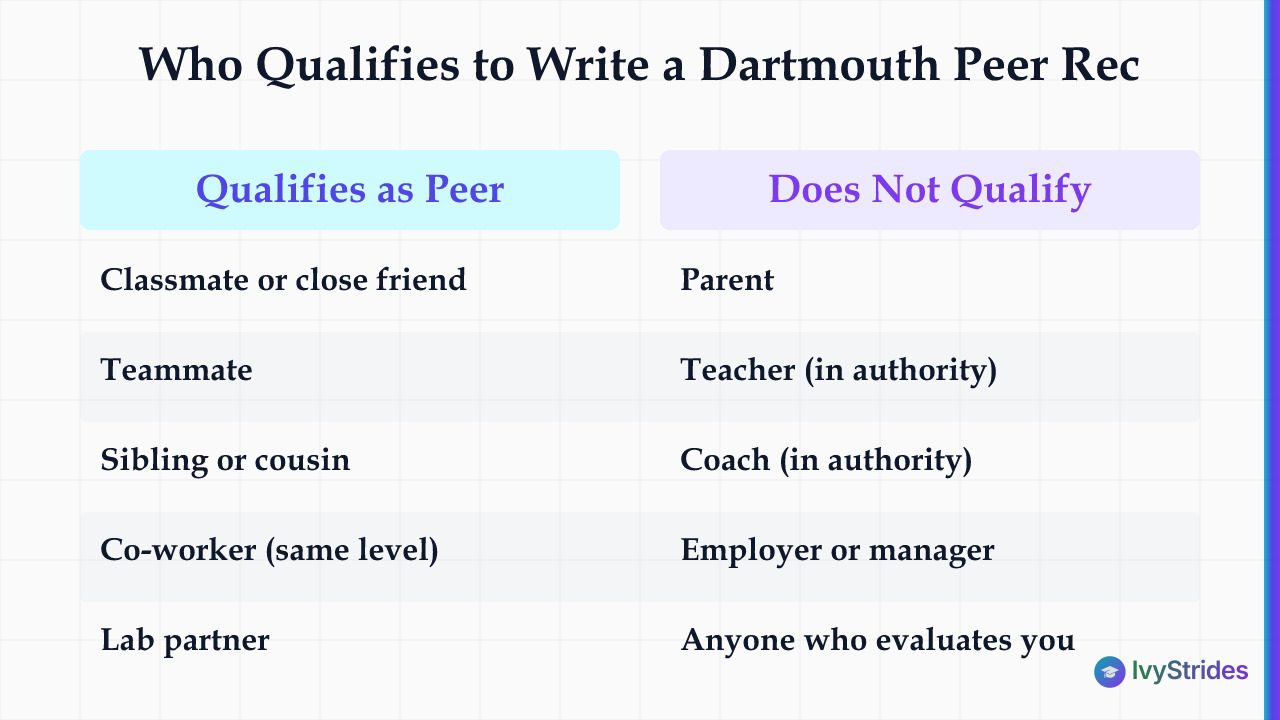
The Dartmouth peer recommendation can be written by any person the applicant considers a peer who holds no supervisory or oversight role over them. Dartmouth defines "peer" broadly: a classmate, teammate, sibling, cousin, or co-worker all fit, per the peer recommendation glossary. The one firm line is supervision. If the writer grades you, manages you, or coaches you from a position of authority, they're out.
Why a sibling qualifies but a parent does not. A sibling, cousin, or co-worker sits beside you, not above you. A parent, teacher, or employer sits in an evaluative seat. Dartmouth wants the view from the peer's chair, not another authority figure's assessment.
The peer recommendation is separate from the two teacher evaluations and the counselor report Dartmouth requires, so it adds a fourth voice to the file. Teacher and counselor letters cover academic performance and character; the peer letter is the only recommendation Dartmouth asks for from someone with no supervisory role. Dartmouth calls itself one of the few colleges to invite a peer letter, while how many recommendation letters most colleges require varies by college type.
| Writer type | Qualifies? | Why |
| Classmate or close friend | Yes | A peer with no authority over you |
| Teammate | Yes | Peer relationship, no oversight |
| Sibling | Yes | Family peer, not a supervisor |
| Cousin | Yes | Family peer, not a supervisor |
| Co-worker (same level) | Yes | Peer at work, not your manager |
| Lab partner | Yes | Peer in an academic project |
| Parent | No | Holds an oversight role |
| Teacher or coach (in authority) | No | Evaluates or supervises you |
One nuance: a classmate can write it even if they are also applying to Dartmouth, and Dartmouth's FAQ says that is not a problem. The rule is about role, not pedigree.
Choosing the Right Person: Who Among Eligible Writers Should You Ask
The best Dartmouth peer recommendation comes from someone who knows you in an unguarded, informal context and can describe character, interpersonal dynamics, humor, and the everyday moments a teacher letter never sees. A current student on Dartmouth's admissions blog calls the peer letter a unique window into the applicant, less formal than a teacher or counselor letter but often more revealing about kindness, loyalty, and character.
That window matters because Dartmouth reads every application as a whole, not as a sum of separate credentials. A letter that reports your GPA back to the reader wastes the slot. One that captures how you handle a losing game, a late lab night, or a hard conversation does the actual work.
Informal depth beats formal credential. The writer does not need an impressive title. Another student blogger, unpacking what a strong peer letter does, describes the value as seeing you through the eyes of a peer with no supervisory role. A teammate who has seen you at 6 a.m. practice knows you better, for this purpose, than a famous mentor who has met you twice.
Ask a close friend or teammate rather than a formal mentor. The question is not whether your writer is impressive enough, but whether they know you in an unguarded, informal context.
Be careful with the supervisor-adjacent choice. A coach who also grades your PE class, or an employer you report to, may feel like a peer but sits on the wrong side of the oversight line. Dartmouth says it wants a peer and already has enough letters from teachers, coaches, and other supervisors.
The peer letter and the Dartmouth supplemental essays work together to surface character; the peer letter adds a voice you cannot write yourself. Dartmouth readers weigh both, so keep them distinct by writing supplemental essays that show who you are beyond the transcript rather than echoing the letter.
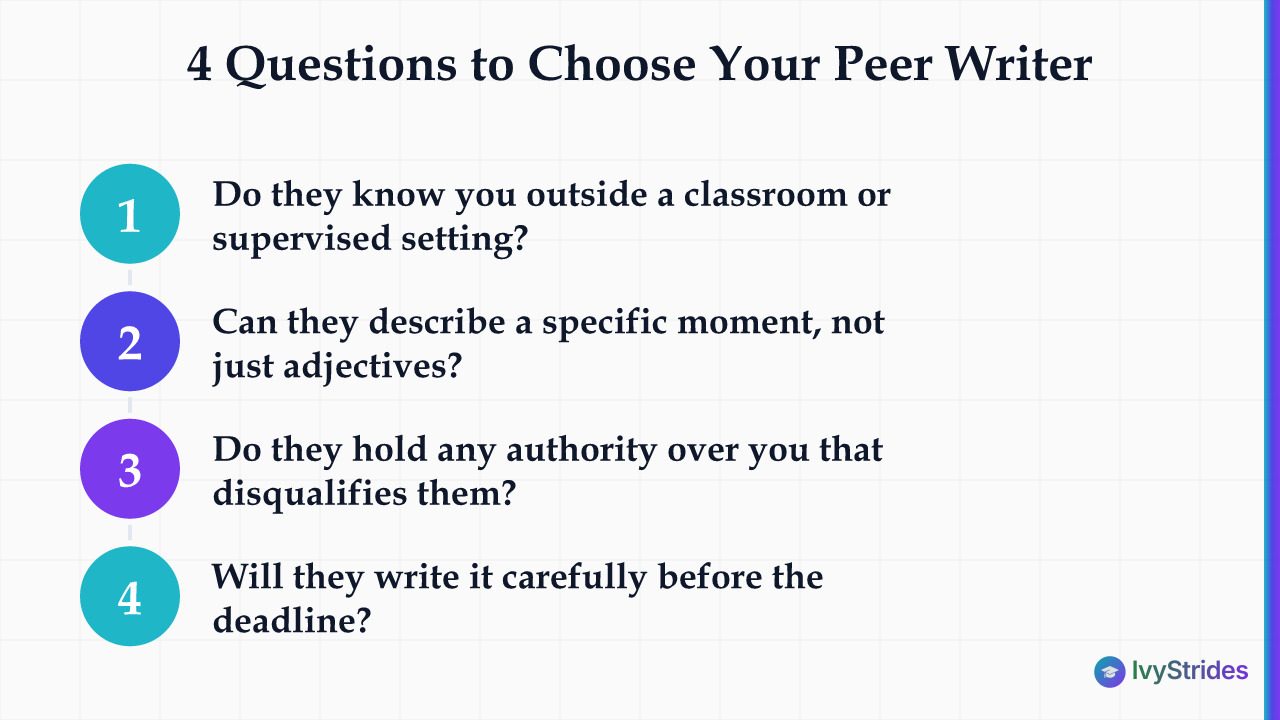
Four questions to ask before you choose your peer writer:
-
Does this person know me outside a classroom or supervised setting?
-
Can they describe a specific moment, not just adjectives?
-
Do they hold any authority over me that would disqualify them?
-
Will they actually write it carefully before the deadline?
Choose someone who has seen you in an unscripted moment over the most credentialed person in your network. IvyStrides admissions counselors plan the Dartmouth peer recommendation alongside essays and the rest of the application in college admissions counseling for grades 11 and 12.
How Much Weight Dartmouth Places on the Peer Recommendation

Photo by RDNE Stock project on Pexels
The Dartmouth peer recommendation is strongly encouraged, not required, so you can get in without one. But skipping it leaves a gap in evidence about character, a factor Dartmouth rates Very Important. The letter still arrives through Dartmouth's holistic review, where character and personal qualities carry real weight.
That weight is documented. In section C7 of its 2025-26 Common Data Set, Dartmouth rates eight factors as Very Important, including character/personal qualities, the application essay, recommendations, and standardized test scores. The peer letter is one of the few components that speaks to character from an outside, non-evaluative voice.
Because Dartmouth rates character and personal qualities as Very Important in its 2025-26 Common Data Set, the peer recommendation is one of the few application components that speaks to those qualities from an outside, non-evaluative voice. Dartmouth uses the letter to see the applicant's character from someone other than a teacher or counselor.
| Selected Very Important factor (CDS C7) | What it captures | Peer rec contributes? |
| Character/personal qualities | Who you are day to day | Yes, directly |
| Application essay | Your voice and thinking | Indirectly |
| Recommendations | Outside testimony | Yes, as a fourth voice |
| Standardized test scores | Academic readiness | No |
| Extracurricular activities | Commitments and spike | Sometimes, through anecdote |
| Rigor of secondary record | Course difficulty | No |
What a peer letter looks like in practice. Think concrete, not a reference list. A strong example might describe how you talked a nervous teammate through a meet, or stayed late to fix a shared project without being asked. Specific scenes, not "hardworking and kind."
The peer recommendation works alongside the Dartmouth Writing Supplement, not as a substitute for it; the supplement shows how you think about Dartmouth, while the peer letter shows how someone who knows you informally describes who you are. It also complements the optional, evaluative alumni interview, for which volunteer alumni contact applicants after they apply. Both give Dartmouth a view of you outside the classroom.
The peer rec sits inside a holistic review that rates character and personal qualities as Very Important, which is why the letter carries more weight than its optional status suggests. Dartmouth still reads every application as a whole, so no single piece, the peer rec included, decides anything on its own.
How to Submit the Dartmouth Peer Recommendation Before the Deadline
Dartmouth's peer recommendation glossary page gives two routes: the Common App, where you invite and assign your peer under Dartmouth's Recommenders and FERPA section, or Dartmouth's Application Portal, which opens after you submit the Common App. Dartmouth accepts the letter after the application deadline but says it is most helpful within ten days of that deadline.
On timing, the deadline that anchors everything is your application plan. The Early Decision deadline is November 1, with decisions by mid-December, and ED is binding. If you are applying Early Decision by November 1, aim to have your peer writer submit through Common App or the Dartmouth portal before that date, or within ten days after it.
Plan on January 1 for Regular Decision. Dartmouth's deadline page says January 1, 11:59 p.m. your local time; one QuestBridge paragraph on its Apply page says January 2, so working to January 1 covers both. Don't assume a date from memory.
No published word limit. Dartmouth does not specify a length for the peer recommendation. Don't invent one. Ask your writer for a focused letter built on specific moments, not a two-line note or a sprawling essay.
How to add a peer recommender through Common App:
-
Open your Common App account and go to Dartmouth under My Colleges.
-
Find the Recommenders and FERPA section for Dartmouth.
-
Add your peer writer as a recommender with their name and email, then assign them to Dartmouth.
-
Assigning them sends a Common App email telling them how to access their recommender account.
-
Check with your writer that the letter is submitted, ideally before your application deadline.
Dartmouth's Apply page lists the peer recommendation as recommended, not required. The required components are the application fee or fee waiver, the Common App or QuestBridge, the writing supplement, the secondary school report and counselor evaluation, two teacher evaluations, and the SAT or ACT, with other test options for students at schools outside the U.S.; the art portfolio is optional. Coordinating the peer recommendation with your own application deadline means mapping all your Dartmouth materials against the full 2026-27 application deadline structure on one timeline.
FAQ: Dartmouth Peer Recommendation
Can you get into Dartmouth without a peer recommendation?
Yes. The peer recommendation is optional. Dartmouth strongly encourages it but does not require it, and not submitting one does not automatically disqualify an application. Still, because Dartmouth rates character and personal qualities as Very Important in CDS C7, a strong peer letter adds a peer's view that none of the required letters gives.
How long should the Dartmouth peer recommendation be?
Dartmouth does not publish a word limit for the peer recommendation. Ask for a focused letter that covers specific moments. A letter that is too short reads as perfunctory, and one that rambles risks losing the reader. Aim for concrete and specific, not comprehensive.
Does Dartmouth still do peer recommendations?
Yes. The peer recommendation remains a strongly encouraged optional component for the 2026-27 cycle, for entry in fall 2027. It goes in through the Common App or Dartmouth's Application Portal, and QuestBridge applicants can also email it to submit@dartmouth.edu.
When is the Dartmouth peer recommendation due?
Dartmouth accepts the peer recommendation after the application deadline but says it is most helpful within ten days of that deadline. The Early Decision deadline is November 1. For Regular Decision, Dartmouth's deadline page says January 1, though one Apply page paragraph says January 2, so plan on January 1.
Your Next Step on the Dartmouth Peer Recommendation
You now know who qualifies, who makes the strongest writer, how the letter reaches Dartmouth, and why it carries more weight than its optional label suggests. The move from here is to pick one real person and lock the logistics.
- Name one eligible person who knows you in an informal, non-supervisory setting.
- Check that they can describe a specific moment, not just list qualities.
- Ask them early, well before your November 1 ED date if you are applying early.
- Decide the route, the Common App or the Dartmouth portal, and send the invitation.
- Confirm submission lands within ten days of your application deadline.

Rajesh is a technology leader, entrepreneur, and angel investor with 28+ years in Business & Technology Leadership and Product & Solution Engineering. He is passionate about education, mentoring, and driving digital transformation.