
Columbia Essays Start With a 100-Word Reading List: What Belongs on It
On this page
- What Columbia's 2026-27 Writing Supplement Asks (Prompts and Word Limits)
- What Goes on the Columbia Reading List (and What Does Not)
- Reading List Self-Check Before You Submit
- How to Write Each Columbia Short Answer Without Repeating Your Common App Essay
- What Columbia Looks for in Essays: The Five Qualities Across Your Application
- FAQ: Columbia Supplemental Essays
- How many supplemental essays does Columbia have?
- What does Columbia look for in supplemental essays?
- What to write in a why us essay for Columbia?
- Does Columbia require supplemental essays?
- Your Next Step on the Columbia Supplement
Columbia's 2026-27 writing supplement is one reading list of up to 100 words (titles only, no commentary) plus five short answers of up to 150 words each. Columbia says the questions show your intellectual curiosity, habits of mind, love of learning and sense of self, and why Columbia fits you.
Those details come from Columbia's official Columbia-specific questions page, cited throughout. Verify the live wording there before you submit, because prompts can shift between cycles. This guide covers the 2026-27 cycle only, for fall 2027 entry.
What Columbia's 2026-27 Writing Supplement Asks (Prompts and Word Limits)
Columbia's writing supplement is the set of Columbia-specific questions that first-year applicants to Columbia College or Columbia Engineering answer in addition to their main application and its personal essay. It opens with a 100-word reading list and continues through five short answers of 150 words each. Columbia accepts the Common App, the Coalition Application on Scoir, or, from QuestBridge Finalists, the QuestBridge Application; every applicant confirms Columbia's Accuracy and Authenticity statement, and Columbia expects your materials to be your own original work.
The essay carries real weight. Columbia rates Application Essay as Very Important in its 2025-26 Common Data Set, alongside rigor of secondary school record, class rank, GPA, recommendations, extracurricular activities, and character/personal qualities, so the supplement is not a formality.
Columbia is test-optional for the 2026-27 cycle, so applicants who skip scores show academic depth through their coursework and curriculum rigor as well as the writing. One caveat worth holding: this is cycle-specific. Columbia has announced it will require scores from fall 2028 entry onward, so if you are a sophomore reading ahead, the policy you plan around is different. A strong supplement does not remove the question of whether a submitted score strengthens a test-optional Columbia file, so settle that before you decide how much the writing has to carry.
Deadlines drive your drafting calendar. Columbia's binding Early Decision deadline is November 1, 2026, and Columbia says Early Decision applicants will receive a decision in mid-December. Early Decision applicants need every supplement answer submitted by November 1, so draft early enough to revise. Regular Decision closes January 1. And Columbia runs no interviews, a policy it announced in May 2023, so your written answers carry more of the personal impression a conversation might otherwise add.
| Prompt | Word limit | What it targets |
| Reading list | 100 words | Intellectual life outside class |
| Short answer 1 | 150 words | Lived experience |
| Short answer 2 | 150 words | A disagreement |
| Short answer 3 | 150 words | Navigating adversity |
| Short answer 4 | 150 words | Why Columbia |
| Short answer 5 | 150 words | Your preferred areas of study |
One list and five short answers add up, so it helps to know how many supplemental essays most applicants write across their full list before you budget your fall.
What Goes on the Columbia Reading List (and What Does Not)

Photo by Andrea Piacquadio on Pexels
Columbia's reading list prompt asks for up to 100 words naming the texts, resources, and outlets that shaped your intellectual development outside class. Columbia asks for items separated by commas or semicolons, with no author names, subtitles or explanatory remarks needed. Books, journals, podcasts, plays, museums, and videos all count, per Columbia's own prompt wording.
Many students treat the reading list as a warm-up rather than as a curated argument about who they are intellectually, and the difference shows in how a reader experiences the file. IvyStrides' essay coaches review a student's Columbia supplemental essays as a set, reading the list as a pattern; students who want that outside read work with coaches who review the list against the prompt's stated purpose.
Think curation, not catalog. A list of twenty titles that all point the same direction, with no logic a reader can trace, reads as padding. Our coaching rule of thumb, not a Columbia rule, is ten to fifteen titles that quietly reveal a mind at work, a physics journal next to a jazz documentary next to a novel about exile.
What does not belong. Skip the authors; Columbia says they are not needed. Skip reading assigned for a class, since the prompt covers development outside of academic courses. And skip titles you added to look impressive but never finished, since the short answers will not back them up.
Reading List Self-Check Before You Submit
- Is every title genuinely yours, something you engaged with outside a class requirement?
- Are you at 100 words or fewer, with titles only and no authors?
- Does the mix show range across formats, not just books?
- Would a stranger read a coherent intellectual identity from the list?
- Have you cut anything added only to impress?
- Do your short answers support the picture the list paints?
How to Write Each Columbia Short Answer Without Repeating Your Common App Essay
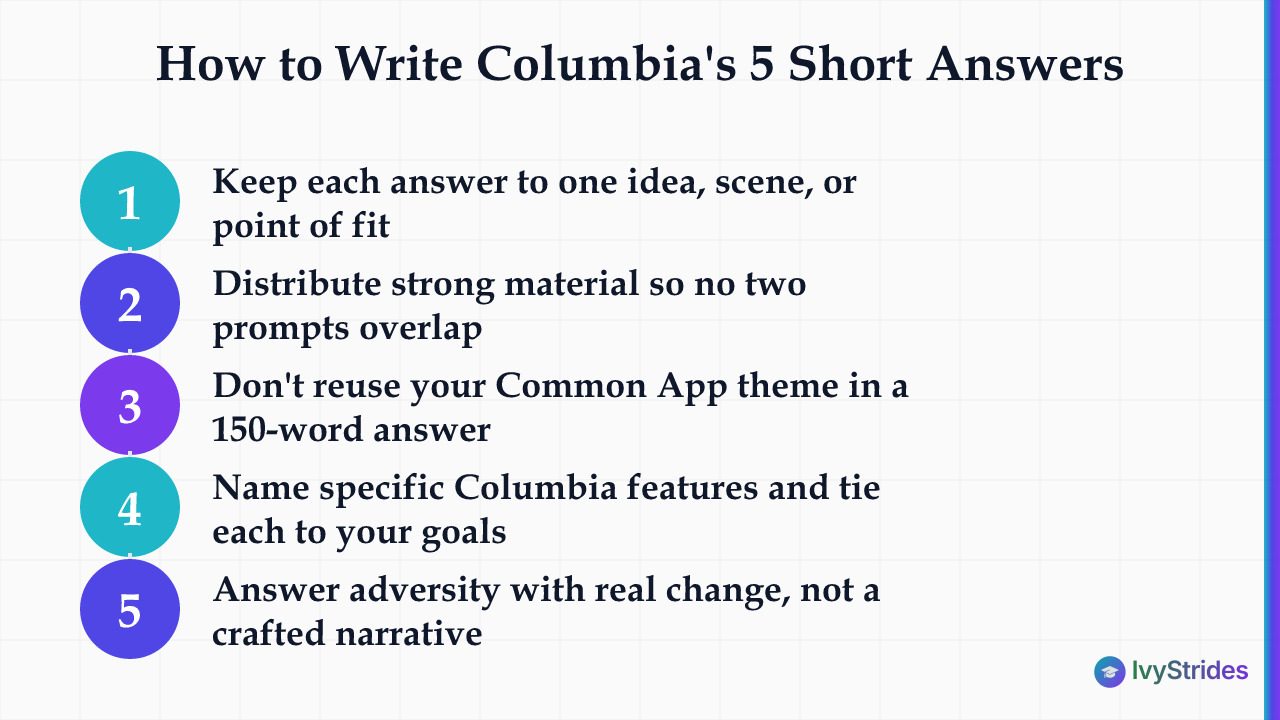
Columbia's five short answers each allow up to 150 words, and each asks about something different. That tight word limit is the whole challenge: 150 words forces one idea, one scene, one point of fit per prompt. There is no room to warm up, so the first sentence has to land.
Because the limit is so tight, repetition is the real risk. Students applying to Columbia alongside several other selective schools need a system for distributing their strongest material across prompts without overlap, which is where knowing how to carry one story across multiple supplemental prompts without repeating yourself earns its keep. Your Common App personal essay already carries one major theme. Do not spend a 150-word answer re-telling it.
| Prompt focus | What Columbia's wording asks | What a strong 150-word answer includes |
| Lived experience | How it shaped the way you would learn from and contribute to Columbia | One aspect, then what you would add |
| Disagreement | How you engaged and what you took away | A real exchange and what shifted |
| Adversity | How you navigated it and how you changed | The situation briefly, then the change |
| Why Columbia | What you find unique and compelling about Columbia | Named features tied to your goals |
| Areas of study | What attracts you to them at Columbia College or Columbia Engineering | One idea you chased past the assignment |
A common pattern in drafts: students write the "Why Columbia" short answer as a list of facts about the university rather than as a statement of personal fit. The fix is the same specificity rule that governs any school-fit essay, and how the "Why This College" structure applies when Columbia asks about fit is worth studying before you draft it. Name the Core Curriculum, the campus-in-city setting, or New York City, then connect each to a concrete goal of yours. Prestige and ranking say nothing about fit.
The adversity question is about change. Columbia asks how you navigated adversity and how you changed as a result. Answer it with a real situation and what you did inside it, not a crafted hardship narrative. Students who recycle a personal-statement theme into one of these answers typically produce a response that feels compressed rather than purposeful.
What Columbia Looks for in Essays: The Five Qualities Across Your Application
On its application process page, Columbia names five things it looks for across your whole application: academic preparation, curiosity, engagement with others, individual voice, and knowledge of Columbia. Columbia says not to use the list as a strict checklist or rubric, and its questions page ties none of the five to a specific question.
Because the five criteria span the whole file, no single essay carries all of them, and the supplement works as a set. Columbia reads holistically through a committee-based review with no formula and no cut-off GPA or test score; no candidate is admitted without discussion by multiple officers. That holistic frame is why Columbia's full admissions requirements and how the supplement fits the broader file matter as context.
| Quality | What Columbia says it looks for | Where Columbia's wording points |
| Academic preparation | Strong performance across subjects, effective writing, a rigorous course load that fits your goals | Transcript, school report, recommendations |
| Curiosity | Big ideas, cross-disciplinary openness, questioning your own beliefs | Columbia-specific questions |
| Engagement with others | Dedication, integrity, kindness, leadership, civic responsibility | Commitments at home, school and beyond |
| Individual voice | Personality, perspectives, motivations | Your whole application |
| Knowledge of Columbia | Core Curriculum, traditional urban campus, New York City | "Why Columbia" question (same "unique and compelling" wording) |
No interviews means the writing is the voice. Columbia runs no interviews and rates Interview as Not Considered in its CDS, so your personal essay and the supplement carry your own voice; individual voice is not a soft quality here, since it does a job an interview would do elsewhere.
One honest caveat: admissions outcomes depend on the full application, not the supplement alone. IvyStrides' admissions counselors review a student's whole Columbia file against each of these five qualities before submission, which is what structured support from a counselor who reads your course list and essays against Columbia's stated criteria looks like from grade 11.
FAQ: Columbia Supplemental Essays
How many supplemental essays does Columbia have?
Columbia's 2026-27 writing supplement has one reading list question of up to 100 words and five short-answer questions of up to 150 words each. The reading list is not a traditional essay; it is a formatted list of titles with no commentary. The five short answers are brief prose responses.
What does Columbia look for in supplemental essays?
Columbia says its questions show your intellectual curiosity, habits of mind, love of learning and sense of self. Across the whole application, it looks for academic preparation, curiosity, engagement with others, individual voice, and knowledge of Columbia. Columbia's review is holistic and committee-based, with no formula and no cut-off score or GPA.
What to write in a why us essay for Columbia?
Columbia's "Why Columbia" question asks why you want to attend and what you find unique and compelling about Columbia. Name specific features, such as the Core Curriculum, the campus-in-city setting, or New York City, and connect each to a concrete goal of yours. Generic praise of ranking or prestige says little about fit.
Does Columbia require supplemental essays?
Yes. Columbia says first-year applicants to Columbia College and Columbia Engineering must respond to its Columbia-specific questions in addition to the Common App or the Coalition Application on Scoir. For 2026-27 that means the 100-word reading list and five 150-word short answers.
Your Next Step on the Columbia Supplement
The supplement rewards planning over polish. Before you draft, pick the one story or idea each question will carry, then work backward from your November 1 or January 1 deadline.
- Build the reading list first, as a curated list with traceable logic, titles only.
- Give each short answer its own story, so none overlap.
- Draft the fit answer with named features tied to your goals, never prestige.
- Read the list and all five answers together to catch repeated stories.
- Verify every prompt against the live Columbia questions page before you submit.

Hemant is a seasoned entrepreneur, investor, and growth strategist with deep ground in education and technology-driven learning. His core training is in Mathematics and Physics — he authored Physics for IB Diploma: Ultimate Revision Guide, recognized as a top student resource.