
Common App Essay 2026: Decoding All 7 Prompts (With Examples)
On this page
- The 2026-27 Common App Essay Prompts: All Seven, Listed and Explained
- How to Pick the Right Prompt: Start With the Story, Not the Wording
- Not Sure Which Prompt Fits Your Story?
- Prompt-by-Prompt Breakdown: Approach, Pitfalls, and a Mini-Example for Each
- Prompt 1: Background, Identity, Interest, or Talent
- Prompt 2: Challenge, Setback, or Failure
- Prompt 3: Questioning a Belief
- Prompt 4: Gratitude
- Prompt 5: Accomplishment or Realization
- Prompt 6: Lose-Track-of-Time Topic
- Prompt 7: Topic of Your Choice
- Do the Common App Essay Prompts Change Every Year?
- What Admissions Officers Actually Look for in a Common App Essay
- How Your Personal Statement and Supplemental Essays Must Work Together
- Common App Essay Timeline: When to Start and How Many Drafts to Plan For
- Topics and Angles to Avoid Across All Seven Prompts
- FAQ
- Is there a single best Common App essay prompt to choose?
- How many essays do you write for the Common App?
- What are the key qualities of a strong college essay?
- Can my Common App essay be about a single memory or moment?
- What is the Common App essay word limit for 2026?
- What should I write about if none of the prompts feel like a fit?
- Ready to Turn Your Story Into a Personal Statement That Works?
The Common App essay prompts for 2026-27 are unchanged from the prior cycle. There are seven options, you write one personal statement of up to 650 words, and the same essay goes to every Common App member school on your list. The prompts cover background and identity, a challenge or setback, a questioned belief, gratitude, an accomplishment, an intellectual passion, and a topic of your choice. Prompt 7 is historically the most selected.
The official prompt text and word limit come from the Common App 2026-2027 announcement. The harder question isn't which prompt is "best" in the abstract. It's which prompt gives your strongest story the most room to breathe, and that's the decision the rest of this article is built to help you make.
The 2026-27 Common App Essay Prompts: All Seven, Listed and Explained
Here are all seven 2026-27 prompts, drawn verbatim from common app essay requirements, with a one-line plain-English read on each.
Prompt 1. Some students have a background, identity, interest, or talent that is so meaningful they believe their application would be incomplete without it. If this sounds like you, then please share your story.
Plain read: tell us the one thing about you the rest of the application can't show.
Prompt 2. The lessons we take from obstacles we encounter can be fundamental to later success. Recount a time when you faced a challenge, setback, or failure. How did it affect you, and what did you learn from the experience?
Plain read: a hard moment, and what you actually took from it.
Prompt 3. Reflect on a time when you questioned or challenged a belief or idea. What prompted your thinking? What was the outcome?
Plain read: show how you think when an idea pushes back.
Prompt 4. Reflect on something that someone has done for you that has made you happy or thankful in a surprising way. How has this gratitude affected or motivated you?
Plain read: someone moved you. What did it change in you?
Prompt 5. Discuss an accomplishment, event, or realization that sparked a period of personal growth and a new understanding of yourself or others.
Plain read: the moment something clicked, and what shifted afterward.
Prompt 6. Describe a topic, idea, or concept you find so engaging that it makes you lose all track of time. Why does it captivate you? What or who do you turn to when you want to learn more?
Plain read: name the thing you nerd out about, and prove it.
Prompt 7. Share an essay on any topic of your choice. It can be one you've already written, one that responds to a different prompt, or one of your own design.
Plain read: blank canvas. Write what you need to write.
A few rules govern every option: the cap is 650 words, there's no stated minimum, and one essay is sent to every Common App school you apply to. The prompts haven't changed since the 2024-25 cycle, when Prompt 4 (Gratitude) replaced an older option.
How to Pick the Right Prompt: Start With the Story, Not the Wording

Photo by www.kaboompics.com on Pexels
Most students open the Common App, read the seven prompts, and try to brainstorm a story that fits one of them. That's backwards.
The students whose essays land hardest do the opposite. They identify two or three of their most specific, most reflective memories first, then ask which prompt gives that story the most room. The prompts are intentionally broad. Prompt 7 exists precisely so that no real story gets squeezed out. Your job isn't to fit a prompt. It's to find the moment only you could write about.
Run candidate stories through what we call the "so what" test: after you tell the story, can you write three sentences about what it reveals about how you think, what you value, or how you've changed? If you can't, it's a narration, not a personal statement. In our coaching, students who fail the "so what" test on a story almost always produce essays that feel competent but forgettable. The ones who pass it produce essays that admissions readers remember.
Here's the part most students miss. A junior we worked with last fall was obsessed with robotics. Her first instinct was Prompt 7, because robotics felt too "topic-specific" for any of the others. But once she narrowed her story to a single 2 a.m. moment debugging a sensor loop and what that taught her about her own thinking, Prompt 6 (the lose-track-of-time prompt) became the obvious home. The story chose the prompt, not the other way around.
Choosing a prompt is only the first step. The brainstorming process that follows determines whether the story you tell is specific enough to be memorable, and our guide to brainstorming the Common App personal statement walks through that next phase in detail. For students who want a coach in the room during that brainstorm, our one-on-one help for common app essay is built for exactly that work. Once you have a draft, the next bottleneck is feedback quality, which is where our essay review service comes in.
Not Sure Which Prompt Fits Your Story?
In a free 15-minute strategy call, an IvyStrides essay coach will review your candidate stories, identify the strongest angle, and tell you exactly which prompt gives it the most room. No prep required. Students and parents both welcome on the call.
Prompt-by-Prompt Breakdown: Approach, Pitfalls, and a Mini-Example for Each
Each prompt rewards a slightly different muscle. Here's the read on each, with the mistake we see most often and a quick anonymized example from coaching.
Prompt 1: Background, Identity, Interest, or Talent
Best for students whose defining characteristic isn't visible elsewhere in the application. A first-generation student raised between two languages. A student whose weekend job at the family bakery shaped how they see work. A competitive Irish dancer when nothing else in the activities list flags it.
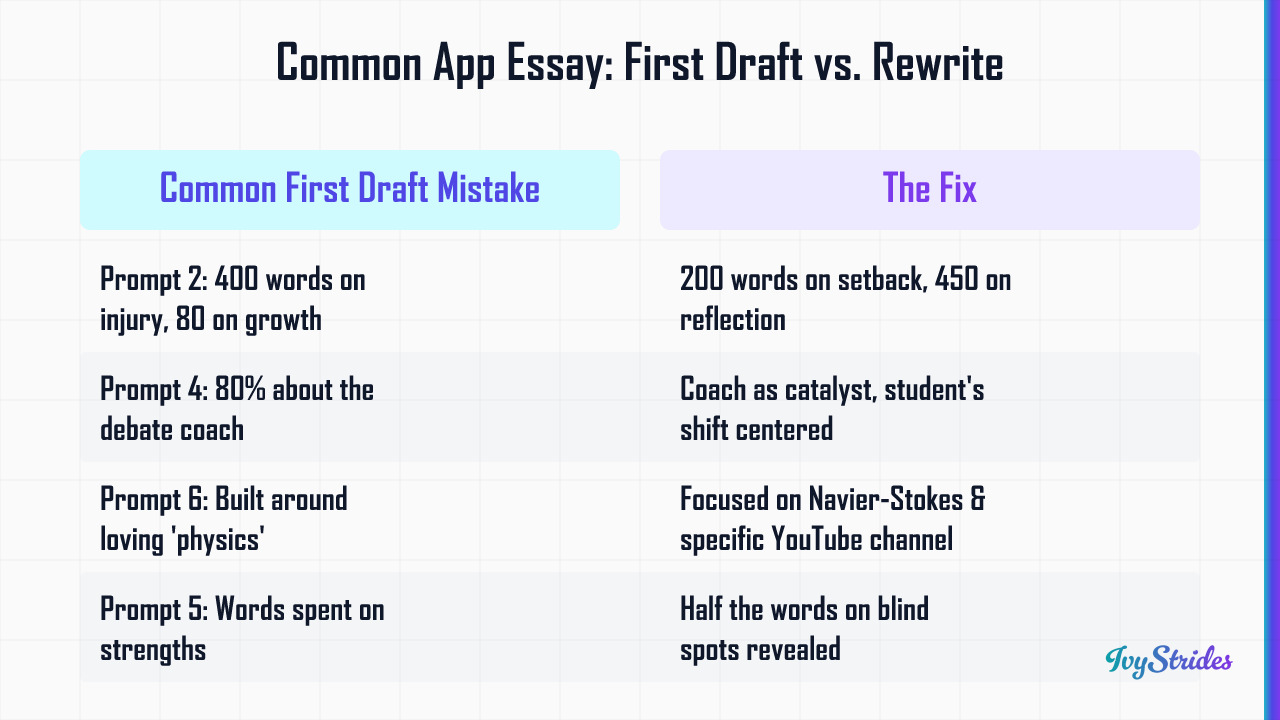
Most common mistake: the essay becomes a resume in prose. The fix is to anchor the whole essay in one specific scene, then let the larger identity emerge through that scene.
Prompt 2: Challenge, Setback, or Failure
Strong fit when the lesson learned genuinely reshaped how you operate, not just how you describe yourself.
Coaching heuristic for Prompt 2: spend no more than 30% of your 650 words on the obstacle itself. That gives you around 200 words for the setback and 450 for what it did to you and what you did with it. We worked with a student whose first draft spent 400 words on a sports injury and 80 words on growth. The rebalance, more reflection, less play-by-play, was what turned the essay into something memorable.
Prompt 3: Questioning a Belief
Rewards intellectual curiosity. Works well for students with a strong academic or philosophical identity. The belief doesn't have to be political or grand. A student who rethought their assumption that "real" musicians don't use software can write a sharper Prompt 3 essay than one who tackles a generic ideological pivot.
Most common mistake: telling the reader what you now believe without showing the messy middle where you actually changed.
Prompt 4: Gratitude
The newest prompt, added for 2024-25 and retained through 2026-27. The trap here is structural. Many drafts spend 500 words describing the person who did the kind thing, and only 150 on what it did to the writer.
We coached a student whose first draft of a Prompt 4 essay was roughly 80% about her debate coach. Beautiful tribute. Wrong essay. The rewrite kept the coach as the catalyst but centered the student's own shift in how she handled losing. That's what Prompt 4 actually asks for.
Prompt 5: Accomplishment or Realization
Broad enough to cover an academic milestone, an athletic moment, an artistic breakthrough, or a quiet personal realization.
Most common mistake: the humble-brag essay. Without a genuine reflective pivot, an accomplishment essay reads as performance. The fix: spend at least half your words on what the accomplishment revealed about your blind spots, not your strengths.
Prompt 6: Lose-Track-of-Time Topic
The specificity prompt. Generic answers kill this one. "Science" is a death sentence. "The mathematics of fluid dynamics in slow-moving rivers" is an essay.
A student we worked with last year had a first draft built around loving "physics." The reader had no traction. When she rewrote it around her obsession with the Navier-Stokes equations and the specific YouTube channel she'd binged in 10th grade, the essay finally had a fingerprint. Name the exact thing. Show the exact rabbit holes you go down.
Prompt 7: Topic of Your Choice
Blank canvas. Historically the most popular option. Useful when your story honestly doesn't fit Prompts 1-6, or when you want to use an unconventional structure (a letter, a list, a braided narrative).
Most common mistake: treating "topic of your choice" as permission to skip the "so what" test. Every guardrail the other prompts give you, reflection, growth, insight, still applies. Prompt 7 just doesn't say it out loud.
If you're applying to specific schools that lean heavily on supplements alongside the personal statement, see our work on Deciding Whether to Apply to the University of Notre Dame? and Apply to Cornell University in 2026: What You Must Know for how the personal statement maps onto each school's reader expectations.
Do the Common App Essay Prompts Change Every Year?
Short answer: rarely. The prompts have been broadly stable since 2017. The most recent change was the 2024-25 cycle, when Prompt 4 (Gratitude) replaced an earlier option. The 2026-27 prompts are confirmed identical to 2025-26 per the Common App announcement.
Common App typically announces the following year's prompts in late winter or spring. That stability matters practically. If you're a rising senior reading this in the summer before senior year, you can start drafting now without waiting for any "official update." In our coaching, students who begin drafting in June or July complete materially more revision cycles before November 1 Early Action deadlines than students who wait until September.
While you're stress-testing your application, it's worth checking how each target school weighs essays alongside scores. Our breakdown of University of Chicago SAT Requirements 2026 is a good example of the quantitative context the essay has to humanize.
What Admissions Officers Actually Look for in a Common App Essay
Admissions officers read the personal statement alongside your transcript, test scores, and AP course load. The essay's job is to add a human dimension that numbers alone cannot convey.
Three things matter most, in our coaching experience across hundreds of personal-statement and supplemental drafts:
Specificity. Named details beat broad claims every time. "The smell of solder in my grandfather's garage" lands. "I love engineering" doesn't.
Voice. The essay should sound like the student speaking, not a college-aged version of a press release. If your parent could have written it, or worse, if an AI tool could have, it's not voiced enough.
Reflection depth. What does this experience reveal about how you think or what you value? The most common weakness we see is a strong opening scene followed by a generic conclusion that could apply to any student. The scene gets you the reader's attention. The reflection earns the rest of the page.
There's a fourth principle worth naming: add new information. The personal statement is one of a small handful of places where the reader gets to see something the activities list doesn't already say. Don't waste those 650 words restating what's elsewhere in the application.
A caveat on weight. Many schools currently allow students to apply without submitting SAT or ACT scores, and at those schools the essay tends to carry relatively more weight in holistic review. Test-optional policies vary by school and by year, so check the current list at the FairTest tracker for any school on your list. None of this means a strong essay can offset a weak transcript. It means the essay is one important component of a holistic file. For context on score interpretation while you plan, see our deep dive on Stanford superscore SAT. Students weighing whether their current score is competitive can also reference our breakdown on is 1300 a good sat score.
How Your Personal Statement and Supplemental Essays Must Work Together
Because the personal statement goes to every school on your list, it must leave room for your supplemental essays to add new information rather than repeat the same themes, which is why treating the two as one coordinated narrative matters from the first draft.
Think of it this way. The personal statement is the "who I am" essay. Supplements are the "why this school" and "what I do" essays. If your personal statement is about your robotics obsession, your "Why Engineering" supplement at one school and your activities-elaboration supplement at another shouldn't all be robotics again. That's three uses of the same story and one wasted application.
A practical workflow we use in coaching: draft the personal statement first. Then list every supplemental essay across all your schools on one page with word limits next to each. Most supplements run 150 to 650 words depending on the school, and you can confirm specifics through the Common App. Map themes deliberately across all of them. Each essay should contribute a distinct facet of who you are.
This matters even more if you're balancing essay work with rigorous coursework like our ap courses online. Your time and your reader's attention are both finite. For students who want a framework for managing the whole senior-year workload, our piece on WOOP Your Way to College Success: A Goal-Setting Tool for High-Achievers is a useful companion.
Common App Essay Timeline: When to Start and How Many Drafts to Plan For
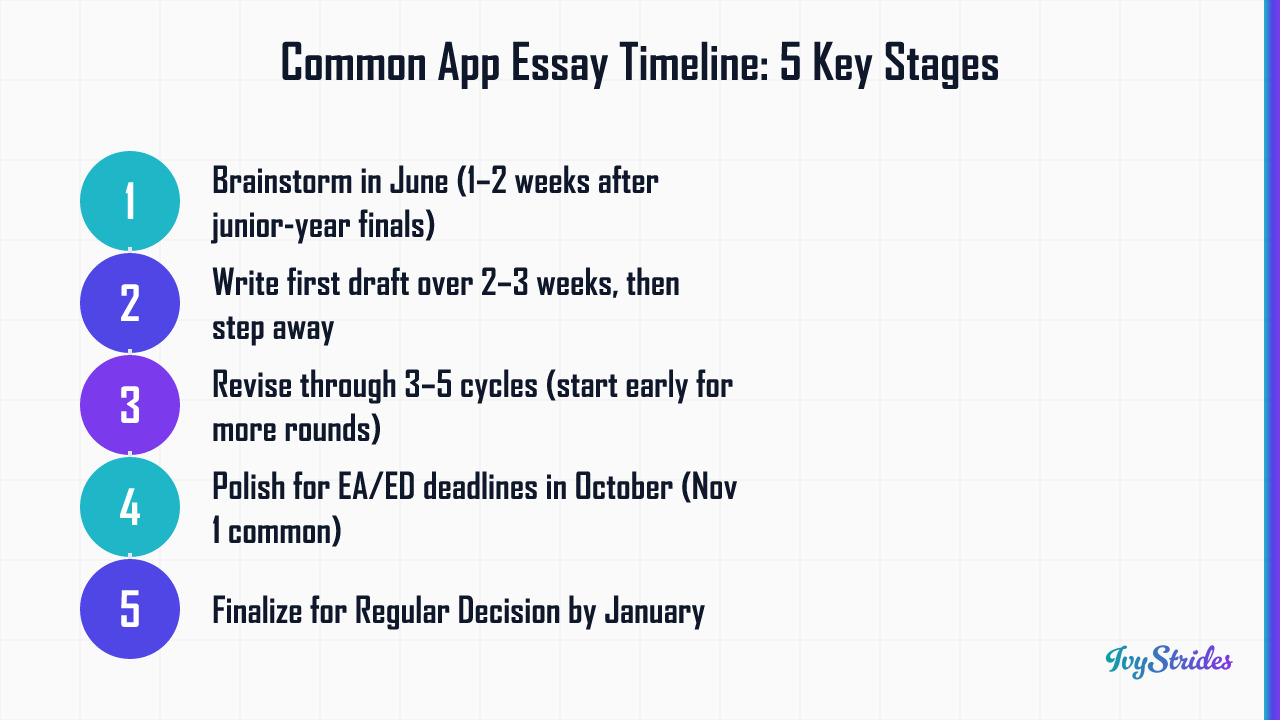
Here's an honest timeline. A strong personal statement typically takes 15 to 25 hours of total work across brainstorming, drafting, and revision. Not 15 hours in a weekend. Fifteen to twenty-five hours over six to ten weeks, with breaks between drafts so the writing has time to settle.
The recommended start is June of the summer before senior year, right after junior-year finals. Brainstorming takes one to two weeks if you take it seriously. The first draft is usually two to three weeks of writing and walking away. Revision, in our coaching, runs three to five cycles. Final polish lands in October for Early Action and Early Decision (November 1 deadlines are most common) or January for Regular Decision.
The Common App platform opens August 1 each year. You can write your essay before the platform opens; the prompts have been public since spring.
One pattern from coaching: students who begin in June average four to five revision cycles before November 1 EA deadlines. Students who start in September average one to two. The single biggest determinant of essay quality isn't talent. It's revision count. And revision count is a function of when you start.
If you're planning testing alongside essays, our guide to MIT sat requirements covers the score profile and timing for one of the most selective application paths. Pair that with the Stanford superscore SAT overview to sequence test sittings around essay drafting.
Topics and Angles to Avoid Across All Seven Prompts
No topic is automatically disqualifying. But in our coaching, certain topics are so frequently submitted that they require an unusually specific angle to differentiate. Worth knowing before you commit:
- The sports-injury comeback. Submitted constantly. Workable only with a genuinely fresh reflection. Not the injury itself, the unexpected thing it revealed.
- The mission trip. Especially when the essay centers what the writer learned about poverty. Risk: the essay becomes about the community visited rather than the writer.
- The immigrant-grandparent tribute. Powerful when it stays anchored in the writer's own evolving relationship with that heritage. Weak when the grandparent ends up as the protagonist.
- The tragedy without transformation. Describing hardship without showing how it changed how you operate now. The reader needs the "after," not just the "during."
Structural traps matter just as much as topic traps:
- The dictionary-definition opening. "Webster's defines resilience as…" Across the supplemental drafts we read each cycle, this is the single most common weak opening.
- The "this experience taught me to never give up" closing. Generic closings are where most otherwise-strong essays collapse.
- The humble brag. Especially in Prompt 5 essays. If the reader finishes the essay impressed only with what you did, not with how you think, the reflective pivot isn't doing its work.
- The essay that's secretly about someone else. Especially in Prompts 2 and 4. The reader needs to leave knowing more about you, not your coach, your sibling, or your grandparent.
For school-specific essay planning beyond the personal statement, see Should You Apply to The Washington University in St. Louis? for how supplements stack against the main essay at a single competitive school.
FAQ
Is there a single best Common App essay prompt to choose?
No single prompt is objectively best. In our coaching, the strongest essays come from students who identified their most specific and reflective story first, then matched it to the prompt that gave it the most room. Prompt 7 is the most popular historically, but popularity doesn't equal effectiveness for any individual student. Pick the prompt your story is already pointing to.
How many essays do you write for the Common App?
You write one personal statement of up to 650 words that goes to every Common App member school on your list. Most selective colleges also require school-specific supplemental essays, which vary in number and word limit by institution. The personal statement and the supplements are separate requirements, and the personal statement is not optional at any Common App member school that requires an essay.
What are the key qualities of a strong college essay?
Several college counselors teach frameworks built around qualities like Detail, Depth, and Differentiation. In our coaching, we use three practical tests. Is the story specific enough that only this student could have written it? Does the essay show genuine reflection rather than just narration? Does it add information not already visible in the rest of the application? Those three questions map closely to what admissions officers consistently describe as the markers of a memorable personal statement.
Can my Common App essay be about a single memory or moment?
Yes, and in many cases a focused scene makes for a stronger essay than a broad survey of experiences. A single well-chosen moment gives you room for sensory detail and reflective depth, which is what distinguishes a personal statement from a list of accomplishments. The only rule: the moment has to open outward into a larger insight about who you are.
What is the Common App essay word limit for 2026?
The Common App essay word limit for 2026-27 is 650 words maximum. There's no stated minimum, but essays that come in under 500 words rarely have enough room for both a specific story and meaningful reflection. Aim for 600 to 650 words to use the space the prompt actually gives you.
What should I write about if none of the prompts feel like a fit?
Prompt 7, topic of your choice, exists precisely for this situation. If your story doesn't map cleanly to Prompts 1 through 6, Prompt 7 gives you a blank canvas. In our coaching, students who feel "none of the prompts fit" often have a strong and unusual story. The challenge is usually framing, not topic. Write the essay your story wants to be, then submit it under Prompt 7.
Pick the story first. The right prompt will reveal itself, the 650 words will start feeling like enough, and the rest of your application will have something to stand on.
Ready to Turn Your Story Into a Personal Statement That Works?
Book a free 15-minute call with an IvyStrides essay coach. You'll leave with a clear prompt choice, a story angle, and a first-draft plan. Students and parents both welcome.

Award-winning author (South Asian Book Award) and graduate of BITS Pilani and UCLA Luskin School of Public Affairs. Brings a published writer's eye to Common App essays and grammatical precision to SAT and ACT R&W instruction.