
How to Handle SAT Vocabulary in Context: The Complete 2026 Playbook for a Top Score
On this page
- What Are Words in Context Questions on the SAT?
- Why SAT Words in Context Questions Trip Up Even Strong Readers
- The 4-Step SAT Words in Context Strategy: Predict Before You Look
- How to Study SAT Vocabulary in Context: Practice Methods That Actually Work
- FAQ: SAT Words in Context
- What is the most effective way to study vocabulary for the SAT?
- Should I use flashcards for SAT vocab?
- How many words in context questions are on the SAT?
- What are "words in context" questions on the SAT?
- Your Next Step on Words in Context
To handle SAT vocabulary in context questions, cover the answer choices, read the passage for signal words and logic clues, predict your own word for the blank, then match that prediction to the closest choice. Words in Context is the Digital SAT's most frequent vocabulary question type, and the passage always holds enough to fill the blank.
Here's the part most students miss: you do not need to know the word. You need to read the surrounding sentences. The format and question counts below come from College Board's official Digital SAT documentation, and the one caveat worth stating up front is that these questions test contextual meaning, not dictionary definitions.
What Are Words in Context Questions on the SAT?
Words in Context questions ask you to choose the word or phrase that best fits a blank in a short passage. They sit inside the Craft and Structure domain of the Digital SAT Reading and Writing section, and they test how a word behaves in a specific sentence, not what it means in isolation.
The Reading and Writing section runs 54 questions in 64 minutes across two 27-question modules, and it splits into four domains: Information and Ideas, Craft and Structure, Expression of Ideas, and Standard English Conventions. Words in Context lives in Craft and Structure alongside Text Structure and Purpose and Cross-Text Connections.
That domain grouping matters because Words in Context is one of three question types inside Craft and Structure; once you lock this strategy, the same predict-from-context habit transfers directly to Text Structure and Purpose questions. For the wider map of that domain, see our overview of craft and structure SAT questions.
Two formats show up. Most Words in Context questions give you one passage with a single blank and four choices. A smaller share pairs the vocabulary test with a short logical-completion setup. Both reward the same reading habit.
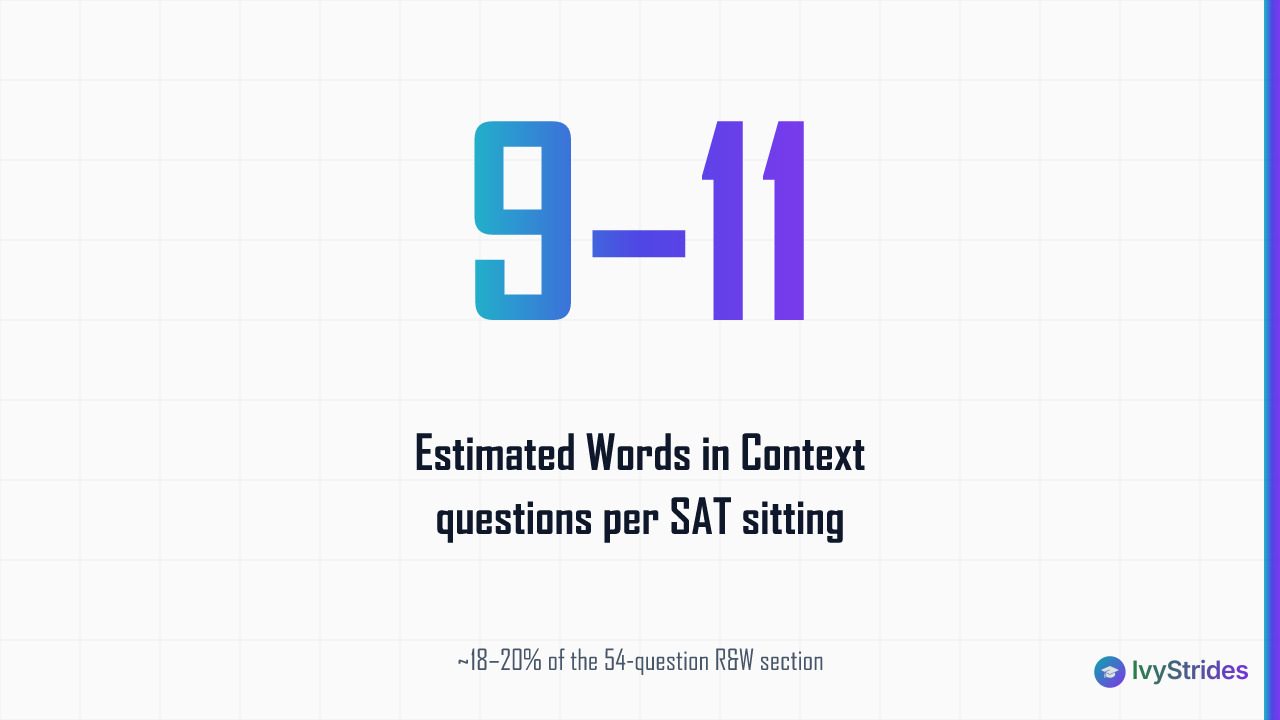
College Board publishes the 54-question total and the Craft and Structure domain share but not a fixed per-type count; applying the domain weighting, IvyStrides estimates roughly 9 to 11 Words in Context questions per sitting, or about 18 to 20% of the section. The exact number varies by test form.
| Feature | Detail |
| Domain | Craft and Structure (one of four R&W domains) |
| Share of section | Roughly 18 to 20% |
| Approximate count | About 9 to 11 of 54 questions |
| What it tests | Contextual meaning, not definitions |
| Formats | Single-blank and paired logical completion |
| Where they appear | Both Module 1 and Module 2 |
Why SAT Words in Context Questions Trip Up Even Strong Readers

Photo by RDNE Stock project on Pexels
Words in Context questions defeat confident readers for one reason: the trap answer is usually a real meaning of the word, just not the meaning the passage needs. Because these questions appear across both adaptive modules, consistent accuracy here protects your Module 1 performance and keeps the harder Module 2 in reach.
Three error patterns account for most misses. First, the secondary-meaning trap. In our coaching with students scoring 600 to 680 on Reading and Writing, the most common Words in Context error is selecting a word's primary dictionary meaning when the passage logic demands a secondary or figurative sense. Second, signal-word blindness: skipping the "however" or "therefore" that sets the direction of the blank. Third, connotation mismatch, where a choice sounds academic and sophisticated but carries the wrong emotional charge.
Common words, uncommon senses. Harder Module 2 questions lean on everyday words used in non-primary ways: "address" a problem, "reflect" a trend, "challenge" an assumption. The word looks easy. The sense is the test. Because Module 2 difficulty is set by your Module 1 performance, these subtler questions cluster where the stakes are highest, which is exactly how the Digital SAT adaptive modules work.
| Trap Type | What It Looks Like | How to Avoid It |
| Secondary meaning | Choice matches a real but wrong sense | Predict from passage logic first |
| Signal-word blindness | You miss "however" or "therefore" | Circle the connector before choosing |
| Connotation mismatch | Sophisticated word, wrong charge | Test positive vs. negative tone |
The 4-Step SAT Words in Context Strategy: Predict Before You Look
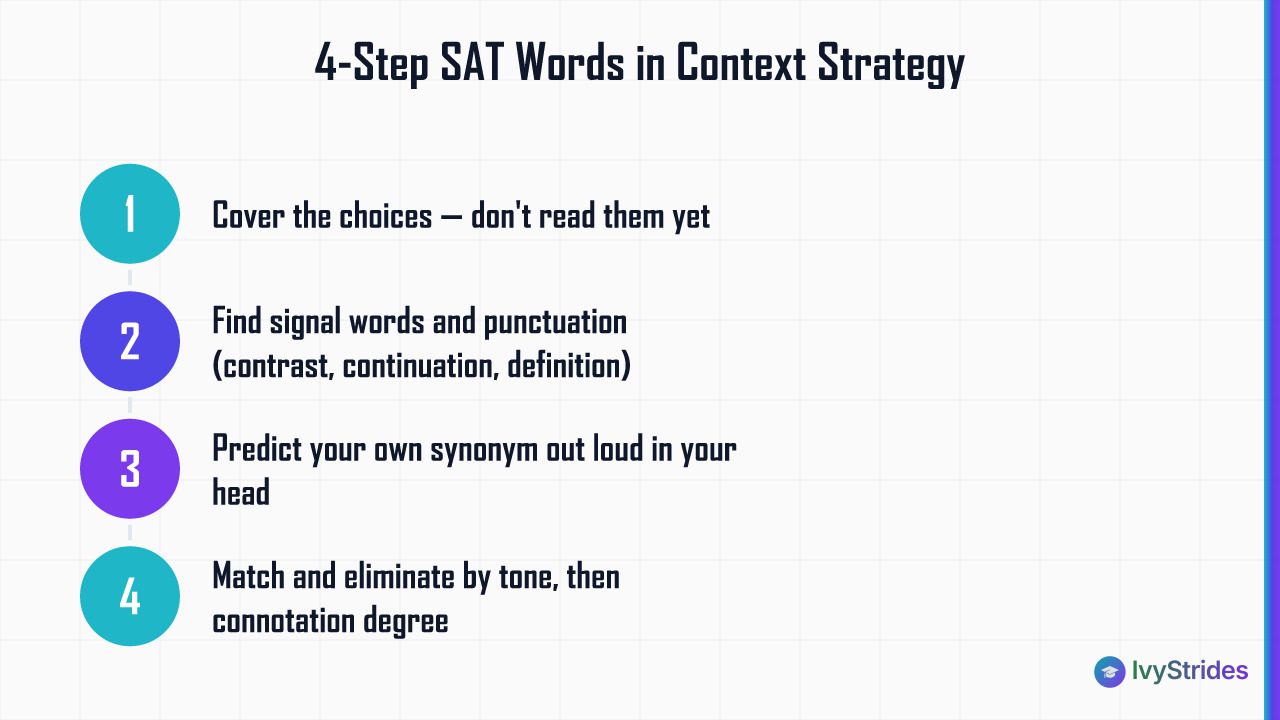
The predict-and-match method solves Words in Context questions in four steps: cover the choices, read for signal words, predict your own word, then match and eliminate by tone. The engine of this method is anchoring avoidance. Read the choices first and one of them will start sounding right before you have earned the answer.
Step 1: cover the choices. Do not read them yet. In our coaching, students who write a prediction word before reading choices reduce choice-induced anchoring, the single biggest source of secondary-meaning errors.
Step 2: find the signal words and punctuation. A contrast signal (however, although, despite, yet, conversely) flips the direction of the blank. A continuation signal (beyond that, therefore, similarly, in fact) keeps it going the same way. Definition signals do the heaviest lifting: a colon, a dash, a semicolon, or an appositive phrase usually restates the blank in plain words a sentence away.
Step 3: predict. Say your own word out loud in your head. "The blank means something like cautious." You now have a target.
Step 4: match and eliminate. Line your prediction against the four choices. When two survive, use tone elimination first (positive vs. negative), then connotation degree (mild vs. strong). This is where the same predict-from-context habit that anchors words in context SAT practice pays off across the section, so it's worth seeing where it fits among the full set of SAT Reading and Writing question types.
| Step | Action | What to Look For |
| 1 | Cover the choices | Nothing yet; read the passage |
| 2 | Scan for signals | Contrast, continuation, definition cues |
| 3 | Predict a word | Your own synonym from the logic |
| 4 | Match and eliminate | Closest fit; tone then connotation |
So what do you do when none of the four choices matches your prediction? Loosen the prediction to a category, not a synonym: "some kind of positive change word." Then eliminate every choice that carries the wrong tone. Two usually fall away immediately. The method works even on a word you have never seen, because you scored the blank before you met the vocabulary.
Here's the honest part. Having the four steps is not the same as running them cleanly at about 82 seconds per question under pressure. If you want a section specialist to review your prediction accuracy on live questions and catch the trap pattern that keeps recurring, our 1-on-1 SAT prep pairs you with an R&W coach who does exactly that before your test date.
How to Study SAT Vocabulary in Context: Practice Methods That Actually Work
The most effective way to study words in context is timed drilling on official questions with error logging by trap type, not bulk word-list memorization. Three approaches earn their time, ranked by payoff for the digital SAT vocabulary reader.
Official drills first. College Board's Bluebook app offers free full-length practice, and its questions match the real adaptive format. After each timed drill, log every Words in Context miss by error type (wrong prediction, ignored signal word, secondary-meaning trap) so patterns surface within two or three sessions. Our full how to review your SAT practice test mistakes walkthrough gives you the log template.
Reading with pauses second. Read dense academic prose and stop at any hard word to predict its meaning before you check. This builds the exact muscle the test rewards.
Targeted flashcards third, and only third. Should you use word lists? Not as a primary strategy. Spaced repetition for a focused set of about 80 to 120 high-frequency academic words and common Latin and Greek roots is more efficient than grinding lists of 500 obscure ones. A word you memorize in isolation still fails you if you ignore the passage's signal words.
In our coaching, students at the 600 to 680 band gain more from 15 to 20 timed questions a week with review than from memorizing 50 new words a week. Students at 700-plus should shift to secondary-meaning drills on harder Module 2 sets. For the practice bank itself, our SAT practice tests library holds Bluebook-style question sets.
| R&W Score Band | Weekly Question Volume | Primary Focus | Error Log Priority |
| 600 to 680 | 15 to 20 | Signal words, prediction habit | Ignored signals |
| 700 to 750 | 20 to 25 | Secondary meanings | Trap-answer choices |
| 750-plus | Maintenance sets | Paired-passage logic | Connotation degree |
One caveat before you build a plan around this: Words in Context is one domain of four, so closing it alone will not carry a target composite. Pair it with the section's other three domains.
FAQ: SAT Words in Context
What is the most effective way to study vocabulary for the SAT?
Timed drills on official Words in Context questions with error logging by trap type outperform bulk word-list memorization. Focus on a targeted set of about 80 to 120 high-frequency academic words, and practice predicting meaning from context on every question, not only the ones that feel hard.
Should I use flashcards for SAT vocab?
Flashcards help for a focused set of high-frequency academic words and common Latin and Greek roots. They are not a substitute for context strategy. The Digital SAT tests meaning in context, so a word you know in isolation can still trip you up when you ignore the passage's signal words.
How many words in context questions are on the SAT?
Words in Context make up roughly 18 to 20% of the 54-question Reading and Writing section, placing about 9 to 11 questions across the two modules. The exact count shifts by test form, but expect at least one in every cluster of five or six R&W questions.
What are "words in context" questions on the SAT?
Words in Context questions ask you to pick the word or phrase that best fits a blank in a short passage. They belong to the Craft and Structure domain of the Digital SAT Reading and Writing section and test contextual meaning, not dictionary definitions.
Your Next Step on Words in Context
You have a repeatable method and a practice plan sized to your score band. The work now is turning the four steps into a reflex under timed conditions.
- Run the predict-and-match method on 10 to 15 official Words in Context questions in the Bluebook app.
- Log every miss by trap type: wrong prediction, ignored signal word, or secondary-meaning trap.
- Review the log after two sessions and drill the single trap that shows up most.
- If the same pattern keeps costing points, get a section specialist to watch you work live questions.

Award-winning author (South Asian Book Award) and graduate of BITS Pilani and UCLA Luskin School of Public Affairs. Brings a published writer's eye to Common App essays and grammatical precision to SAT and ACT R&W instruction.