
Craft and Structure SAT Questions: Words in Context, Text Structure, and Cross-Text Connections
On this page
- What Are Craft and Structure Questions on the SAT?
- Words in Context: How the SAT Tests Vocabulary Now
- Text Structure and Purpose: What the Sentence Is Doing
- Cross-Text Connections on the SAT: Two Texts, One Relationship
- How Craft and Structure Questions Behave in an Adaptive Module
- Not sure which Reading and Writing domain is costing you points?
- A Four-Week Drill Plan for Craft and Structure
- Three Worked SAT Examples, One Per Question Type
- Frequently Asked Questions About Craft and Structure
- How many Craft and Structure questions are on the SAT?
- Are Craft and Structure questions the hardest on the SAT?
- Do I need to memorise vocabulary for Words in Context?
- What is the difference between Text Structure and Purpose and Information and Ideas?
- How do I approach the two-text questions?
- Does Craft and Structure appear in both modules?
- Can I skip Craft and Structure and focus elsewhere?
- Your Next Step on SAT Reading and Writing
- Turn your weakest domain into your most reliable one
Craft and Structure is one of the four content domains on the Digital SAT Reading and Writing section, and it contains exactly three question types: Words in Context, Text Structure and Purpose, and Cross-Text Connections. Each asks something different. Words in Context asks what a word means in the sentence in front of you. Text Structure and Purpose asks what a sentence is doing rather than what it says. Cross-Text Connections asks how two authors relate to each other. Students lose points here because they treat all three as one generic reading task, and one generic approach can't answer three different questions.
The Digital SAT Reading and Writing section runs 54 questions in 64 minutes, split into two modules of 27 questions each. Craft and Structure questions appear throughout both. This guide takes the three types one at a time, gives each a method you can run under time pressure, and ends with a four-week drill plan built around your own error log rather than raw question volume.
Every domain name and question type below comes from College Board's published description of the Reading and Writing section. Where a figure is not something College Board publishes, this page says so rather than inventing a number.
What Are Craft and Structure Questions on the SAT?
Craft and Structure is the SAT Reading and Writing domain that measures, in College Board's own description, the skills needed to understand and use high-utility words and phrases in context, evaluate texts rhetorically, and make connections between topically related texts. Put plainly: vocabulary in use, authorial technique, and how two texts speak to each other.
College Board builds the Reading and Writing section from four content domains. Information and Ideas covers comprehension and evidence. Standard English Conventions covers grammar and punctuation. Expression of Ideas covers revision for rhetorical effect. Craft and Structure covers the three types in this guide. Every module you sit contains questions from all four.
That matters for pacing. You won't meet all of them in a block and then move on. College Board interleaves them, so you need to recognise a question type from its wording within a second or two of reading the prompt, then switch into the right method. Recognition is what saves you time, not raw reading speed.
Here is how the three types announce themselves:
| Question type | The prompt usually says | What it is really asking |
| Words in Context | "as used in the text, the word X most nearly means" | What does this word mean here, in this sentence |
| Text Structure and Purpose | "the main purpose of the underlined sentence is to" | What job is this sentence doing for the passage |
| Cross-Text Connections | "based on the texts, how would the author of Text 2 respond" | What is the relationship between these two authors |
Read the prompt before the passage. On a section this tight, knowing what you're looking for changes what you notice.
Words in Context: How the SAT Tests Vocabulary Now
Words in Context on the SAT tests vocabulary in use, not vocabulary recall. It gives you a word you almost certainly know, in a sentence where the intended sense is narrower than the sense you carry around in your head. The question isn't whether you know the word. It's whether you can tell which of its meanings is operating here.
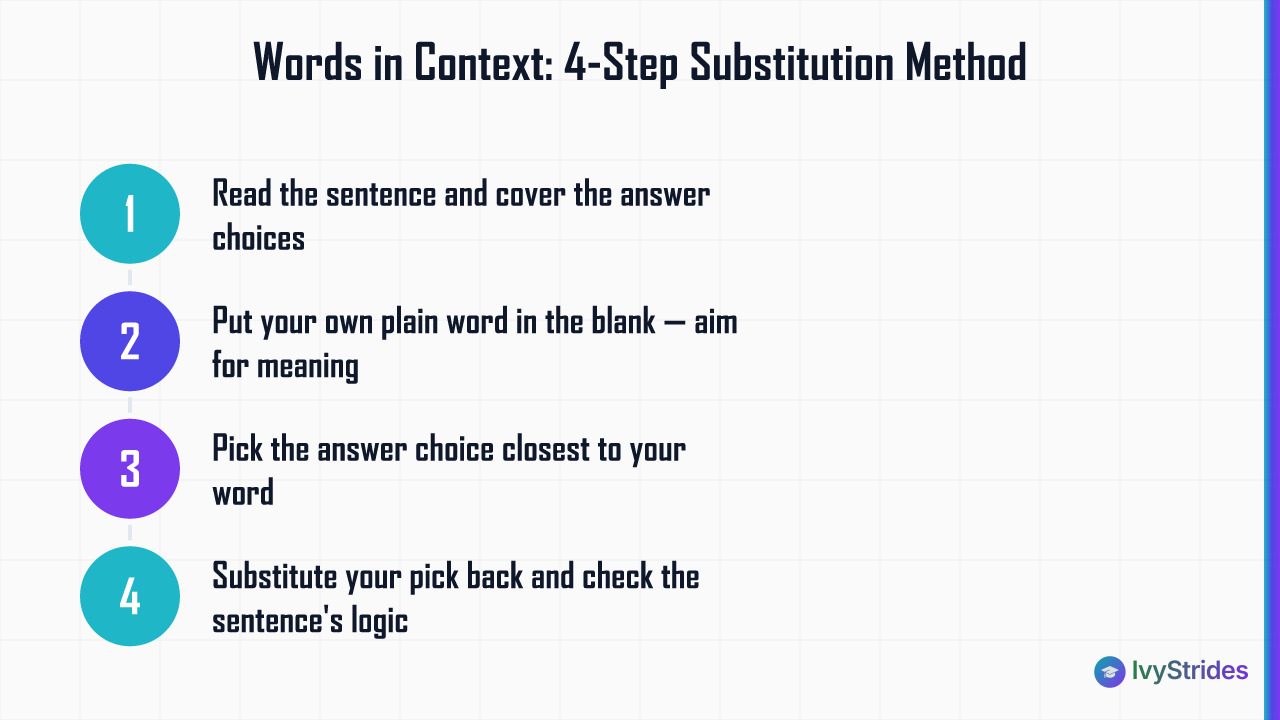
The method is substitution, and it works in one pass:
-
Read the sentence and cover the answer choices.
-
Put your own plain word in the blank, silently. Don't aim for elegance. Aim for the meaning.
-
Now read the four choices and pick whichever sits closest to your word.
-
Substitute your pick back into the sentence and read it once. If it changes the sentence's logic, it's wrong.
Step 2 is the one students skip, and skipping it is what makes this type feel like a coin flip. If you read the choices first, all four look plausible, because all four are real meanings of the word. College Board builds the choices that way on purpose. Your own word is the filter.
Vocabulary lists are a poor use of study time here. College Board picks high-utility words rather than obscure ones, so the difficulty isn't in the word, it's in the sentence around it. Time spent reading carefully beats time spent memorising. If your comprehension is what's actually slipping, improve your SAT Reading score covers the underlying habits.
One warning. Some Words in Context questions ask about a phrase rather than a single word, and the phrase can be idiomatic. The same method applies, but your substitute has to cover the whole phrase, not just its last word.
Text Structure and Purpose: What the Sentence Is Doing
Text Structure and Purpose is the SAT question type students find hardest to name. The rule that solves it: the correct answer never restates the sentence, it describes the sentence's job.
Split the two apart deliberately:
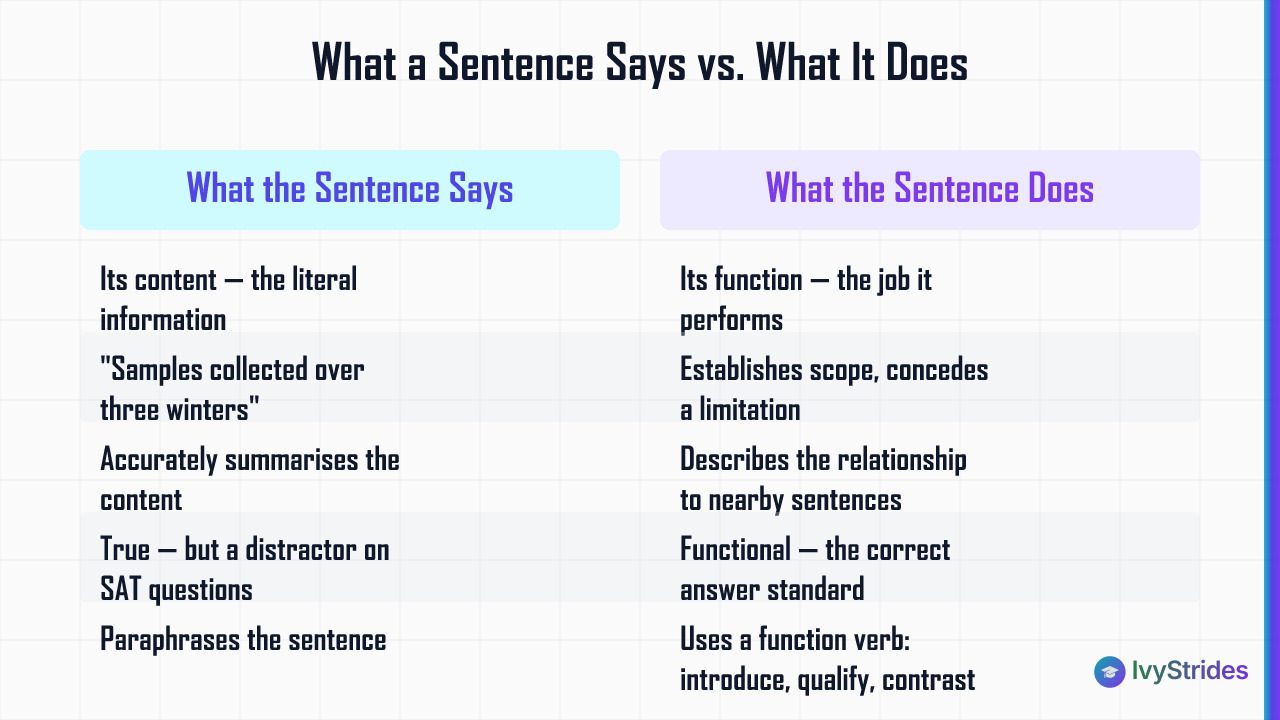
- What the sentence says is its content. "The samples were collected over three winters."
- What the sentence does is its function. It might establish the study's scope, or concede a limitation, or set up the contrast that follows.
Text Structure and Purpose questions ask for the second one. Every answer choice that accurately summarises the content and stops there is a distractor, and it usually tempts more students than any other choice on the screen, because it is true. True isn't the standard. Functional is.
The method:
-
Read the underlined sentence, then read the sentence before it and the sentence after it. The function lives in the relationship between them, never in the sentence on its own.
-
Say the job in your own words, starting with a verb. "It introduces." "It qualifies." "It gives an example of."
-
Match to the choice that begins with the same kind of verb.
-
Reject any choice that only paraphrases.
Some questions here ask about the whole text rather than one sentence. The method is the same at a larger scale: what does the opening do, what does the middle do, what does the close do. Reading for structure rather than detail is also the habit that protects your clock, which is why it overlaps with SAT reading speed more than students expect.
Answer choices in this type lean on a small set of function verbs: introduce, illustrate, qualify, contrast, summarise, challenge, explain, and a handful of others. Learning to hear those verbs as a category is worth more than any vocabulary list.
Cross-Text Connections on the SAT: Two Texts, One Relationship
Cross-Text Connections is the SAT question type that gives you two short texts on one topic and asks how they relate. Usually it asks how the author of Text 2 would respond to a claim in Text 1. Decide the relationship before you read the choices, and the distractors stop working.
Almost every mistake comes from reading both texts as information rather than as positions. The fix is to decide each author's stance before you look at the answers.
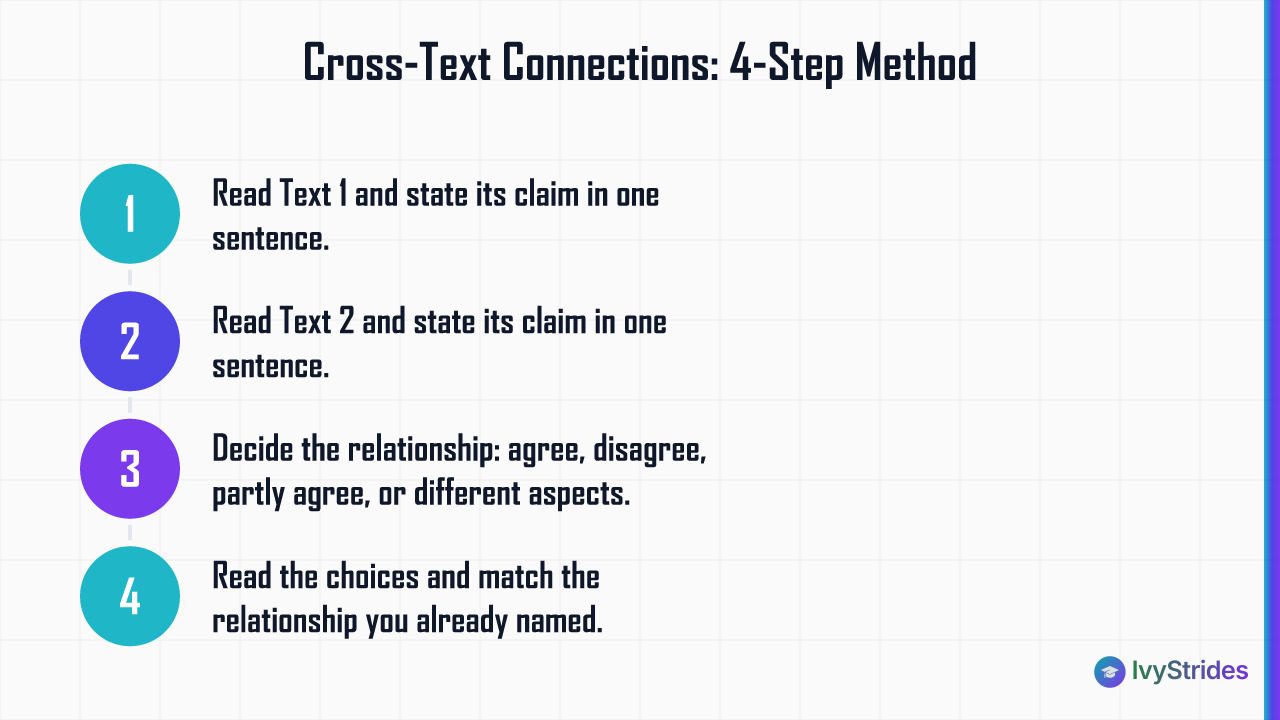
The method:
-
Read Text 1. In one sentence, state its claim.
-
Read Text 2 and do the same for its claim.
-
Before reading a single answer choice, decide the relationship: agree, disagree, partly agree, or address different aspects of the same question.
-
Read the choices and find the one matching the relationship you already named.
Step 3 is where the points are. If you go into the answers without a stance, the distractors will supply one, and the test writers make them sound reasonable. If you go in having already decided that Text 2 partly agrees but objects to the method, the wrong answers become visibly wrong.
The commonest trap is a choice that is factually accurate about one text while saying nothing about the relationship. Accurate isn't the same as responsive. The question asked about the connection, and that's what the right answer describes.
Partial agreement deserves particular attention. Real disagreement between two published authors is rarer than students assume, and the SAT reflects that. Watch for a second author who accepts the finding but rejects the interpretation, or who accepts the interpretation and simply doubts that it generalises beyond the study. The same discipline of separating a claim from its evidence shows up in command of evidence questions.
How Craft and Structure Questions Behave in an Adaptive Module
SAT Craft and Structure questions appear in both modules, and they get harder if you do well. The Reading and Writing section is section-adaptive: you sit two modules of 27 questions. Your performance across the first module determines the difficulty of the second, which means Craft and Structure questions do not sit at a fixed difficulty across your whole test. They scale with you.
The practical consequence is that Module 1 isn't a warm-up. A strong first module routes you into a harder second module, and the harder module is where the higher score bands are available. A weak first module caps what the section can return, no matter how well you perform afterwards. How Module 1 sets your score ceiling covers the routing logic in full. For how the two modules combine into a single section score, see how the Digital SAT is scored.
What changes at higher difficulty isn't the question types. It is the texts and the distractors. Words in Context items use sentences where two meanings both nearly fit. Text Structure and Purpose items use sentences whose function is genuinely double, and the right answer names both halves. Cross-Text Connections items pair authors whose disagreement is narrow and technical rather than broad.
The methods above do not change with difficulty. That's the argument for drilling them until they're automatic: when the questions get harder, procedure is what you have left.
Not sure which Reading and Writing domain is costing you points?
A diagnostic shows you the exact question types you are losing, by name.
A Four-Week Drill Plan for Craft and Structure
Four weeks is enough to fix SAT Craft and Structure, and the plan below is built on error review rather than volume. Doing 200 questions without reviewing them just teaches you your existing habits. Four weeks of structured work beats four weeks of grinding.
Week 1: separate the types. Do short untimed sets. After every question, write down which of the three types it was before you check the answer. The goal is recognition speed, not accuracy. In our coaching, most students discover they cannot reliably tell Text Structure and Purpose from Information and Ideas questions, and that confusion alone accounts for a slice of their misses.
Week 2: one method per session. Take a single type and run its method deliberately. Slow is correct here. You're building the procedure that'll run automatically later, when you don't have attention to spare for it.
Week 3: timed mixed sets. Now interleave all three types under time. Expect accuracy to dip. That dip is the measurement you want, because it shows you which method collapses first under pressure.
Week 4: error log only. Do no new questions for the first half of the week. Go back through every miss and write, in one sentence, why the right answer was right. Not why yours was wrong. Why the right one was right. Then do one final timed set.
Keep the error log by question type rather than by date. After three weeks it'll tell you plainly whether your losses sit in one type, which is the single most useful thing you can know before test day. In our coaching, students who track this way usually find their misses are far less evenly spread than they assumed.
Craft and Structure sits alongside the other three domains, and a weakness in one is often mistaken for a weakness in another. If your error log shows losses on transition words, that is Expression of Ideas, and SAT transitions questions addresses it directly. If your losses are punctuation and sentence boundaries, that is Standard English Conventions, a different domain with a different fix.
Three Worked SAT Examples, One Per Question Type
Here is each SAT Craft and Structure method running on a worked item. We wrote these illustrative questions in the style of the test, not retired College Board questions.
Words in Context. The passage reads: "The committee's report was measured, avoiding the alarm that had characterised earlier coverage." As used in the text, "measured" most nearly means:
Cover the choices. Your own word, taken from the sentence alone, is something like "restrained" or "careful" because the second half contrasts it with alarm. Now the choices: (A) rhythmic, (B) restrained, (C) quantified, (D) significant. Both A and C are real meanings of "measured", and both are wrong here. B matches your word. The contrast with "alarm" did all the work, and you found it before the distractors could offer you anything.
Text Structure and Purpose. A paragraph describes a restoration project, then the underlined sentence reads: "The first two winters produced almost no growth." What is its main purpose?
Say the job out loud before you look. Read what follows: the next sentence describes changing the planting method. So the underlined sentence sets up a problem the team then responded to. Now the choices. One will accurately summarise it as reporting a disappointing early result. That's true, and it's a distractor, because it describes content rather than function. The right answer will say it establishes the difficulty that motivated a change in approach. Function, not content.
Cross-Text Connections. Text 1 argues a teaching method improved outcomes in a large trial. Text 2 accepts the trial result but notes every school in it had unusually small classes. How would the author of Text 2 most likely respond to Text 1?
State the relationship before reading a single choice: Text 2 agrees with the finding and doubts it generalises. That is partial agreement about scope, not disagreement about the result. The distractors will offer flat disagreement, which overstates Text 2, and enthusiastic agreement, which ignores its objection. The choice that survives will accept the finding while questioning whether it transfers to ordinary class sizes.
Notice what all three share. In each case the answer was decided before the choices were read. That's the entire method, repeated three ways.
Frequently Asked Questions About Craft and Structure
How many Craft and Structure questions are on the SAT?
College Board publishes the domain and its question types but does not publish a fixed per-domain question count for every test form, and the section is adaptive, so treat any specific number quoted elsewhere with caution. What College Board publishes: the Reading and Writing section is 54 questions across two 27-question modules, and every module contains questions from all four domains.
Are Craft and Structure questions the hardest on the SAT?
Not inherently. They feel hard because three distinct tasks share one domain name, so students who have not separated them experience the domain as unpredictable. Once each type has its own method, the difficulty comes from the texts rather than the questions.
Do I need to memorise vocabulary for Words in Context?
Memorising lists is a poor return on your time. College Board tests high-utility words rather than obscure ones, and the difficulty lives in the sentence, not the word. Reading widely and running the substitution method will move your score further than any deck of flashcards.
What is the difference between Text Structure and Purpose and Information and Ideas?
Information and Ideas asks what the text says and what the evidence supports. Text Structure and Purpose asks what a sentence or text is doing. If a correct answer could begin with the word "because," it is likely Information and Ideas. If it could begin with "to introduce" or "to qualify," it is Text Structure and Purpose.
How do I approach the two-text questions?
Read both texts and state each author's claim in your own words before you look at any answer choice. Then name the relationship: agree, disagree, partly agree, or answering different questions. Choose the answer matching the relationship you already identified.
Does Craft and Structure appear in both modules?
Yes. All four domains appear in both modules of the Reading and Writing section. Because the section is adaptive, your first-module performance determines how difficult the second module's questions are.
Can I skip Craft and Structure and focus elsewhere?
No domain is skippable when questions are interleaved and the section is adaptive. Weakness in one domain drags on the first module, and the first module determines the difficulty band available in the second.
Your Next Step on SAT Reading and Writing
Craft and Structure on the SAT rewards procedure over reading talent. Do three things: name the question type, run its method, and log every miss by type. That's the whole approach, and it's learnable in weeks rather than months.
If you want to know which of the three types is actually costing you points, that comes from a diagnostic with the questions categorised by type, not from a practice-test score. You can read about how we structure that work on the IvyStrides about page. You can also meet the tutors who coach Reading and Writing specifically.
Turn your weakest domain into your most reliable one
Section-specialist coaching, built from your own error log.

Award-winning author (South Asian Book Award) and graduate of BITS Pilani and UCLA Luskin School of Public Affairs. Brings a published writer's eye to Common App essays and grammatical precision to SAT and ACT R&W instruction.