
How to Improve SAT Reading Speed: The Complete 2026 Playbook for a Top Score
On this page
- Why You Run Out of Time on the Digital SAT Reading and Writing Section
- How to Triage Digital SAT Reading Questions by Type and Time Cost
- How to Build SAT Reading Speed With Timed Practice Drills
- What a Good SAT Reading Score Looks Like on the 200-800 Scale
- FAQ: Digital SAT Reading and Writing Pacing
- Is a 700 on the reading SAT good?
- How do I get faster on the SAT reading section?
- Will reading novels help me improve my SAT reading score?
- How can I improve my SAT reading score in a week?
- Your Next Step on SAT Reading Speed
To improve SAT reading speed, read the question stem before the passage so you know exactly what to find. Then triage: answer grammar, transitions, and vocabulary questions first, and save dense literary passages for last. With 54 questions in 64 minutes, your budget is roughly 71 seconds per question.
The Digital SAT Reading and Writing section is a two-module adaptive test scored from 200 to 800, according to College Board. Most students treat a timing problem as a reading-speed problem. It isn't. Flag anything over 75 seconds and move on.
Why You Run Out of Time on the Digital SAT Reading and Writing Section
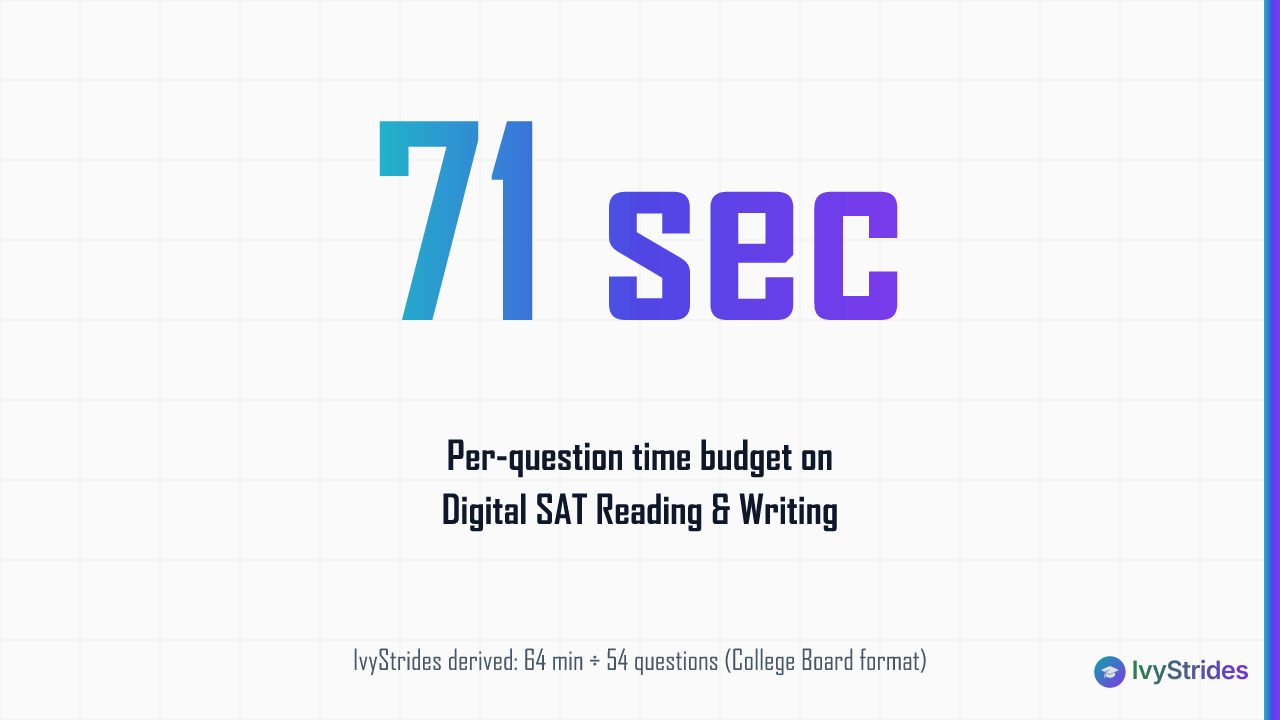
The Digital SAT Reading and Writing section runs 54 questions in 64 minutes across two 27-question modules, per College Board. That gives you a per-question budget of roughly 71 seconds. College Board publishes the module counts and the total time but not the per-question figure; IvyStrides divides 64 minutes by 54 questions to derive it.
You don't run out of time because you read slowly. You run out because you read every question with equal attention, then re-read the passage when the answer doesn't jump out. A Transitions question and a dense Cross-Text Connections pair get the same careful treatment, so easy points cost as much as hard ones.
The adaptive structure raises the stakes. The section routes you to a harder or easier Module 2 based on your Module 1 performance, per College Board. Blowing your budget in Module 1 means rushed guesses, weaker routing, and a lower ceiling on your R&W section score before you open the second module.
In our coaching, students who run out of time in Module 2 are usually spending 90 to 120 seconds on a single Cross-Text Connections question back in Module 1. That's one question eating the budget of nearly two.
| Module | Questions | Time Allowed | Seconds Per Question |
| Module 1 | 27 | 32 minutes | about 71 |
| Module 2 | 27 | 32 minutes | about 71 |
| Full section | 54 | 64 minutes | about 71 |
Module timing derived by IvyStrides from College Board's published 27-question, 64-minute format.
For the full timing picture including the break, see how long is the SAT.
How to Triage Digital SAT Reading Questions by Type and Time Cost
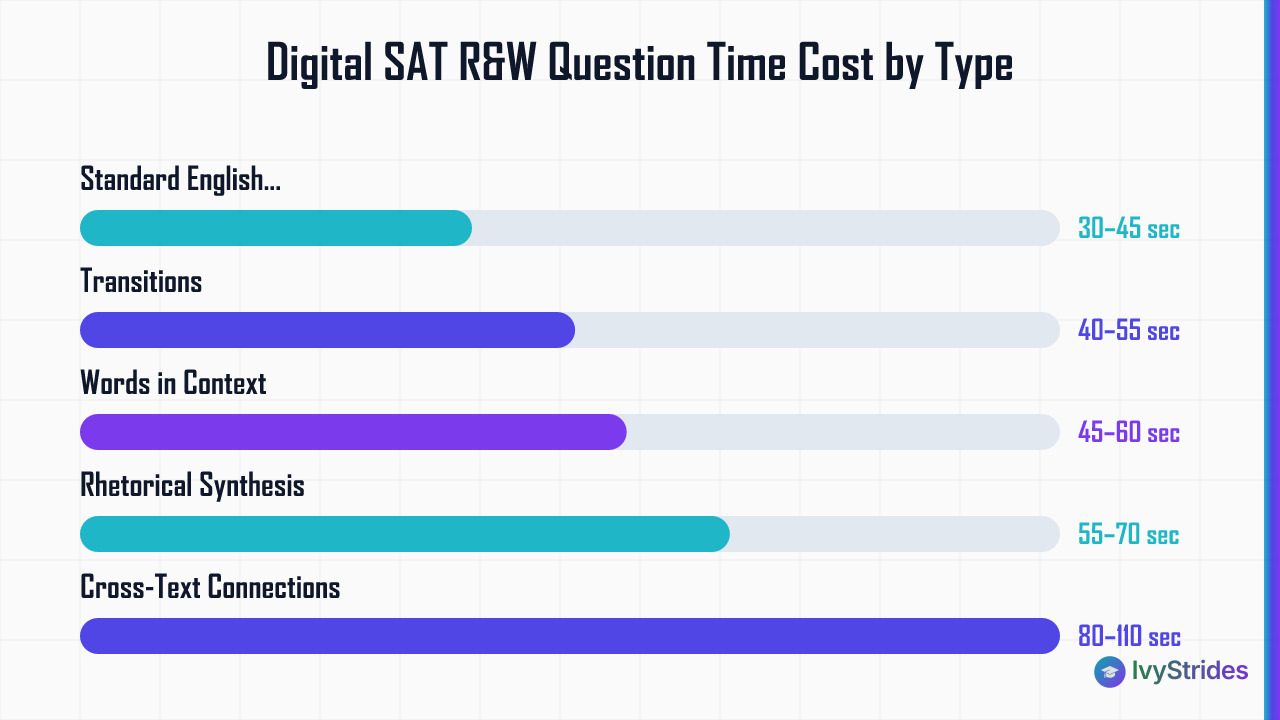
Question triage on the Digital SAT Reading and Writing section means answering the cheap questions first and deferring the expensive ones. Standard English Conventions, Transitions questions, and Words in Context cost the least time; Cross-Text Connections and dense Information and Ideas questions cost the most. That gap is your lever.
Because your budget is fixed at about 71 seconds per question, the goal is to bank time on fast questions and spend it on slow ones. A Standard English Conventions item, testing a comma splice or subject-verb agreement, needs no passage reading and settles in 30 to 40 seconds. That banked time funds the two-passage Cross-Text Connections question that genuinely needs 90.
Read the question stem first. For any passage-based question, read what's being asked before you read the passage. The stem tells you whether you're hunting for the author's main claim, a single word's meaning, or a structural choice, so you read looking for one thing instead of absorbing all of it. This is where re-reading disappears.
The flag-and-move rule. No single question gets more than 75 seconds. Hit the limit, flag it in Bluebook, pick your best remaining answer, and move. In our coaching with students in the 550 to 700 R&W band, the 75-second cap is the fastest way to stop one hard question from stranding four easy ones you never reached.
Use process of elimination as your default on the tough ones. Cross out three wrong answers rather than hunting for the perfect one; the wrong answers are usually easier to disqualify than the right one is to confirm.
| Question Type | Content Domain | Triage Priority | Typical Time (sec) |
| Standard English Conventions | Standard English Conventions | First | 30 to 45 |
| Transitions | Expression of Ideas | First | 40 to 55 |
| Words in Context | Craft and Structure | First | 45 to 60 |
| Rhetorical Synthesis | Expression of Ideas | Middle | 55 to 70 |
| Command of Evidence | Information and Ideas | Middle | 60 to 80 |
| Text Structure and Purpose | Craft and Structure | Later | 60 to 80 |
| Cross-Text Connections | Craft and Structure | Last | 80 to 110 |
Knowing which of the four R&W domains each question belongs to is the prerequisite for triage; see the full domain breakdown in our guide to Digital SAT Reading and Writing question types.
How to Build SAT Reading Speed With Timed Practice Drills
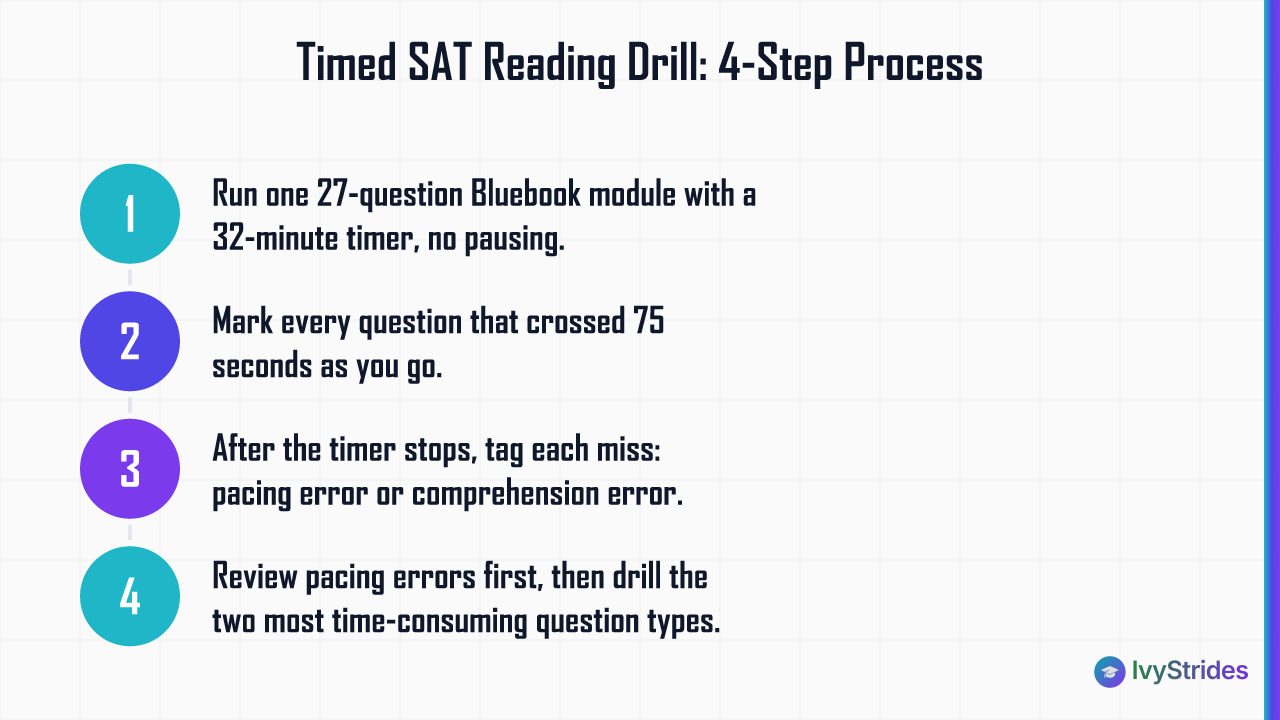
The timed single-module drill is the practice that makes triage stick. Run one 27-question module from an official Bluebook test under a strict 32-minute clock, then log every question where you exceeded 75 seconds. The drill turns the triage order and the flag rule from things you know into things your hands do under pressure.
Bluebook is the official Digital SAT practice platform, and its full-length practice tests are free through College Board. Every drill in this guide should run on a real Bluebook module, not on scattered passages.
Log two error types, not one. After each drill, sort your misses into pacing errors and comprehension errors. A pacing error is a question you got wrong because you rushed or ran out of clock. A comprehension error is one you'd have missed with unlimited time. In our coaching, separating these two in post-drill review is the single most clarifying step for a student whose R&W score is flat.
-
Run one 27-question module in Bluebook with a 32-minute timer, no pausing.
-
Mark every question that crossed 75 seconds as you go.
-
After the timer stops, tag each miss: pacing error or comprehension error.
-
Review the pacing errors first, then drill the two question types that ate the most time.
Space these drills one timed module every two to three days across two to four weeks, then add at least one full-length Bluebook test per week in the final three weeks before your date. In our coaching, students who log pacing errors separately tend to see their R&W timing settle within two to three weeks of consistent drills.
For the review method that turns those logs into gains, see how to review your SAT practice test mistakes. If your pacing is solid but your score is still flat, the problem may be comprehension rather than speed; our guide on why your SAT Reading score is not improving walks through the diagnostic.
Here's the part most students miss: knowing the drill is not the same as reading your own log. A specialist can tell a pacing error from a comprehension error in your data faster than you can, and adjust next week's focus accordingly. That's the core of SAT 1-on-1 prep.
What a Good SAT Reading Score Looks Like on the 200-800 Scale
The Digital SAT Reading and Writing section is scored from 200 to 800, per College Board. A 700 sits at roughly the 96th percentile, a 600 near the 75th, and a 480 close to the 50th, according to College Board score data. Better pacing moves you up this scale by converting blank Module 2 questions into attempted ones.
Because pacing recovers points you were leaving on the table, the gains from timing work show up faster than gains from comprehension work. In our coaching with students in the 550 to 650 R&W band, those who apply question triage consistently tend to gain roughly 30 to 60 points within three to four weeks of structured pacing drills. That's typical, not guaranteed, and it depends on where your errors live.
Pacing alone has a ceiling. If you're already finishing the section and still stuck, the gap is comprehension, and no timing trick closes it. Reading speed work recovers unanswered questions; it does not teach you to parse a dense Craft and Structure passage you'd have missed anyway.
| R&W Section Score | Approximate Percentile | What It Signals |
| 750 to 800 | 99th | Top-tier selective readiness |
| 700 | about 96th | Competitive at highly selective colleges |
| 600 | about 75th | Above the national midpoint |
| 480 | about 50th | National midpoint |
| 400 | about 20th | Foundational gaps remain |
Test-optional policies vary by school and by year, per FairTest, so check each college's current stance before deciding whether to submit. Even where a score is optional, a strong R&W section still helps at most selective colleges, and admissions outcomes always depend on the full application.
For the full scale including how R&W combines into your composite, see SAT scores explained. Before you register, know the size of your gap and whether it closes in time.
FAQ: Digital SAT Reading and Writing Pacing
Is a 700 on the reading SAT good?
Yes. A 700 on the Digital SAT Reading and Writing section is about the 96th percentile, which is competitive at highly selective colleges. For most students targeting a composite above 1400, a 700 R&W is a strong component. Whether to submit it depends on the full application and each school's current test policy.
How do I get faster on the SAT reading section?
Triage first: answer Standard English Conventions, Transitions, and Words in Context questions before the dense passage-based ones. Read the question stem before the passage so you scan for one thing instead of absorbing everything. Set a 75-second flag limit per question and move on rather than re-reading.
Will reading novels help me improve my SAT reading score?
Reading complex non-fiction and literary texts builds the background comprehension that makes SAT passages easier to process, but it does not replace timed practice on actual Digital SAT question types. In our coaching, students who combine regular reading with timed module drills tend to improve faster than those who do either alone.
How can I improve my SAT reading score in a week?
Focus on two changes: apply question triage on every practice module and enforce the 75-second flag rule. Run one timed 27-question Bluebook module per day, log which question types consumed the most time, and review only those errors. Comprehension gaps take longer than a week; pacing gains can appear fast.
Your Next Step on SAT Reading Speed
Faster reading on the Digital SAT R&W section is a decision problem, not an eye-speed problem. You fix it by choosing what to read, in what order, and when to cut a question loose.
- Run one timed 27-question Bluebook module tonight at a strict 32-minute clock.
- Apply the triage order: Standard English Conventions and Transitions first, Cross-Text Connections last.
- Enforce the 75-second flag rule on every question, no exceptions.
- Tag each miss as a pacing error or a comprehension error before you review anything.
- Repeat every two to three days, then add a full-length test weekly in your final three weeks.

Award-winning author (South Asian Book Award) and graduate of BITS Pilani and UCLA Luskin School of Public Affairs. Brings a published writer's eye to Common App essays and grammatical precision to SAT and ACT R&W instruction.