
Best Digital SAT Prep in 2026: How to Choose the Right Program
On this page
- The short answer: what "best" actually means
- Why the Digital SAT changed what "good prep" looks like
- 7 criteria for choosing Digital SAT prep
- Formats compared: self-study, apps, cohorts, and 1-on-1
- Match the prep to your score gap
- Red flags to avoid
- Questions to ask any provider before you pay
- Where IvyStrides fits
- Frequently asked questions
The best Digital SAT prep is not a single product — it's the option that matches your student's score gap, learning style, and budget, and that is built for the Bluebook adaptive test rather than the old paper SAT. For a small gap (under ~100 points), free official tools plus disciplined self-study are often enough. For a larger gap, or a student who needs accountability, live instruction or 1-on-1 tutoring on a Bluebook-style adaptive platform produces the most reliable gains. The seven criteria below tell you how to judge any program — free, big-brand, boutique, or private tutor — before you spend a dollar.
This guide is deliberately vendor-neutral. It covers what to look for, the trade-offs between formats, and the questions that separate a real program from a repackaged content library. Where IvyStrides fits, we say so plainly in one section near the end — but the criteria apply to whichever provider you choose.
The short answer: what "best" actually means
"Best" is relative to three things:
- Your score gap — the distance between a recent diagnostic and your target score. A 60-point gap and a 300-point gap call for completely different programs.
- How the student learns — some students self-motivate with an app; most benefit from a live teacher and a schedule they can't quietly skip.
- The format of the test itself — since March 2024 the SAT is digital, adaptive, and taken in College Board's Bluebook app. Any prep that still drills paper-test pacing and question order is preparing for a test that no longer exists.
If a provider can't tell you how their program adapts to those three things, it isn't the best fit — no matter how big the brand or how low the price.
Why the Digital SAT changed what "good prep" looks like
The Digital SAT runs as two adaptive Reading and Writing modules followed by two adaptive Math modules. Your performance on Module 1 routes you into an easier or harder Module 2, and that routing determines the score band you can reach (College Board).
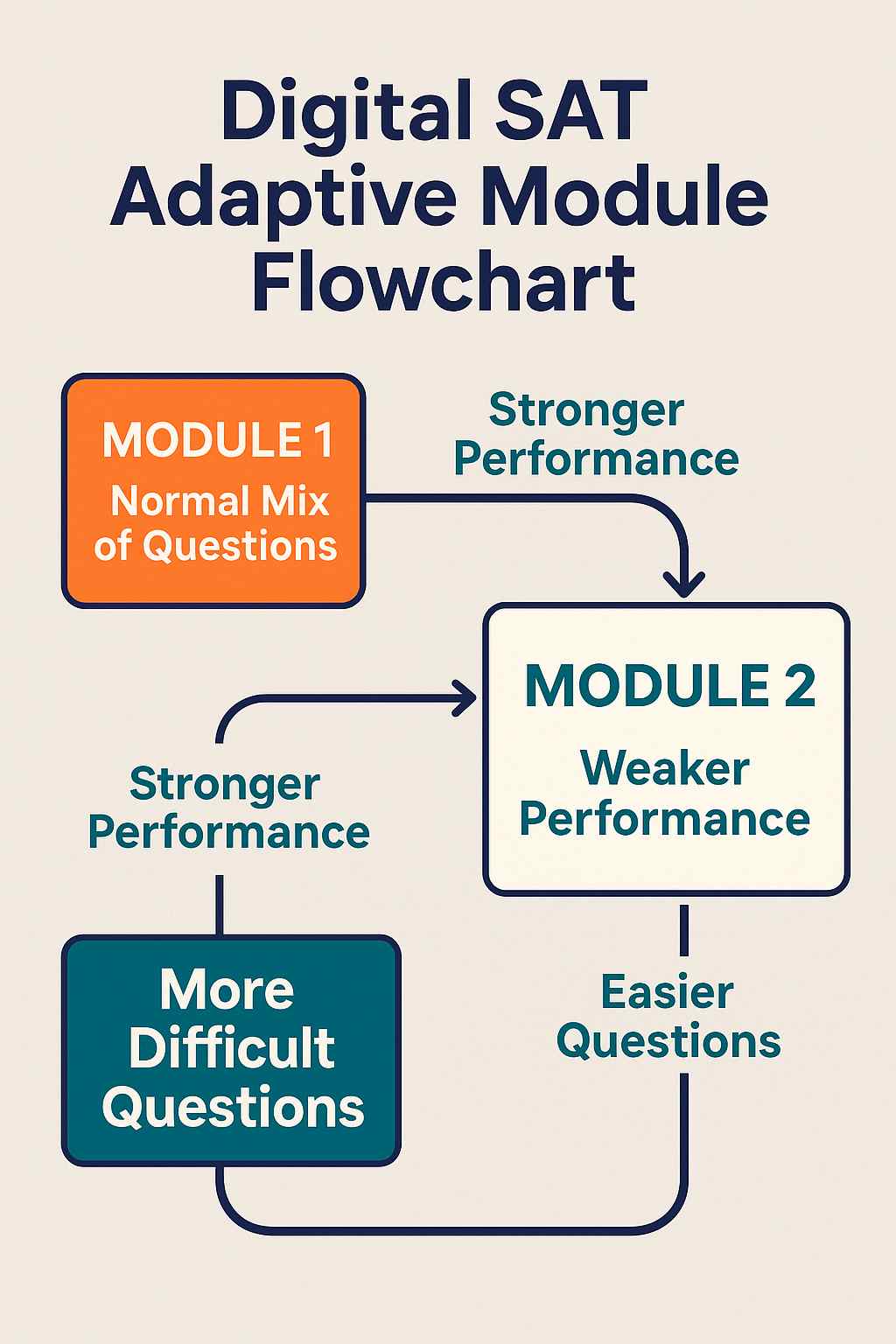
Three consequences follow, and they should shape how you evaluate any program:
- Module 1 is disproportionately important. Because it decides which Module 2 you see, early accuracy matters more than it did on the linear paper test. Good prep teaches this explicitly.
- Practice has to be adaptive. A static PDF or a fixed set of questions can't reproduce the routing. Realistic prep uses full-length adaptive mocks that behave like Bluebook.
- On-screen tools change tactics. The built-in Desmos calculator, annotation, and flag-for-review tools are part of the test. Students should practice with them, not discover them on test day.
This is the single biggest reason old advice ("buy the thickest prep book") no longer holds.
7 criteria for choosing Digital SAT prep
Use these as a scorecard. The best program for you will clearly satisfy most of them.
1. Bluebook-style adaptive practice tests. The practice platform should mirror the real thing — adaptive multistage routing, the same on-screen UX, the built-in calculator, and instant scoring on the 400–1600 scale. Fixed question sets or paper mocks under-prepare students for the routing. Ask to see a sample test before enrolling. (You can try an adaptive mock here to feel the difference.)
2. Diagnostic-first, not curriculum-first. A credible program starts with a full-length diagnostic and reads the section-level breakdown before quoting a plan. If someone sells you a fixed package before seeing where you actually lose points, that's a content library with a price tag, not a personalized plan.
3. Tutor experience and specialization. Who actually teaches — and how long have they done it? Section specialists (SAT Math vs. SAT Reading and Writing) know the question-type taxonomy cold. Experience correlates with gains far more than brand name does.
4. The right format for the student. Self-paced app, small live cohort, or 1-on-1 — each suits a different student (see the comparison below). The best program is honest about which one you actually need instead of upselling the most expensive tier.
5. A real feedback loop. Every practice test should come with reviewed answer explanations and a tutor who adjusts focus based on the data — not just a score and a "study harder." Recordings of live sessions (so a missed class isn't a lost week) are a strong signal.
6. An honest, verifiable track record. Ask how score gains are measured. "Average +200 points" means little without a baseline: measured from what to what, over how many students? Favor providers who describe their methodology (e.g., first diagnostic → final official test) over those quoting a number with no denominator.
7. Points-per-dollar, not just price. Cheap generic tutoring that doesn't move the score is expensive. Premium coaching that closes a 250-point gap can be a bargain. Judge cost against realistic hours and expected gains — our full SAT/ACT tutoring cost guide breaks down the 2026 price tiers.
Formats compared: self-study, apps, cohorts, and 1-on-1
There are four broad ways to prep. None is universally "best" — each fits a different student and budget.
| Format | Best for | Typical cost | Trade-off |
|---|---|---|---|
| Free official tools (Bluebook practice, Khan Academy) | Self-motivated students, small gaps | Free | No accountability, no personalization, no live help |
| Self-paced prep app / course | Independent learners who want structure | $20–$100/mo | Passive; easy to drift; feedback is automated |
| Live small-group cohort | Most students; want a teacher + schedule | $300–$2,000 | Paced for the group, not the individual |
| 1-on-1 tutoring | Big gaps, tight timelines, specific weak sections | $2,000–$8,000+ | Highest cost; quality depends entirely on the tutor |
A practical rule of thumb: start with the free official practice to set a baseline, then add the lightest format that will actually close your gap and keep you accountable. Most students land on a live cohort, stepping up to 1-on-1 when the gap is large or the timeline is short.
Match the prep to your score gap
- Under ~100 points: Free Bluebook practice + Khan Academy + a disciplined 4–6 week plan is often enough. Our 30-day SAT study plan is a good template.
- 100–200 points: A structured course or live cohort with adaptive mocks and a real feedback loop. Self-study alone tends to plateau here.
- 200+ points, or a tight retake window: 1-on-1 tutoring built around a diagnostic, with weekly adjustments. This is where personalization pays for itself.
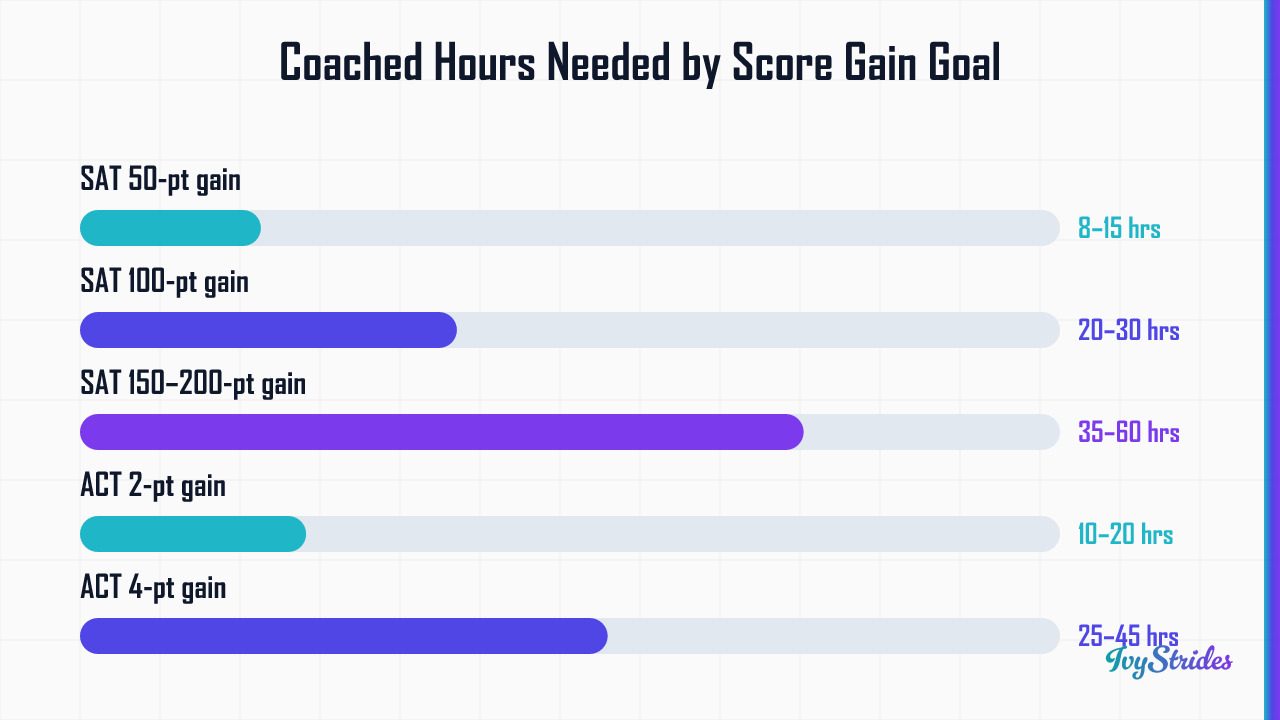
Hours scale with the size of the gain. As a rough guide, coached-hour estimates by target look like this:
Not sure of your gap? Take one full adaptive mock, then read the section breakdown — that number, not a sales pitch, should drive the decision.
Red flags to avoid
- No diagnostic before a quote. Personalization can't exist without it.
- Paper-test materials for a digital test. Ask specifically whether practice is Bluebook-style adaptive.
- Guaranteed scores. No ethical program can guarantee a specific score; be wary of anyone who does.
- Score claims with no methodology. "+300 points!" with no baseline or sample size is marketing, not evidence.
- One generalist tutor for every section and every student. Depth beats one-size-fits-all.
Questions to ask any provider before you pay
Copy-paste this checklist into your first call:
- Is your practice platform Bluebook-style adaptive, with the on-screen calculator and instant 400–1600 scoring?
- Do you run a full-length diagnostic before recommending a plan?
- Who will actually teach my student, and how many years have they taught the Digital SAT?
- How do you measure score gains — from what baseline, over how many students?
- What happens when a student misses a session or a concept doesn't click?
- How many hours do you estimate for my student's specific gap, and why?
- What does the total cost cover, with no hidden add-ons?
A strong provider answers all seven without hesitation.
Where IvyStrides fits
To be direct: IvyStrides is one strong option in the live-instruction + Bluebook-adaptive category, and we think it's the right fit for students who want a real teacher and a personalized plan rather than a video library. Every plan starts with a full-length diagnostic; practice runs on a Bluebook-style adaptive platform with reviewed explanations; and students choose between a small live cohort or 1-on-1 tutoring with senior tutors. We report outcomes with a stated method (measured from each student's first diagnostic to their final official test), and sessions are recorded so a missed class isn't a lost week.
If that matches what your student needs, a free 30-minute consultation includes a diagnostic and an honest hours estimate — no card required. If it doesn't, the seven criteria above will still help you choose well elsewhere. Deciding between the SAT and the ACT first? Start with our ACT vs SAT guide.
Frequently asked questions
Is free prep (Khan Academy + Bluebook) enough? For a small gap and a self-motivated student, often yes. The official tools are genuinely good. What they don't provide is accountability, personalization, or a human to explain why you keep missing a question type — which is exactly what larger gaps need.
Is expensive SAT prep worth it? Only if it closes your gap. Judge points-per-dollar, not sticker price. A $150/hr specialist who lifts a stuck student 200 points is better value than $60/hr generic tutoring that stalls. See our tutoring cost guide for the full breakdown.
How many hours of prep do I need? It depends on the gap. Roughly 20–30 coached hours for a 100-point gain and 35–60 for a 150–200 point jump (see the chart above), with less for small gains and more for larger ones. A diagnostic is the only honest way to estimate.
Online or in-person? Online prep is typically 10–20% cheaper at the same quality and gives you access to specialists regardless of location. For the Digital SAT — a test taken on a computer — online prep also mirrors the actual testing environment.
When should I start? Ideally 3–6 months before your target test date, so there's time for a diagnostic, instruction, and several full-length adaptive mocks. Cramming works far less well on an adaptive test.

Hemant is a seasoned entrepreneur, investor, and growth strategist with deep ground in education and technology-driven learning. His core training is in Mathematics and Physics — he authored Physics for IB Diploma: Ultimate Revision Guide, recognized as a top student resource.