
Yale ACT Code and Score Requirements: What You Need to Apply

On this page
- Yale's ACT Code Is 0618: The Quick Answer
- How to Send Your ACT Scores to Yale Using Code 0618
- What ACT Score Do You Actually Need to Be Competitive at Yale
- Not Sure If Your ACT Score Is Ready for Yale? Let's Find Out.
- Does Yale Superscore the ACT, and How Should That Shape Your Retake Plan
- Yale's Current Testing Requirement: Is Yale Test-Optional in 2026 or 2027
- How Your ACT Score Fits Into Yale's Holistic Admissions Review
- Yale ACT Score Requirements for International Students
- Building a Realistic ACT Prep Timeline to Hit Yale's Score Range
- FAQ
- What is Yale University's ACT code?
- Should I submit a 30 ACT score to Yale?
- Can I get into Yale with a 34 ACT?
- Is a 35 ACT a good score for Yale?
- Does Yale superscore the ACT?
- Is Yale test-optional in 2027?
- How do I report my ACT score to Yale after I have already applied?
- What are my chances of getting into Yale with a 1520 or 1590 SAT score?
- Your Yale Application Starts With the Right Score Plan.
Yale's ACT code is 0618, and the middle-80% ACT composite for the fall 2025 enrolling class is 33 to 35. As of fall 2025, Yale requires all first-year and transfer applicants to submit ACT or SAT scores.
Two things to know before the deeper sections. First, Yale's SAT and AP CEEB code is a separate number (3987), and confusing the two is the most common reason ACT scores fail to route correctly. Second, self-reported scores are accepted on the Common App; you only need to send official scores if you're admitted and enroll. The harder question is whether your current composite belongs in front of Yale's admissions committee at all. The next section starts there.
Yale's ACT Code Is 0618: The Quick Answer
Yale's ACT code is 0618. That's the number ACT, Inc. uses to route your official score report to Yale Admissions. You can designate Yale as a recipient in two places: at registration (before test day) or through your ACT account at act.org after your scores are released.
Don't confuse this with Yale's CEEB code 3987, which the College Board uses for SAT and AP score sends. Different testing organization, different code system. The ACT runs its own 4-digit institutional code list separate from the CEEB registry. Mix these up and your scores won't reach Yale, costing you days or weeks chasing a missing report. We've seen it happen with a junior we coached last fall who entered 3987 on her ACT registration; her scores never routed to Yale, and she had to pay for a second send three weeks before the deadline.
A note on timing: Yale accepts self-report of scores on the Common App, with an official score send required only at the point of enrollment verification for admitted students. That means your code 0618 send doesn't have to land before the application deadline in most cases. Confirm the current policy on Yale's standardized testing page before you assume; score-send deadlines shift.
If you're also submitting SAT scores, the process is nearly identical but uses Yale's SAT CEEB code 3987 instead; our guide on how to send SAT scores to Yale University walks through that submission step by step.
How to Send Your ACT Scores to Yale Using Code 0618
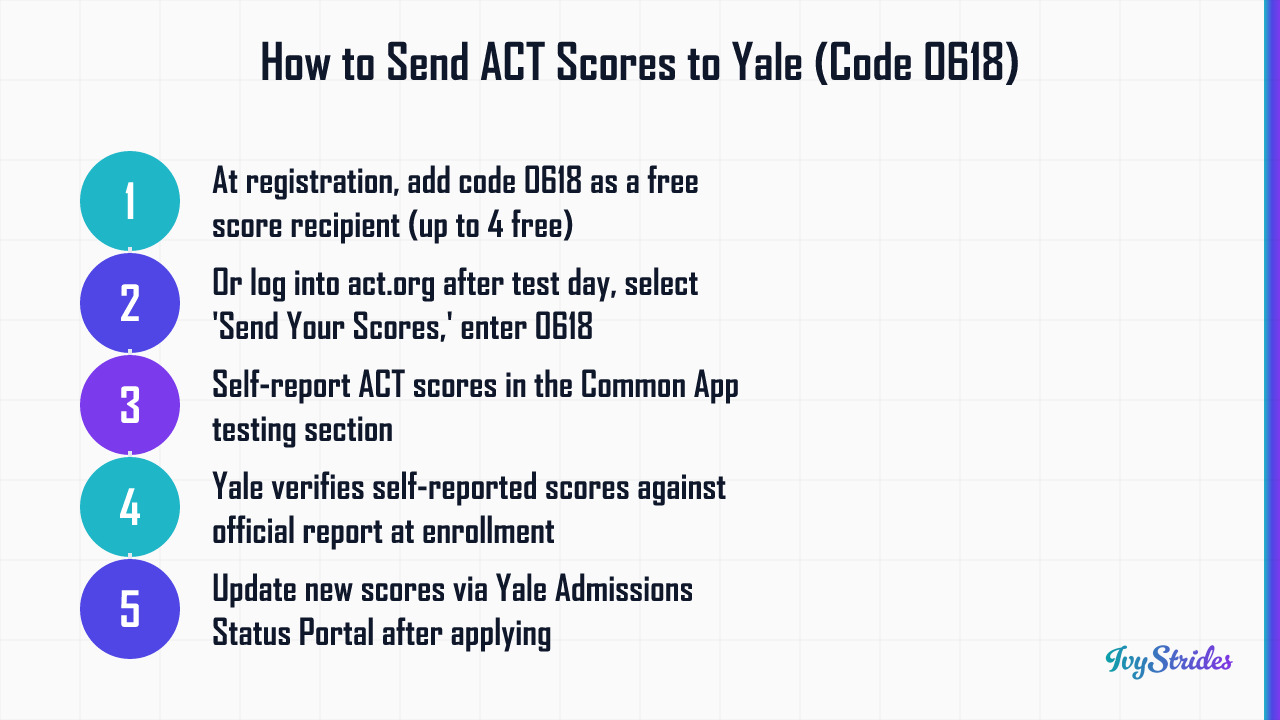
You have two clean paths.
Path 1: Designate Yale at registration. When you register for an ACT test date, you can list up to four free score recipients, per ACT, Inc.'s current policy. Enter 0618 in one of those four slots. Your scores will be sent automatically to Yale once they're released, usually 10 to 14 days after test day for the multiple-choice sections. This is the cheapest and simplest route.
Path 2: Send scores after test day. Log into your ACT account at act.org, select "Send Your Scores," and enter code 0618. ACT, Inc. charges a per-recipient fee for sends made after the free window closes. This is your route if you tested before deciding to apply to Yale, or if you want to see your scores before committing to send.
On the Common App, you'll self-report your ACT composite and section scores in the testing section. Yale accepts self-reported scores at the application stage and verifies them against the official report at enrollment. If you take the ACT again after submitting your application, you can update your scores through the Yale Admissions Status Portal, which activates after you apply.
One question we field constantly: should you take the ACT at all, or pivot to the SAT? If you haven't locked in your test yet, our ACT vs SAT comparison breaks down the format differences and which test tends to favor which student profile. If you're already deep in ACT prep, our act practice test online library is built for diagnostic-driven study.
What ACT Score Do You Actually Need to Be Competitive at Yale
Here's where most students get vague advice. Let's be specific.
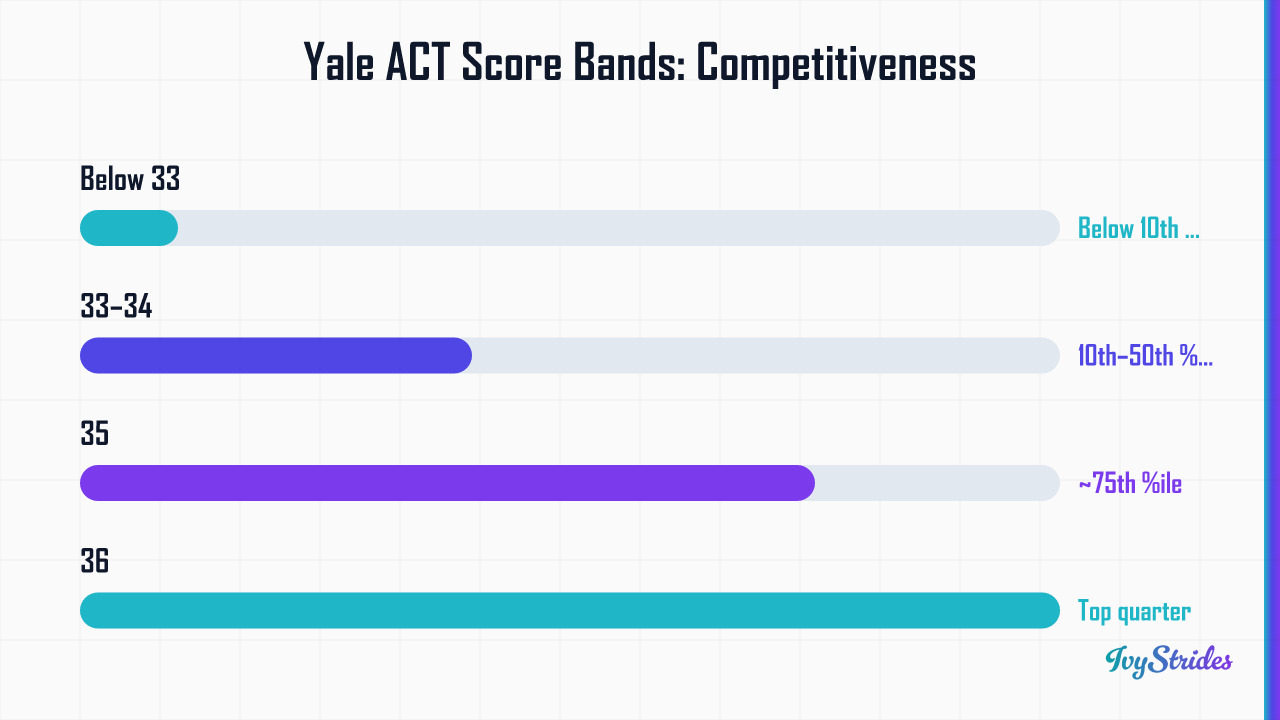
Yale's middle 80% ACT composite range for students who enrolled in fall 2025 is 33 to 35 (10th to 90th percentile), according to Yale Admissions Class Profile. 10% of enrolled students scored below 33, 10% scored above 35, and the bulk of the class landed in the middle. Yale's acceptance rate sits at approximately 3.7%, per the most recently published Common Data Set, so the score range is descriptive, not a cutoff.
Translating the percentile into score bands:
Below 33. Below the 10th percentile of Yale's enrolled class (Yale Admissions). Submitting a score in this band is unlikely to help your application. If you have time before your deadline, a targeted retake is almost always the better move.
33 to 34. Inside Yale's middle 80% range (Yale Admissions), but in the lower half. A 33 sits near the 10th percentile of enrolled students; a 34 is closer to the median but still below it. These scores work if the rest of your application is exceptionally strong: top-quartile GPA, rigorous AP coursework with 4s and 5s, distinctive essays, real extracurricular depth.
35. At or above the 75th percentile of enrolled students (Yale Admissions). Your test score is not a weakness in your application. It won't admit you (nothing single-handedly does at a 3.7% acceptance rate), but it removes a question mark.
36. Top quarter of admitted students. The ACT composite is no longer something Yale will scrutinize.
So what about a 30? Honestly, a 30 sits well below Yale's enrolled range. We've coached students who submitted a 30 and didn't get in; we've also coached students who retested to a 34 and did. The score is not destiny, but it is a signal, and Yale's reader is comparing your file to thousands of 35s and 36s.
If Yale is one of several reach schools on your list, the same score-benchmarking logic applies at Stanford; see our Stanford ACT requirements breakdown for a side-by-side comparison. Before you commit to retaking the ACT specifically, it's worth confirming the ACT is the stronger fit for your skill profile; our ACT vs SAT comparison breaks down the format differences and which test tends to favor which student.
One pattern we see in our coaching: students who submit scores without a diagnostic first tend to retest without improving, because they're practicing the wrong sections. A real diagnostic tells you where the points are hiding. That's what 1-on-1 ACT prep is built around.
Not Sure If Your ACT Score Is Ready for Yale? Let's Find Out.
Book a free 15-minute strategy call. We'll review your current score, identify your biggest section gaps, and map out a realistic timeline to reach Yale's competitive range, whether you have 6 weeks or 6 months.
Does Yale Superscore the ACT, and How Should That Shape Your Retake Plan
Yes. Yale reviews the highest section scores across multiple ACT sittings, per Yale's standardized testing page. This is called a superscore, and it changes your retake math.
Quick refresher on how the ACT composite works: your composite is the average of four section scores (English, Mathematics, Reading, Science), rounded to the nearest whole number. Each section is scored 1 to 36.
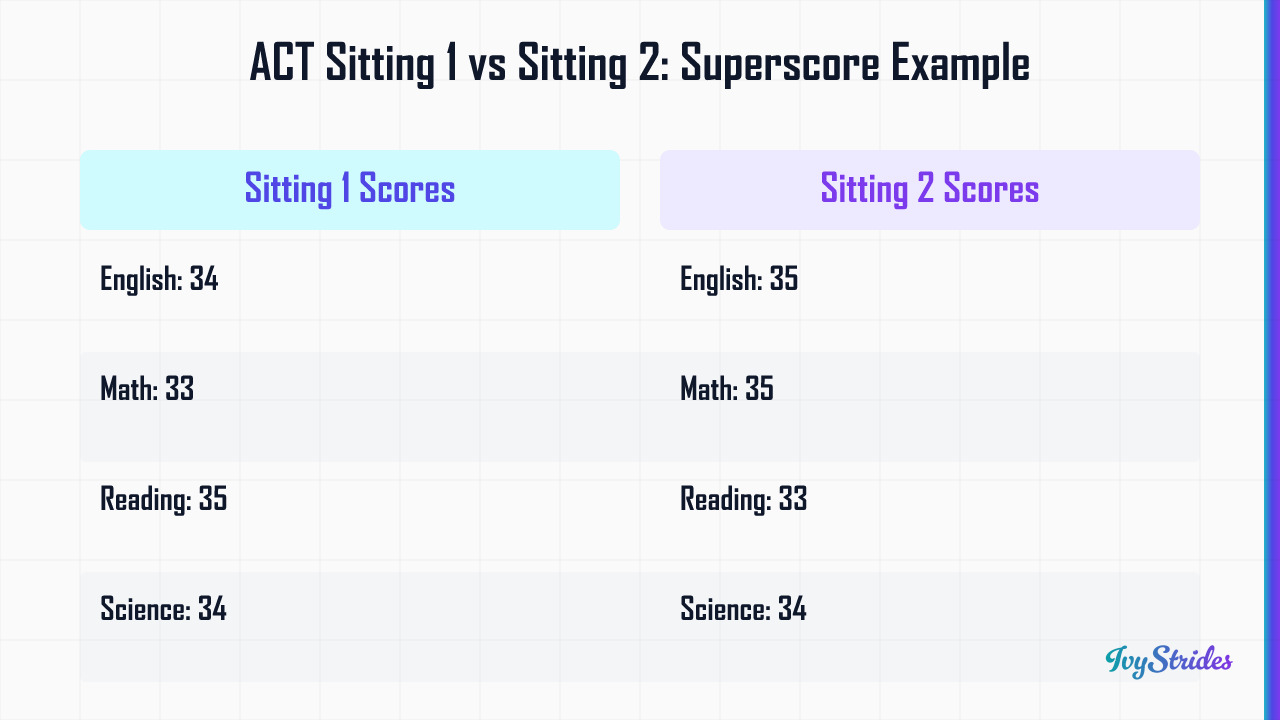
Here's why superscoring matters. Imagine you take the ACT twice:
- Sitting 1: 34 English, 33 Math, 35 Reading, 34 Science → composite 34
- Sitting 2: 35 English, 35 Math, 33 Reading, 34 Science → composite 34
Neither sitting alone gives Yale a 35. But the superscore (best of each section: 35E, 35M, 35R, 34S) averages to 34.75, which Yale will see as a 35. Same student, same effort, different presentation.
The strategic implication: each retake should be a section-targeted retake, not a generalized one. Identify your two weakest sections via a full-length diagnostic. Spend 6 to 8 weeks doing focused work on those sections. Retest. Lock the gain. Move on.
In our coaching with students targeting 34 to 36, the most common single-section gain is 2 to 3 points on ACT Science or ACT Math after 6 to 8 weeks of targeted work. ACT Science in particular is where strong students leave points on the table; the section isn't really about science content, it's about reading data representations under time pressure, and once a student learns the passage-type structure, scores move quickly.
A real example. A student we worked with last cycle came in at a 31 composite. Her diagnostic showed Science at 28 and Reading at 34. We didn't touch Reading. Eight weeks of Science work brought her to a 33 composite on the retake, with Science at 33. Superscored, Yale saw a 34. She's now a freshman there.
If you're building out a fuller study plan, our ACT prep overview covers section-specialist coaching. If you're still weighing tests, is the SAT harder than the ACT gets into the comparative difficulty question with more nuance.
Yale's Current Testing Requirement: Is Yale Test-Optional in 2026 or 2027
Short answer: no. Yale is test-required for fall 2025 applicants and onward, based on the policy reinstated after the test-optional period from 2020 through 2024.
The fuller history: Yale went test-optional in 2020 in response to pandemic-era testing disruptions. The policy stayed in place through the fall 2024 admissions cycle. In February 2024, Yale announced it would reinstate a standardized testing requirement beginning with applicants for the fall 2025 entering class, citing internal research that scores helped admissions readers identify strong candidates from under-resourced schools.
Under the current policy, applicants must submit one of the following:
- An ACT composite score (sent via code 0618), or
- An SAT score (sent via CEEB code 3987), or
- AP or IB scores as an alternative testing credential
That last option is worth pausing on. Yale's policy treats AP or IB scores as a valid testing submission, which is unusual among Ivy League peers. For students with strong AP performance, this is a genuine alternative path. See ap courses online for how we structure subject-specialist AP prep.
Is Yale test-optional in 2027? As of the date of this article, no. Yale has not announced a return to test-optional policy for the 2027 cycle. Testing policies at selective universities have shifted multiple times in the last five years, so before you apply, verify the current policy directly at admissions.yale.edu. The FairTest tracker at fairtest.org is a reasonable secondary source for monitoring test-optional changes across schools.
For a deeper comparison of how the two main tests stack up under current formats, see our sat vs act comparison.
How Your ACT Score Fits Into Yale's Holistic Admissions Review
A 35 ACT will not get you into Yale by itself. Neither will a 36. Yale admits roughly 3.7% of applicants, and most rejected applicants have scores Yale would happily admit.
So what actually moves the needle alongside your score?
Course rigor and AP performance. Yale's readers look at the strength of your high school curriculum relative to what was available to you. AP scores of 4 and 5 in subjects like AP Calculus BC, AP US History, AP Chemistry, and AP English Literature carry weight, both as predictors of college readiness and (under current policy) as an accepted AP or IB score alternative for testing.
GPA in context. Yale recomputes GPAs against your school's profile. A 3.95 unweighted at a high school known for grade deflation reads differently than a 3.95 at a school where half the class is above 3.9.
The essays. This is where strong applicants separate. Yale's supplement asks short-answer questions and the "Why Yale" essay, with word limits varying by prompt per Common App and Yale Admissions specifications. The students who land at Yale almost always have a personal statement that does something specific, not generic; the supplements demonstrate real fit, not boilerplate enthusiasm.
A strong ACT score opens the door at Yale, but Yale's admissions process is deeply holistic; the essays carry significant weight, and working with a common app essay tutor who understands Yale's supplemental prompts can sharpen that part of your application. We also offer a dedicated essay review service for students who already have drafts and need a coach to push them toward final.
Application timeline. Yale's Single-Choice Early Action deadline is typically November 1, with Regular Decision at January 2 (verify each cycle at admissions.yale.edu). SCEA is restrictive: you can't apply early to other private universities. For students with strong scores and applications ready by November, SCEA historically carries a modestly higher admit rate.
In our coaching with students applying to Ivy League schools, the combination of a 35+ ACT, strong AP performance, and a specific personal essay narrative produces the most competitive application packages we see. None of these alone is enough.
Yale ACT Score Requirements for International Students
The ACT code 0618 applies globally. There is no separate Yale code for international applicants. Whether you're testing in Seoul, Lagos, or São Paulo, the same four digits route your scores to Yale Admissions.
What changes for international applicants is the English proficiency requirement. Per Yale Admissions, non-native English speakers must submit an English proficiency test score in addition to ACT or SAT. Yale accepts:
- TOEFL
- IELTS
- Duolingo English Test
Minimum scores and current policy details should be confirmed at admissions.yale.edu before you test; Yale's thresholds and accepted tests can change between cycles, and posting specific minimums here without a current citation would be irresponsible given the stakes.
A logistical note: not every country has an ACT test center on every test date. Check international test center availability at act.org well before you plan to register. Some students in smaller markets need to travel to a regional hub city to test, which means building extra time into your prep timeline.
IvyStrides serves students worldwide through online 1-on-1 prep. The same section-specialist methodology applies regardless of location. For students who started with us in Singapore, Mumbai, and Dubai over the past three cycles, the timeline math has worked the same as for US-based students: a diagnostic, a targeted plan, a midpoint retest, and a final attempt.For section-specialist work, browse our online SAT Math tutor page.
Building a Realistic ACT Prep Timeline to Hit Yale's Score Range
The question every student really has is: from where I sit today, can I get to a 33+ in time? Honestly, it depends on your starting score and your remaining weeks.
Here's the framework we use in our coaching.
Starting below 30. In our coaching with students at this score band, plan for 16 to 20 weeks of structured prep to reach the 33 to 35 range. The first 4 weeks are foundation work across all four sections; the next 8 to 10 are targeted weakness work; the final 4 to 6 are full-length timed practice and pacing refinement. For students completing the IvyStrides 1-on-1 ACT program from this starting point, a 4+ point composite gain is typical.
Starting at 31 to 33. In our coaching with students at this score band, plan for 8 to 12 weeks. You don't need foundational rebuilding; you need surgical section work. A diagnostic identifies the one or two sections where you're leaking the most points, and the plan focuses there.
Starting at 34 to 35. Plan for 4 to 8 weeks of section-targeted work, focused on whichever single section is dragging your composite. The goal here is usually a half-point or one-point composite gain that lifts you from a 34 to a 35, or a 35 to a 36, via superscore.
Every IvyStrides ACT plan starts with a full-length diagnostic practice test, scored at the section level, before any tutoring begins. This is non-negotiable. We don't start coaching until we know exactly where the points are hiding. Then section-specialist coaches (separate coaches for English, Math, Reading, and Science) work with the student on the specific weaknesses the diagnostic surfaced.
At the midpoint of the plan, students take a second full-length practice test. This is the spaced retesting check: real progress, or do we need to recalibrate? If the gains aren't showing up, we adjust the plan before the official test, not after.
For a broader view of how we sequence prep, see our ACT prep overview. If you're also thinking about SAT pacing structure, our sat study plan shows how the same diagnostic-driven approach plays out for the Digital SAT.
FAQ
What is Yale University's ACT code?
Yale's official 4-digit ACT code is 0618. Enter this code when registering for the ACT or when requesting a score send through your ACT account at act.org. Yale's SAT and AP CEEB code is a separate number, 3987, used by the College Board.
Should I submit a 30 ACT score to Yale?
A 30 ACT composite falls below the 10th percentile of students who enrolled at Yale in fall 2025 (Yale Admissions Class Profile), where the middle 80% range runs from 33 to 35. Submitting a 30 is unlikely to strengthen your application. If you have time before your deadline, a targeted retake plan focused on your two weakest sections is a better path than submitting a score that sits well below Yale's enrolled range.
Can I get into Yale with a 34 ACT?
A 34 ACT composite falls within Yale's middle 80% range (33 to 35 for fall 2025 enrolled students per Yale Admissions Class Profile), so it's not disqualifying. A 34 sits near the lower half of that range, meaning the majority of enrolled students scored at or above it. A 34 can work if the rest of your application, including GPA, AP rigor, essays, and extracurriculars, is exceptionally strong. If you have time to retest, targeting a 35 or 36 would improve your position.
Is a 35 ACT a good score for Yale?
A 35 ACT composite is at or above the 75th percentile of Yale's enrolled students based on Yale Admissions Class Profile, making it a genuinely competitive score. It doesn't guarantee admission, since Yale's acceptance rate is approximately 3.7% and the process is holistic, but a 35 means your test score is not a weakness in your application.
Does Yale superscore the ACT?
Yes. Yale reviews the highest section scores across multiple ACT sittings, which means your effective composite is built from your best English, Mathematics, Reading, and Science scores regardless of which test date they came from. This makes strategic retaking worthwhile: focus each retake on the one or two sections where you have the most room to grow.
Is Yale test-optional in 2027?
As of the date of this article, Yale requires ACT or SAT scores from all first-year and transfer applicants, a policy reinstated for fall 2025 applicants after a test-optional period from 2020 through 2024. Yale has not announced a return to test-optional for 2027 applicants. Students should verify the current policy directly at admissions.yale.edu before applying, as testing policies across selective universities can change.
How do I report my ACT score to Yale after I have already applied?
Yale allows applicants to self-report new or additional scores after submitting their application. Log in to your Yale Admissions Status Portal and follow the instructions to update your testing information. Official scores from ACT, Inc. using code 0618 are required by enrollment, not by the application deadline in most cases, but confirm the exact deadline with Yale's admissions office.
What are my chances of getting into Yale with a 1520 or 1590 SAT score?
Yale's middle 50% SAT range for enrolled students is approximately 1470 to 1570 based on available data, meaning a 1520 sits within that range and a 1590 is above it. Neither score guarantees admission given Yale's roughly 3.7% acceptance rate and holistic review process. A strong SAT score removes a potential weakness but doesn't substitute for a compelling essay, strong GPA, and demonstrated intellectual curiosity. If you're submitting SAT scores, use Yale's SAT CEEB code 3987, not the ACT code 0618.
You have the code. You have the score range. You know how Yale uses superscoring and where your current ACT composite sits relative to the enrolled class. What's left is the plan: a diagnostic, a targeted timeline, and a coach who knows which section is costing you points.
Your Yale Application Starts With the Right Score Plan.
IvyStrides section-specialist ACT coaches work 1-on-1 with students targeting 33 to 36. Start with a diagnostic, build a targeted plan, and retest with confidence. Book your free 15-minute call today.

Award-winning author (South Asian Book Award) and graduate of BITS Pilani and UCLA Luskin School of Public Affairs. Brings a published writer's eye to Common App essays and grammatical precision to SAT and ACT R&W instruction.