
Is the PSAT Harder Than the SAT? A Complete 2026 Comparison
On this page
- Quick Answer: Which Test Is Harder?
- PSAT vs SAT: Side-by-Side Comparison Table (2026)
- Understanding the Purpose of Each Test: More Than Just Practice vs. Admissions
- The PSAT
- The SAT
- What the PSAT and SAT Have in Common
- How Much Harder Is the SAT Than the PSAT?
- Math: Where the Biggest Difficulty Gap Shows Up
- Reading and Writing: Passage Complexity and Reasoning
- Time Pressure and Mental Stamina
- PSAT-to-SAT Score Conversion: What Your PSAT Score Predicts
- How the Scales Work
- Sample PSAT-to-SAT Score Conversion Chart
- Why Conversions Aren't Guarantees
- Was the 2025 PSAT Harder? What It Means for 2026
- Is the PSAT Harder for 10th Graders?
- Why the PSAT Still Matters (Even If It's Easier)
- 5 Strategies to Go from PSAT to SAT Success
- 1. Analyze Your PSAT Score Report
- 2. Target SAT-Only Math Topics Early
- 3. Practice with Full-Length SAT Mock Exams
- 4. Adjust Your Pacing Strategy
- 5. Start Prep Early with a Structured Plan
- Common Myths About PSAT and SAT Difficulty
- Myth 1: The PSAT Doesn't Matter
- Myth 2: The SAT Is Always Harder
- Myth 3: A High PSAT Score Guarantees a High SAT Score
- Myth 4: You Should Prep the Same Way for Both
- Conclusion: Turning the PSAT into Your SAT Advantage
- FAQs: PSAT vs SAT Difficulty
Two tests. Similar names. Both can shape your academic future.
Yet ask in school hallways or parent WhatsApp groups, and you'll hear it all - from "The PSAT is easier than the SAT" to "They're the same."
Neither is true in full. The PSAT and SAT share a family resemblance, but each has its own purpose, difficulty profile, and impact. Knowing those differences could save you months of second-guessing and inefficient prep.
The PSAT is often a student's first step into serious college-bound testing. The SAT is the leap that can influence admissions, scholarships, and even career opportunities.
In 2026, the comparison is even more interesting: both exams are fully digital, both use adaptive testing, and both can be compared through PSAT-to-SAT score conversion. But difficulty is about more than a score scale - it's about question style, timing pressure, mental stamina, and how you prepare.
In this guide, we'll strip away the myths, walk through each difference that matters, and show you how to turn both tests into opportunities. You'll also see where strategic PSAT prep can become the perfect springboard for SAT success - something we've helped thousands of IvyStrides students achieve.
Secure your spot in our SAT Online Classes for expert-led prep and proven strategies.
Quick Answer: Which Test Is Harder?
Most students find the SAT slightly more difficult than the PSAT, but it's not because the SAT has trickier questions in every section. Here's why the SAT tends to feel tougher:
- Broader Content: The SAT includes a wider range of math and evidence-based reading questions, pushing slightly beyond the PSAT's scope.
- Higher Stakes: A high SAT score can directly impact college admissions and merit-based scholarships, which naturally increases the pressure. If test-day nerves are a concern, check out these strategies to overcome SAT anxiety.
- Timing Pressure: While both tests use a similar adaptive digital format in 2026, the SAT's pacing can feel more demanding.
- Grade-Level Gap: Many students take the PSAT in 10th or early 11th grade, while the SAT often comes later, when expectations are higher.
But here's the critical part: If you've prepared well for the PSAT, the leap to the SAT becomes manageable. The question isn't just which is harder - it's how you can use the PSAT as a launchpad for SAT success.
Key Takeaway: The SAT is harder than the PSAT on average, but students who treat the PSAT as a diagnostic tool and follow a structured prep plan often close the gap quickly. In our 2025 cohort, students who scored 1200 on the PSAT averaged 1310 on the SAT after 8 weeks of targeted prep.
PSAT vs SAT: Side-by-Side Comparison Table (2026)
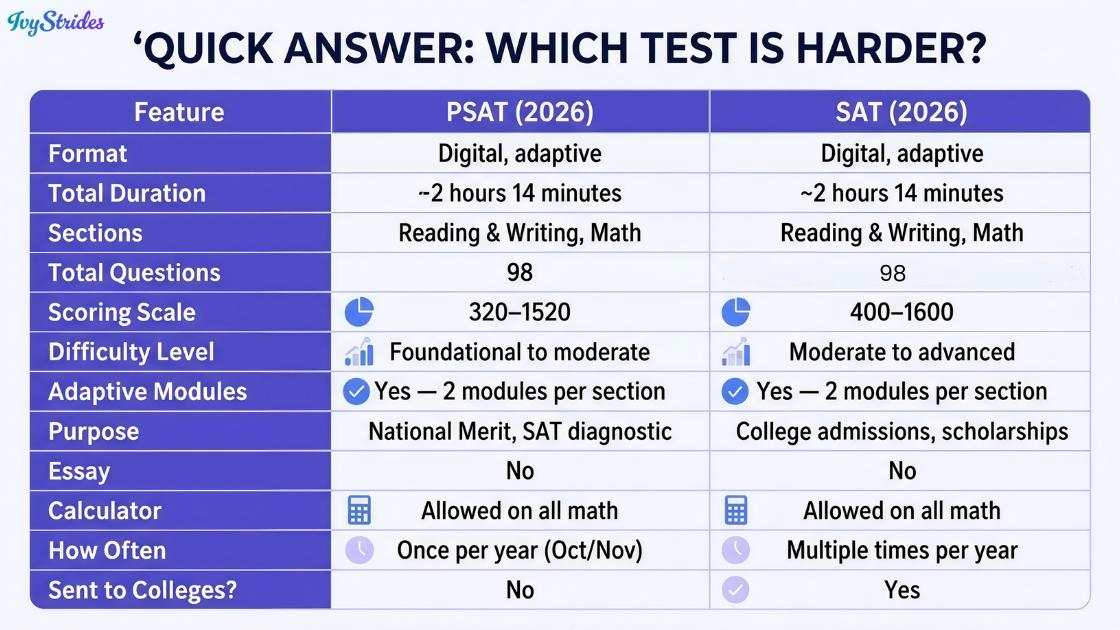
Before diving into the details, here's a quick at-a-glance comparison of the two tests:
| Feature | PSAT (2026) | SAT (2026) |
| Format | Digital, adaptive | Digital, adaptive |
| Total Duration | ~2 hours 14 minutes | ~2 hours 14 minutes |
| Sections | Reading & Writing, Math | Reading & Writing, Math |
| Total Questions | 98 | 98 (how many questions are on the SAT) |
| Scoring Scale | 320–1520 | 400–1600 |
| Difficulty Level | Foundational to moderate | Moderate to advanced |
| Adaptive Modules | Yes - 2 modules per section | Yes - 2 modules per section |
| Purpose | National Merit, SAT diagnostic | College admissions, scholarships |
| Essay | No | No |
| Calculator | Allowed on all math | Allowed on all math |
| How Often | Once per year (Oct/Nov) | Multiple times per year |
| Sent to Colleges? | No | Yes |
According to College Board's 2025–2026 test specifications, both exams share the same digital adaptive engine. The key differences lie in scoring range, content depth, and what's at stake.
Understanding the Purpose of Each Test: More Than Just Practice vs. Admissions
Knowing why each test exists is the first step to preparing the right way and scoring higher.
The PSAT
The PSAT is more than a "practice SAT." It plays a specific role in your college prep journey.
- Usually taken in 10th or 11th grade, it measures your current skills and can qualify you for National Merit Scholarships.
- It gives you test-day experience without the pressure of college admissions.
The SAT
This is a high-stakes exam used by colleges to judge readiness, decide admissions, and award merit-based financial aid.
- Think of the PSAT as a diagnostic tool. It highlights your strengths and pinpoints areas to improve months before the SAT.
- The SAT is the official scorecard that colleges will review when making decisions.
When you use the PSAT as the starting point for SAT prep, you can spot weaknesses early, strengthen them, and face the SAT with more skill and confidence.
What the PSAT and SAT Have in Common
Several GSC queries ask: "Is the PSAT the same as the SAT?" The short answer is no, but they're closely related.
Here's what's identical or nearly identical:
- Same maker: Both are created by the College Board.
- Same digital platform: Both use the Bluebook app with the same interface.
- Same adaptive structure: Two modules per section, with the second module adjusting difficulty based on your first-module performance.
- Same content domains: Heart of Algebra, Problem-Solving and Data Analysis, Advanced Math, Reading comprehension, and Standard English Conventions.
- No penalty for guessing: On both tests, there's no deduction for wrong answers , so you should never leave a question blank.
- Calculator allowed: Both permit calculator use on all math questions.
The differences? The SAT's scoring ceiling is higher (1600 vs. 1520), the SAT includes more advanced content, and only the SAT is sent to colleges.
How Much Harder Is the SAT Than the PSAT?
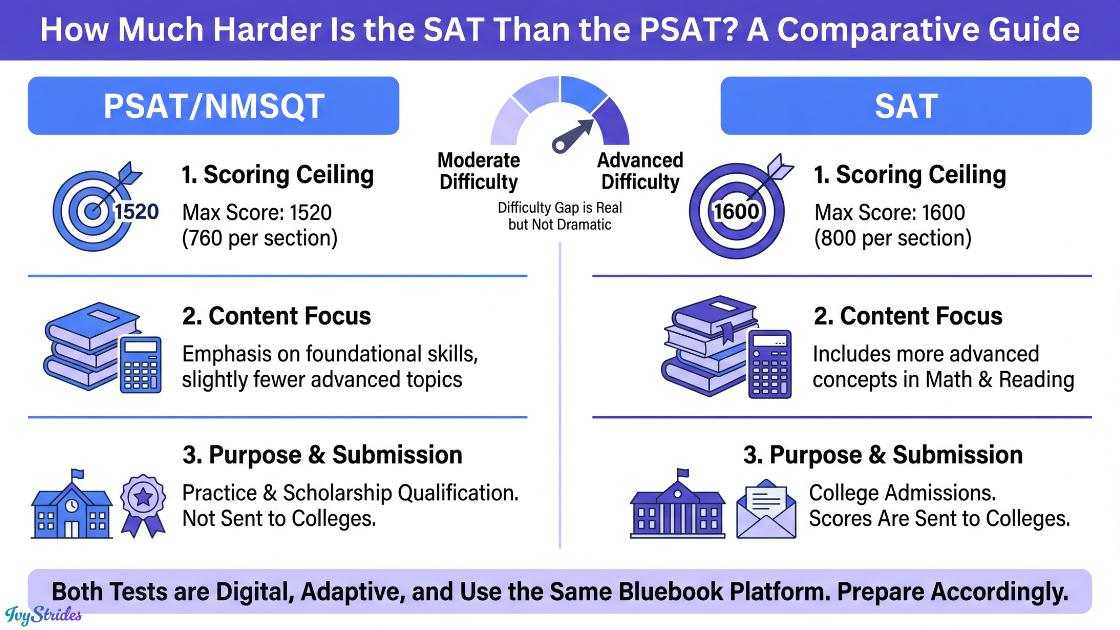
The difficulty gap between the PSAT and SAT isn't dramatic, but it's real. Let's break it down section by section.
Math: Where the Biggest Difficulty Gap Shows Up
The PSAT tests core math concepts, often with more straightforward phrasing. The SAT pushes further into:
- Advanced algebra - more complex systems of equations, quadratics, and polynomial manipulation. Review SAT algebra questions and patterns to see exactly what's added.
- Trigonometry - basic trig ratios and unit circle concepts appear on the SAT but rarely on the PSAT.
- Advanced data analysis - questions involving standard deviation and more complex statistical reasoning.
- Multi-step problem solving - SAT math questions more frequently require chaining 2–3 concepts together.
In our experience tutoring thousands of students, math is where the biggest score difference shows up between PSAT and SAT performance. Students who don't specifically study SAT-only math topics often lose 40–80 points in this section alone.
Reading and Writing: Passage Complexity and Reasoning
The SAT includes a greater variety of complex reading passages and multi-step reasoning questions.
- SAT passages tend to draw from more challenging source material - think historical documents, dense scientific studies, and literary analysis.
- Evidence-based questions on the SAT require deeper inference and synthesis across multiple parts of a passage.
- The PSAT's reading passages are still challenging, but they lean toward more accessible vocabulary and shorter reasoning chains.
Time Pressure and Mental Stamina
Both exams have similar total timing (~2 hours 14 minutes), but the SAT may require faster problem-solving on harder items, especially in math.
- The SAT's harder second modules demand quicker decision-making under pressure.
- Because the stakes are higher, many students report feeling more mentally drained during the SAT.
- Building SAT reading speed and timing strategies before test day makes a significant difference.
If test anxiety is something you struggle with, learning to reduce stress while studyingfor the SAT can help you perform closer to your true ability on test day.
PSAT-to-SAT Score Conversion: What Your PSAT Score Predicts
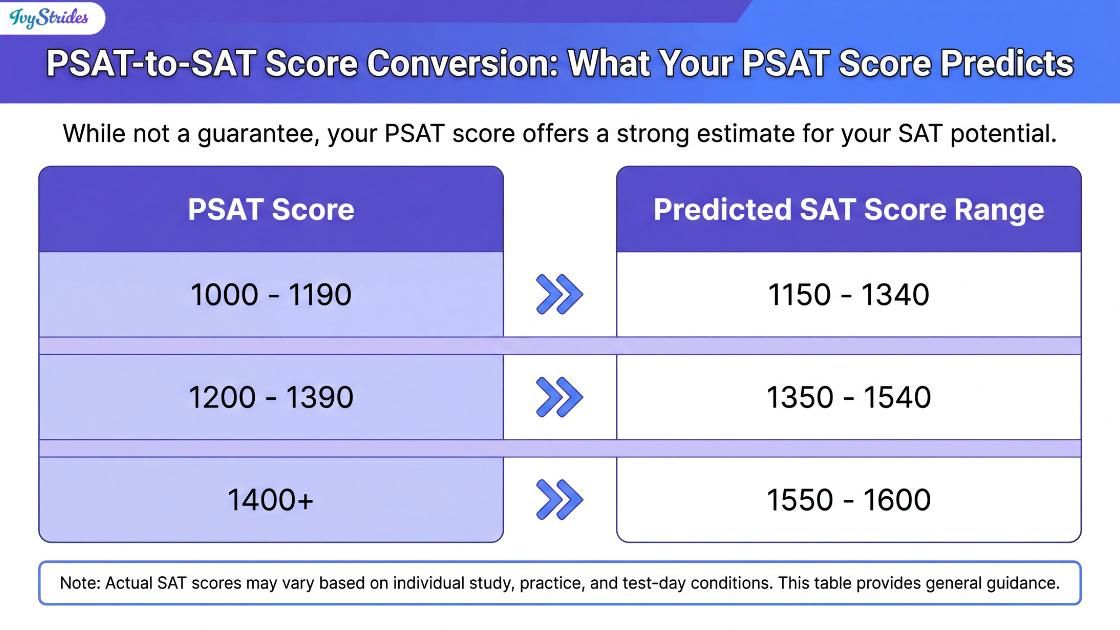
Many students and parents want to know: If I score X on the PSAT, what will I get on the SAT?
While score conversions can give an estimate, they're not a guarantee.
How the Scales Work
- PSAT: 320–1520 scale
- SAT: 400–1600 scale
The scales are aligned so a perfect PSAT score of 1520 roughly equals a 1600 on the SAT in terms of percentile ranking. To understand what a 1520 SAT score means for college admissions, check out our detailed breakdown.
Sample PSAT-to-SAT Score Conversion Chart
Based on College Board's score alignment data and historical student performance, here's an estimated conversion table:
| PSAT Score | Estimated SAT Range | Percentile (Approx.) |
| 1470–1520 | 1530–1600 | 99th+ |
| 1400–1460 | 1460–1540 | 97th–99th |
| 1300–1390 | 1360–1460 | 92nd–97th |
| 1200–1290 | 1260–1370 | 82nd–92nd |
| 1100–1190 | 1150–1270 | 67th–82nd |
| 1000–1090 | 1050–1170 | 48th–67th |
| 900–990 | 950–1070 | 30th–48th |
What does a 1200 on the PSAT equal on the SAT? Roughly 1260–1370, depending on your prep between tests.
What is a 1470 PSAT equivalent to on the SAT? Approximately 1530–1560 - solidly in the 99th percentile range.
Why Conversions Aren't Guarantees
The SAT includes slightly more complicated questions and may cover topics not on the PSAT, so scores can shift up or down depending on your prep between tests.
Variables that affect your actual SAT score include:
- How much targeted prep you do between the PSAT and SAT
- Whether you study SAT-only topics (advanced algebra, trig, complex passages)
- Test-day conditions - sleep, stress, and familiarity with the testing environment
- Time between tests - more time generally means more room for improvement
Data from College Board shows PSAT scores correlate with SAT performance at roughly 0.9, but targeted prep accounts for the remaining variance.
After receiving your PSAT results, use them to create a targeted SAT prep plan. Our Free SAT Resources page offers downloadable practice tests and study materials to close the gap between your current and target scores.
Was the 2025 PSAT Harder? What It Means for 2026
If you took the PSAT in October 2025, you're not alone in thinking it felt tougher than expected. Many students on forums like Reddit reported the 2025 PSAT felt harder, particularly in math - with more multi-step problems and less straightforward algebra.
Here's what to keep in mind:
- College Board standardizes difficulty. Each year's test is equated so that scores remain comparable across administrations. A "harder" test doesn't mean lower scores - the curve adjusts.
- Perception vs. reality. Students who hadn't prepped specifically for adaptive testing often felt the second math module was significantly harder. That's the adaptive format working as designed.
- What this means for 2026 test-takers: If you're taking the PSAT in fall 2026, expect a similar format and difficulty level. The best preparation is understanding the adaptive structure and practicing with full-length digital tests.
The bottom line? Whether the 2025 PSAT was "harder" matters less than how you use your score to prepare for the SAT. Focus forward.
Is the PSAT Harder for 10th Graders?
This is one of the most common questions we hear from sophomore students and their parents.
Yes, the PSAT can feel harder for 10th graders but not because the test itself is different. Every student takes the same PSAT regardless of grade level. The difference is readiness:
- Curriculum exposure: By 10th grade, many students haven't completed Algebra II or Pre-Calculus, which means some PSAT math topics feel unfamiliar.
- Reading maturity: Sophomores typically have less experience with the dense, evidence-based passages that appear on the test.
- Test-taking stamina: Younger students often have less experience with 2+ hour standardized tests.
The good news? Your 10th-grade PSAT score doesn't count for National Merit - that's your 11th-grade score. So treat the 10th-grade PSAT as a pure diagnostic. Identify your weak areas, start targeted prep, and you'll be in a much stronger position by junior year.
Students who take the PSAT as sophomores and then follow a structured plan like our 30-day SAT study plan consistently see the biggest score jumps.
Why the PSAT Still Matters (Even If It's Easier)
Many believe the PSAT is "just practice," but it serves several important purposes:
- National Merit Scholarships: Your 11th-grade PSAT/NMSQT score is the sole qualifier for National Merit recognition, which can lead to significant scholarship money.
- Diagnostic value: It's the best low-stakes way to identify exactly where you need to improve before the SAT.
- Test-day experience: Familiarity with the digital adaptive format, the testing environment, and time pressure , all without college admissions on the line.
- Motivation: A strong PSAT score builds confidence. A weak one creates urgency. Either way, it drives action.
Quick Tip: Don't skip the PSAT just because colleges won't see your score. The data it provides is invaluable for building a targeted SAT prep strategy.
5 Strategies to Go from PSAT to SAT Success
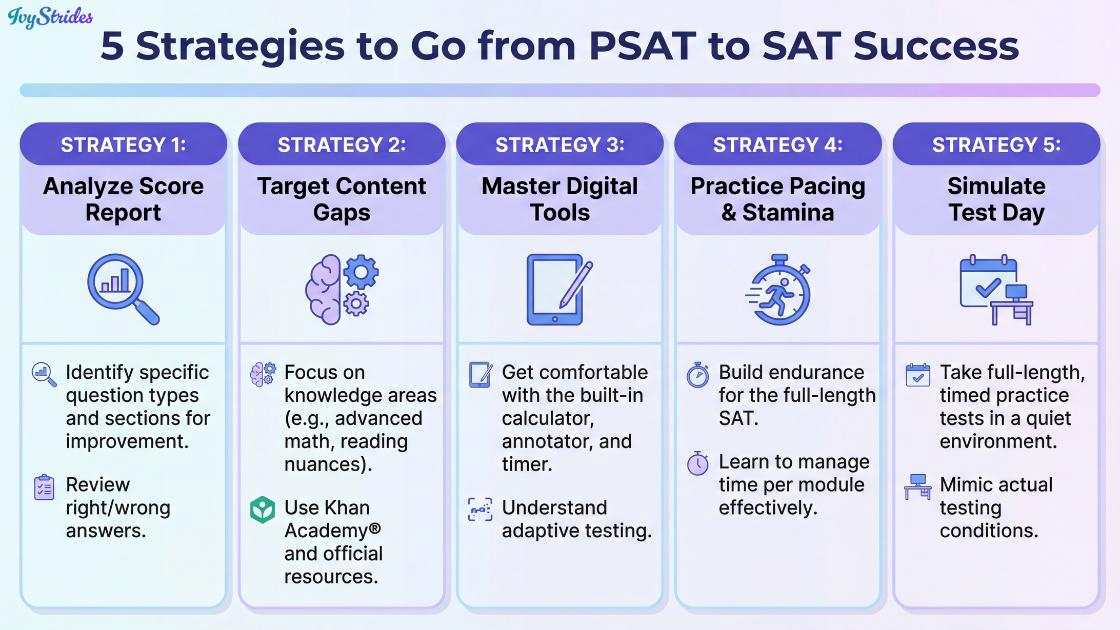
Your PSAT score is a starting point, not a finish line. With the right strategies, you can turn your results into a roadmap for SAT success.
1. Analyze Your PSAT Score Report
Don't just look at your total score. Dig into the section breakdowns and question-level data. Identify which content domains cost you the most points - that's where your SAT prep should start.
2. Target SAT-Only Math Topics Early
The SAT covers topics the PSAT doesn't emphasize, including advanced algebra, trigonometry, and complex word problems. Start studying these early so they feel familiar by test day. Our guide on SAT algebra questions and patterns is a great starting point.
Watch out for common mistakes on specific problem types - for example, quadratic formula errors are one of the most frequent point-losers on the SAT.
3. Practice with Full-Length SAT Mock Exams
The PSAT gives you a taste of the format, but only full-length SAT practice tests build the stamina and pacing instincts you need. Aim for at least 4–6 full practice tests before your SAT date.
4. Adjust Your Pacing Strategy
The SAT's harder second modules demand faster, more confident decision-making. Practice under timed conditions and develop a strategy for when to skip and return to tough questions. SAT reading speed and timing strategies can help you find the right pace.
5. Start Prep Early with a Structured Plan
The earlier you begin bridging the gap, the more time you have to refine strategies, improve accuracy, and boost confidence before your SAT. Our 30-day SAT study plan provides a step-by-step approach for making that transition.
Remember: unlike the PSAT (once per year), you can take the SAT multiple times. But starting prep early means you're more likely to hit your target score on the first or second attempt.
SAT Prep Classes offer personalized feedback, digital practice, and score-tracking tools to maximize gains.
Common Myths About PSAT and SAT Difficulty
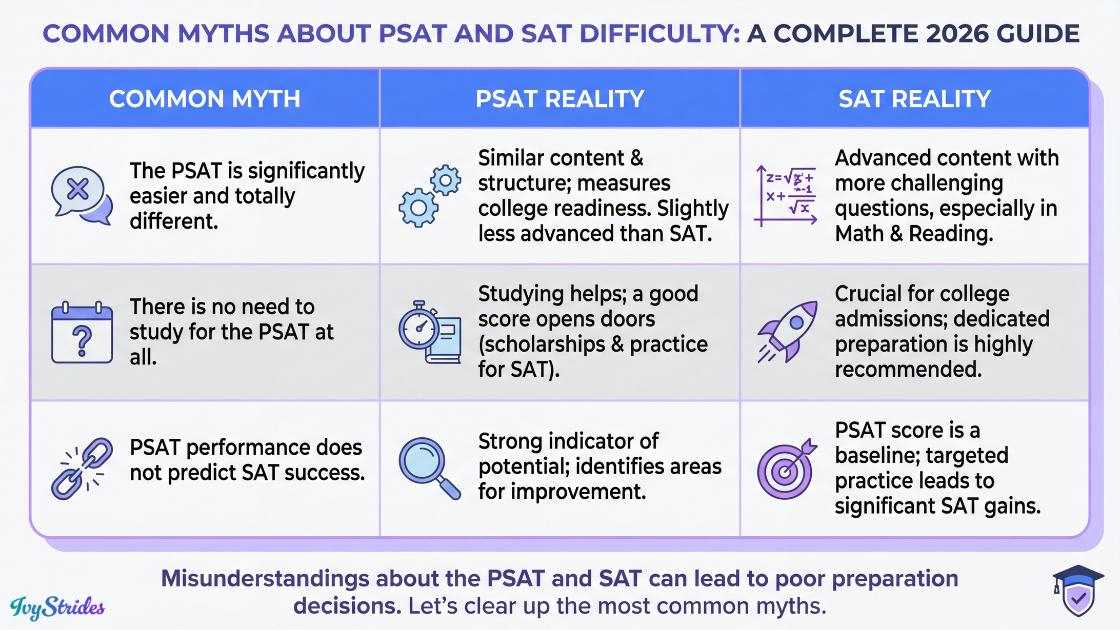
Misunderstandings about the PSAT and SAT can lead to poor preparation decisions. Let's clear up the most common myths.
Myth 1: The PSAT Doesn't Matter
Many believe the PSAT is "just practice," but it can qualify you for National Merit Scholarships and help shape your SAT prep strategy. Dismissing it means missing a valuable diagnostic opportunity.
Myth 2: The SAT Is Always Harder
While the SAT often includes more complex questions, students who build strong skills early may find the transition smooth - sometimes even easier than expected.
Some students actually report the SAT feeling more manageable because they've prepped more intensively for it than they did for the PSAT.
Myth 3: A High PSAT Score Guarantees a High SAT Score
A strong PSAT score is promising, but without targeted SAT prep, performance can plateau or drop.
Data from College Board shows PSAT scores correlate with SAT performance at roughly 0.9, but targeted prep accounts for the remaining variance.
Myth 4: You Should Prep the Same Way for Both
The tests share structure, but the SAT's broader content coverage calls for targeted study on topics the PSAT doesn't test. Check our Last-Minute SAT Tips to see how final adjustments before test day can make a bigger difference than you think.
Conclusion: Turning the PSAT into Your SAT Advantage
So, is the PSAT harder than the SAT? In short, the SAT typically includes more challenging content, but the PSAT is your best low-pressure opportunity to prepare for it.
The key isn't just knowing the differences , it's using your PSAT results as a launchpad for targeted SAT prep.
At IvyStrides, we've helped students across the USA, India, and Canada transform PSAT performance into top SAT scores , unlocking scholarships and admissions to elite universities.
Wondering how the SAT compares to the ACT instead? Read our guide on is the SAT harder than the ACT to figure out which test is the best fit for you.
If you're ready to map out your path to a dream score, talk to our Counsellors for a personalized study plan.
Talk To Our Counsellor
FAQs: PSAT vs SAT Difficulty
1. Is the PSAT harder for 10th graders?
Not necessarily. The PSAT is the same test for all students, but 10th graders may find it more challenging due to less exposure to advanced math and complex reading passages. Your 10th-grade score doesn't count for National Merit , use it as a diagnostic.
2. Is the SAT harder than it used to be?
The digital SAT has changed question formats and timing, but with adaptive modules, some students find it more manageable , especially with targeted prep.
3. Does the PSAT have an essay like the old SAT?
No. The PSAT does not include an essay section, and the SAT's optional essay was discontinued in 2021.
4. Is the PSAT scored the same way worldwide?
Yes, the scoring scale is consistent globally, though some international test dates and conditions may differ.
5. Can I retake the PSAT if I'm not happy with my score?
You can take the PSAT once per year, typically in 10th and 11th grade. Your 11th-grade score counts for National Merit consideration.
Unlike the PSAT, you can take the SAT multiple times - most students take it 2–3 times.
6. Do colleges see your PSAT scores?
No. PSAT scores are for your use (and scholarship eligibility) only; they are not sent to colleges.
7. Are the math topics identical on both tests?
They overlap significantly, but the SAT may include more advanced algebra, data analysis, trigonometry, and geometry concepts.
8. Is the digital PSAT adaptive like the digital SAT?
Yes. Both use adaptive modules, adjusting question difficulty based on your performance in earlier sections.
9. What does a 1200 on the PSAT equal on the SAT?
A 1200 PSAT score typically translates to roughly 1260–1370 on the SAT, based on College Board's score alignment data. However, your actual SAT score depends heavily on how much targeted prep you do between tests.
10. Is a 700 on the PSAT good?
A 700 on a single PSAT section (Reading & Writing or Math) is strong - it places you around the 90th–95th percentile for that section. Combined, a total score in the 1400+ range is considered excellent.
11. What PSAT score is top 1 percent?
For the 2025–2026 testing cycle, a PSAT score of approximately 1460–1520 places you in the top 1% nationally. The exact cutoff varies slightly by state for National Merit purposes.
12. Was the 2025 PSAT harder than previous years?
Many students reported the 2025 PSAT felt harder, especially in math. However, College Board equates each test so that scores remain comparable across years. A "harder" test comes with a more generous curve.
13. Is the PSAT easy?
The PSAT isn't easy - it's a rigorous standardized test. However, compared to the SAT, it covers slightly less advanced content. Students who prepare specifically for the PSAT's format and content tend to find it manageable.

Hemant is a seasoned entrepreneur, investor, and growth strategist with deep ground in education and technology-driven learning. His core training is in Mathematics and Physics — he authored Physics for IB Diploma: Ultimate Revision Guide, recognized as a top student resource.