
SAT Prep for Middle Schoolers: A Head Start with PSAT 8/9 and Talent Search
On this page
Most middle schoolers do not need to "prep for the SAT" in any traditional sense, and no sixth grader should be grinding through timed test drills. But grades 6-8 are a genuinely good time to build the underlying skills the test rewards — strong reading habits, solid math fundamentals, and light familiarity with the digital format — and, for some students, to sit an above-grade test like the PSAT 8/9 or a talent-search exam that can qualify them for gifted and enrichment programs. The right approach is gradual and low-pressure: short sessions, real reading, and curiosity, not cramming. This post explains where to start, when to wait, and how to keep the whole thing healthy.
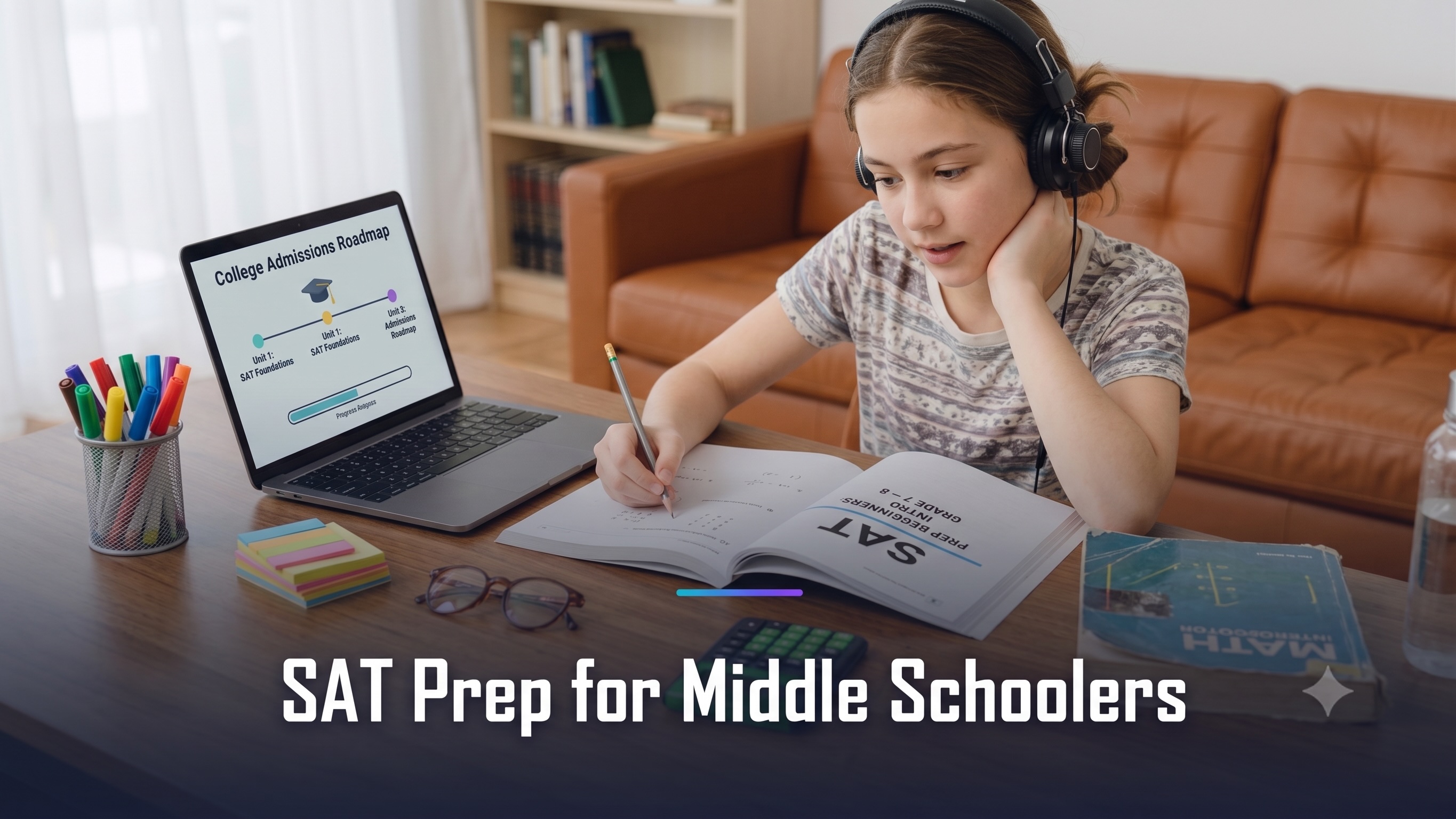
What "SAT prep" actually means in middle school
For a student in grades 6-8, the goal is not to memorize test tricks or race a clock. It is to build the foundation the SAT eventually measures years later.
That foundation is mostly ordinary good schooling: reading widely, understanding what you read, and being fluent with core math. A student who reads for pleasure and keeps up in math is already doing the most important "prep" there is.
Test familiarity comes second, and it comes lightly. Knowing what a digital standardized test looks like — the interface, the question styles, the pacing — removes anxiety later. A single low-stakes exposure in middle school can do more for confidence than months of drilling ever would.
The PSAT 8/9 as an on-ramp
The PSAT 8/9 is the College Board's entry point into the SAT family, designed specifically for 8th and 9th graders. It is shorter and gentler than the SAT, but it uses the same skills and the same digital, adaptive format.
Think of it as a baseline, not a verdict. It tells you where a student stands in reading, writing, and math relative to grade-level expectations, and it flags areas worth strengthening over the next few years. Because scores are reported on a scale that connects to the SAT, families get an early, realistic picture without high stakes attached.
For students a little further along, the PSAT prep track (grades 8-11, and National Merit-aware for older students) picks up naturally where the PSAT 8/9 leaves off. Trying a free PSAT practice test first is a low-commitment way to see the format before deciding whether a proctored sitting makes sense.
Above-grade testing and talent-search programs
One reason some families explore testing early is talent search. Programs like the Johns Hopkins Center for Talented Youth (CTY) — and similar university-run talent searches — invite students to take a test above their current grade level. Scoring well on an above-grade exam can qualify a student for gifted identification, summer programs, online courses, and other academic enrichment.
The logic behind above-grade testing is simple: a grade-level test often cannot distinguish among high-achieving kids because they all score near the top. A harder test spreads them out and reveals genuine readiness for more advanced work.
This is an opportunity, not an obligation. Talent-search qualification can open real doors, but plenty of thriving, capable students never take these tests and are none the worse for it. If your child is curious, hungry for more challenge, and enjoys the material, above-grade testing can be a rewarding stretch. If it would only add stress, it is fine to skip.
Why early prep actually pays off later
The Digital PSAT and the Digital SAT share the same engine. They are built on the same adaptive testing model, the same content domains, and the same digital interface (the Bluebook app). A student who grows comfortable with the PSAT 8/9 format is, without any cramming, becoming comfortable with the exact system they will face on the SAT.
That continuity is the quiet advantage of starting early. Skills compound. A middle schooler who reads consistently, keeps their algebra sharp, and has seen the digital format once or twice arrives at the SAT prep years later with far less to unlearn and far less anxiety.
The payoff is not a higher score at age 12. It is a calmer, better-prepared student at 16.
What age-appropriate prep looks like
Healthy middle-school prep barely resembles test prep at all. Here is the difference between an approach that builds a student up and one that risks burning them out.
| Healthy foundation building | Counterproductive cramming |
|---|---|
| Reading for 20-30 minutes most days, by choice | Timed reading drills every night |
| Strengthening math fundamentals and mental math | Grinding full-length SAT sections repeatedly |
| One or two light exposures to the digital format | Weekly high-stakes practice tests |
| Short, focused sessions with breaks | Long, pressured study marathons |
| Curiosity and a growth mindset | Fear of a "bad" score at age 12 |
Keep sessions short. A middle schooler's attention and stamina are still developing. Thirty focused minutes beats two exhausted hours.
Protect the reading habit above all. Reading volume — fiction, nonfiction, whatever a kid loves — is the single biggest long-term lever for the verbal side of the test, and it never feels like prep.
Treat the format as exposure, not a test. Let a student click through a practice interface once so it is familiar, then move on. There is no need to chase a number this early.
Signs a kid is ready — and signs to wait
Not every middle schooler should start this, and readiness matters more than age.
Signs a student is ready: they read willingly and often, they are comfortably ahead in math, they express curiosity about tests or enrichment programs, and they can sit with a challenge without shutting down. For these kids, a light PSAT 8/9 experience or a talent-search test can be motivating.
Signs to wait: the student already feels stretched by regular schoolwork, gets anxious about grades and testing, or shows no interest. Pushing a reluctant 11-year-old toward standardized testing tends to backfire — it can turn a natural learner into a stressed one.
When in doubt, wait. There is no academic penalty for starting the SAT track in 9th or 10th grade instead of 6th. The students who do best long term are the ones who stay curious, not the ones who started earliest.
How IvyStrides approaches early prep
For families who decide their middle schooler is ready, IvyStrides assigns an early-foundation learning path oriented around the PSAT 8/9 and talent-search goals, built specifically around the student's grade and objectives.
Rather than pushing SAT content too soon, the path emphasizes fundamentals, gradual format familiarity, and short sessions calibrated to a younger learner's stamina. Parents get a clear picture of where their child stands and what to strengthen next — without the pressure of high-stakes prep.
If you are unsure whether early prep fits your child, that is exactly the right question to bring to a free consultation, or you can start by exploring the PSAT prep track to see what a grade-appropriate plan looks like.
Frequently asked questions
Should my 6th grader start SAT prep now? Almost certainly not in the traditional sense. At that age, the best "prep" is reading widely and staying strong in math. Formal testing only makes sense if your child is genuinely curious or is pursuing a talent-search program, and even then it should be light and low-pressure.
What is the PSAT 8/9 and who takes it? It is the College Board's entry-level exam in the SAT family, designed for 8th and 9th graders. It uses the same digital, adaptive format as the SAT but is shorter and gentler, making it a low-stakes way to establish a baseline.
How does testing connect to programs like Johns Hopkins CTY? Talent searches invite students to take an above-grade test. A strong score can qualify them for gifted identification, summer programs, and online enrichment courses. It is an opportunity worth exploring for interested students, but it is optional.
Does prepping in middle school really help the actual SAT later? Yes, because the Digital PSAT and Digital SAT share the same adaptive engine, content areas, and interface. Skills and format familiarity built early carry directly forward, so students arrive at SAT prep with less to relearn and less anxiety.
How do I keep early prep from stressing my child out? Keep sessions short, protect the reading habit, treat the digital format as exposure rather than a graded test, and follow your child's interest. If they feel stretched or anxious, it is completely fine to wait a year or two.

Hemant is a seasoned entrepreneur, investor, and growth strategist with deep ground in education and technology-driven learning. His core training is in Mathematics and Physics — he authored Physics for IB Diploma: Ultimate Revision Guide, recognized as a top student resource.