
Falling Behind in Your SAT Class? What to Drop and What to Redo

On this page
- Why the Digital SAT Math Adaptive Structure Changes What You Study First
- Which Digital SAT Math Topics to Drop and Which to Redo by Score Band
- How to Build Your Digital SAT Math Week-by-Week Schedule
- How to Turn SAT Math Practice Into Real Score Gains Before Test Day
- FAQ: Digital SAT Math Study Plans
- How to create an SAT study plan?
- What is the best way to study for the digital SAT?
- How rare is a 800 SAT Math?
- How many hours per day should I study for the digital SAT?
- Your Next Step on Digital SAT Math
Start with a full-length Bluebook practice test to get a real score baseline. A Digital SAT Math study plan is a score-band-specific sequence of drills built from your diagnostic errors, not a topic checklist. Sort wrong answers by content domain, then drill your two weakest domains first.
Those format figures, 44 questions in 70 minutes across two adaptive modules, come from the College Board. The harder question is what to cut. If you score below 700, complex numbers and advanced trigonometry return fewer points per hour than linear equations, and the adaptive structure below explains why.
Why the Digital SAT Math Adaptive Structure Changes What You Study First
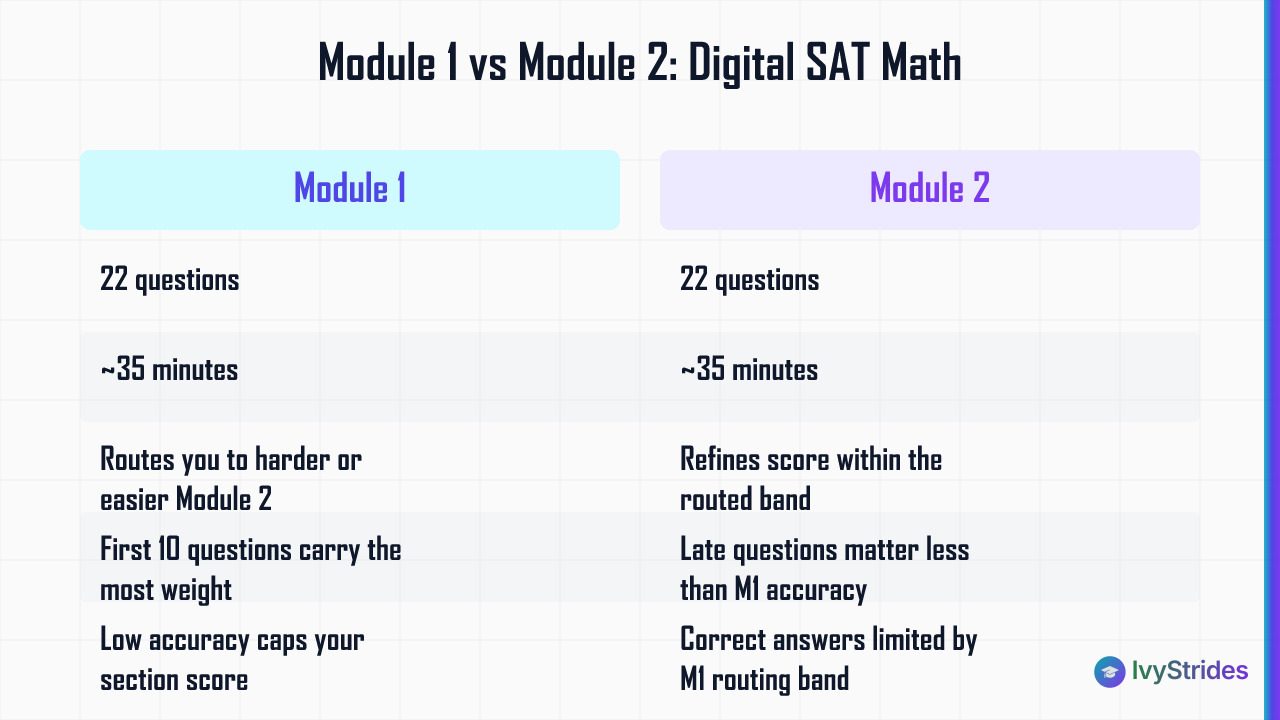
The Digital SAT Math section runs 44 questions in 70 minutes across two adaptive modules, per the College Board. Your work on the first module decides which second module you see, so early-question accuracy is the single highest-use variable in your plan.
Because Module 1 accuracy determines whether you route into the harder or easier Module 2, the first 10 questions of your Math section carry more weight than the last 10, and your study plan should reflect that. A student who scores below 600 on Module 1 routes to the easier Module 2, which caps the Math section score no matter how many Module 2 questions they answer correctly.
The score ceiling drives everything. That routing cap is why speed drills on hard late questions are the wrong first move. Fix your Module 1 accuracy before you touch anything else.
Practice the tool, not just the topic. The Desmos graphing calculator sits on every Math question, and as of the 2026-27 update, students can resize the embedded calculator, per the College Board. Fluency with it saves real time, but only if you drilled it before test day.
| Module | Questions | Time | What It Determines |
| Module 1 | 22 | ~35 min | Routes you to harder or easier Module 2 |
| Module 2 | 22 | ~35 min | Refines score within the routed band |
| Full section | 44 | 70 min | Section score, 200 to 800 |
Only the Bluebook app replicates this adaptive routing in practice, so a paper worksheet can't tell you whether you'd clear the Module 1 threshold. Do this next: open Bluebook, take one full-length test, and note your Module 1 accuracy before anything else.
Which Digital SAT Math Topics to Drop and Which to Redo by Score Band
The four SAT Math content domains are the Algebra domain, the Advanced Math domain, Problem-Solving and Data Analysis, and Geometry and Trigonometry, per the College Board. They carry different weights, and that weighting is your triage rule.
The four SAT Math domains are not equally weighted: the Algebra domain and Advanced Math domain together account for roughly 70% of questions, which is why a student below 650 who spends three weeks on trigonometry is trading points for coverage. For most students below 700, time spent on complex numbers returns fewer points than the same time on linear equations. That's not a knock on hard topics. It's arithmetic on where the questions actually sit.
High yield holds across every band. Linear equations, systems of equations, quadratics, percent and ratio problems, and data interpretation appear on every test regardless of routing. An 800 on SAT Math is roughly a top-1% score, and a 700+ sits near the top 10%, so the triage below scales to where you actually are.
| Score Band | Drill First (High Yield) | Redo If Time Allows | Drop (Low Yield Here) |
| Below 550 | Linear equations, ratios, data reading | Systems, basic quadratics | Trigonometry, complex numbers |
| 550 to 650 | Systems, quadratics, percent problems | Function notation, geometry | Complex numbers, advanced trig |
| 650 to 750 | Advanced Math, nonlinear systems | Circle geometry, right triangles | Imaginary-number arithmetic |
| 750+ | Hardest Advanced Math, edge cases | Trigonometry, all Geometry | Nothing; coverage matters here |
For a full domain-by-domain breakdown to build your drill list, see our guide to SAT math topics. Do this next: pull your diagnostic errors, tag each by domain, and circle the two domains with the most misses.
How to Build Your Digital SAT Math Week-by-Week Schedule
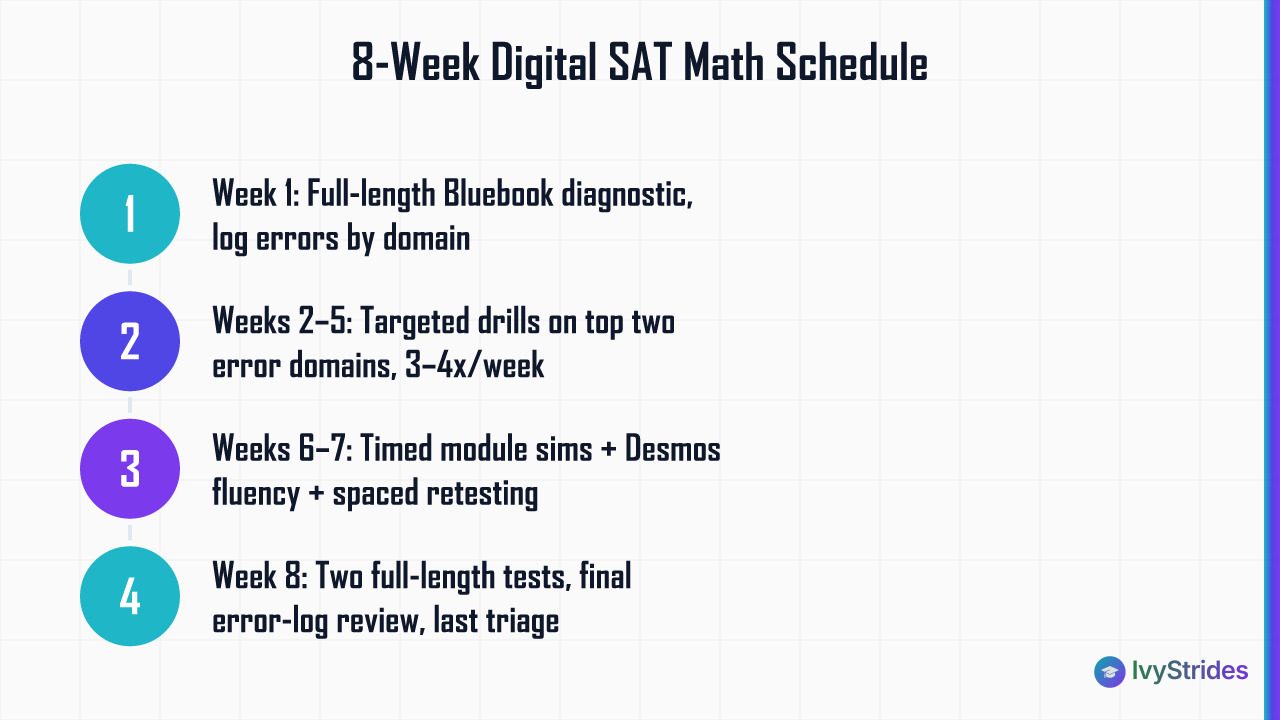
A realistic Digital SAT Math plan runs about 8 to 12 weeks at roughly 10 to 15 hours per week, sequenced from diagnostic to drills to timed simulation. Those two weakest domains from the triage table get the hours; ordering the weeks right beats piling on more of them.
Free official practice anchors the whole plan. Full-length Bluebook tests and the College Board Student Question Bank, which filters by domain and difficulty, are both free, per the College Board. You don't need a paid question set to start. You need the discipline to work from your own error data.
Here's the phase sequence for an 8-week build:
-
Week 1: Full-length Bluebook diagnostic. Log every wrong answer by content domain. No studying yet, just measuring.
-
Weeks 2 to 5: Targeted drills on your top two error domains, 3 to 4 sessions per week, pulled from the question bank by domain and difficulty.
-
Weeks 6 to 7: Timed module simulations, 22 questions in about 35 minutes, plus Desmos fluency drills and spaced retesting on the topics you drilled in weeks 2 to 5.
-
Week 8: Two full-length practice tests spaced about a week apart, a final error-log review, and a last triage of anything still shaky.
Logging each wrong answer as either a content gap or a pacing error is what separates students who improve on a retake from those who plateau. Stretch this to 12 weeks by widening the drill phase, not by adding a third domain too early.
For a schedule you can adapt across a longer horizon, see our 3 month sat study plan templates. For downloadable material, our sat prep book 2026 pdf roundup collects the official routes. Do this next: block four 90-minute sessions into next week's calendar and label each with a domain.
How to Turn SAT Math Practice Into Real Score Gains Before Test Day

Photo by https://kaboompics.com/ on Pexels
Three habits convert a Digital SAT Math plan into actual points: the error log, spaced retesting, and Desmos fluency. Everything else is passive review, and passive review is exactly what keeps a plan from moving a score.
The error log does the heavy lifting. Categorize each wrong answer as a content gap or a pacing error, because the fixes run opposite. In our coaching with students in the 550-650 band, the most common cause of a plateau is re-reading notes rather than retesting flagged question types under timed conditions. Our SAT mistake tracker gives you the categorization template to run this properly.
Spaced retesting means revisiting flagged question types every 7 to 10 days, not once. Desmos fluency is concrete: practice graphing parabolas to read a vertex, solving systems, and evaluating functions before test day. Students who drill these consistently save roughly 30 to 60 seconds per relevant question compared to those who meet Desmos cold. Across students we've coached from below 600 to above 700, the single highest-use change was shifting from topic-list studying to domain-error triage from a real Bluebook test.
Run this weekly checklist:
- One full-length or module simulation under timed conditions
- Error log updated, each miss tagged content gap or pacing error
- Two domain drill sessions on your top error category
- One spaced-retest session on a topic from two weeks ago
- Ten minutes of Desmos drills: parabola vertex, systems, functions
- One review pass of last week's flagged questions
- A quick note on pacing: are you clearing Module 1 with time to check?
If your score has stalled despite a structured plan, that plateau is the signal a self-directed approach has hit its limit. A section-specialist SAT Math coach can spot whether the gap is content, pacing, or Desmos habit, then adjust the plan in real time, which is what 1-on-1 SAT Math prep is built for. Remember that a strong Math score is one component of the full application, and test-optional policies vary by school and year.
FAQ: Digital SAT Math Study Plans
How to create an SAT study plan?
Start with a full-length Bluebook practice test to get a real baseline score. Sort wrong answers by content domain, name your top two error categories, and build a week-by-week schedule that drills those domains first. Retest them every 7 to 10 days, and add a timed full-length simulation every two weeks.
What is the best way to study for the digital SAT?
The most effective approach combines a diagnostic baseline from the Bluebook app, domain-specific drills on your two highest-error areas, deliberate Desmos practice, and spaced full-length simulations every 10 to 14 days. Studying from a topic list without a diagnostic first is the most common reason scores plateau. The adaptive routing means early accuracy matters most.
How rare is a 800 SAT Math?
An 800 on SAT Math is roughly a top-1% score. According to College Board percentile data, fewer than 1 in 100 test-takers reach a perfect Math section score. For most students targeting selective colleges, a 750+ is the more practical benchmark and is reachable with roughly 10 to 12 weeks of targeted prep.
How many hours per day should I study for the digital SAT?
Most students benefit from 90-minute focused sessions, four to five days per week, rather than long daily marathons. Over an 8 to 12 week plan, that totals roughly 50 to 90 hours of structured prep. Consistency and error-log review matter more than raw hours.
Your Next Step on Digital SAT Math
A working Digital SAT Math plan is diagnostic-first and score-band-specific, ordered so Module 1 accuracy and your two weakest domains get the hours, not whatever topic feels most intimidating.
- Take one full-length Bluebook test this week and record your Module 1 accuracy.
- Tag every wrong answer by content domain and circle your top two.
- Drop complex numbers and advanced trig if you're below 700; drill linear equations, systems, and data first.
- Retest flagged question types every 7 to 10 days and run a timed module simulation before test day.

Two decades teaching quantitative and verbal aptitude on standardized tests. Rare dual expertise across Math and Verbal — particularly effective for students with gaps on both sides. Senior AP Mentor for our Calculus and English tracks.