
How Long Should You Study for the ACT? How to Plan Your Prep Time
On this page
- How Long Is the ACT and Why the Format Shapes Your Prep Plan
- What Your ACT Starting Score Tells You About Study Time
- How Many ACT Study Hours Does Your Score Gap Actually Require
- How to Build Your ACT Study Schedule Around Real Test Dates
- FAQ: ACT Study Time and Score Benchmarks
- Is 2 months enough to study for ACT?
- Is getting a 33 on the ACT hard?
- Is 27 out of 36 a good ACT score?
- How many hours a day should you study for the ACT?
- Your Next Step on ACT Prep
How long you should study for the ACT depends on three things: the gap between your diagnostic Composite and your target, how many sections sit below target, and the weeks left before your test date. The ACT is a 125-minute core exam of English, Math, and Reading, scored on a 1 to 36 Composite. A student with one weak section and a small gap needs less time than one with three weak sections and a large gap.
No single hour count fits every student, and any plan works only once you know your real starting point. ACT, Inc. publishes the format and scoring behind every figure here, so the honest first move is a timed, full-length practice test.

How Long Is the ACT and Why the Format Shapes Your Prep Plan
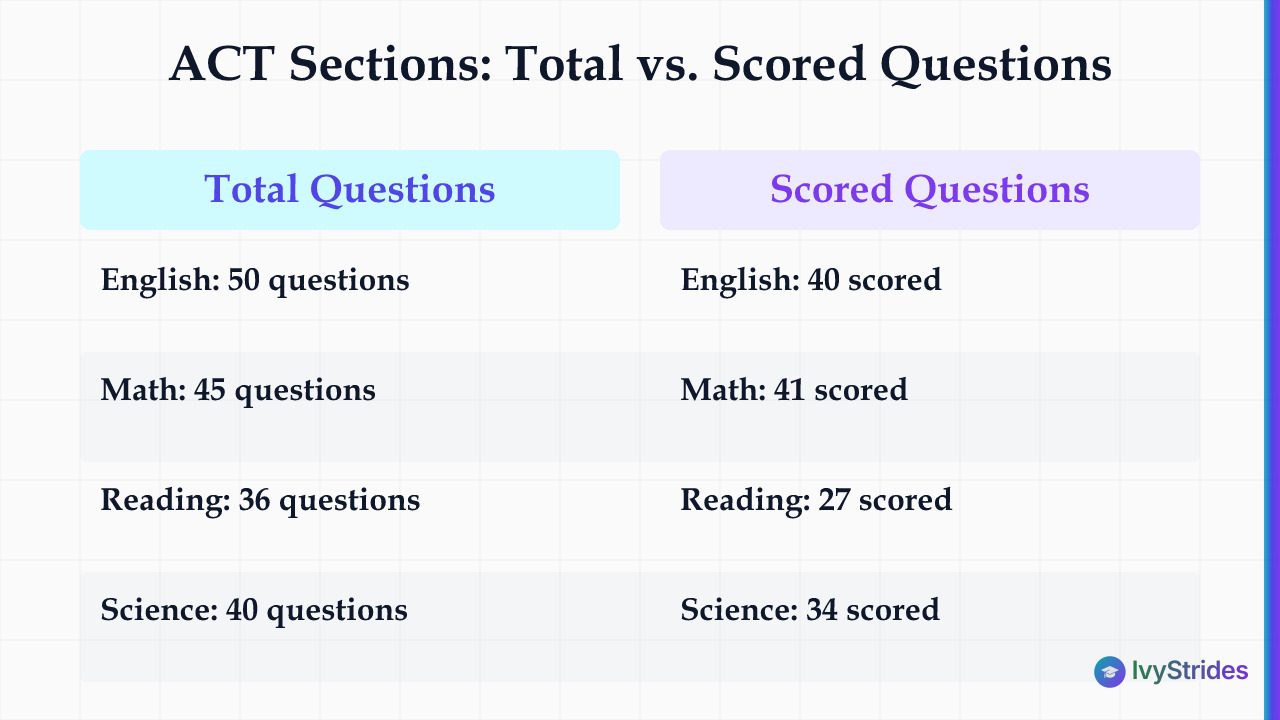
The enhanced ACT core runs 131 questions in 125 minutes across English, Math, and Reading, per ACT, Inc.. The ACT is a timed, multiple-choice college admissions test scored on a 1 to 36 scale, and the format decides how you should pace your practice.
That 125-minute window matters because not every question you answer counts. The ACT embeds unlabeled field-test items in each multiple-choice section, so the scored count sits below the total you see on test day.
| Section | Questions | Scored | Time | In Composite? |
| English | 50 | 40 | 35 min | Yes |
| Math | 45 | 41 | 50 min | Yes |
| Reading | 36 | 27 | 40 min | Yes |
| Science (optional) | 40 | 34 | 40 min | No |
| Writing (optional) | 1 essay | - | 40 min | No |
Composite math. The ACT Composite is the average of English, Math, and Reading, rounded to the nearest whole number. Science earns a separate score and a STEM score; it does not touch the Composite. The Writing score, reported on a 2 to 12 scale, does not affect it either.
One quieter change: enhanced ACT Math questions offer four answer choices instead of five, per ACT, Inc. That raises the odds on an educated guess and rewards clean process of elimination, so build the four choices and the lower scored counts into your pacing targets.
What Your ACT Starting Score Tells You About Study Time

Photo by Andy Barbour on Pexels
Your starting score, measured on the same 1 to 36 Composite scale, sets how many hours you need, not the calendar. Before you can answer how long to study, you need a real starting number: a timed, full-length practice ACT under test conditions is the baseline to plan from. Begin by running a timed diagnostic rather than a section you did last week.
A diagnostic does more than hand you a Composite. It tells you which of the three scored sections is holding you down, and that is the section that decides your hours.
| What the diagnostic shows | What it means for your plan |
| Composite well below target | Larger total hours; expect a longer prep window |
| One section far behind the others | Front-load that section; it has the most room to improve |
| Even scores, small gap | Fewer hours, mostly pacing and error review |
| Running out of time on sections | Pacing work before new content |
Why scored counts drive pacing. You answer 50 English questions but only 40 are scored; you answer 36 Reading questions but only 27 count. You can't tell which is which on test day, so you pace for the full set. In Reading, that means practicing all 36 questions inside 40 minutes, not slowing down because you assume some are throwaways.
For context on the target you set: the national mean Composite is 19.1 on ACT's 2026-27 national ranks. A higher target can be worth extra hours when it clears the Composite threshold some universities set for automatic merit awards, so weigh that payoff before you fix your number.
How Many ACT Study Hours Does Your Score Gap Actually Require
There is no fixed number of ACT study hours: your score gap, the distance from your diagnostic Composite to your target, sets the total, and the calendar is a second, separate lever. A larger gap demands more hours, and hours-per-week times weeks has to add up to that total. Those are two choices you make independently.
Treat them as separate dials. A reader with a modest gap and a test date months away can study lightly each week; the same reader with a test date a few weeks out needs more hours each week to reach the same total. IvyStrides' analysis of ACT's section table, 131 core questions in 125 minutes, puts the average pace at about 57 seconds per question. English gives you less time per question than Math and Reading, so time every practice set against its own section limit.
Get your Daily IV Dose on Instagram: quick study tips and test-day advice for high school students. Follow @ivy.strides.
Is two months enough? It depends on the size of your gap, how many of the three scored sections are weak, and how much time is left before your test date. A small gap in one section fits a two-month window more easily than a large gap spread across all three. When the gap is large, consider a later test date or a planned second sitting rather than packing more hours into each week.
Deciding which section to work on first comes before deciding the hours. In IvyStrides' 1-on-1 ACT prep, a diagnostic test sets the baseline and the focus areas for a custom ACT study roadmap, session frequency and section emphasis are tuned weekly as results come in, and the pace follows the student's retake window or target test date rather than a fixed class calendar.
Here are the signs your timeline is too short:
- Your diagnostic gap is large and your test date is close
- Two or three sections, not one, sit below target
- You're scoring below the national mean and aiming well above it
- You keep running out of time mid-section
- School, sports or work leave few open hours in your week
- Your test date leaves no room for a retake before your application deadlines
If two months is your window, lay the two months out week by week: open with the diagnostic, give the middle weeks to your weakest section, and keep the final weeks for full-length timed tests with error review. How you spend the hours matters as much as the count, so weigh live sessions against self-paced study before you lock the format in.
How to Build Your ACT Study Schedule Around Real Test Dates
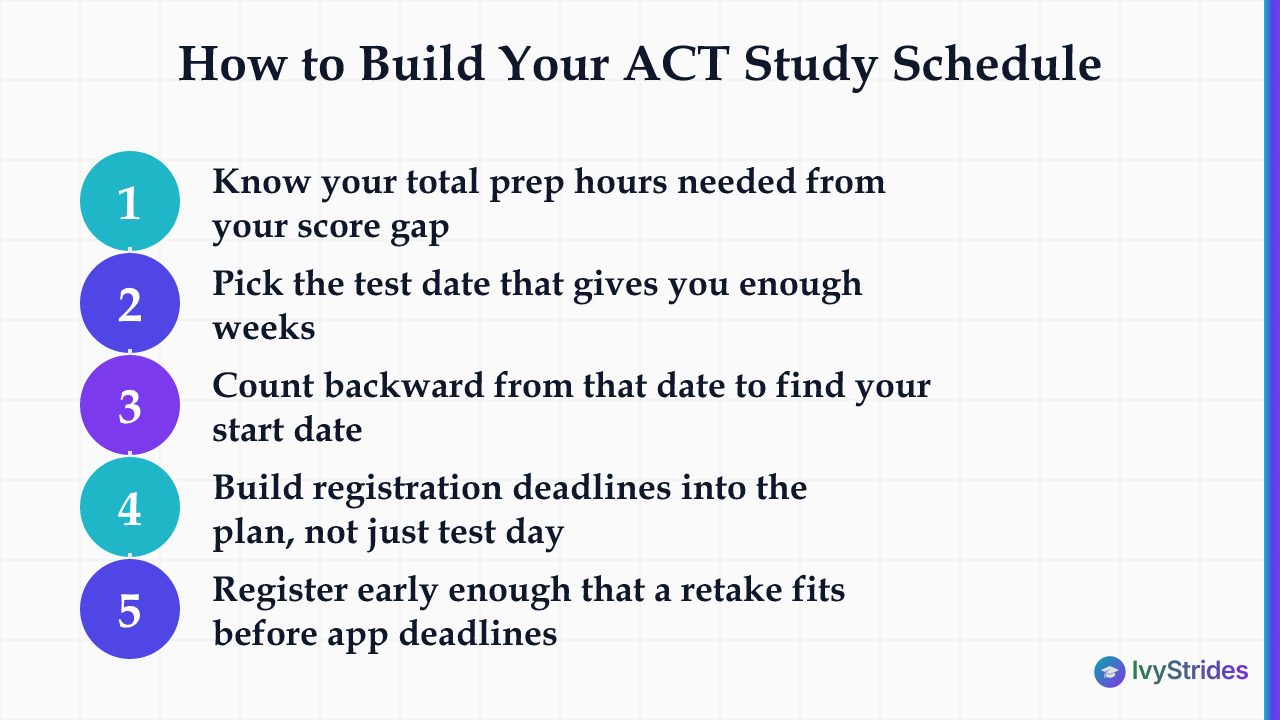
The 2026-27 ACT calendar offers seven national test dates; the five from December 12, 2026 onward are in the table below, and each one anchors a prep window you count backward from. Once you know your total hours, you pick the date that gives you enough weeks to spend them, then work the calendar in reverse.
Start from the date, subtract your prep weeks, and that lands you on a start date. Miss the regular deadline and late registration adds $42.00 to your cost, so build the deadline into the plan, not just the test day.
| Test Date | Regular Registration Deadline | Late Registration Deadline |
| December 12, 2026 | November 9, 2026 | November 29, 2026 |
| February 27, 2027 | January 22, 2027 | February 9, 2027 |
| April 10, 2027 | March 5, 2027 | March 23, 2027 |
| June 12, 2027 | May 7, 2027 | May 25, 2027 |
| July 10, 2027 | June 4, 2027 | June 22, 2027 |
Leave room after the test, too: each 2026-27 ACT date has its own score release window, and your scores have to reach colleges before their deadlines.
Plan the retake before you need it. If your first sitting falls short, ACT's superscore, a Composite built from your best English, Math, and Reading scores across all your test dates, means a focused second attempt on your weakest section can still raise it. Not every college superscores the ACT, so check each school's policy, and register for a first date early enough that a retake fits before your application deadlines.
With a tight window, build the plan around your weakest section rather than a generic schedule. Once the date is set, turn the weeks you have into a study plan that starts from your diagnostic and gives each session one section and one task.
One caveat worth holding: test-optional policies vary by school and year, and a strong ACT is one lever in an application, not the whole case. A good Composite helps; it does not decide admission on its own.
FAQ: ACT Study Time and Score Benchmarks
Is 2 months enough to study for ACT?
It can be, depending on three things: how far your diagnostic Composite sits from your target, how many of the three scored sections are weak, and how much time is left before your test date. A small gap in one section fits two months more easily; a large gap across two or three sections points to a later test date or a planned retake.
Is getting a 33 on the ACT hard?
A 33 places a student at the 98th percentile on ACT's 2026-27 national ranks, so few test takers score higher. How hard it is for you depends on your starting score and on which sections sit below 33, so put the work into those sections and the errors your practice tests reveal, not into repeat full tests alone.
Is 27 out of 36 a good ACT score?
A 27 Composite sits at the 89th percentile on ACT's 2026-27 national ranks. ACT notes that some universities expect scores in the 30s while others consider the mid-20s competitive, so whether a 27 clears your bar depends on the enrolled-student score range at each school on your list.
How many hours a day should you study for the ACT?
No set daily figure fits everyone. Spread the work your plan needs across the days left before your test date, keep sessions regular rather than saving everything for one weekend block, and include full-length timed tests so your pacing holds for the whole 125-minute core.
Your Next Step on ACT Prep
You now have the tool that matters: your hours follow your score gap, and your calendar follows your hours. The order is fixed, and skipping the first step leaves the rest guesswork.
- Take a timed, full-length ACT under test conditions to find your true starting Composite.
- Subtract that from your target to get your score gap, and name the section pulling you down.
- List the sections below target, then set the weekly hours you can keep up.
- Pick a 2026-27 test date that leaves enough weeks for that work, plus room for a retake, and register before its regular deadline.
Daily SAT and ACT prep on YouTube: short strategy videos from IvyStrides. Subscribe to IvyStrides on YouTube.

Rajesh is a technology leader, entrepreneur, and angel investor with 28+ years in Business & Technology Leadership and Product & Solution Engineering. He is passionate about education, mentoring, and driving digital transformation.