
Homeschooled Applicants: How to Take the SAT and PSAT and Show Rigor to Selective Colleges
On this page
- Does Homeschooling Hurt College Admissions? What Colleges Actually Say
- How Homeschoolers Register for the SAT and PSAT at Authorized Test Centers
- What Selective Colleges Want From a Homeschool Application
- A Grade-by-Grade Testing Plan for Homeschooled Students
- FAQ: Homeschool College Admissions
- How hard is it for homeschoolers to get into college?
- Do colleges favor homeschoolers?
- What percentage of homeschooled students go to college?
- Does homeschooling look bad to colleges?
- Your Next Step as a Homeschool Family
Homeschooled students can apply to and attend selective US colleges. A homeschool applicant is a student whose school record comes from home instruction rather than an institution, so the family supplies what a school would provide automatically: a parent-made transcript, a description of the curriculum and grading, and outside evidence such as SAT, ACT, or AP scores.
MIT, for one, has no separate requirements for homeschooled applicants and considers them within their context, including their schooling choice (MIT Admissions).
Does Homeschooling Hurt College Admissions? What Colleges Actually Say
Homeschooling does not hurt college admissions when the application file carries external validation. What slows a review is a file with no verifiable evidence of achievement.
Three validators do the work. The first is a standardized test score, SAT or ACT. The second is AP exam results. The third is dual enrollment, meaning community college or university courses taken during high school; MIT says the vast majority of its admitted homeschoolers took advanced classes outside the homeschool, such as at a local college or online. Each one is scored or graded by someone other than the parent, which is the whole point.
Test-optional does not mean test-irrelevant. Test-optional policies vary by school and year (FairTest), and for a homeschooled applicant an SAT or ACT score is one of the few data points in the file that no family member graded. Homeschoolers sit AP exams at a local school authorized to give them (College Board). Schools submit AP exam orders by mid-November, but a school can still add a homeschooler after that deadline at its discretion.
AP scores run 1 to 5, and College Board rates a 3 as qualified for college credit and placement (College Board AP Program). Credit and placement policies vary by college. The course itself can be studied at home or through an online AP class, and the exam in May is the same AP exam either way.
| Validator | What It Shows | How to Access It | Caveat |
| SAT or ACT | General readiness, scored externally | Register with College Board or ACT | Test-optional policy varies by school |
| AP exams | Subject mastery, scored 1 to 5 | Test at an authorized local school | Credit policy varies by college |
| Dual enrollment | College coursework, outside grades | Enroll at a local community college | Transfer credit varies by college |
| PSAT/NMSQT | National Merit screening data | Ask a participating school to include you | Counts in the National Merit entry year, usually grade 11 |
More than 1,200 member colleges accept the Common App (Common App), and admissions outcomes depend on the full application, not test scores alone.
How Homeschoolers Register for the SAT and PSAT at Authorized Test Centers
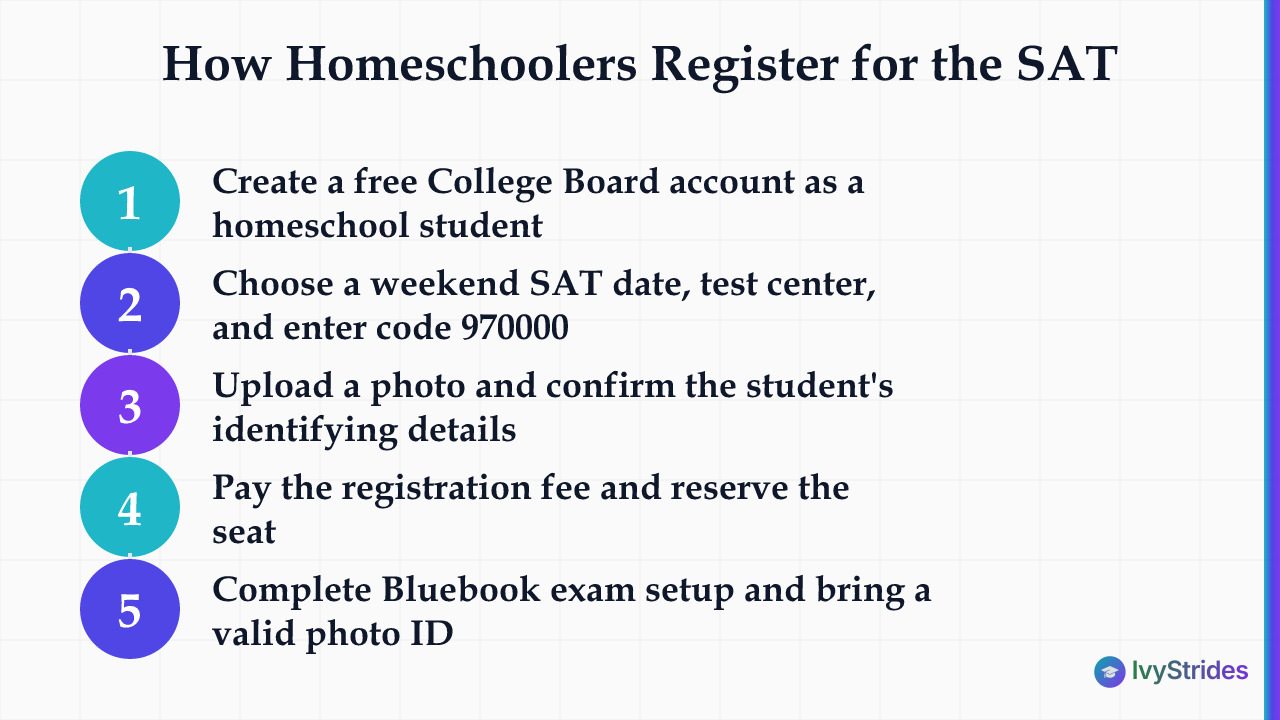
Homeschool students register for the SAT online through a College Board account and enter 970000 as the high school code (College Board). The digital SAT is a 2-hour-14-minute adaptive exam of 98 questions scored on a 400 to 1600 scale (College Board). The PSAT/NMSQT works differently.
Those 98 questions split into Reading and Writing, 54 questions in 64 minutes across two modules, and Math, 44 questions in 70 minutes across two modules. Open weekend dates: December 5, 2026 (deadline November 20, late registration November 24), March 6, May 1 and June 5, 2027.
-
Create a free College Board account, checking "I am no longer in high school/My school is not listed" when asked where you go to school.
-
Choose a weekend SAT date and a nearby test center, and enter the homeschool code.
-
Upload a photo and confirm the student's identifying details.
-
Pay the registration fee and reserve the seat.
-
Before test day, complete exam setup in Bluebook to get the admission ticket, and bring an acceptable photo ID.
The PSAT is not self-service. Homeschoolers cannot take the PSAT/NMSQT at home, so the National Merit Scholarship Corporation (NMSC) tells them to contact a local high school as early as possible, and each school's officials decide whom it tests (NMSC Guide). College Board tells homeschoolers to reach participating schools at least four weeks before the testing window begins, earlier where the district sets its own deadline (College Board).
College admissions insights on LinkedIn: follow IvyStrides for application guidance and counseling updates.
The PSAT/NMSQT mirrors the SAT: the same multistage adaptive design and the same 2 hours and 14 minutes of testing, 98 questions in all (College Board). It scores on a 320 to 1520 scale, which makes a junior-year score a baseline for SAT planning, not a prediction.
For National Merit, the score report also carries a Selection Index, which NMSC computes "by doubling the Reading and Writing section score, adding the Math section score, and dividing the total by 10" (NMSC Guide). IvyStrides' analysis of that formula against College Board's 160-to-760 range for each PSAT/NMSQT section reproduces the published 48-to-228 scale (160 on both sections gives 48; 760 on both gives 228) and shows that each Reading and Writing point carries twice the weight of a Math point (College Board).
NMSC uses that index to screen entrants, and its qualifying scores vary from year to year and from state to state, so any cutoff quoted before NMSC announces it is an estimate. The fall 2026 testing window closed on October 30, so a homeschooled sophomore can start lining up a participating school for next fall's PSAT/NMSQT. A junior who missed the 2026 test because of illness, an emergency, or another extenuating circumstance can still write to NMSC to request alternate entry, postmarked by April 1, 2027.
What Selective Colleges Want From a Homeschool Application

Photo by Kaboompics.com on Pexels
Four documents carry a homeschool application: a transcript with course descriptions, a school profile, the counselor forms, and outside scores or grades.
The transcript needs translation. A homeschool transcript lists course titles, grades, credit hours, and a clear explanation of the grading scale, because an admissions reader can't assume an A means the same thing it does at a conventional school. The school profile sits alongside it: a one-page description of curriculum philosophy, sequencing, and grading approach that gives the transcript context.
On the Common App, the student invites the home school supervisor, such as a parent, as the school counselor (Common App). The supervisor then completes the School Report a counselor would normally submit, which adds home school questions on the educational philosophy and setting, the grading scale, coursework outside the transcript, and extra testing.
Most letters come from outside the family. MIT welcomes a recommendation from a parent but requires at least three in total, usually a counselor and two teachers, and names summer program mentors and job supervisors as good recommenders (MIT Admissions). College Board's advice points the same way: ask one of the student's course instructors for a letter, since colleges prefer that this writer not be the parent (BigFuture).
The Common App personal essay runs to a 650-word maximum, and Common App kept its seven prompts unchanged for 2026-27 (Common App).
Homeschool Application File Checklist for Selective Colleges
- Transcript with course titles, grades, credit hours, and the grading scale explained
- One-page school profile covering curriculum philosophy and sequencing
- School Report and counselor letter from the home school supervisor
- SAT or ACT score, submitted where a strong result helps
- AP exam results and any dual-enrollment transcript
- Recommendation letters from instructors, mentors, or supervisors outside the family
- Common App personal essay within the 650-word maximum
A Grade-by-Grade Testing Plan for Homeschooled Students
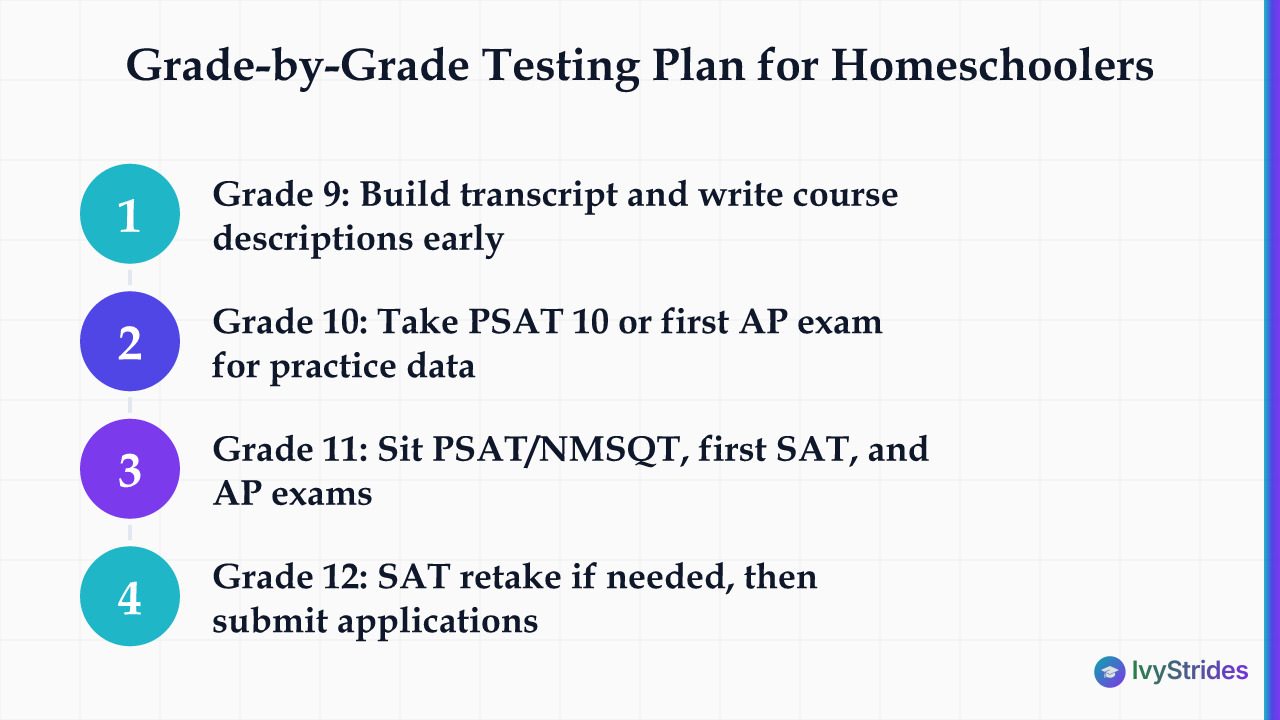
A homeschool testing plan spreads the SAT, PSAT, and AP across grades 9 through 12 so no single year carries everything. Timing matters most for the PSAT/NMSQT, the qualifying test for the National Merit Scholarship Program (College Board): NMSC requires a student spending the usual four years in high school to take it in the third year, usually grade 11, and a sophomore who tests for guidance must test again as a junior to enter (NMSC Guide).
Start documentation early. In 9th grade the priority is not a test but a habit: write course descriptions as you finish each course, while the detail is fresh. IvyStrides' grade-by-grade college counseling in 9th and 10th grade puts that early start in writing: a four-year course map and a first activity plan in grade 9, then a testing recommendation in grade 10.
| Grade | Key Test or Task | Window | Why It Matters |
| 9 | Build transcript and course descriptions | Ongoing | Detail fades if logged later |
| 10 | PSAT 10 or first AP exam if ready | Spring / May | Early practice data |
| 11 | PSAT/NMSQT, first SAT, AP exams | Fall / spring | NMSC entry year for most students |
| 12 | SAT retake, submit applications | Fall | Early deadlines arrive first |
Junior year is the pivot. Grade 11 carries the National Merit PSAT sitting, a first SAT to generate a real score, and AP exams that validate subject rigor. A junior SAT leaves senior year open for one targeted retake rather than a scramble.
In 12th grade the work shifts to applications. Map your testing milestones against each college's deadlines, including when essays need a finished draft. If no one in the family has been through US admissions, expect the same knowledge gaps that first-generation applicants work through, from fee waivers to deadlines.
FAQ: Homeschool College Admissions
How hard is it for homeschoolers to get into college?
Homeschooling is not a disqualifier, but it does require more deliberate documentation. MIT, for example, has a long history of admitting homeschooled students, and a file with SAT or ACT scores, AP results, and a well-written school profile supplies what a school otherwise would.
Do colleges favor homeschoolers?
Each college sets its own policy, and MIT, for one, has no separate requirements for homeschooled applicants. College Board's guidance adds that admission officers accept recommendation letters from any adults influential in a homeschooled student's life.
What percentage of homeschooled students go to college?
NCES's homeschooling statistics count how many students are homeschooled, not how many go on to college (NCES). One selective college publishes its own share: homeschooled applicants make up less than 1% of MIT's applicant pool and less than 1% of its student body.
Does homeschooling look bad to colleges?
Homeschooling does not look bad when the file is complete and externally validated. An incomplete file, with no test scores, no AP or dual-enrollment record, and a vague school profile, raises questions a traditional transcript would answer automatically. The fix: take the SAT or ACT, sit AP exams in your strongest subjects, and submit a detailed school profile with the application.
Your Next Step as a Homeschool Family
Start assembling the file long before applications open:
- Log course descriptions as each course finishes, starting in 9th grade.
- Create a College Board account and take a full-length Bluebook practice test.
- Contact a participating school about a PSAT/NMSQT seat at least four weeks before the fall window.
- Identify the AP exams or dual-enrollment courses that will validate rigor.
- Draft the one-page school profile that explains your curriculum and grading scale.
Watch the method, then try it: IvyStrides explains SAT and ACT question types on YouTube.

Hemant is a seasoned entrepreneur, investor, and growth strategist with deep ground in education and technology-driven learning. His core training is in Mathematics and Physics — he authored Physics for IB Diploma: Ultimate Revision Guide, recognized as a top student resource.