
The SAT for International Students: Dates, Centers, and US Admissions (2026)
On this page
- What the Digital SAT Is and Why It Matters for International Applicants
- 2026 SAT Test Dates and Registration Deadlines for International Students
- How Much Does the SAT Cost for International Students
- Do International Students Actually Need the SAT for US Admissions
- What SAT Score Do International Students Actually Need
- Is the International SAT Harder Than the US Version
- How International Students Should Prepare for the SAT
- How the SAT Fits Into Your US College Application Strategy
- FAQ
- Can international students register for the SAT from any country?
- Is a 1200 SAT score competitive for US college admissions as an international student?
- How many times can an international student take the SAT?
- Are SAT fee waivers available for international students?
- Does submitting an SAT score hurt an international applicant at a test-optional school?
- Is the SAT harder than IELTS for international students?
- Your Next Step
International students register for the Digital SAT through the College Board International Testing portal. The total cost is $111 in most regions: a $68 base fee plus a $43 international surcharge. In 2026, international test dates typically fall in March, May, August, October, and December, with the August 22, 2026 sitting confirmed and registration closing August 7. The exam itself is identical to the version US students take: 2 hours 14 minutes, two adaptive sections (Reading and Writing; Math), scored 400 to 1600. Competitive US universities generally expect scores in the roughly 1300 to 1550+ range depending on selectivity.
These fee and date figures come directly from College Board's international testing pages, cited section by section below. The harder questions come next: whether you need the SAT at all in a test-optional era, what score actually clears the bar at your target schools, and how to prep efficiently from outside the US.
What the Digital SAT Is and Why It Matters for International Applicants
The Digital SAT is a 2 hour 14 minute exam delivered on College Board's Bluebook app at authorized test centers worldwide. It has two sections. Reading and Writing runs 64 minutes across 54 questions split into two adaptive modules. Math runs 70 minutes across 44 questions, also split into two adaptive modules. Total scale: 400 to 1600.
Here's what "adaptive" means in practice. Module 1 of each section is a mixed-difficulty set. Your performance on Module 1 determines whether Module 2 pulls from a harder or easier question pool. A stronger Module 1 unlocks a higher scoring ceiling in Module 2. That single fact reshapes how international students should pace the first 32 minutes of R&W and the first 35 minutes of Math.
There is no separate "international version" of the SAT. Every test-taker sits the same Bluebook exam, uses the same built-in Desmos calculator, and is scored on the same scale, per College Board's international testing page. If you've heard rumors that the international SAT is harder or uses recycled forms, that was true of the pre-2023 paper version. It isn't true of the Digital SAT.
Why does the score still matter when so many US schools went test-optional? Because "test-optional" isn't "test-blind." Applicants who submit strong scores are admitted at meaningfully higher rates than non-submitters at most test-optional schools that publish this breakdown in their Common Data Set. For international students especially, whose transcripts come from dozens of grading systems (IB, A-levels, CBSE, Abitur, national curricula), an SAT score is often the one apples-to-apples signal an admissions reader has. For a fuller walkthrough of section timing, see how long is the SAT. For the full IvyStrides approach, our SAT prep overview covers the methodology.
2026 SAT Test Dates and Registration Deadlines for International Students
International SAT administrations in 2026 fall in the standard windows: March, May, August, October, and December. Specific dates and center availability vary by country, so the schedule you see in Delhi isn't identical to the one in Lagos or São Paulo. The confirmed August sitting is Saturday, August 22, 2026, with registration closing August 7, 2026, per College Board's SAT Dates and Deadlines page. Verify every other date against that page before you commit, because release timing shifts year to year.
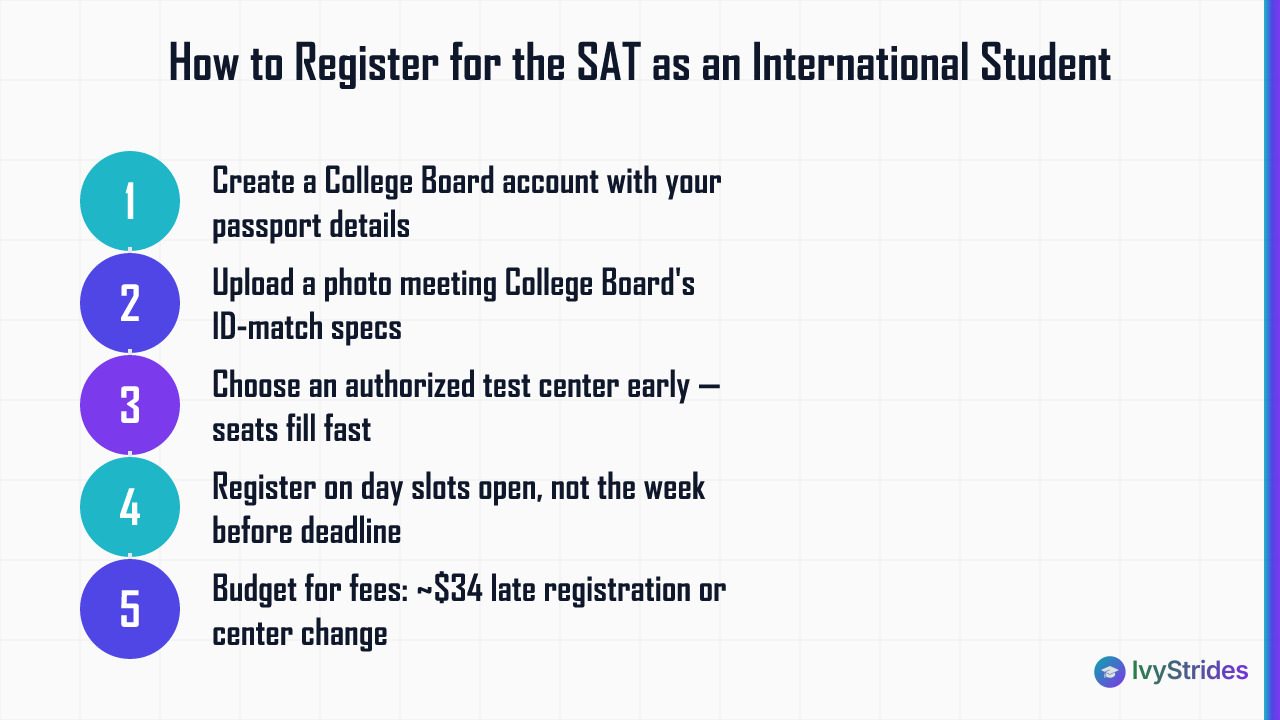
Registration itself is straightforward but has more moving parts than the US process. You'll need a College Board account, a photo that meets their ID-match specifications, and the exact name and date of birth from your passport. Choose your authorized test center during registration; international seats fill faster than domestic ones, particularly in India, mainland China, South Korea, and the UAE, where demand outpaces capacity in most cycles. Registering the day slots open, not the week before deadline, is the difference between sitting in your city and flying to a neighbouring country.
Two costs to plan for beyond the base fee: late registration adds roughly $34, and switching your test center after you register also runs about $34. Verify both figures on College Board's fee page before you register, since they update periodically.
For the full US and international schedule side by side, see our SAT test dates 2026 guide, which covers every registration deadline and score release date through the 2026–2027 cycle. International test centers fill up faster than domestic ones; if your preferred center is already full, our guide on what to do if SAT test centers are full walks through practical alternatives. The full step-by-step registration walk-through lives in our SAT exam registration guide.
How Much Does the SAT Cost for International Students
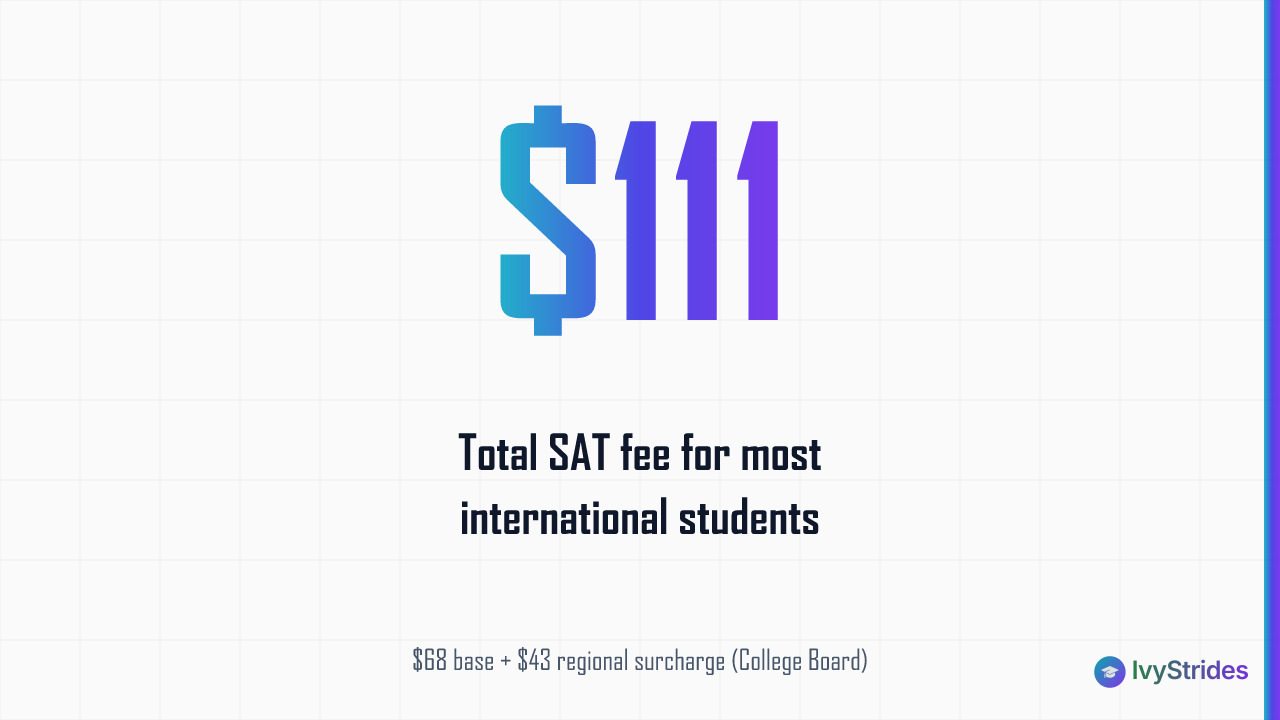
For most international students, the total is $111: $68 base registration plus a $43 regional surcharge, per College Board's international fees page. A handful of regions carry a slightly different surcharge; the portal will show your exact total during registration.
Beyond that base, the fees you might actually hit:
- Late registration: roughly $34 on top of the base if you register after the standard deadline.
- Test center change: about $34 if you switch centers after your original registration.
- Cancellation: around $34 if you cancel before the deadline. Verify this against the primary source before you rely on it.
- Score-send: the first four score sends are free if you designate them at registration. Each additional report costs $13.
SAT fee waivers exist, but they're primarily for US-based, income-eligible students. International students are generally not eligible for the standard College Board waiver. Some international schools have relationships with College Board that provide limited support, so ask your school counsellor whether anything applies to you before you assume you're paying the full sticker.
For a full breakdown of every fee line item, including score-send costs and refund rules, see our SAT fees and waivers guide. If you need to walk back a registration, how to cancel SAT registration covers the process and the refund window.
Do International Students Actually Need the SAT for US Admissions
Short answer: it depends on your list, but for competitive US universities in the 2026 cycle, yes, you almost certainly should submit an SAT score.
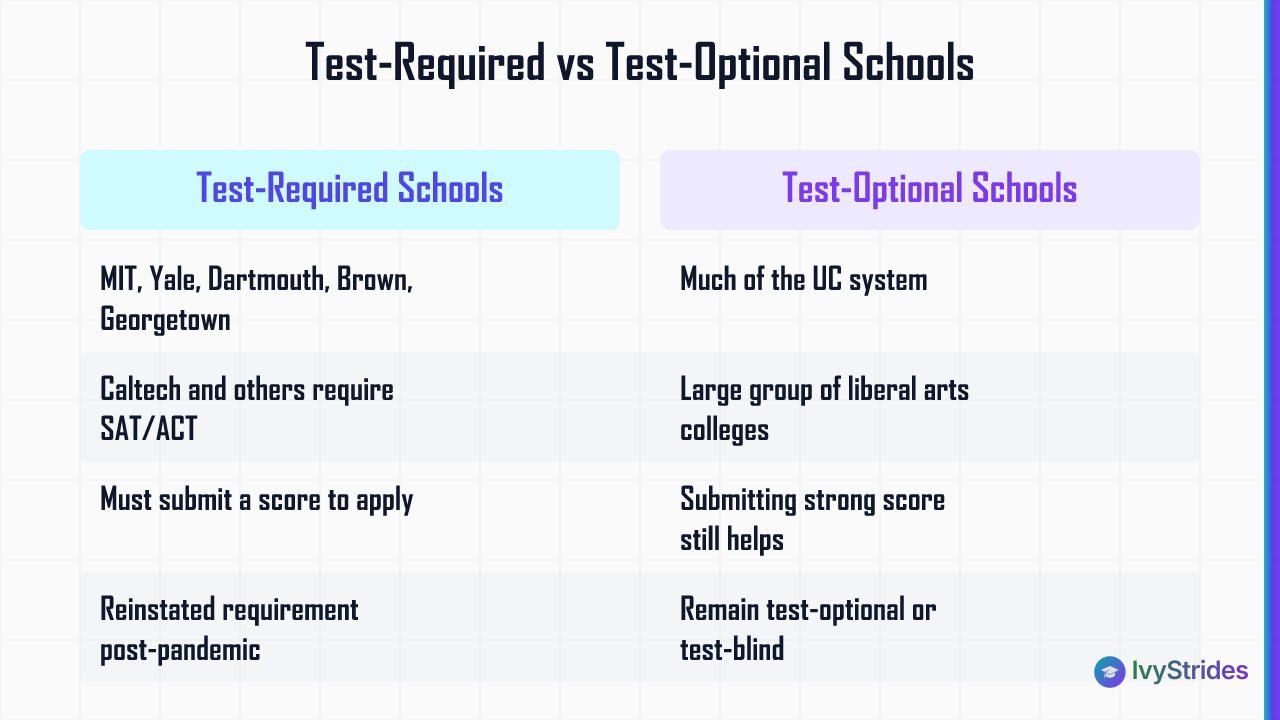
Several selective US universities that went test-optional during the pandemic have reinstated the requirement. MIT, Yale, Dartmouth, Brown, Georgetown, Caltech, and others require the SAT or ACT for the 2025–2026 cycle and beyond. Others, including much of the UC system and a large group of liberal arts colleges, remain test-optional or test-blind. Policies change; check FairTest for the current tracker and verify each of your target schools on its own admissions page before you decide whether to submit.
Here's the part most international students miss. At schools that remain test-optional, submitting a strong score still helps. Multiple published Common Data Sets show that applicants who submit test scores are admitted at higher rates than non-submitters, particularly in the top 30 to 50 range. The decision rule we use in our coaching: if your score sits within or above the school's published mid-50% score range, submit it. If it's meaningfully below, withhold under the test-optional policy where available.
The other reason the SAT matters more, not less, for international applicants: US admissions readers see transcripts from every grading system on Earth. An IB predicted 42, a CBSE 92%, and a UK A-level AAA aren't directly comparable. An SAT score is. Whether you're from an IB school in Singapore or a national curriculum school in Turkey, a 1450 tells a US reader roughly the same thing about your academic readiness. That common benchmark carries weight, especially at schools that see few applicants from your country. A top score also feeds into recognition programs for eligible domestic students, though National Merit consideration is limited to US-based PSAT/NMSQT takers, not international sitters.
For how test scores slot into the broader timeline, see college application deadlines.
One caveat worth stating plainly: no SAT score guarantees admission, and no missing score guarantees rejection. Admissions decisions turn on the whole application: transcript rigour, essays, recommendations, extracurriculars, demonstrated interest, and, yes, test scores. The SAT is one signal among several.
What SAT Score Do International Students Actually Need
Score benchmarks by university tier, framed as mid-50% score ranges (the middle half of admitted students). Verify each school via its current Common Data Set before finalizing your target.
- Highly selective (Ivy League, MIT, Stanford, Caltech, Chicago, Duke): roughly 1500 to 1580.
- Selective top 30 to 50: roughly 1350 to 1500.
- Mid-tier private and flagship state universities: roughly 1200 to 1400.
- Broad-access universities: about 1100 to 1300 is typically competitive.
For percentile context: a 1400 puts you in roughly the top 5 to 7% of test-takers globally. A 1300 clears the US national average of about 1010 to 1020. A 1200 is above that average but sits below the mid-50% range at most schools ranked in the top 100.
Historical research data on international student SAT performance in US institutions puts the mean around 1351, with Math averaging near 712 and R&W near 640. That skew, stronger Math than R&W, is a pattern we see repeatedly in our coaching with students from IB, Indian board, and East Asian curricula. Treat 1351 as a historical benchmark, not a current College Board figure. Frame your own target around your specific school list.
Superscoring works in your favour. Most US universities superscore the SAT, taking your highest R&W score and your highest Math score across all attempts. That means two or three sittings, spaced with real prep between them, typically yield a higher submitted composite than a single attempt. In our coaching, students who take the SAT twice with roughly 8 to 12 weeks of targeted work between attempts tend to see the largest superscore gains.
Once you have a target score in mind, our SAT percentiles guide explains exactly what each score band means in percentile terms and how admissions offices read the number. For students landing in specific score neighbourhoods, is 1300 a good SAT score and is 1500 a good SAT score for Ivy League go deeper.
Is the International SAT Harder Than the US Version
No. It's the same exam.
College Board administers a single Digital SAT globally through the Bluebook app. Same question pool, same adaptive modules structure, same 400 to 1600 scale, same difficulty calibration. The rumour that "the international SAT is harder" traces back to the pre-2023 paper era, when College Board used regionally recycled forms and international administrations sometimes drew from a different question bank. That practice ended with the digital transition. Today, a student sitting in Mumbai and a student sitting in Massachusetts see forms drawn from the same calibrated pool, per College Board's international testing page.
What's different is the surrounding experience. Registration is more expensive, deadlines are earlier in practice because seats fill faster, and score-send timing can lag slightly for international administrations.
The genuine prep difference is the language load. The Reading and Writing section tests academic English at a level that trips up non-native speakers on specific question types: craft and structure (identifying rhetorical purpose), cross-text connections (comparing two short passages on a shared topic), and inference from dense passages on unfamiliar topics. If you're a non-native English speaker, expect to spend proportionally more prep time on R&W than on Math.
The flip side: students from rigorous math curricula, IB HL Math, Indian board mathematics, Chinese Gaokao track, Russian and Eastern European systems, often find Math content familiar. Algebra, advanced math (quadratics, exponentials, functions), problem-solving and data analysis, and geometry all fall within curricula those students have already covered by Grade 11. For a deeper walk-through of the exam and content, see the official SAT study guide 2026.
How International Students Should Prepare for the SAT
Prep should be diagnostic-first. Not "start with Chapter 1 of a review book." Not "watch 40 hours of video." Start by sitting a full-length official Digital SAT practice test in Bluebook, timed, in one sitting, before you touch any prep material. That single diagnostic test tells you three things that matter: your baseline composite, your section split (are you Math-weak or R&W-weak or both?), and, if you look carefully at your Module 2 difficulty, whether the adaptive engine routed you into the higher or lower Module 2 pool.
From that baseline, the framework we use in our 1-on-1 program:
-
Diagnose the specific weakness. Not "R&W is weak" but "Module 2 craft-and-structure questions are dropping about 4 to 6 points." Section-specialist coaching matters here because the Reading and Writing section and the Math section require different diagnostic vocabularies.
-
Target that weakness with focused practice. Untimed drill work on the exact question types you're missing, then timed sets, then full sections.
-
Retest on a spaced schedule. A short practice section every week, a full timed test every 3 to 4 weeks. The point isn't to grind more tests, it's to measure whether your targeted work is closing the gap.
-
Iterate the diagnosis. Your weak points at 1250 aren't your weak points at 1380.
Realistic timeline: roughly 12 to 16 weeks of structured prep at about 6 to 10 hours per week. That works out to somewhere near 80 to 120 total study hours. For students completing the program from the 1100 to 1300 band, 200+ point improvement is a typical outcome in our coaching. Students starting higher (1350+) typically see smaller absolute gains but higher percentile jumps, since the point curve steepens near the top.
Register at least 12 weeks before your target test date. In our coaching, international students who complete two full-length practice tests before test day, ideally the last one in the week before, hit their target scores more consistently than students who cram right up to the deadline. Students who take a Bluebook diagnostic before their first coaching session also set more realistic timelines than those who skip that step.
Start with our Official SAT practice tests library for full-length timed practice. After your diagnostic, use our SAT study plan guide to map out a week-by-week schedule that fits your school calendar and test date. If you're still deciding between the SAT and ACT, our SAT study guide covers the Digital SAT format in depth so you can compare it against the ACT before committing.
For students who want section-specialist support (a different coach for R&W and Math, matched to your specific weakness bands), our 1-on-1 SAT prep program is built for exactly this. Everything is delivered online, so the same tutor pool serves students in Singapore, Nairobi, and São Paulo. If you're juggling school and prep with a compressed timeline, our approach to online SAT prep for busy students may be useful.
How the SAT Fits Into Your US College Application Strategy
Your SAT score is one signal, not the whole application. Admissions readers evaluate transcript rigour, teacher recommendations, extracurricular depth, demonstrated interest, and, most importantly for international applicants, the essays. A strong SAT tells a reader you can handle college-level reading and quantitative work. It doesn't tell them who you are.
For international students, the SAT does specific strategic work. It normalizes a foreign transcript that a US admissions officer may not know how to weight. It offsets grade deflation in systems like UK A-levels where a "B" carries different meaning than in the US 4.0 GPA world. And it sits alongside AP scores (if you've taken any) as evidence of academic readiness independent of your school's grading conventions. An SAT of 1500 plus AP scores of 4 or 5 in two or three subjects is a strong combination for selective admissions, particularly from schools that don't send many applicants to US universities. AP credit policies vary by college, so check each school directly.
The essay is where you become a person on the page. Your Common App personal statement (650 words) and your supplemental essays (usually 150 to 400 words each per school) are what turn a competitive transcript and score into an admit. For international applicants, the essays also carry the weight of explaining context: your school, your country, your particular path. For a walkthrough of the prompts, see our how to answer Common App prompts guide.
Your SAT timeline should align with your overall college application calendar; our college application deadlines guide shows how test dates, essay drafts, and submission windows fit together. If you want a quick check on your projected Digital SAT scoring, our digital SAT calculator lets you sanity-check practice results against the actual scoring curve.
One caveat, always: admissions outcomes depend on the full application. A 1550 doesn't guarantee Yale. A 1380 doesn't lock you out of Cornell. The score is necessary at many schools; it's never sufficient.
FAQ
Can international students register for the SAT from any country?
Yes, in most cases. The College Board administers the SAT in the majority of countries through authorized test centers, and you register through the same international testing portal regardless of where you sit the exam. A small number of countries have limited or no test center availability; students in those regions may need to travel to a neighbouring country. Check the portal early in your planning to see what's available in your city.
Is a 1200 SAT score competitive for US college admissions as an international student?
A 1200 sits above the US national average of roughly 1010 to 1020, so it clears a real threshold. But for selective and highly selective US universities, where mid-50% score ranges typically start at 1350 and go up, a 1200 is below the competitive band. Treat 1200 as a diagnostic starting point rather than a final submission score if your target list includes schools ranked in the top 100. With roughly 12 to 16 weeks of structured prep, a 150 to 200 point gain from 1200 is a typical outcome in our coaching.
How many times can an international student take the SAT?
College Board doesn't cap the number of attempts. Most US universities superscore the SAT, taking your highest R&W and highest Math across sittings, so multiple attempts genuinely help. In our coaching, two to three sittings with roughly 8 to 12 weeks of targeted work between them produces the strongest superscore results. Register early: international test centers fill faster than US ones, and last-minute registration in high-demand regions is a real risk.
Are SAT fee waivers available for international students?
Generally, no. College Board fee waivers are primarily reserved for US-based, income-eligible students. Most international students pay the full $111. Some international schools that partner with College Board offer limited local support, so ask your school counsellor whether anything applies to your specific situation before you assume you're paying full price. Fees per College Board.
Does submitting an SAT score hurt an international applicant at a test-optional school?
No, submitting a strong score never hurts. Test-optional schools don't penalize applicants for submitting. The question is whether your score helps: submit if you're within or above the school's published mid-50% score range, withhold if you're meaningfully below. Policies shift year to year, so verify the current policy on each school's admissions page rather than relying on prior-year information.
Is the SAT harder than IELTS for international students?
They measure different things and most selective US universities require both from non-native English speakers. IELTS tests English language proficiency; the SAT tests academic reasoning in Reading and Writing and Math. The SAT's Math content is generally more demanding than anything on the IELTS, and the SAT's R&W section tests academic English at a level that non-native speakers often find harder than IELTS reading. They aren't substitutes: plan to prepare for and take both if your target schools require English proficiency separately.
Your Next Step
The registration steps, fees, and score benchmarks in this guide are the logistics layer. The strategy layer, what score you actually need, how to close the gap from your current baseline, and how to time your sittings against your application deadlines, is where most international students want a second set of eyes.
Award-winning author (South Asian Book Award) and graduate of BITS Pilani and UCLA Luskin School of Public Affairs. Brings a published writer's eye to Common App essays and grammatical precision to SAT and ACT R&W instruction.