
Are Mechanical Pencils Allowed on AP Exams? The 2026 Answer (and Why)
On this page
- The Short Answer: Mechanical Pencils Are Not Allowed on AP Exams
- Why Mechanical Pencils Are Banned: The Scanning and Security Reasons
- What Happens If You Show Up With Only a Mechanical Pencil
- Pencil vs. Pen: Which AP Exam Sections Use Which
- Does the Same Rule Apply to the SAT and ACT?
- The Complete AP Exam Day Packing List (Beyond Just Pencils)
- AP Exam Scoring: What a 70% Raw Score Actually Means
- FAQ
- Can I bring a mechanical pencil to an AP exam if I only use it for scratch work?
- Are erasers allowed on AP exams?
- What calculators are allowed on AP exams?
- Does the mechanical pencil ban apply to hybrid AP exams?
- Is a No. 3 pencil acceptable if I cannot find a No. 2?
- Can I use a mechanical pencil on the Digital SAT?
- The Bottom Line
No, mechanical pencils are not allowed on AP exams. The College Board requires sharpened No. 2 wooden pencils for every multiple-choice bubble sheet and prohibits mechanical pencils on all AP subject exams. For free-response sections, most AP exams require a black or dark-blue ballpoint pen, not a pencil. Bring at least three sharpened No. 2 wooden pencils and two pens to every AP exam.
Those requirements come straight from the College Board's "What to Bring on Exam Day" page. The harder question is why the rule exists and what actually happens if you show up with only a mechanical pencil in your backpack. Both answers are below, along with the 2026 packing list, calculator permissions by subject, and how the rule connects to the SAT and ACT.
The Short Answer: Mechanical Pencils Are Not Allowed on AP Exams
The College Board's prohibited items list is explicit. Mechanical pencils, No. 3 pencils, and colored pencils are all banned from AP exam rooms. Only sharpened No. 2 wooden pencils are accepted for the multiple-choice section, and only black or dark-blue ballpoint pens are accepted for the free-response section.
The minimums the College Board recommends:
- At least three sharpened No. 2 wooden pencils with clean, effective erasers for the multiple-choice bubble sheet.
- At least two black or dark-blue ballpoint pens for the free-response booklet.
- A separate eraser if you want one. Separate erasers are permitted, and they often work better than the tiny stub worn down on top of a pencil.
The rule applies to every AP subject in 2026. It applies to paper exams, hybrid exams, and the paper components of digital-and-paper exams. It applies regardless of whether the mechanical pencil is fancy, cheap, thick-lead, or brand new. For the full logistics rundown beyond writing tools, our guide to what to bring to AP exam day covers the complete required-and-recommended checklist.
Why Mechanical Pencils Are Banned: The Scanning and Security Reasons
Two reasons drive this policy, and both are worth understanding so the rule sticks.
Reason one: optical mark recognition scanners. AP multiple-choice bubble sheets are read by OMR scanners. These machines are calibrated for the specific darkness, opacity, and mark consistency produced by No. 2 (HB) wooden pencil graphite. When a bubble is filled with softer No. 2 graphite, the scanner reads a dense, uniform dark patch and registers it as filled. Simple. Reliable. Fast.
Mechanical pencils change the physics. Most refill leads sold for 0.5 mm and 0.7 mm mechanical pencils are HB, but many are H, 2H, or harder grades that produce a lighter, thinner, less consistent mark. The narrow tip of a mechanical pencil also doesn't fill a bubble the same way a rounded wooden pencil tip does. The result: marks that scan inconsistently, half-filled bubbles the machine reads as blank, or stray thin lines that get misread. Even if your mechanical pencil happens to hold HB lead, the College Board doesn't want to gamble a student's score on which refill was in the barrel that morning.
Reason two: test security. Mechanical pencils have replaceable components. The barrel unscrews. The eraser cap pops off. The lead chamber can be repacked. Every one of those pieces is a potential concealment vector for a small note, and the College Board's AP Exam Terms and Conditions frame the prohibited items list as a security measure as much as a scanning one. A sharpened wooden pencil has no hidden compartments. The policy removes the risk category.
The same reasoning is why the answer to whether mechanical pencils are allowed on the SAT is also no.
What Happens If You Show Up With Only a Mechanical Pencil
Here's the honest version of the worst case, and then the fix.
Proctors are trained to enforce the prohibited items list before the exam begins. During check-in, proctors typically ask students to place bags at the front or side of the room and to have only permitted supplies on the desk. If a proctor sees a mechanical pencil on your desk, they'll ask you to swap it out. In many rooms, extra No. 2 pencils are available from the proctor or a nearby student. Problem solved, no impact on your score.
The scarier scenarios are the ones nobody wants:
- You bubble the entire multiple-choice section in mechanical pencil before anyone notices. The scanner reads your sheet inconsistently. Some bubbles register, some don't. You can't re-bubble after the exam ends.
- You get flagged mid-exam and lose focus for the next 20 minutes because you're rattled.
- You realize the mistake at the door, have no wooden pencils, and can't leave to buy them.
In our coaching, students who review the AP exam rules checklist the week before testing report zero supply-related issues on the day. Students who skip that review occasionally arrive without enough sharpened pencils, or with the wrong calculator model, or without their photo ID. We've also seen students bring only mechanical pencils because a teacher or peer gave them incorrect information. In every case the proctor intervened before the exam started, but the stress cost focus in the first section. Losing ten minutes of composure to a preventable supply error is not a fair trade for a score you've prepared months to earn.
The fix costs nothing. Pack the night before. Three sharpened No. 2 wooden pencils, two black or dark-blue ballpoint pens, an approved calculator if your subject allows one, photo ID, and admission ticket. Done.
Structured, subject-specialist instruction before exam day matters as much as the supplies you bring. Students who want a per-subject teacher can explore our AP courses online, where each AP subject has its own dedicated instructor rather than a generalist covering everything.
Pencil vs. Pen: Which AP Exam Sections Use Which
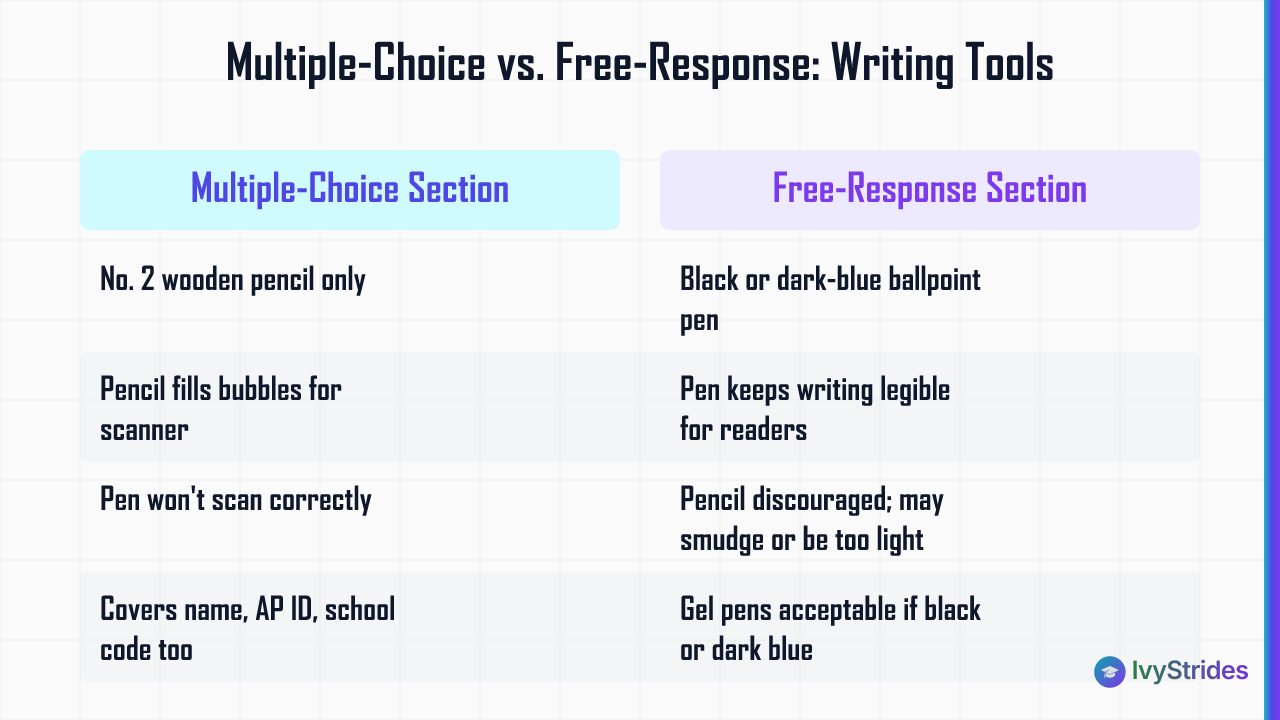
The split is section-based, not subject-based, and confusing the two is a common source of exam-day panic.
Multiple-choice section: No. 2 wooden pencil only. Every bubble on the answer sheet, plus the clerical information (name, date of birth, AP ID, school code), must be filled in with a No. 2 pencil. The scanner reads it all. A pen on the bubble sheet won't scan correctly.
Free-response section: black or dark-blue ballpoint pen. Almost every AP subject requires pen for the free-response booklet. Readers score handwritten responses, and pen keeps writing legible through shipping and scanning. Gel pens are generally acceptable if the ink is black or dark blue. Using pencil on the free-response section is discouraged and can create scoring issues if the marks are too light to read or if they smudge.
A few subject-specific additions to the allowed list:
- AP Physics 1, AP Physics 2, AP Physics C: Mechanics, AP Physics C: Electricity and Magnetism: rulers and straightedges are permitted. This is the most common subject-specific tool addition. See our AP Physics 2 breakdown for the full unit and exam structure.
- Calculator-permitted subjects: AP Calculus AB, AP Calculus BC, AP Statistics, AP Physics 1, AP Physics 2, AP Physics C: Mechanics, AP Physics C: Electricity and Magnetism (graphing calculators), and AP Chemistry (scientific or graphing calculator). Verify your specific model against the College Board's approved calculator list before exam day. Our AP Calculus BC page walks through the exam structure and calculator use.
- Hybrid AP exams: some AP exams use digital multiple-choice on a device with paper free-response. The paper section still requires a black or dark-blue ballpoint pen. Mechanical pencils remain prohibited for any paper component.
The rule of thumb: pencil bubbles, pen prose. Bring both.
Does the Same Rule Apply to the SAT and ACT?
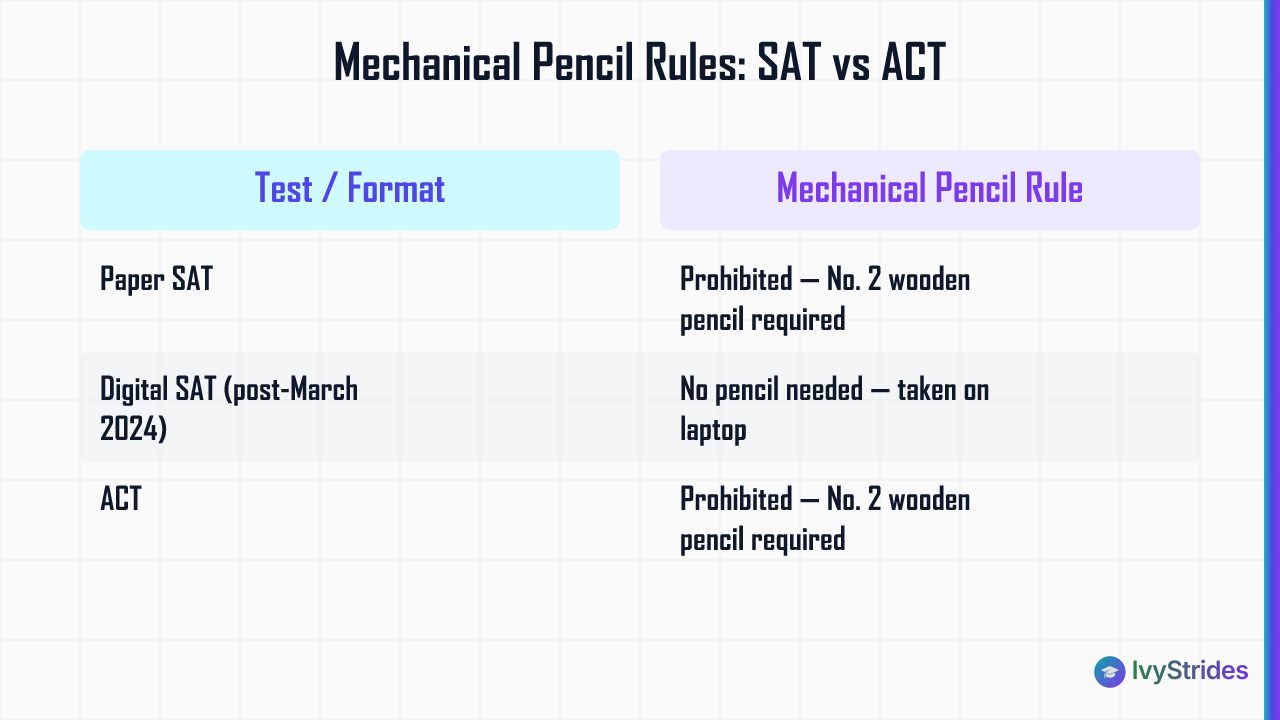
Mostly, yes. Here's the current picture across the three tests IvyStrides coaches.
Paper SAT. Mechanical pencils are prohibited. No. 2 wooden pencils are required. Same OMR scanning reason, same test-security reason.
Digital SAT (post-March 2024). The Digital SAT is administered on a laptop through the College Board's Bluebook app, so no pencil is used for the test itself. Scratch paper is provided at the testing site for math work. The mechanical pencil prohibition doesn't really apply because there's no bubble sheet, but you also don't need to pack a pencil for the exam. Current format details are on the College Board's Digital SAT site.
ACT. ACT, Inc.'s test day policy prohibits mechanical pencils and requires No. 2 wooden pencils with erasers. ACT bubble sheets are also OMR-scanned, and the same reasoning applies.
The same prohibition applies to the SAT: mechanical pencils are not permitted on paper-based SAT administrations, though the Digital SAT is taken on a laptop and requires no pencil at all. For a deeper walkthrough of that specific policy, see our article on whether mechanical pencils are allowed on the SAT. If you're preparing for the SAT this cycle, the full SAT test day checklist is worth reviewing the week before.
The pattern across all three tests is consistent: paper bubble sheets require No. 2 wooden pencils, and mechanical pencils are always excluded.
The Complete AP Exam Day Packing List (Beyond Just Pencils)
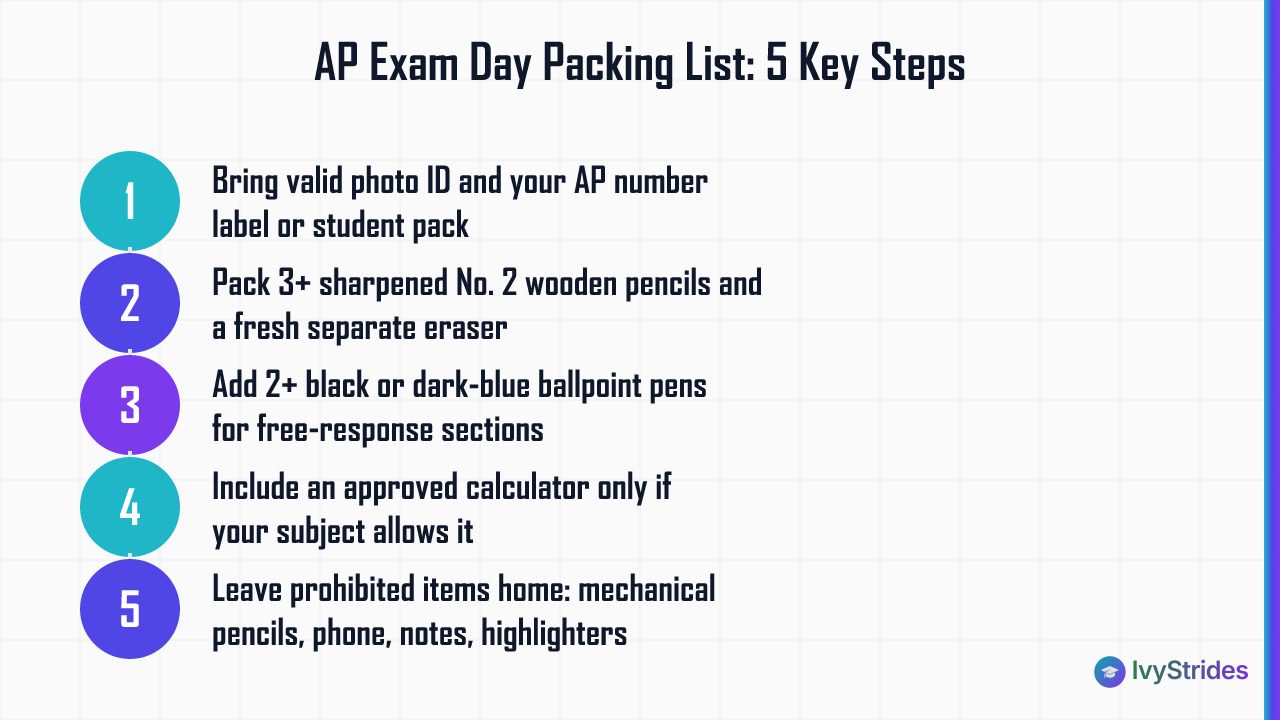
Pencils are one item on a longer list. Here's what the College Board requires and allows, based on the current AP Central "What Students Need to Know" policy.
Required:
- Valid, current photo ID (for students testing outside their own school, or as required by your school's policy).
- Your AP student pack if this is your first AP exam of the year, or your AP number label.
- Admission ticket if your school issues one.
- At least three sharpened No. 2 wooden pencils with soft erasers.
- At least two black or dark-blue ballpoint pens for free-response.
Permitted and often recommended:
- An approved calculator, only for subjects where calculators are allowed.
- A watch that doesn't beep, doesn't have internet access, and isn't a smartwatch. Optional but useful for pacing when the room clock is out of your sightline.
- Snacks and water for the break, kept in your bag at the front of the room.
Erasers, specifically. Yes, separate erasers are allowed. A clean, effective eraser matters more than students think, because stray graphite marks on the bubble sheet can confuse the OMR scanner into reading a blank as filled or a filled as ambiguous. If the eraser on your pencil has worn down to the metal ferrule, it'll scratch the paper and leave gray streaks. Bring a fresh separate eraser. It's a two-dollar insurance policy.
Prohibited (partial list, verify the full list before exam day):
- Mechanical pencils, No. 3 pencils, colored pencils.
- Rulers and protractors (except for AP Physics).
- Scratch paper from home (the testing site provides it).
- Phones, smartwatches, fitness bands, wireless earbuds, and any device with internet or recording capability.
- Books, notes, dictionaries, and highlighters.
- Food or drink at the desk during the exam (permitted during the scheduled break).
Across our AP coaching cohorts, the most common exam-day logistics errors are, in order: wrong calculator model, insufficient pencils, forgetting a photo ID, and wrong pencil type. The pencil rule is just one item on the full AP exam day checklist; our full rundown of what to bring to AP exam day covers every required and recommended item from photo ID to approved calculators.
Arriving with the right supplies is the logistics side of AP success. The content side is equally important, and our guide to how to study for AP exams maps out study plans for every major AP course. Students who want structured, subject-specialist instruction before May can also compare our AP prep courses by subject.
AP Exam Scoring: What a 70% Raw Score Actually Means
Since this question shows up alongside the pencil question in Google, a quick primer.
AP exams are reported on a 1 to 5 scale. A 3 is generally considered passing for college credit purposes, though credit policies vary widely by institution. On many AP exams, a raw score in the range of roughly 65% to 75% of available points earns a 5, but the threshold moves subject by subject and year by year. On AP Calculus BC, for instance, the raw-to-scaled conversion has historically been forgiving. On AP English Literature, it tends to be tighter.
The College Board doesn't publish a fixed percentage-to-score conversion because thresholds are set after each administration using a process that accounts for exam difficulty and the population of test takers. That's why the same raw performance can score differently in different years. For the full mechanics, see our breakdown of AP scores explained.
One caveat that matters for admissions planning: whether colleges accept AP credit is a school-by-school question. A 5 on AP Calculus BC may earn eight credits at one university, zero at another, and placement without credit at a third. Verify each target school's current AP credit policy before assuming credit.
A procedural error on exam day cannot undo months of preparation. Knowing how AP scores are calculated and what a 4 or 5 requires keeps the bigger picture in view.
FAQ
Can I bring a mechanical pencil to an AP exam if I only use it for scratch work?
No. The College Board prohibits mechanical pencils in the exam room entirely, regardless of intended use. Proctors are instructed to remove them from desks during check-in. Bring only sharpened No. 2 wooden pencils and black or dark-blue ballpoint pens.
Are erasers allowed on AP exams?
Yes. Separate erasers are permitted and recommended. A clean eraser prevents stray graphite marks that can confuse the OMR scanner. The eraser attached to your pencil counts too, as long as it hasn't worn down to the metal ferrule, which can scratch the answer sheet and leave gray streaks.
What calculators are allowed on AP exams?
Calculator permissions are subject-specific. Graphing calculators are permitted on AP Calculus AB, AP Calculus BC, AP Statistics, AP Physics 1, AP Physics 2, and both AP Physics C exams. Scientific or graphing calculators are permitted on AP Chemistry. Most other AP exams, including AP Biology and AP Environmental Science multiple-choice, don't allow calculators. Verify your specific model on the College Board's approved calculator list before exam day, because permitted models are updated periodically.
Does the mechanical pencil ban apply to hybrid AP exams?
Yes, for any paper component. Hybrid AP exams have a digital multiple-choice section taken on a device and a paper free-response section. The paper section still requires a black or dark-blue ballpoint pen, and mechanical pencils remain prohibited for any paper materials. The digital section requires no pencil at all.
Is a No. 3 pencil acceptable if I cannot find a No. 2?
No. The College Board explicitly lists No. 3 pencils as prohibited alongside mechanical pencils and colored pencils. No. 3 pencils have harder lead and produce lighter marks that OMR scanners may not read reliably. Only No. 2 wooden pencils are accepted. They're stocked at every drugstore, office supply store, and grocery store in the country, so this is a fixable problem the night before.
Can I use a mechanical pencil on the Digital SAT?
The Digital SAT is administered on a laptop through the Bluebook app, so no pencil is used for the exam itself. Scratch paper is provided at the testing site for math work. The mechanical pencil rule doesn't really apply because there's no bubble sheet to scan, and you don't need to bring any pencil for the test itself.
The Bottom Line
Pack three sharpened No. 2 wooden pencils, two black or dark-blue ballpoint pens, and a separate eraser the night before every AP exam. Verify your calculator model if your subject permits one. Bring photo ID and your admission ticket. Leave the mechanical pencils at home. That's the entire writing-tool question, resolved.
The bigger question is whether the preparation behind the pencil is where it needs to be. That's what our AP specialists work on with students 1-on-1, subject by subject, from now through May. You can meet the coaches on our tutors page.
Last reviewed: 2026 AP exam cycle. Format, scoring, and calculator policies are verified annually against the current College Board AP Students and AP Central documentation.

Award-winning author (South Asian Book Award) and graduate of BITS Pilani and UCLA Luskin School of Public Affairs. Brings a published writer's eye to Common App essays and grammatical precision to SAT and ACT R&W instruction.