
Stanford ACT Requirements: Code, Superscore Policy, and Score Cutoffs

On this page
- The Direct Answer: Does Stanford Superscore the ACT?
- Stanford ACT School Code and How to Send Your Scores
- What ACT Score Do You Actually Need for Stanford?
- Not Sure If Your ACT Score Is Stanford-Ready?
- Is a 34 ACT Good Enough for Stanford?
- How Stanford's ACT Superscore Policy Compares to Peer Schools
- Does Stanford Require the ACT Writing or Science Sections?
- Is Stanford Test-Optional for 2026 and 2027 Applicants?
- Stanford ACT vs SAT: Which Test Should You Submit?
- Beyond the Score: How Stanford Uses ACT Results in Holistic Review
- ACT Prep Strategy for Stanford: How Many Times to Test and When to Stop
- FAQ
- What is Stanford's ACT school code?
- Does Stanford require the ACT with Writing?
- Should I submit my ACT superscore or my highest single-sitting composite to Stanford?
- Which Ivy League schools accept an ACT superscore?
- Does Stanford require SAT or ACT scores from international students?
- Is Stanford test-optional for 2027 applicants?
- Does Stanford require all ACT scores to be sent?
- One Honest Diagnostic Changes the Whole Plan
- Your Stanford ACT Strategy Starts With One Honest Diagnostic
Stanford's ACT school code is 0434, the middle-50% ACT composite for admitted students is 34 to 36, and yes, Stanford does superscore the ACT. Stanford is test-required for the Class of 2026 and 2027; ACT Writing is not required.
Those figures come from Stanford's official undergraduate admissions page, which is the only source that matters here; several older guides and competitor write-ups still claim Stanford doesn't superscore the ACT, and they're wrong. The harder question is how to time your sittings to maximize the superscore, and whether your current composite belongs in front of the admissions committee at all. The rest of this piece works through both.
The Direct Answer: Does Stanford Superscore the ACT?
Yes. Stanford superscores the ACT.
Stanford's official position, published on admission.stanford.edu, is that applicants "may report the calculated ACT superscore in addition to your highest section scores." An ACT superscore is the average of your best English, Math, Reading, and Science section scores across multiple test sittings, recalculated into a single composite on the 1-36 scale.
One thing worth flagging, because it has caused real confusion in the last two cycles: several older guides and competitor blog posts still claim Stanford does not superscore the ACT. That was the historical policy. It is no longer current. Trust the official source over the secondary write-up, and verify on Stanford's admissions page before making testing decisions.
You have two ways to get scores to Stanford. You can self-report your superscore on the Common App in the testing section, which is what most applicants do at the application stage. You can also send official scores directly through ACT.org. If you're admitted and enroll, Stanford requires an official score report before matriculation.
If you're weighing whether to submit an ACT or SAT score, our breakdown of SAT scores to send to Stanford University covers the SAT superscore policy, score ranges, and submission strategy for the Digital SAT.
Stanford ACT School Code and How to Send Your Scores
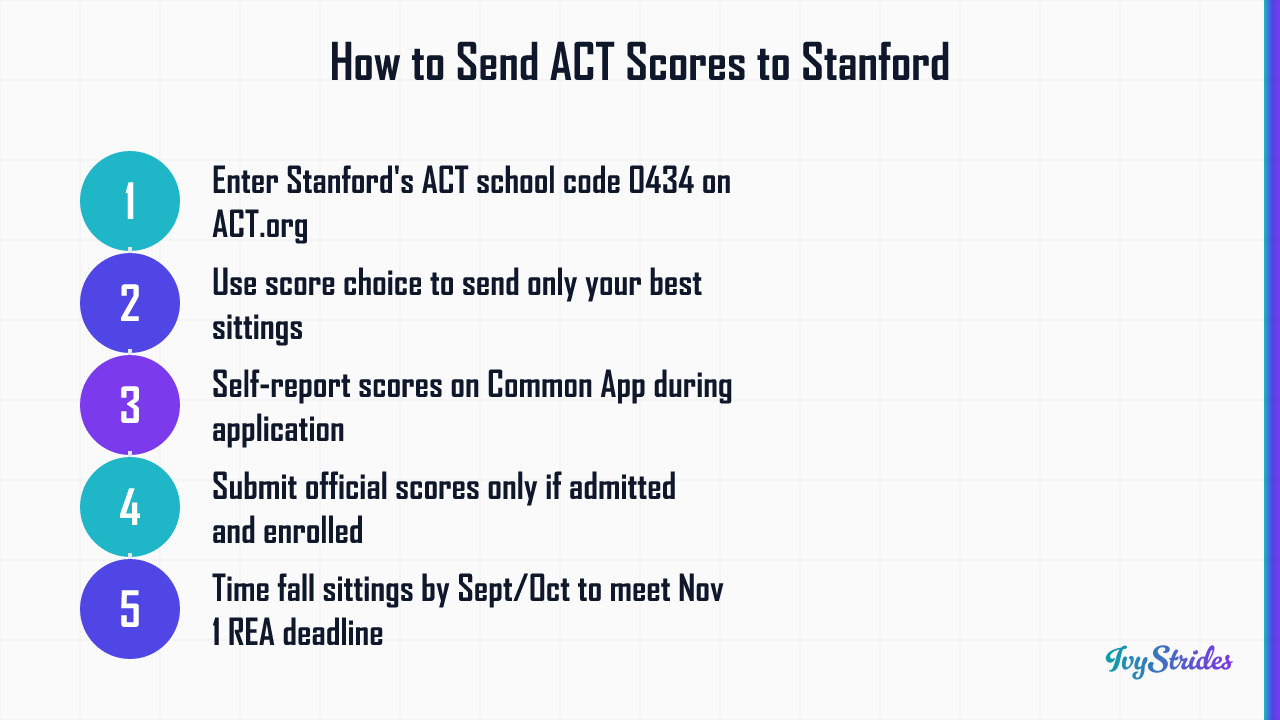
Stanford's ACT school code is 0434. You'll enter that code on ACT.org when you request an official score report.
A few logistics before you click send. Stanford does not require you to report all ACT sittings. You can use ACT's score-choice option to send only the sittings you want considered, which is part of why a superscore strategy works at Stanford: if your second sitting has a stronger Math section but weaker Reading, you can still report it because section-by-section, it contributes to a better superscore.
Most students self-report scores on the Common App during the application phase rather than paying for official sends. That's allowed. Stanford accepts self-reported scores at the application stage and only requires an official ACT score report if you're admitted and enroll. For a parallel walkthrough on official sends to a peer school, see our guide on how to send SAT scores to Columbia University, which covers the same mechanics through College Board.
Timing matters. Stanford's Restrictive Early Action deadline is November 1, and Regular Decision is January 2. If you're testing in the fall of senior year, the September or October ACT sittings are your last realistic options for REA. Build in two weeks of buffer for score processing.
What ACT Score Do You Actually Need for Stanford?
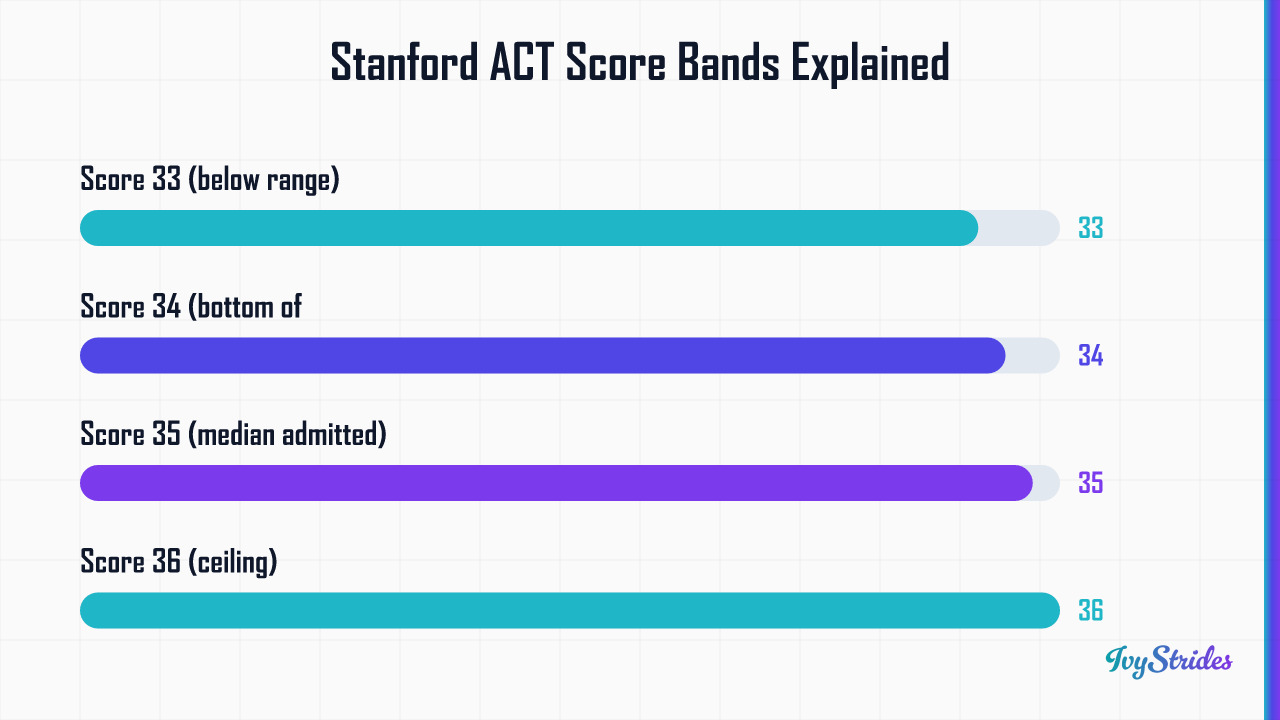
Stanford's middle-50% ACT composite range is 34 to 36 (Stanford Admissions). About 25% of admitted students scored below 34, and 25% scored at 36 (Stanford Admissions). The median sits around 35.
Here's what each band actually signals.
A 34 composite places you within the middle-50% range. Per ACT.org's national percentile tables, a 34 is approximately the 99th percentile nationally. It clears Stanford's quantitative bar. It doesn't differentiate you from the thousands of other applicants sitting in that same band.
A 35 composite is in the heart of the admitted-student distribution. It's the most common score among admitted applicants and signals strong academic readiness without raising flags in either direction.
A 36 composite is the score ceiling. It's the 99th-plus percentile and the strongest possible testing data point. It doesn't get you in. Stanford's acceptance rate is approximately 3-4%, and the majority of 36 scorers who apply are not admitted.
Here's the part most students miss. Moving from 35 to 36 produces marginal admissions benefit at a school like Stanford. Moving from 33 to 35 changes how your file reads. In our coaching with students at the 33-34 band targeting Stanford, we typically recommend one targeted retake focused on the weakest section before pivoting to essay work. A student with a 33 composite but a 36 in English and a 32 in Math has a clear path to a 35 superscore by improving one section.
If your current ACT composite is below 34, a structured prep plan built around a diagnostic test and section-specialist coaching is the most reliable path to closing that gap before your Stanford application deadline. Our 1-on-1 ACT prep is built around exactly this work. If you're still deciding which test to take, our breakdown of ACT vs SAT difficulty walks through which test profile tends to favor which student.
Not Sure If Your ACT Score Is Stanford-Ready?
Book a free 15-minute strategy call. Our ACT coaches will review your current score, identify your highest-leverage section to improve, and tell you honestly whether a retake makes sense before your application deadline. Parents welcome on the call.
Is a 34 ACT Good Enough for Stanford?
Short answer: yes, a 34 is competitive. It's not a slam dunk.
A 34 sits at the lower bound of Stanford's middle-50% range (Stanford Admissions). About 25% of admitted students scored below 34, which tells you the score won't disqualify you. It also won't carry your application on its own. At a school with a 3-4% acceptance rate, the testing piece is necessary, not sufficient.
The strategic question gets more interesting when you look at the superscore angle. A student with a flat 34 across all four sections is in a different position than a student with a 34 composite who has 36 English, 36 Reading, 32 Math, and 32 Science. The second student has obvious upside on a retake. Spend eight weeks on Math with a section specialist, retake, and you're now reporting a 35 superscore even if the composite barely moves.
A junior we worked with last fall came in with exactly that asymmetric profile, scoring 33 composite with strong verbal and weaker quant. We ran a Math-only retake plan, kept the other sections cold, and the second sitting produced a 35 superscore. That was the score she reported. Meanwhile, students who keep retaking from a 34 hoping to hit 36 often plateau, burn through fall of senior year, and arrive at the essay phase with rushed drafts.
You can pressure-test your current section profile with an ACT practice test online under timed conditions before deciding whether to retake.
How Stanford's ACT Superscore Policy Compares to Peer Schools
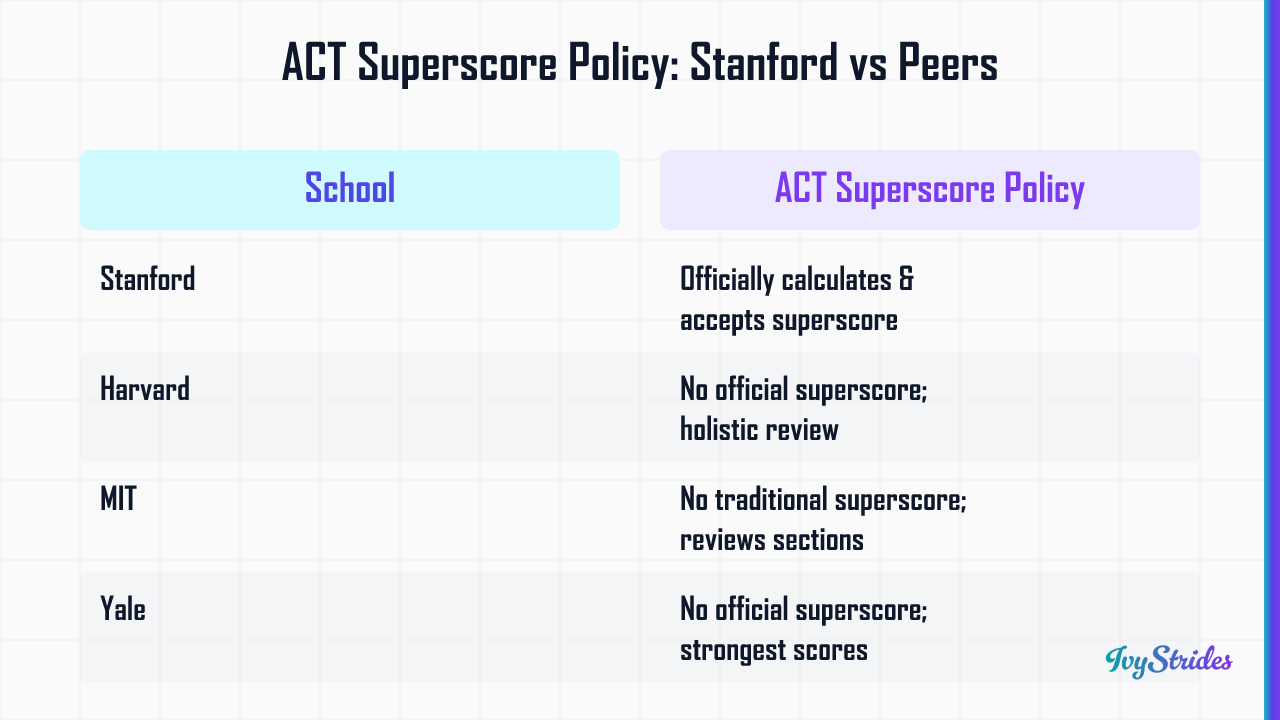
Stanford's ACT superscore policy is genuinely favorable compared to most peer schools. Here's how the landscape looks across the elite tier, based on each school's current admissions page.
| School | ACT Superscore Policy |
| Stanford | Calculates and accepts ACT superscore; allows reporting alongside highest section scores |
| Harvard | Does not officially calculate an ACT superscore; considers highest section scores across sittings in holistic review |
| MIT | Does not superscore the ACT in the traditional sense; considers section scores across sittings |
| Yale | Does not officially superscore the ACT; considers strongest section scores in context |
| Princeton | Does not officially superscore the ACT; reviews all submitted scores holistically |
| Columbia | Does not officially calculate an ACT superscore; considers your strongest scores |
The strategic implication. If your list includes Stanford and several traditional Ivies, your testing plan should still optimize for a strong superscore (Stanford rewards it) while also producing a strong single-sitting composite (the Ivies will weight that). For a comparison anchor on a peer school's SAT policy, see our breakdown of MIT SAT requirements. For ACT-specific code and send mechanics at another peer, our Yale ACT code guide covers the logistics.
Stanford's superscore policy now aligns with several peer institutions, though policies vary enough that students applying to multiple elite schools should verify each school's current stance before deciding how many times to test. Policies change between cycles. Always check the official admissions page.
Does Stanford Require the ACT Writing or Science Sections?
No on Writing. Yes on Science, in the sense that Science is part of the standard ACT.
Stanford does not require the ACT Writing (essay) section. Per admission.stanford.edu, only the standard ACT composite is required. If you've already taken the ACT with Writing, your Writing score will appear on your report, but it doesn't factor into your composite or your superscore.
Science is a different category. It's one of the four sections that make up the ACT composite (English, Math, Reading, Science), so you can't skip it. It's also included in the superscore calculation. Per ACT.org, the Science section tests data interpretation, scientific reasoning, and experimental design, not memorized facts. Many students underprepare for it because they assume it's a content test.
In our coaching, students targeting Stanford who are strong in Science often anchor their superscore there. A 36 Science contributes the same weight to your composite as a 36 in any other section, and Science is the section where pacing and passage-mapping strategy produce the biggest gains in the shortest training window.
If you're considering switching to the Digital SAT (no Science section), our SAT prep overview walks through the format trade-offs.
Is Stanford Test-Optional for 2026 and 2027 Applicants?
No. Stanford is test-required for applicants entering in fall 2026 and fall 2027.
Stanford was test-optional during the pandemic cycles from 2021 through 2023. The university has since reinstated a test-required policy, and applicants must submit either an SAT or ACT score with their application. This applies to domestic and international applicants alike. Both tests are administered globally and accepted equally.
One caveat. Test-optional policies vary by school and year. Stanford's current policy could change between application cycles, and peer schools have moved in different directions over the last three years. Verify on Stanford's official admissions page before submitting. The FairTest tracker is a useful tool for monitoring test-optional and test-required policy changes across schools.
Still in the SAT-vs-ACT decision phase? Our SAT vs ACT comparison walks through format, scoring, and student-fit factors for the current cycle.
Stanford ACT vs SAT: Which Test Should You Submit?
Stanford accepts both the SAT and ACT equally. There's no stated preference. The admissions office has confirmed this in multiple public statements, and Stanford superscores both tests, which removes one common reason students choose one over the other.
So the question becomes: which test plays to your strengths?
Score concordance helps frame the decision. Per College Board's concordance tables, an ACT 34 maps to roughly an SAT 1500-1520, an ACT 35 to roughly 1540-1560, and an ACT 36 to roughly 1590-1600. Submit the test where your concorded score is higher.
In our coaching, students who are stronger in fast-paced reading, data-table interpretation, and scientific reasoning tend to perform better on the ACT. Students who prefer fewer, longer passages, algebra-heavy math, and adaptive-module pacing tend to favor the Digital SAT. Neither test is universally easier. Our breakdown of is the SAT harder than the ACT goes deeper on the format-specific demands.
Choosing between the ACT and SAT for Stanford is a strategic decision worth making early; our ACT vs SAT comparison walks through format differences, scoring, and which test tends to favor which student profile.
A working approach. Take a diagnostic on each test, compare concorded scores, then commit to the higher-projected test for the rest of your prep. Splitting prep across both is rarely worth it unless your diagnostics are nearly identical. Either way, your test score is one input. Strong essays still carry significant weight, which is why pairing test prep with our Common App essay coaching is the typical strategy for students targeting Stanford.
Beyond the Score: How Stanford Uses ACT Results in Holistic Review
A 36 ACT does not get you into Stanford. That's the single most important context for any conversation about score targets.
Stanford's acceptance rate is approximately 3-4% (Stanford Admissions). The majority of applicants with a 36 ACT are not admitted. The admissions office uses holistic review, weighing academics, extracurriculars, essays, recommendations, character, and context alongside test scores. A strong ACT score clears a quantitative bar. It does not differentiate you from the thousands of other applicants who also cleared it.
A strong ACT score clears the quantitative bar, but Stanford's holistic review means your essays carry significant weight; working on your Common App personal statement and Stanford supplementals in parallel with test prep is the smarter strategy. Stanford's supplemental essay prompts cover intellectual vitality, meaningful activities, and the well-known roommate letter. Each one is short. Each one rewards specificity and voice over polish.
Stanford also considers AP exam scores as part of its academic profile review, so students aiming for Stanford should treat ACT prep, AP coursework, and essay writing as a connected strategy rather than separate tasks. Stanford asks applicants to self-report all AP scores, so don't take the exam if you're not prepared to disclose the result. Our AP courses online program runs per-subject specialist coaches because the demands of AP Calculus BC are nothing like the demands of AP US History.
The practical pivot point. In our coaching, students who reach a 35+ ACT composite are typically advised to shift prep time toward Stanford's supplemental essays rather than chasing a 36. The marginal benefit of a 36 is small. The marginal benefit of a sharper, more specific roommate essay is large. If your essays need a second pair of eyes, our essay review service is built for exactly this stage.
ACT Prep Strategy for Stanford: How Many Times to Test and When to Stop
Here's a concrete framework if you're targeting Stanford's middle-50% range (Stanford Admissions).
Step 1: Diagnostic first. Every credible prep plan starts with a full-length, timed ACT under realistic conditions. Without a diagnostic, you're guessing at your baseline. We use the diagnostic to map section-level strengths and weaknesses, then build a section-by-section plan from there.
Step 2: Section-specialist coaching. Generalist tutoring is the wrong tool for the ACT. The pacing, content, and strategy demands of ACT English are not the same as ACT Science. Our coaches are organized by section: English/Reading, Math, and Science as distinct specialties. In our coaching with students targeting 34+ on the ACT, typical improvement from a 30 baseline to a 34+ composite takes 3-4 months of structured prep with section-specialist work. A 4+ point improvement is typical for students completing the full IvyStrides ACT program from a 30-32 baseline.
Step 3: Superscore-driven retake strategy. If your first sitting reads 36 English, 32 Math, 34 Reading, 33 Science, your second sitting should focus almost exclusively on Math. Don't try to lift every section equally. Find the single biggest gap and close it.
Step 4: Know when to stop. Most students who get into Stanford took the ACT two or three times. Going beyond three sittings without a clear section-improvement trend is a signal to pivot. Pattern observed across our student cohorts: students who take the ACT more than three times without a section-improvement trend rarely see composite gains above one point. Your time after that is better spent on essays and AP exam prep.
Step 5: Timeline. For Restrictive Early Action (November 1), aim to finish testing by September of senior year. For Regular Decision (January 2), the October or December sittings are your last realistic windows. Build in buffer for the score-send process if you're using official reports.
For a fuller walkthrough of section-specific tactics, see our ACT prep overview. If you want a parallel plan structure for the SAT, our SAT study plan follows the same diagnostic-driven approach.
An anonymized example from last cycle. A student came in with a 33 composite: 36 English, 32 Math, 30 Reading, 34 Science. Reading was the obvious target. Eight weeks of section-specialist Reading coaching focused on passage-mapping and question-type triage, one retake, and the student left with a 35 superscore. Reading alone moved from 30 to 35. The other sections held steady because we didn't waste prep hours on them.
FAQ
What is Stanford's ACT school code?
Stanford's ACT school code is 0434. Enter this code when sending official ACT scores through ACT.org. You may also self-report your scores on the Common App during the application phase, but official scores must be sent directly to Stanford if you are admitted and choose to enroll.
Does Stanford require the ACT with Writing?
No. Stanford does not require the ACT Writing section. The standard ACT composite (English, Math, Reading, Science) is sufficient. If you took the ACT with Writing, that score will appear on your report but does not factor into your composite or your superscore.
Should I submit my ACT superscore or my highest single-sitting composite to Stanford?
Stanford's official policy allows you to report your calculated ACT superscore in addition to your highest section scores. If your superscore is higher than your best single-sitting composite, report the superscore. Stanford admissions officers are familiar with superscore calculations and will consider them. Many admitted students have submitted superscores to Stanford without issue.
Which Ivy League schools accept an ACT superscore?
Policies vary and change between cycles. As of the current application cycle, Stanford superscores the ACT. Most traditional Ivy League schools (Harvard, Yale, Princeton, Columbia) do not officially calculate an ACT superscore, though some consider section scores informally as part of holistic review. Always verify on each school's official admissions page before applying.
Does Stanford require SAT or ACT scores from international students?
Yes. Stanford's test-required policy applies to all applicants, including international students. Both the SAT and ACT are accepted worldwide. International applicants should check testing center availability in their country through College Board's international testing page or ACT.org and build their testing timeline around realistic sitting dates.
Is Stanford test-optional for 2027 applicants?
No. Stanford reinstated a test-required policy and requires either an SAT or ACT score from applicants entering in fall 2026 and fall 2027. Stanford was test-optional during the pandemic years but has since returned to requiring standardized test scores. Verify the current policy on Stanford's official admissions page before your application cycle opens.
Does Stanford require all ACT scores to be sent?
No. Stanford does not require you to send all ACT sittings. You may use ACT's score-choice option to send only the sittings you want considered. You can also self-report scores on the Common App. You are not penalized for taking the ACT multiple times.
One Honest Diagnostic Changes the Whole Plan
The Stanford ACT picture isn't actually complicated once you have the right facts. Superscoring is allowed. The code is 0434. The middle-50% range is 34 to 36 (Stanford Admissions). Writing isn't required. Test scores are required. What's hard is knowing whether your current score is close enough to be worth one more sitting, or whether it's time to move your hours to essays.
Your Stanford ACT Strategy Starts With One Honest Diagnostic
Whether you're at a 31 and need a clear path to 34, or at a 34 wondering whether one more retake is worth it, our section-specialist ACT coaches can give you a straight answer in 15 minutes. No pressure, no pitch. Just a plan. Parents are welcome on the call.

Award-winning author (South Asian Book Award) and graduate of BITS Pilani and UCLA Luskin School of Public Affairs. Brings a published writer's eye to Common App essays and grammatical precision to SAT and ACT R&W instruction.