
Expression of Ideas on the SAT: Rhetorical Synthesis and Transitions
On this page
- What Is Expression of Ideas on the SAT?
- Rhetorical Synthesis on the SAT: The Goal Sentence Decides Everything
- The Four Distractor Patterns in SAT Rhetorical Synthesis
- A Worked SAT Rhetorical Synthesis Example
- Where Transitions Fit in Expression of Ideas
- Losing points and not sure which domain they came from?
- How Expression of Ideas Behaves in the Adaptive Modules
- How to Practise Expression of Ideas Without Wasting Sets
- Frequently Asked Questions About Expression of Ideas
- How many Expression of Ideas questions are on the SAT?
- What are rhetorical synthesis questions on the SAT?
- Why do I keep picking answers that turn out to be wrong when they seem true?
- Are transitions part of Expression of Ideas?
- Is Expression of Ideas the same as the old SAT essay?
- Should I read the notes or the goal first?
- Does this domain appear in both modules?
- Your Next Step on Expression of Ideas
- Make rhetorical synthesis your most predictable question type
Expression of Ideas is the SAT Reading and Writing domain that asks you to revise a text so it achieves a stated goal, and it contains two question types: Rhetorical Synthesis and Transitions. Rhetorical synthesis gives you a set of bulleted notes and one instruction, then asks which sentence best does what the instruction asked. Transitions give you a gap between two sentences and ask which logical connector belongs there. Both reward the same habit, which is deciding what the writing needs to accomplish before you look at a single answer choice.
The SAT is a standardised college admissions test scored from 400 to 1600, and its Digital SAT Reading and Writing section runs 54 questions in 64 minutes across two modules of 27. Expression of Ideas questions sit interleaved with the other three domains, so you'll meet them without warning. This guide covers rhetorical synthesis in depth, because it's the type students understand least, then covers where transitions fit and points you to the dedicated guides for them.

What Is Expression of Ideas on the SAT?

Photo by https://kaboompics.com/ on Pexels
Expression of Ideas is one of the four SAT Reading and Writing domains, and it contains exactly two question types: Rhetorical Synthesis and Transitions. It measures, in College Board's own description, the ability to revise texts to improve the effectiveness of written expression and to meet specific rhetorical goals. The operative phrase is "specific rhetorical goals". You aren't being asked what's true, or what reads nicely. You're being asked what accomplishes a stated purpose.
That's what separates this domain from the other three. Information and Ideas asks what the text says and what the evidence supports. Craft and Structure questions ask what words mean and what sentences do. Standard English Conventions asks what's grammatical. Expression of Ideas asks what's effective, given a goal somebody else has set for you.
In our coaching, students who score well on Information and Ideas questions often lose disproportionately here, because comprehension and rhetorical judgement are genuinely different skills and a strong reader has no built-in advantage on the second one. Students who treat these as reading questions lose points steadily and can't explain why. They read the material, understand it perfectly, pick the answer that best summarises it, and get it wrong. The summary wasn't the task.
Here's how the four domains differ in what they actually ask of you:
| Domain | The question is really asking | What makes an answer wrong |
| Information and Ideas | What does the text say, and what does the evidence support | It misstates the text or the data |
| Craft and Structure | What does this word mean here, or what is this sentence doing | It describes content instead of function |
| Expression of Ideas | What accomplishes the stated goal | It's true but performs the wrong rhetorical move |
| Standard English Conventions | What is grammatical | It breaks a punctuation or sentence-boundary rule |
Read down the right-hand column and the difference becomes obvious. In three of the four domains, a wrong answer is wrong because something about it is inaccurate. In Expression of Ideas, a wrong answer is usually completely accurate. That single fact explains most of the points lost here, and it's why a strategy of checking answers against the passage stops working the moment you enter this domain.
Rhetorical Synthesis on the SAT: The Goal Sentence Decides Everything
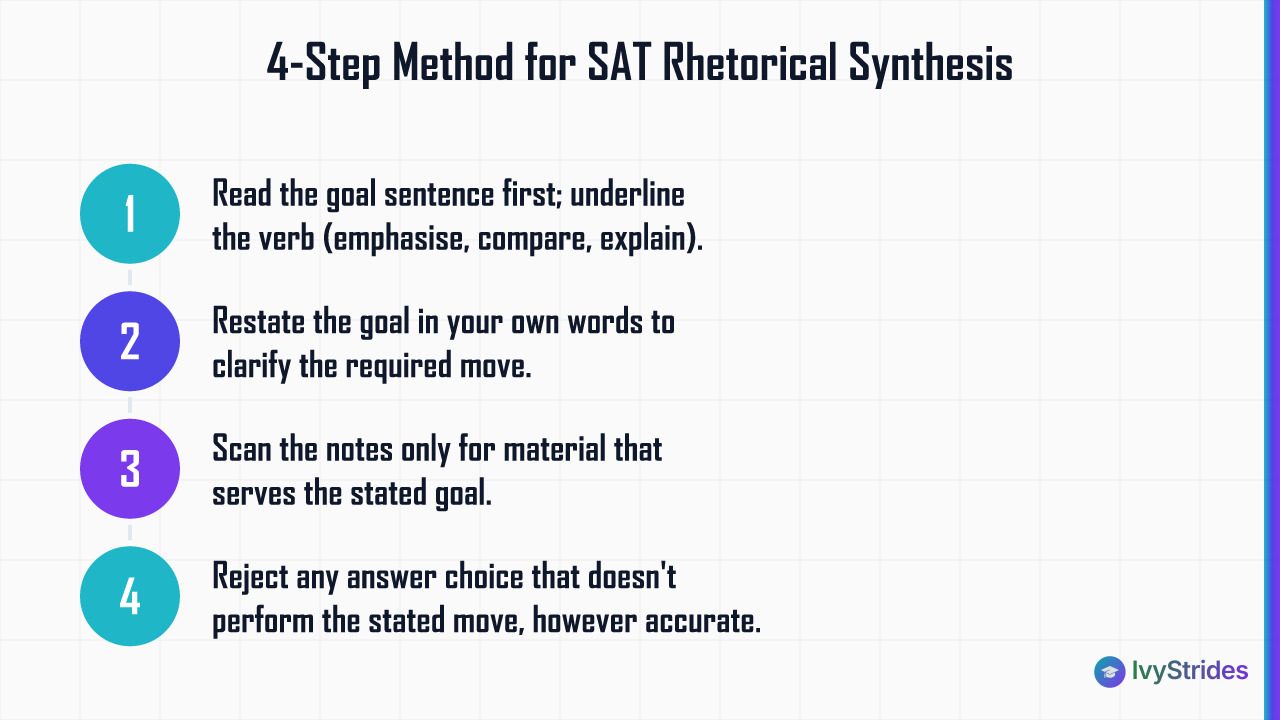
In SAT rhetorical synthesis, the goal sentence is the instruction and the bulleted notes are only raw material. The format is consistent: four to six notes presented as a student's research on some topic. Then you get one sentence that begins something like "The student wants to emphasise a similarity between the two methods." Then four answer choices, each a sentence built from the notes.
The notes are raw material. The goal sentence is the instruction. Everything depends on reading the instruction as an instruction.
Here's the method:
-
Read the goal sentence first, before the notes. Underline the verb: emphasise, compare, explain, introduce, present.
-
Say the goal back in your own words. "They want a contrast." "They want the purpose of the study."
-
Now read the notes, looking only for material that serves that goal. Most notes won't.
-
Read the choices and reject every one that doesn't perform the stated move, no matter how accurate it is.
Step 4 is where the points live. Every answer choice in a well-built rhetorical synthesis question is factually consistent with the notes. None of them contain errors. Three of them do the wrong job. If you're checking answers against the notes for accuracy, all four pass and you're choosing at random.
Read the goal first, and the question stops being about reading comprehension at all. It becomes a matching task, and matching tasks are fast.
The Four Distractor Patterns in SAT Rhetorical Synthesis
The wrong answers aren't random. College Board builds them from a small set of shapes, and once you can name the shape you can eliminate on sight. The two question types in this domain are rhetorical synthesis and transitions, and both use the same distractor logic.
True but off-goal. The sentence accurately combines two notes and says something entirely correct. It just doesn't do what the goal asked. This is the most common trap and the hardest to resist, because nothing about it looks wrong.
Right notes, wrong emphasis. The sentence uses exactly the material the goal points at, but frames it backwards. If the goal asked you to emphasise a similarity, this choice presents the same two facts as a contrast.
Invents information. The sentence adds a claim the notes don't support. Usually it's small, a causal word where the notes only showed correlation, or a generalisation the study never made.
Right content, wrong rhetorical move. The sentence covers the correct material and even frames it correctly, but performs a different action: it explains when the goal asked for an introduction, or summarises when the goal asked for a comparison.
Notice that only one of these four involves an actual falsehood. That's the reason accuracy-checking fails as a strategy here. Three of the four wrong answers are true.
A Worked SAT Rhetorical Synthesis Example

Photo by Andy Barbour on Pexels
Methods are easier to trust when you watch one run. This is an illustrative item written in the style of the test, not a retired College Board question.
The notes:
- Two greenhouse trials tested a new irrigation schedule.
- Trial A used sandy soil and ran for six weeks.
- Trial B used clay soil over the same six-week period.
- Yields rose in both trials.
- Water use fell in Trial A but held steady in Trial B.
The goal: The student wants to emphasise a similarity between the two trials.
Say the goal back: they want one thing the trials shared. Now scan the notes for shared features. Duration is shared. Yield direction is shared. Soil type differs. Water use differs.
So the answer must foreground duration or yields, and must not lead with soil or water. Now the choices become easy to sort. A choice contrasting sandy and clay soil is true and off-goal. A choice reporting that water use fell in Trial A is true, uses the notes, and describes a difference rather than a similarity. A choice claiming the schedule "causes" higher yields invents a causal claim the notes don't make. The surviving choice will say both trials ran six weeks and both produced higher yields.
The whole question took one decision: what do these two things have in common. That decision was available before reading any choice.
Where Transitions Fit in Expression of Ideas
Transitions are the second SAT Expression of Ideas question type: you get two sentences with a gap between them, and you choose the connector that fits their logical relationship. Name the relationship first, then pick the word.
The principle is the same as synthesis. Decide the relationship before you look at the words. Does the second sentence contrast with the first, extend it, give an example of it, or state its result? Name that relationship, then pick the connector that expresses it. Students who work the other way round, trying each word in the gap to see which sounds right, end up choosing on rhythm, and the test punishes that reliably.
Transitions already have dedicated coverage on this site, so this guide won't duplicate it. For the error patterns and the three-step fix, read why students miss SAT transitions questions. For graded practice items, read worked transitions examples.
One point worth adding here. Transitions and rhetorical synthesis feel unrelated, and students often log them separately, but they fail for the same reason: reading the answer choices before deciding what the passage needs.
Losing points and not sure which domain they came from?
A diagnostic names the question types, not just the score.
How Expression of Ideas Behaves in the Adaptive Modules
SAT Expression of Ideas questions appear in both modules of the Reading and Writing section, and they scale in difficulty with your performance. The section is section-adaptive: your work across the first module of 27 questions determines how hard the second module is.
What gets harder isn't the format. It's the margin between the choices. On an easier rhetorical synthesis item, two of the four choices will obviously fail the goal. On a harder one, all four perform plausible rhetorical moves and the difference between the best and second-best is a single word of emphasis. On harder transitions items, two connectors express relationships that are genuinely close, like a result and a simple continuation.
Because Module 1 sets the ceiling, the domain you're weakest in does disproportionate damage early. How Module 1 sets your score ceiling covers the routing in detail.
The method doesn't change as difficulty rises. Read the goal, name the relationship, then look. That's the point of drilling it until it's automatic: when the margins narrow, procedure is the only thing that still works.
How to Practise Expression of Ideas Without Wasting Sets
Practise SAT Expression of Ideas by restating the goal in writing before you answer, not by grinding sets. Doing sets and checking answers teaches almost nothing here, because the explanation for a miss is nearly always the same and nearly always unhelpful: you picked a true statement that didn't do the job.
Try this instead. Before you look at any answer choice, write the goal in your own words on paper. Six words at most. Then answer. When you review, compare your restatement with the actual goal sentence rather than comparing your answer with the key. Misses trace back to a misread goal far more often than to a misread note, and you can only see that if you wrote the restatement down.
Keep the error log by goal verb. In our coaching this is the single change that moves this domain fastest. Sort your misses into emphasise, compare, explain, introduce, and present. Students who log this way usually find their losses cluster in one or two verbs rather than spreading evenly, and that's a much smaller problem to fix than "I'm bad at Expression of Ideas".
One more separation worth making. If your misses involve commas, semicolons or sentence boundaries, that's not this domain at all. That's Standard English Conventions, and it has a different fix built on punctuation rules rather than rhetorical goals. Students routinely conflate the two and then practise the wrong thing for weeks.
Frequently Asked Questions About Expression of Ideas
How many Expression of Ideas questions are on the SAT?
College Board publishes the domain and its two question types but doesn't publish a fixed per-domain question count for every form, and the section is adaptive, so treat specific numbers quoted elsewhere with caution. What is published: Reading and Writing is 54 questions across two 27-question modules, and every module draws from all four domains.
What are rhetorical synthesis questions on the SAT?
They give you bulleted research notes and a sentence stating what the student wants to accomplish, then ask which answer best achieves that goal using the notes. The goal sentence is the instruction, and the notes are only raw material.
Why do I keep picking answers that turn out to be wrong when they seem true?
Because true isn't the standard. In a well-built rhetorical synthesis question, three of the four choices are factually consistent with the notes and simply do the wrong job. Checking for accuracy can't separate them, and only the goal can.
Are transitions part of Expression of Ideas?
Yes. Expression of Ideas contains exactly two question types: Rhetorical Synthesis and Transitions. They look different but fail the same way, when a student reads the choices before deciding what relationship the passage needs.
Is Expression of Ideas the same as the old SAT essay?
No. The essay is gone from the SAT, and Expression of Ideas is a multiple-choice domain. It tests revision judgement rather than your own writing.
Should I read the notes or the goal first?
The goal, always. Reading the notes first means holding five facts in memory with no filter for what matters. Reading the goal first turns the notes into a short search for the two or three that serve it.
Does this domain appear in both modules?
Yes. All four domains appear in both modules, and because the section is adaptive, how you perform in Module 1 determines the difficulty of the Expression of Ideas questions you meet in Module 2.
Your Next Step on Expression of Ideas
Do one thing on every SAT Expression of Ideas question: read the goal sentence, restate it in six words or fewer, and only then look at the choices. That single habit is what separates students who find this domain predictable from students who find it arbitrary.
If you want to know whether your losses sit in synthesis, in transitions, or in Conventions questions you've been miscategorising, that comes from a diagnostic with the items sorted by type. You can read how we structure that work on the IvyStrides about page. You can also meet the tutors who coach Reading and Writing specifically.
Make rhetorical synthesis your most predictable question type
Section-specialist Reading and Writing coaching.

Award-winning author (South Asian Book Award) and graduate of BITS Pilani and UCLA Luskin School of Public Affairs. Brings a published writer's eye to Common App essays and grammatical precision to SAT and ACT R&W instruction.