
How Much Does the SAT Cost? The Honest, Data-Backed Answer for 2026
On this page
- The SAT Registration Fee in 2026: The Direct Answer
- SAT Add-On Fees: Where the Real Costs Accumulate
- SAT Score Send Fees: The Hidden Cost Most Students Miss
- SAT Fee Waivers: Who Qualifies and How to Get One
- SAT Registration Fees for International Students
- How Much Does It Cost to Retake the SAT?
- The Real Cost of the SAT: Registration Plus Prep
- What Does the SAT Registration Fee Actually Cover?
- SAT vs. ACT Cost: A Quick Comparison
- How to Register for the SAT and Pay the Fee in 2026
- FAQ
- Is the SAT score out of 1600?
- Is a 900 SAT score considered good?
- How rare is a 1350 SAT score?
- Does the SAT cost money if you fail?
- How much does it cost to send SAT scores to colleges?
- Can international students get a SAT fee waiver?
- Is the SAT fee the same in California, Texas, Florida, and Georgia?
The SAT registration fee is $68 for U.S. students in 2026, per College Board. International students pay $68 plus a $43 regional fee, for a base total of $111. Add-on fees, such as late registration ($38), test center changes ($34), and score sends beyond the four free reports ($13 each), can raise your total. Students who qualify for a College Board fee waiver pay nothing for the base registration and receive additional benefits. The fee is identical in every U.S. state, including California, Texas, Florida, and Georgia.
These figures come directly from College Board's published fee schedule, last verified against the 2025-26 testing year. The harder questions come next: which add-ons are avoidable, when a fee waiver applies, and how retakes and score sends stack up when you're applying to a dozen schools.

The SAT Registration Fee in 2026: The Direct Answer
The Digital SAT has been the current format since March 2024, administered through College Board's Bluebook app with an adaptive two-module structure per section. The fee structure carried over from the paper test unchanged.
| Student Type | Base Fee |
| U.S. student (all states) | $68 |
| International student | $111 ($68 base + $43 regional fee) |
Fees per College Board.
There is no state-level surcharge. A student registering in Los Angeles, Houston, Miami, or Atlanta pays the same $68 as a student in Vermont. Some readers arrive here after seeing older figures on social media, including a $60 number that circulated in an old College Board post. Ignore it. The current published fee is $68, verifiable on the College Board test fees page and the international fees page.
For a deeper cost overview and waiver context, see our SAT fees and waivers 2025-26 breakdown.
SAT Add-On Fees: Where the Real Costs Accumulate
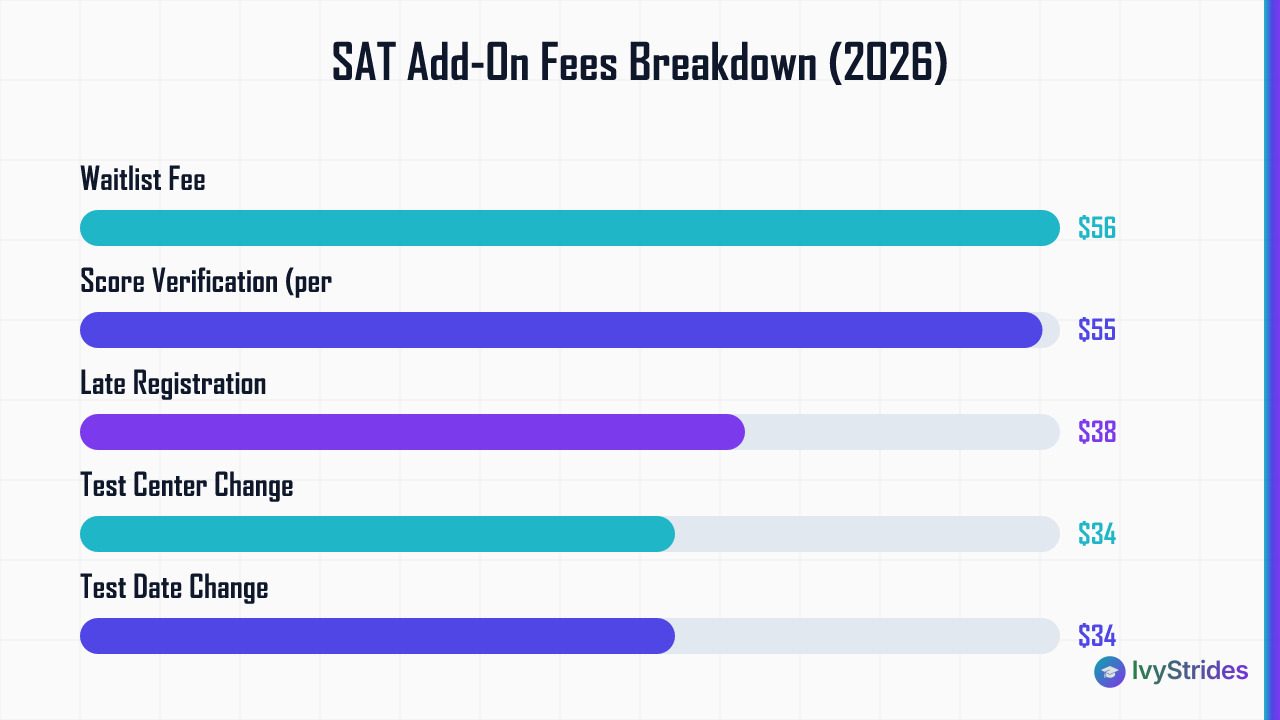
This is where families get surprised. The $68 fee is a floor, not a ceiling.
Fees per College Board.
| Service | Fee | When It Applies |
| Late registration | $38 | Registering after the standard deadline but before the late deadline |
| Test center change | $34 | Switching your assigned test center after registration |
| Test date change | $34 | Moving your registration to a different SAT administration |
| Waitlist fee | $56 | Attempting to test without a confirmed seat |
| Score verification (hand scoring) | $55 per section | Requesting a manual re-score of your Reading and Writing or Math section |
Fees per College Board.
In our coaching, the single most avoidable line item is the $38 late registration fee. Students who wait to feel "ready" before registering usually pay it and end up at a less convenient test center, sometimes an hour or more from home. Register the day you commit to a test date. See the full SAT test dates 2026 schedule to plan your registration window.
If your plans shift after you pay, refunds are partial and time-limited. Our SAT cancellation and refund guide explains exactly what you recover and by when. All figures above are cited to the College Board test fees page linked in the previous section and are subject to change; verify current fees before registering.
SAT Score Send Fees: The Hidden Cost Most Students Miss
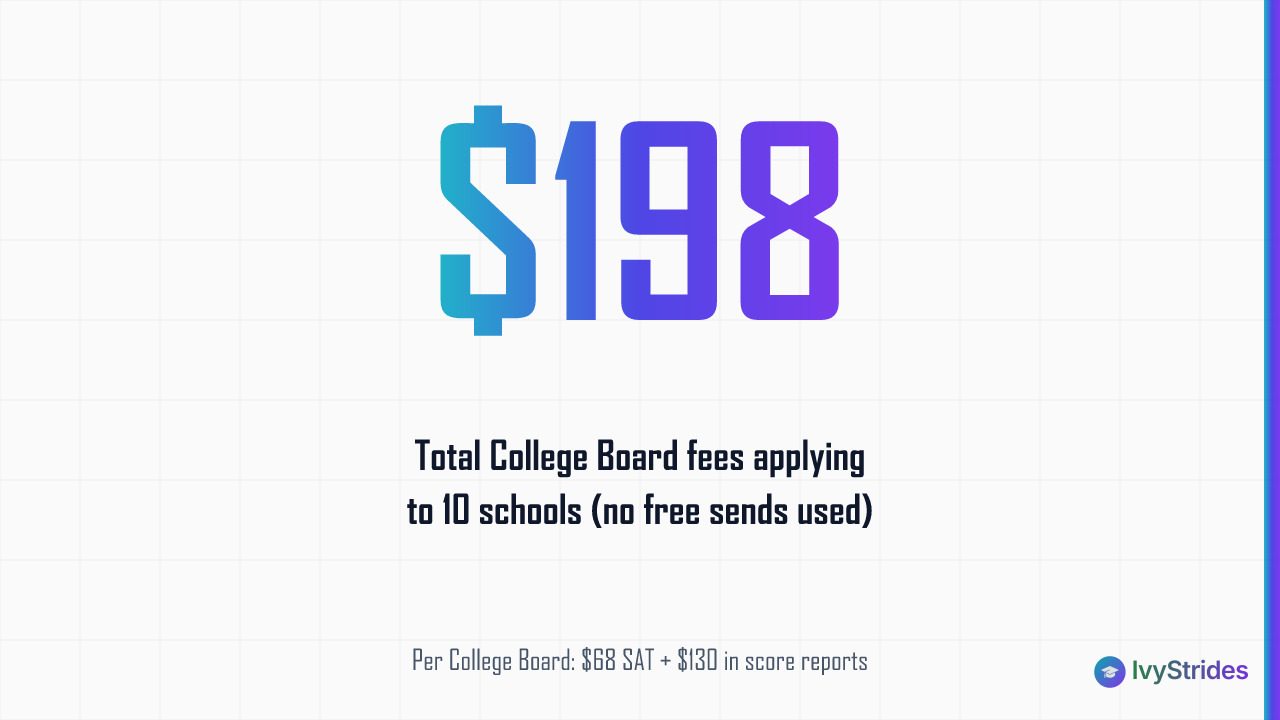
Here's the part most students miss until they're already applying.
When you register, College Board includes four free score reports you can send to colleges. Those free sends must be designated at registration or within nine days of the test. After that window, each additional report costs $13.
Fees per College Board.
Do the arithmetic on a real application list. A student applying to ten schools who didn't designate any free sends at registration would pay $68 for the SAT plus $130 in score reports, for $198 in College Board fees on a single test attempt. That climbs fast for students who retake and apply broadly.
Fees per College Board.
In our coaching, this is the most common financial surprise families report, not the base fee itself. The fix is simple: build a preliminary college list before you register, use the four free sends strategically, and treat post-registration sends as the exception, not the rule. Score Choice lets you decide which test dates to release to which schools, which further reduces wasted sends.
Score send fees add up quickly if you apply to many schools. The full breakdown to how to send SAT scores to colleges covers free-send windows, Score Choice, and how to avoid paying $13 per report unnecessarily.
SAT Fee Waivers: Who Qualifies and How to Get One
The College Board SAT fee waiver eliminates the $68 base fee and unlocks a set of additional benefits that materially reduce the cost of applying to college.
Fees per College Board.
Who qualifies (U.S. students):
- Enrolled in the National School Lunch Program or another federal free/reduced-price lunch program
- Family income within USDA Income Eligibility Guidelines
- Enrolled in a federal, state, or local program that aids students from low-income families (e.g., Federal TRIO)
- Family receives public assistance
- Living in federally subsidized public housing, a foster home, or homeless
- Ward of the state or an orphan
Eligibility is confirmed by a school counselor, not by the student directly. The counselor issues the waiver code, and the student applies it at registration.
What the waiver unlocks:
- Up to two free SAT registrations
- Unlimited free score sends to colleges (not just four)
- Free CSS Profile submissions to participating schools
- College application fee waivers at participating institutions
International students testing outside the United States are generally not eligible; fee waivers are a domestic-student program. Eligibility criteria may update; verify with your school counselor or the current College Board fee waiver guidelines before applying.
For students who qualify, the waiver is one of the highest-use pieces of the college prep process. Combine it with our free SAT resources hub to keep total prep spend near zero.
SAT Registration Fees for International Students
Testing outside the United States changes the math.
Base international fee: $68 (registration) + $43 (regional fee) = $111
Fees per College Board.
The $43 regional fee applies regardless of which country you test in, whether that's the UAE, Singapore, Nigeria, Brazil, or India. On top of that base, some countries add local taxes.
Fees per College Board.
India example: Indian students pay the $111 base plus GST (goods and services tax), which brings the total to approximately $134.07 per publicly reported figures. GST is country-specific and subject to change; treat this as illustrative, not universal. Verify current totals at the College Board international fees page before you register.
International students should also plan for the near-total absence of fee waivers outside the U.S. The waiver program is built around domestic income-eligibility criteria and is generally not available to international registrants.
One note from our end: IvyStrides is online-first and global. Section-specialist coaches work with students across major test-center regions on the same tutor pool as our U.S. students. If you're weighing whether to invest in prep from abroad, our SAT prep overview covers how the 1-on-1 model works across time zones.
How Much Does It Cost to Retake the SAT?
Each SAT attempt costs the same $68 (or $111 international). College Board does not charge a retake surcharge. There is no discount for repeat test takers either.
Fees per College Board.
Modeled out for a typical U.S. student:
- Two attempts: $136 minimum
- Three attempts: $204 minimum
- Add one late registration and score sends to a dozen schools, and the total realistically lands around $300 to $350 in College Board fees alone
Fees per College Board.
In our coaching with students targeting a 200-point improvement, two to three attempts spaced roughly 8 to 12 weeks apart is the typical pattern. The gap matters. Cramming two attempts three weeks apart rarely moves the score, because there isn't enough time to work through diagnosed weaknesses between sittings.
Score Choice and superscoring (where accepted) make retakes strategically worthwhile: many colleges will take your highest section scores across dates. A student who tests three times can present the best Reading and Writing score from one sitting and the best Math score from another.
Most students in our coaching take the SAT two to three times. The how many times can you take the SAT guide explains how many attempts are typical and how to space them for maximum score gain. Before budgeting for retakes, it helps to know what score you're aiming for; the good SAT score 2026 guide maps percentiles to college ranges so you can set a realistic target.
The Real Cost of the SAT: Registration Plus Prep
Look, the $68 registration fee is the entry ticket. The real investment for most families is prep.
Fees per College Board.
Here's the honest range, framed as typical market pricing rather than a promise:
- Self-study: Free to low-cost. Bluebook's official practice tests, released by College Board, are the strongest free resource. A prep book adds roughly $20 to $30. Total spend can stay under $50.
- Group prep courses: Typically $300 to $1,500 depending on hours and provider. Group instruction is efficient on price per hour but not personalized to your specific weaknesses.
- 1-on-1 tutoring: Ranges widely. Personalized, diagnostic-driven programs sit at the higher end of the market because instruction is calibrated to the student's exact score band and section-level weaknesses.
Fees per College Board.
For students completing the IvyStrides diagnostic-driven 1-on-1 SAT program, a 200+ point improvement is a typical outcome. That framing is deliberate. Not "guaranteed," not "average." Typical, and dependent on starting score, hours invested, and completion of the plan.
Why prep investment often pays for itself: a 200-point SAT gain frequently moves students into higher merit scholarship brackets. At many private universities, a jump from a 1300 to a 1500 can shift merit awards by roughly $10,000 to $25,000 per year, which is about $40,000 to $100,000 over four years. That math is why families treat prep as an investment, not a cost. Outcomes depend on the school, the student's full application, and financial aid policies.
Fees per College Board.
The IvyStrides approach starts with a real practice test as a diagnostic, identifies the specific question types costing the most points, and assigns section-specialist coaches (SAT Reading and Writing and SAT Math are handled by different specialists, not one generalist).
Paying the registration fee is step one; building a structured prep plan is step two. The official SAT study guide 2026 walks through exactly how to use the weeks between now and test day. For students who prefer to self-study first, start with our SAT practice tests to establish a baseline. When you're ready to build a week-by-week schedule, our SAT study plan breaks down each phase. Students ready to move faster can explore 1-on-1 SAT prep directly.
What Does the SAT Registration Fee Actually Cover?
Fair question. What are you paying for?
- Test administration and proctoring at your assigned test center
- Bluebook, the College Board's proprietary digital testing app used for the current Digital SAT
- Score processing and reporting through the College Board's infrastructure
- Four free score sends to colleges (if designated at registration or within nine days)
- Access to your score report on your College Board account
What the fee does not cover: prep books, tutoring, practice test libraries beyond the free Bluebook set, AP exam fees (those are separate), or CSS Profile submissions. If someone tells you the SAT fee includes prep, they're wrong.
Once you know what the SAT costs, the next question is what score you need. The SAT score scale and percentiles guide explains what a 1200, 1350, or 1500 means for your target colleges. If you're wondering about the actual test-day experience, our guide to how long is the SAT covers timing across the two adaptive modules per section.
SAT vs. ACT Cost: A Quick Comparison
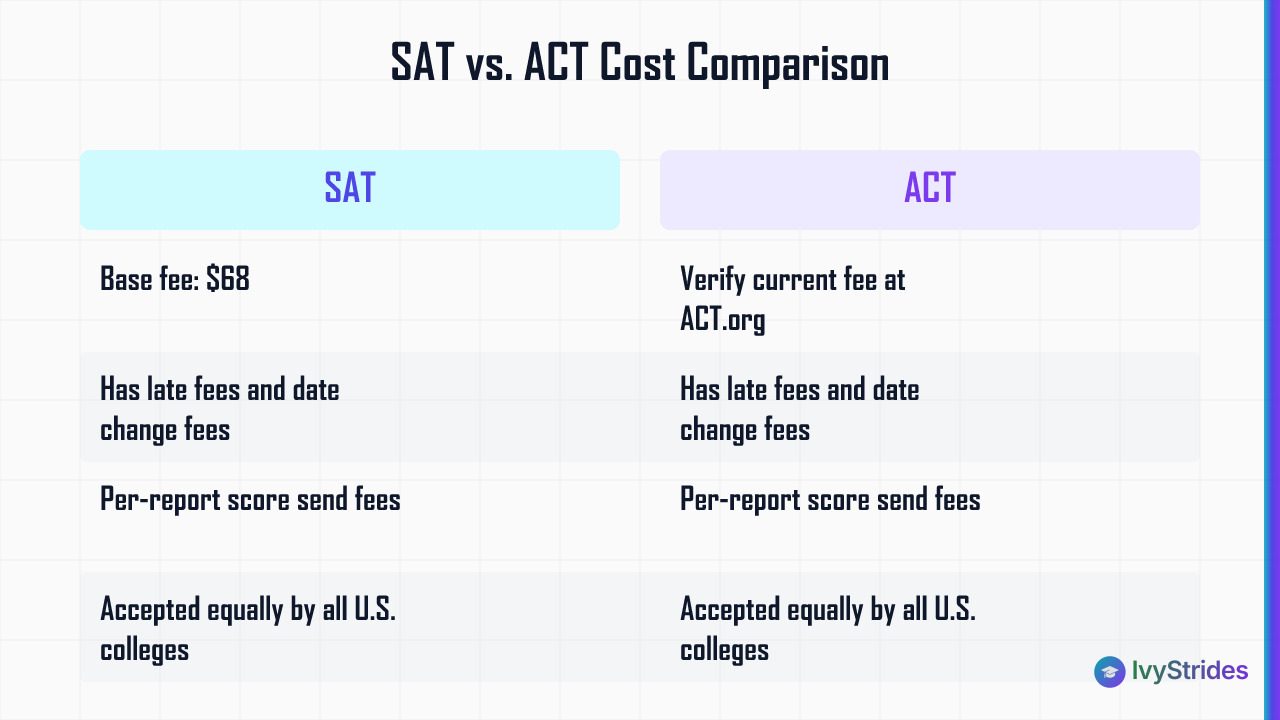
Both tests cost about the same at the base level.
- SAT base fee: $68 (College Board)
- ACT base fee: verify current pricing at ACT.org before registering, as ACT fees have changed in recent testing cycles
Both tests have similar add-on structures: late fees, test date changes, and per-report score sends. Cost is not a meaningful differentiator between the two.
The real question is fit. Some students score meaningfully higher on one test format than the other, and a diagnostic practice test on each is the most reliable way to find out. Every U.S. college accepts both tests equally; the choice should be driven by which test your brain is built for, not by a small difference in add-on pricing.
How to Register for the SAT and Pay the Fee in 2026
The registration flow is straightforward if you have your information ready.
-
Create or log in to a College Board account at collegeboard.org
-
Select a test date and test center from the official SAT dates and deadlines calendar
-
Enter student information (name, school, demographic questions)
-
Designate up to four free score sends if you know your college list
-
Pay the fee with credit card, debit card, or fee waiver code
-
Confirm registration and save your admission ticket
Register as soon as you commit to a test date. Preferred test centers fill first, and the $38 late fee is one of the easiest to avoid. For a step-by-step walkthrough with screenshots and troubleshooting for common registration errors, see our SAT exam registration 2026 guide.
FAQ
Is the SAT score out of 1600?
Yes. The Digital SAT is scored on a 400-1600 scale, with 800 possible points in each of the two sections: Reading and Writing, and Math. College Board has used this scale since 2016. A perfect 1600 places a student in roughly the 99th+ percentile and is achieved by about 300 test takers per year.
Is a 900 SAT score considered good?
A 900 sits below the national average, which lands around 1010 to 1020 for the Digital SAT. It places a student in roughly the 25th to 30th percentile. For most four-year colleges, a score in the 1000 to 1100 range is a more competitive floor; selective schools typically look for 1300 and above. A 900 is a starting point, not a ceiling, and targeted prep can move scores significantly from that band.
How rare is a 1350 SAT score?
A 1350 places a student roughly in the 84th to 90th percentile, meaning they scored higher than about 84 to 90% of test takers nationally. It's a strong score for many selective colleges and sits above the median at a large number of well-regarded universities. Students targeting the top 25 nationally typically aim for 1450 or higher.
Does the SAT cost money if you fail?
The SAT doesn't have a pass or fail outcome. It produces a score on the 400-1600 scale, and every registration costs the same $68 base fee regardless of how the student performs. If the score is lower than your target, you can retake for the same fee. Fee waivers cover up to two attempts for eligible students.
Fees per College Board.
How much does it cost to send SAT scores to colleges?
College Board includes four free score sends when you register, provided you designate the schools at registration or within nine days of the test. After that, each additional report costs $13. If you apply to many schools or decide to send scores after your free-send window closes, those $13 fees add up quickly. Planning your college list before you register is the simplest way to minimize this cost.
Fees per College Board.
Can international students get a SAT fee waiver?
Fee waivers are generally available only to income-eligible students attending U.S. high schools. International students testing outside the United States are typically not eligible. Budget for the $111 base fee plus any country-specific taxes, such as GST in India.
Fees per College Board.
Is the SAT fee the same in California, Texas, Florida, and Georgia?
Yes. College Board charges a flat $68 registration fee for all U.S. students regardless of state. There is no state-level surcharge in California, Texas, Florida, Georgia, or any other U.S. state. The only geographic fee difference is the $43 international regional fee for students testing outside the United States.
Fees per College Board.
The registration fee is fixed. Everything after it, timing, retake strategy, score sends, and prep quality, is what actually determines your outcome. If you want help mapping those variables to your specific starting score and target schools, our coaching team is built for that. Read more about our approach on the IvyStrides about page. You can also meet the tutors who work with students at each score band.

Award-winning author (South Asian Book Award) and graduate of BITS Pilani and UCLA Luskin School of Public Affairs. Brings a published writer's eye to Common App essays and grammatical precision to SAT and ACT R&W instruction.