
Who Qualifies for SAT Extended Time? The Documentation College Board Wants
On this page
- What Conditions Qualify for SAT Extended Time
- What Documentation College Board Requires for SAT Extended Time
- SAT Extended Time Documentation Checklist
- How Long Is the SAT With 50% Extended Time
- Do Colleges See Your SAT Extended Time Accommodation
- FAQ: SAT Extended Time Eligibility and Documentation
- Do people with ADHD get extra time on SAT?
- How long is the SAT if you have 50% extra time?
- Do colleges know if you have extended time on SAT?
- What is 50% extended time?
- Your Next Step on SAT Extended Time
SAT extended time is an accommodation for students whose documented disability slows timed test performance, and College Board's Services for Students with Disabilities must approve it before test day. Qualifying conditions include learning disabilities, ADHD, psychiatric disorders, and physical or medical conditions, each backed by a professional evaluation and a school 504 plan or IEP.
Those categories and the approval standard come from College Board's SAT accommodations pages, cited throughout. The harder question, and the one that stalls most families, is whether the paperwork you already have proves what SSD actually looks for: not just a diagnosis, but a measured effect on timed work.

What Conditions Qualify for SAT Extended Time
Four disability categories qualify for SAT extended time: learning disabilities, attention deficits, psychiatric disorders, and physical or medical conditions. A qualifying disability is one a licensed professional has diagnosed and documented as slowing a student's performance under timed conditions. Section 504 of the Rehabilitation Act and the ADA entitle students with documented disabilities to reasonable testing accommodations, which is the legal footing for the whole SSD process.
Diagnosis alone is not the standard. College Board's SSD approves extended time when the documentation shows functional impact, meaning the condition demonstrably affects processing speed, reading fluency, or sustained attention on a timed test. Two students with the same ADHD diagnosis can get different answers, because one report quantifies the timed-performance gap and the other only names the condition.
| Condition Category | Common Examples | Key Functional Impact |
| Learning disabilities | Dyslexia, dysgraphia, dyscalculia | Reading fluency, written output, number processing |
| Attention deficits | ADHD (inattentive, hyperactive, combined) | Sustained attention, processing speed |
| Psychiatric disorders | Generalized anxiety, depression, OCD | Concentration under timed pressure |
| Physical and medical | Chronic illness, visual or hearing loss, injury | Stamina, access, physical response speed |
So yes, ADHD counts, and so does dyslexia, generalized anxiety disorder, and a chronic health condition. But College Board evaluates each request individually and treats no category as automatic approval. The evidence, not the label, carries the decision.
What Documentation College Board Requires for SAT Extended Time
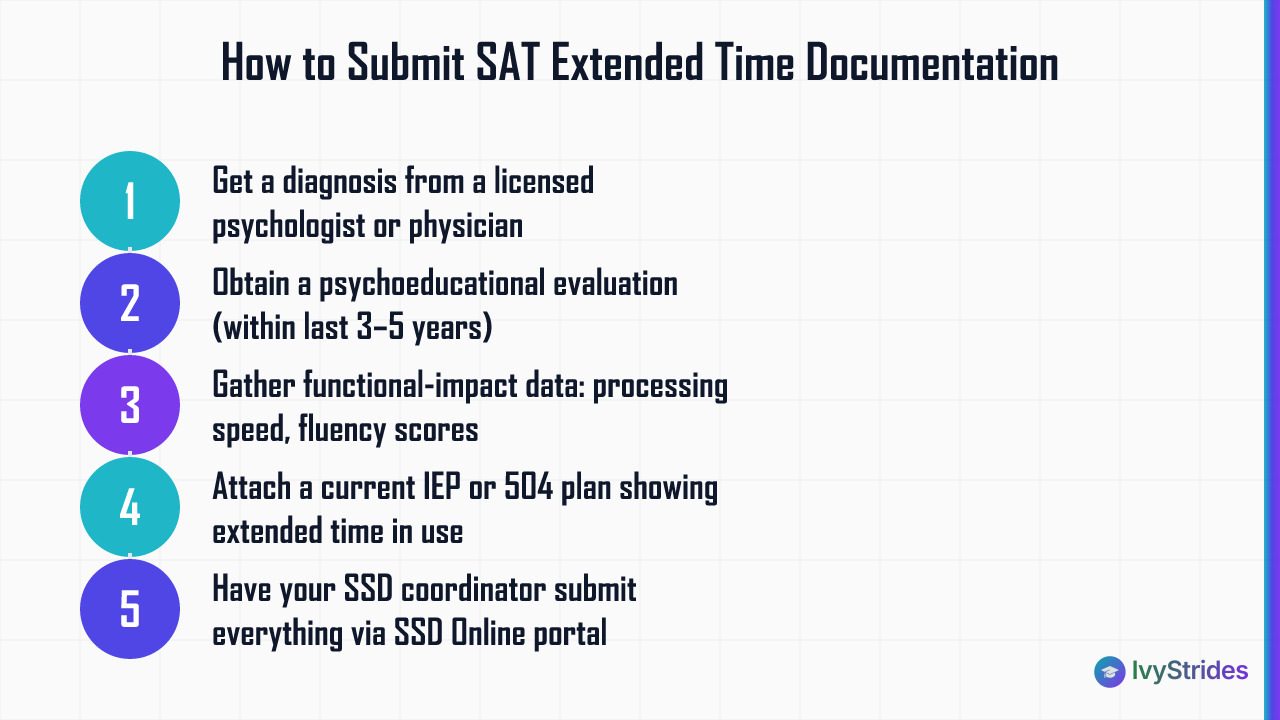
SSD evaluates three documentation pillars: a licensed professional's diagnosis, a psychoeducational or neuropsychological evaluation showing functional impact, and a school accommodation history. Building on the functional-impact standard from the last section, the evaluation is where that impact gets proven with data: processing-speed scores, reading-fluency measures, timed-task results a reviewer can weigh.
Recency matters. College Board generally expects psychoeducational testing completed within the last three to five years, recent enough to reflect the student's current profile. This is general guidance, and individual cases vary, but in our coaching, students who apply with an evaluation older than five years frequently receive a documentation request from SSD that delays approval past their target test date.
The school accommodation history is the third pillar. A current IEP (Individualized Education Program, issued under IDEA) or a 504 plan (issued under Section 504) shows the student already uses extended time in the classroom, which strengthens the request considerably.
SAT Extended Time Documentation Checklist
| Required Item | Details |
| Professional diagnosis | From a licensed psychologist, physician, or other qualified provider |
| Psychoeducational or neuropsychological evaluation | Typically within the last 3 to 5 years |
| Functional-impact evidence | Processing speed, reading fluency, or attention data from the evaluation |
| School accommodation history | Current IEP or 504 plan showing extended time already in use |
| SSD coordinator submission | Your school's coordinator files the request through the SSD portal |
Who submits the request? Your school's SSD coordinator, not the family directly, files it through College Board's SSD Online portal. Start there early; the coordinator often needs a week or two to assemble records before submitting.
Confirming your paperwork meets the functional-impact bar, before you submit, is the difference between an approval and a denial with no time to reapply. One more distinction worth knowing: SSD can approve extended time for all sections or for one section only, so a student with dyscalculia might receive Math-only time.
That is also the moment a prep plan starts to matter. Once time is approved, a section specialist can build the schedule around your actual approved timing, which is exactly what our SAT 1-on-1 prep is built to do. You can also see how we match students to a coach by section on our tutors page.
How Long Is the SAT With 50% Extended Time
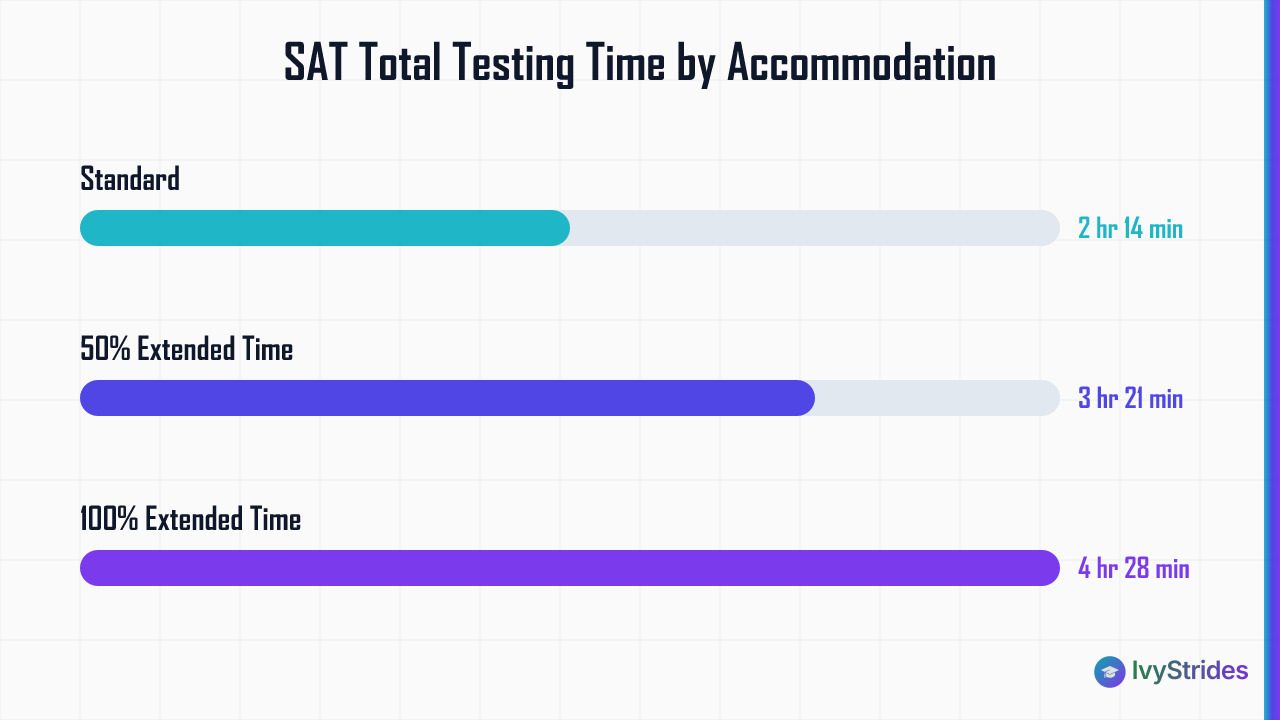
With 50% extended time, the Digital SAT runs 3 hours and 21 minutes of testing plus breaks; with 100% extended time it runs 4 hours and 28 minutes plus breaks. Building on the approved-timing point above, the extension applies per section, so 50% extended time (time-and-a-half) means 1.5 times the standard allotment on each module.
The standard Digital SAT runs 2 hours 14 minutes of testing time, 2 hours 24 minutes with the break, across 98 questions. Extended time adds directly on top of that baseline. For the full standard-timing picture alongside these figures, see our breakdown of how long is the SAT.
| Accommodation Level | Reading and Writing | Math | Total Testing Time |
| Standard | 64 min | 70 min | 2 hr 14 min |
| 50% extended time | 96 min | 105 min | 3 hr 21 min |
| 100% extended time | 128 min | 140 min | 4 hr 28 min |
Section-specific approval changes only the approved section. A student approved for Reading and Writing only tests that section at 96 minutes while Math stays at the standard 70. In our coaching, students approved for section-specific time often underestimate how much the pacing changes on the one approved section, which is why the plan has to be built around the exact allotment, not the general idea of extra time.
Knowing your approved timing is only half the equation; our guide to the SAT with extra time on the SAT covers how to pace each module once the accommodation is in place. Longer sittings also come with the extra breaks that longer accommodations schedule, so plan test day around stamina, not just the clock.
College Board publishes the standard 70-minute Math section and the 3-hour-21-minute total; IvyStrides derives the per-section Math duration of 105 minutes at 1.5x.
Do Colleges See Your SAT Extended Time Accommodation
Colleges do not see your SAT extended time accommodation on the score report. College Board does not flag accommodation status on the standard score report it sends to colleges. Building on the timing picture above, whatever your approved sitting looked like, the report shows the same fields any student's report shows.
| Data Field | Included on Score Report? |
| Total score (400 to 1600) | Yes |
| Section scores | Yes |
| Test date | Yes |
| Test center | Yes |
| Accommodation status | No |
Disclosure is your choice. Some colleges ask about accommodations in their own application materials, which is separate from anything College Board controls, and a student may choose to mention a disability in an essay or additional-information section. That is a personal decision, not a requirement, and a strong score reported with or without accommodation is still yours to submit. When it comes time to send scores, our guide to how to send SAT scores to colleges covers the full process.
Removing the disclosure worry is often the last barrier before a family decides to apply. Once the accommodation is approved, the timing is set and the plan can be built around it.
FAQ: SAT Extended Time Eligibility and Documentation
Do people with ADHD get extra time on SAT?
Yes, ADHD is a qualifying condition for SAT extended time. College Board's SSD approves requests when a licensed professional has diagnosed ADHD and documented how it specifically impairs timed test performance. A current IEP or 504 plan showing school-based extended time strengthens the application, though approval is decided case by case.
How long is the SAT if you have 50% extra time?
With 50% extended time, the Digital SAT runs 3 hours and 21 minutes of testing time plus breaks, versus 2 hours 14 minutes under standard conditions. IvyStrides derives this figure from the inputs cited above. The Reading and Writing section extends to 96 minutes and Math to 105 minutes.
Do colleges know if you have extended time on SAT?
No. College Board does not include accommodation status on the standard score report it sends to colleges. Colleges receive your total score, section scores, test date, and test center, but not whether you tested with extended time. Any disclosure in application materials is entirely your choice.
What is 50% extended time?
50% extended time means a student receives 1.5 times the standard time on each section. On the Digital SAT it is the most common approval level, extending Reading and Writing from 64 to 96 minutes and Math from 70 to 105 minutes.
Your Next Step on SAT Extended Time
Whether your documentation qualifies comes down to one test: does it show functional impact, and is it recent enough for SSD to trust? Confirm that before your registration window closes, because a denial late in the cycle rarely leaves room to reapply. Policies and documentation standards change, so verify current requirements at accommodations.collegeboard.org.
- Pull your most recent psychoeducational or neuropsychological evaluation and check the date against the three-to-five-year guidance.
- Confirm the report names a functional impact on timed performance, not just a diagnosis.
- Locate your current IEP or 504 plan as accommodation-history evidence.
- Contact your school's SSD coordinator to submit through College Board's SSD portal, well ahead of your test date.

Two decades teaching quantitative and verbal aptitude on standardized tests. Rare dual expertise across Math and Verbal — particularly effective for students with gaps on both sides. Senior AP Mentor for our Calculus and English tracks.