
How to Build a Balanced College List With Free Public Data (Reach, Target, Safety)
On this page
A balanced college list is the single most important — and most commonly botched — part of an application year. Get it right and you have real choices in April. Get it wrong (too many reaches, no safety you'd actually attend, no eye on cost) and a strong student can end up with a thin set of options. The good news: you can build a genuinely balanced list yourself, for free, using two public data sources that most families don't realize exist. This guide shows you exactly how — and where our free College Fit Finder does the sorting for you.
What "balanced" actually means
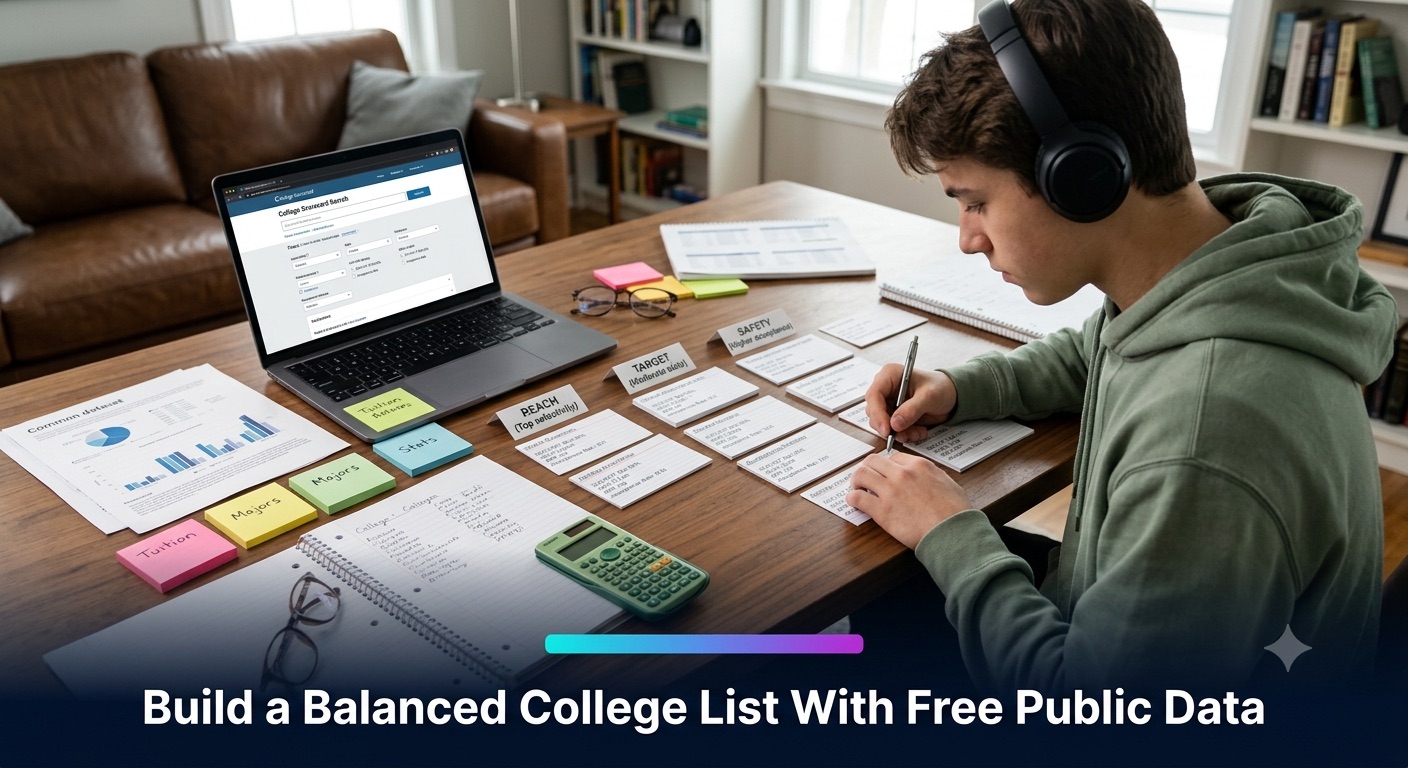
A balanced list is spread across three tiers, defined by your profile, not a school's prestige:
- Safety — your scores and grades are clearly above the admitted-student profile and the admit rate is high. Admission is very likely.
- Target (also called a match) — your profile sits inside the school's middle-50% range. A realistic, solid chance.
- Reach — your profile is below the typical admit, the admit rate is very low, or your intended major is far more competitive than the school's overall rate.
A workable list is usually 8–12 schools: roughly 2–3 safeties you'd be happy to attend and can afford, 3–5 targets, and 2–4 reaches. The exact mix depends on your budget and how selective your reaches are — but the non-negotiable rule is that every list is anchored by safeties you would genuinely enroll in.
The two free data sources that do the work
You don't need a paid database. Two public sources cover the essentials:
1. The U.S. Department of Education's College Scorecard. This is the official federal dataset on every American college. It gives you, per school: the overall admit rate, the middle-50% SAT and ACT ranges, the average net price after aid, and enrollment size. It's free, downloadable, and has a public API. It is the backbone of any honest college list.
2. Each college's own Common Data Set (CDS). Every year, colleges publish a standardized report called the Common Data Set. Section C covers admissions and includes two things Scorecard doesn't: the average high-school GPA of the enrolled class, and the class-rank distribution (what percent were in the top 10%). Search "[college name] common data set" and you'll usually find it on the school's institutional-research page.
Between these two, you can place almost any college into reach/target/safety for your specific numbers — no guesswork, no sales pitch.
The method, step by step
Step 1 — Know your own numbers. Write down your best SAT or ACT, your unweighted GPA on a 4.0 scale (this matters — see below), and your class rank if your school reports one.
Step 2 — For each school, pull three numbers. From Scorecard: the admit rate and the mid-50% SAT/ACT band. From the CDS: the average unweighted GPA (if published).
Step 3 — Compare and classify. The logic is simple:
- If your test score is above the school's mid-50% band and the admit rate is high → lean safety.
- If your score sits inside the band → lean target.
- If your score is below the band, or the admit rate is single digits → reach (a sub-10% admit rate is a reach for essentially everyone, regardless of scores).
- Then adjust with GPA and rank: a GPA well above the school's average nudges it more attainable; well below nudges it stricter.
Step 4 — Apply the major adjustment. Admit rates are school-wide, but some majors admit far more competitively than the overall number — computer science, engineering, business, nursing, and biology especially. If you're applying to an impacted major, treat borderline schools one tier stricter.
Step 5 — Sanity-check cost. A "safety" you can't afford isn't a safety. Use Scorecard's net-price figure and each school's net-price calculator before you finalize.
A worked example
Say you have a 1300 SAT and a 3.7 unweighted GPA, and you're eyeing a big public flagship with a mid-50% SAT of 1270–1480, a 40% admit rate, and a published average GPA of 3.85.
- Your 1300 is inside the 1270–1480 band → starts as a target.
- Your 3.7 GPA is a bit below the 3.85 average → keeps it a target (not a safety).
- If you're applying for CS at that school, bump it toward reach.
That's the entire method. It's not magic — it's just reading public numbers consistently.
Weighted vs. unweighted GPA: the one trap
The most common mistake is comparing your weighted GPA to a school's unweighted average (or vice versa). Many big public universities publish a weighted, capped GPA on their own scale; many privates publish unweighted. Comparing across scales silently distorts everything. When in doubt, compare unweighted to unweighted — and if a school only reports weighted, lean on test scores and admit rate instead.
Let the free tool do the sorting
Reading Scorecard and CDS by hand for 15 schools is a real afternoon of work. Our free College Fit Finder does it instantly: enter your SAT/ACT, GPA, class rank, home state, and intended major, and it pulls real colleges from the same public data and sorts them into Reach, Target, and Safety — with a plain-English reason for each, and the major adjustment built in. You can also type any specific college to see exactly where it lands for you. It's free, no sign-up, and nothing is stored.
It's the same fit logic our counsellors start with — just automated, so you can build a first draft of your list in five minutes and spend your energy on the parts that actually need judgment.
Where a tool stops and judgment begins
Data gets you a balanced list. It doesn't get you an optimized one. Which reaches are worth an application given your specific story, how to sequence early-action and early-decision, whether a "target" is really a target for your intended major and profile, and how to build the essays and activities that move a holistic read — that's where an experienced counsellor earns their keep. That judgment is the job of our college admissions counselling: the college list, the application strategy, and the essays, planned and coached month by month.
If you'd like a second set of eyes on your list, book a free consultation. Either way, start with the data: it's public, it's free, and it's the honest foundation every good list is built on.

Hemant is a seasoned entrepreneur, investor, and growth strategist with deep ground in education and technology-driven learning. His core training is in Mathematics and Physics — he authored Physics for IB Diploma: Ultimate Revision Guide, recognized as a top student resource.