
Are Your PSAT Results 2025 Good Enough for SAT Success in 2026?

On this page
- How to Analyze Your PSAT Results 2025
- How to Read Your PSAT Score Report 2025
- What Counts as a Good PSAT Score for 11th Graders in 2025?
- National Merit for your PSAT Results 2025
- What Your PSAT Results 2025 Mean for Your SAT 2026 Preparation
- Your SAT 2026 Prep Plan Based on Your PSAT 2025 Score Band
- Choosing the Right SAT 2026 Test Dates
- Conclusion
- Frequently Asked Questions
If you’re an 11th grader looking at your PSAT Results 2025, the first thing you probably want to know is whether your score actually puts you on track for a strong SAT next year. A 1400+ is excellent for junior year, a 1300+ is strong and has real upward potential, and anything from 1150 to 1250 means there is plenty of room to grow before SAT season begins.
YourPSAT scoredepicts your current strengths, the areas that need good attention, and how close you are to achieving the skill level expected to send your SAT scores to NYU, UCLA, or even Princeton once you take the SAT in 2026.
In this blog, our expert team here at Ivystrides breaks down what your PSAT results 2025 mean for junior year, how to read the parts of the score report that actually matter, what your National Merit chances look like, and how to build a simple SAT roadmap that moves you consistently toward the score range you want.
How to Analyze Your PSAT Results 2025
Your PSAT score is more than a number; it’s a snapshot of how prepared you are for the SAT and where real improvement can happen for your SAT 2026 prep.
How to Read Your PSAT Score Report 2025
Your PSAT score report has many numbers, charts, and colored bands. But only a few parts truly help you understand where you stand for the SAT.
Here’s how to read your PSAT scores the right way:
- Total Score (320 to 1520) - A 320-1520 total score places you somewhere on the PSAT scale, which is slightly lower than the SAT scale. What matters is your starting line. A strong junior-year score tells you your foundation is solid. A mid-range or lower score simply shows you where the gaps are.
- Reading and Writing + Math Scores - Each section is scored from 160 to 760. The split matters because the SAT will use the same structure. If one section feels far weaker, that is your first target area for the next few months.
- Percentiles - Percentiles tell a clearer story. If you’re in the 80th or 90th percentile, you’re already outperforming most juniors nationwide. For example, a student in the 90th percentile scored higher than 90 percent of other test takers.
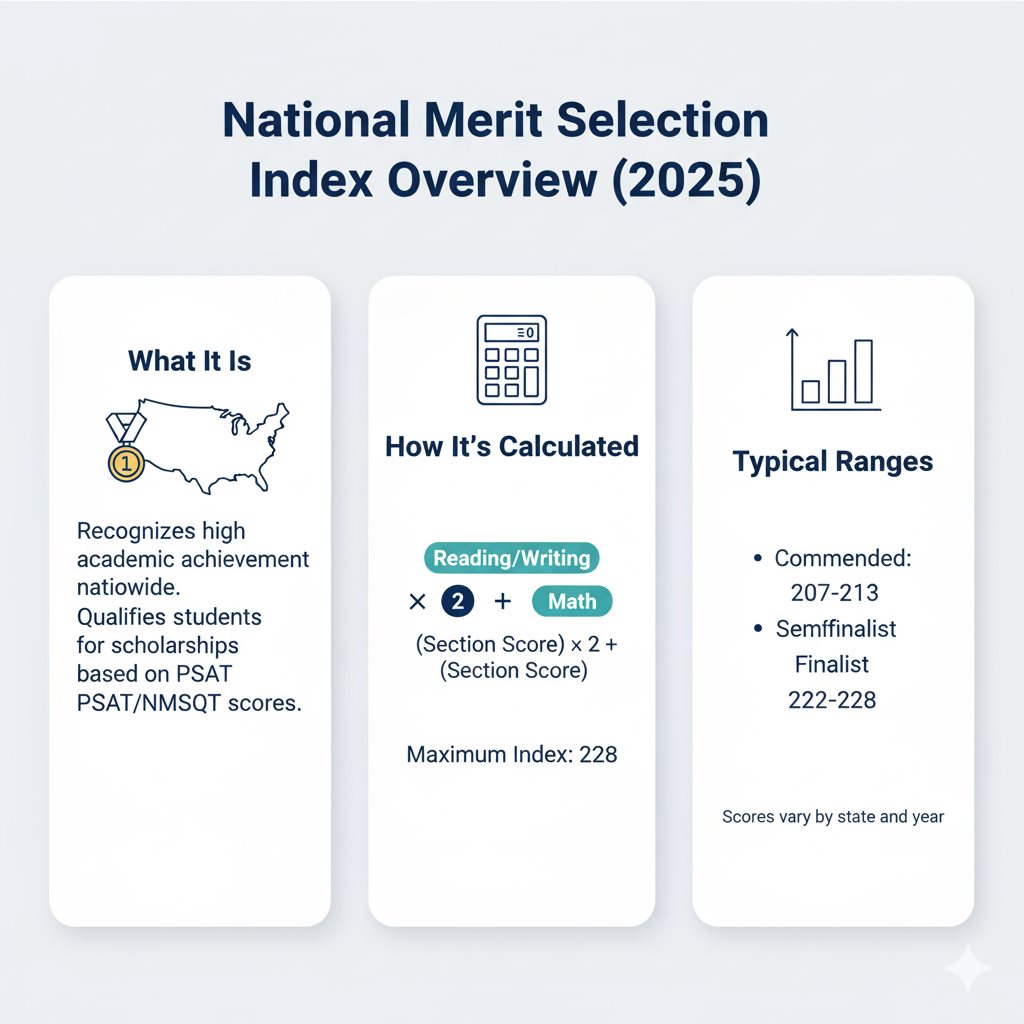
- Selection Index- The Selection Index is used only for National Merit, but it still gives you insight into your academic standing among top-performing juniors. If your index is high enough to be in the National Merit range, that’s great. If it’s not, it does not affect your college admissions in any way. Colleges do not ask for it, and they do not evaluate students based on National Merit status. What this number really shows is whether you mastered the Reading and Writing section at a high level, since it is weighted double.
- Skill Breakdown- Your skills breakdown highlights patterns: maybe you struggled with transition words, or misread dense paragraphs, or lost track during algebraic function questions. These patterns are the same ones that show up on the SAT. This breakdown is the first step in building a smarter SAT 2026 plan.
What Counts as a Good PSAT Score for 11th Graders in 2025?
A PSAT score in the 1450-1520 range usually means you’re already operating at a high level for junior year. Students here tend to understand the major ideas well, and the problems they miss are often the small things: rushing through a question, second-guessing an answer, or losing pace near the end of a module. This range often overlaps with National Merit cutoffs in many states, so it’s a strong place to begin. With steady practice and a bit more discipline around timing, many students here grow into the 1500+ SAT bracket with proper guidance as SAT prep is essential for college admissions.
Scores in the 1300-1440 zone are also a very good sign. Most juniors at this level already know the core material and simply need a bit of polish. The gains come from tightening reading logic, brushing up on grammar decisions, or working through the tougher algebra and function questions. When those small pieces click, students in this band often settle somewhere in the 1380-1500 SAT range.
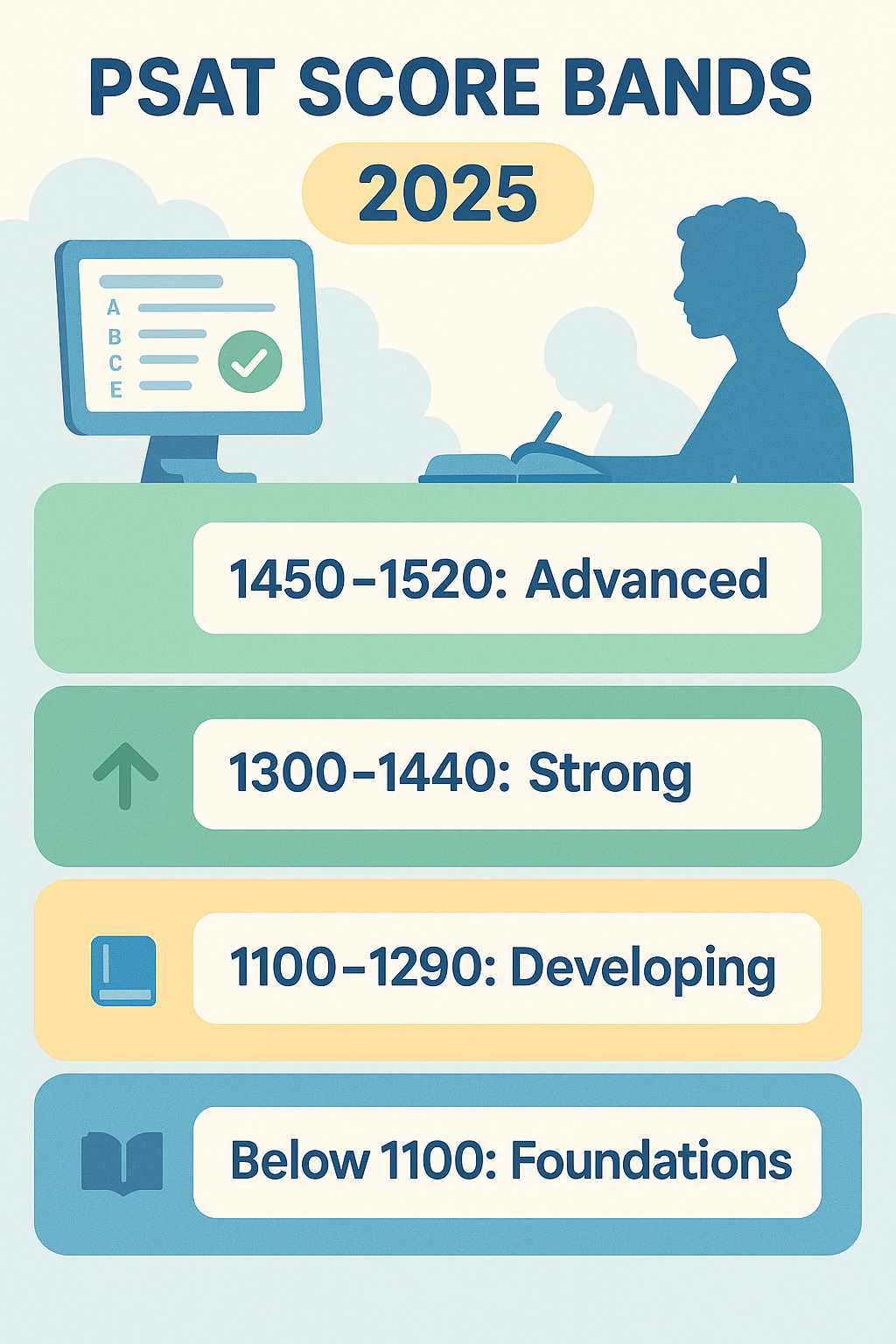
If you’re in the 1100-1290 range, you’re right in the middle of where many juniors land, and this is often the zone where growth feels the fastest. The gaps are easier to spot and fix: algebra basics, grammar rules, or keeping your concentration steady in longer reading passages. Because these patterns are predictable, students here regularly see jumps of 120-150 points once they follow a consistent plan.
A score below 1100 doesn’t reflect your potential; it simply shows that your foundation needs some rebuilding before you push higher. Grammar, basic algebra, and reading structure respond quickly to regular practice. Many juniors who begin in this range end up scoring 1200 or higher by early senior year after a few months of focused work. The starting point matters far less than your willingness to build the basics and stick with a routine that fits you.
National Merit for your PSAT Results 2025
National Merit is a goal for junior year students, but it’s not the definition of success. It is a recognition based on one score on one test, not a college requirement.
- A Selection Index in the 220+ range is often competitive for Semifinalists in many states.
- An index around 216-219 sits in the borderline zone; some states cut lower, some higher.
- Scores from 210-215 often line up with Commended recognition.
It is not essential for admission to schools like UCLA, Michigan, Georgia Tech, NYU, or even highly selective campuses like Harvard, Yale, Columbia University, or Brown.
What Your PSAT Results 2025 Mean for Your SAT 2026 Preparation
Is the PSAT harder than the SAT?No, it is not. Your PSAT score gives an indication for the SAT. Once you understand your score range and the skills behind it, you can move into a focused plan that leads you into spring and summer testing windows with clarity. The goal is progress that compounds over time whilst understanding the main difference between PSAT and SAT.
Your SAT 2026 Prep Plan Based on Your PSAT 2025 Score Band
- If you’re already in the 1450+ PSAT zone, your strategy is refinement. You’re close to mastery, so the biggest gains come from the smallest adjustments. Work on timing, pattern recognition, and advanced question types. Narrow your attention to traps and predictable errors. This is the type ofSAT preparation that helps high-scoring studentslift themselves into the ranges expected by schools like Brown, Dartmouth, or Duke.
- If you’re between 1250-1440 in your PSAT score**,** think of this range as the “high-upside” zone. You have the core understanding but need more consistency. Spend most of your time reviewing algebra, transitions, reading logic, and data questions. Run full-length digital practice tests every few weeks to build stamina. Students in this range oftenreach competitive SAT levels for universities such as NYU, Northeastern, or Georgia Tech with a focused plan.
- If you’re below 1250 PSAT, you need to build your basics first. Strengthen grammar, sentence structure, and the standard algebra skills that appear on every SAT. Short, repeated practice sessions work far better than long, unfocused study blocks. Many students who start in this zone end up scoring well above national averages by spring, proof that starting “lower” simply means you have more room to grow.
Choosing the Right SAT 2026 Test Dates
Your timing matters more than you think. Most juniors benefit from finishing the SAT before the college application season picks up.
The Three Best SAT Windows for Juniors
- March 2026
- May 2026
- June 2026
Testing in March, May, or June 2026 gives you room to build momentum without feeling squeezed by deadlines. If the first attempt doesn’t land where you want, you still have time to retest and combine a stronger superscore long before applications open. Finishing early also frees up mental space for essays and the rest of your application list, especially if schools like UPenn, Yale, or if you want tosend your SAT score to Stanford University. Choosing any of these months keeps the process steady and controlled, instead of rushed at the end of junior year.
Conclusion
Your PSAT Results 2025 tell a simple story: once you understand your section strengths, the patterns behind your mistakes, and the score bands that juniors typically grow into, the SAT stops feeling like a mystery.
Some students reading this will be sitting with a 1400 and wondering how to reach that next jump toward a top score. Others might be somewhere in the 1100s, unsure whether improvement is even realistic. Both paths are normal. Both move forward the same way: start early, fix the small things first, and keep your momentum steady instead of dramatic.
Frequently Asked Questions
What does a 1400 PSAT score mean for my SAT chances in 2026?
A 1400 PSAT usually means you’re already working at a strong level. Many juniors in this range reach the high 1400s or low 1500s on the SAT once they improve pacing and reduce predictable errors.
How do I know if my PSAT score is close to the National Merit cutoff for 2025?
Check your Selection Index, not your total score. Most states fall somewhere between 216 and 222, so if you land in that area, you are close. It varies slightly every year, so being “near” the range still matters.
What SAT score should I aim for if I scored around 1200 on the PSAT in 2025?
A lot of juniors start here. With steady practice, a 1280-1400 SAT is realistic, and many go higher once timing improves. It’s a good base for competitive state universities and several strong private colleges.
How much improvement is normal from PSAT to SAT for juniors?
Most juniors grow about 80-150 points. Students who fix pacing issues or grammar basics often jump even more, especially if their PSAT mistakes came from rushing.
When should I take the SAT in 2026 after getting my PSAT 2025 score?
Most juniors do well on testing in March, May, or June 2026. These dates give you time to prep, and you still have room to retest if you want a superscore.
Does my PSAT score matter for college applications?
No, colleges won’t see your PSAT. It only matters for National Merit and for showing you where to start preparing for the SAT.

Two decades teaching quantitative and verbal aptitude on standardized tests. Rare dual expertise across Math and Verbal — particularly effective for students with gaps on both sides. Senior AP Mentor for our Calculus and English tracks.